
STEADI: intervene
The Complete Tornado Safety Guide for Seniors Living Alone
Standard tornado safety guidance assumes someone else is home to help during the critical minutes of a warning. This guide explains how seniors living alone can prepare with accessible shelter alternatives, a structured support network, and a kit designed for solo use before, during, and after a tornado.
A tornado warning is a poor time to discover that the official safest place is down a flight of stairs, the walker is in the kitchen, the hearing aids are on the nightstand, and the person who usually helps is twenty miles away. The usual tornado safety advice is still right in broad strokes: get to the lowest, most interior space you can, stay away from windows, and protect your head and neck.[1] For seniors living alone, the harder question is what can actually happen in the first few minutes without a second set of hands.
The best tornado safety tips for seniors living alone are not a longer list of supplies. They are a plan that removes decisions before the siren sounds. Three things carry most of the weight: a shelter you can reach without heroic speed or stairs, a support network that knows its job before the storm, and a kit built for one person using one pair of hands.
Start With the Minutes You Actually Have
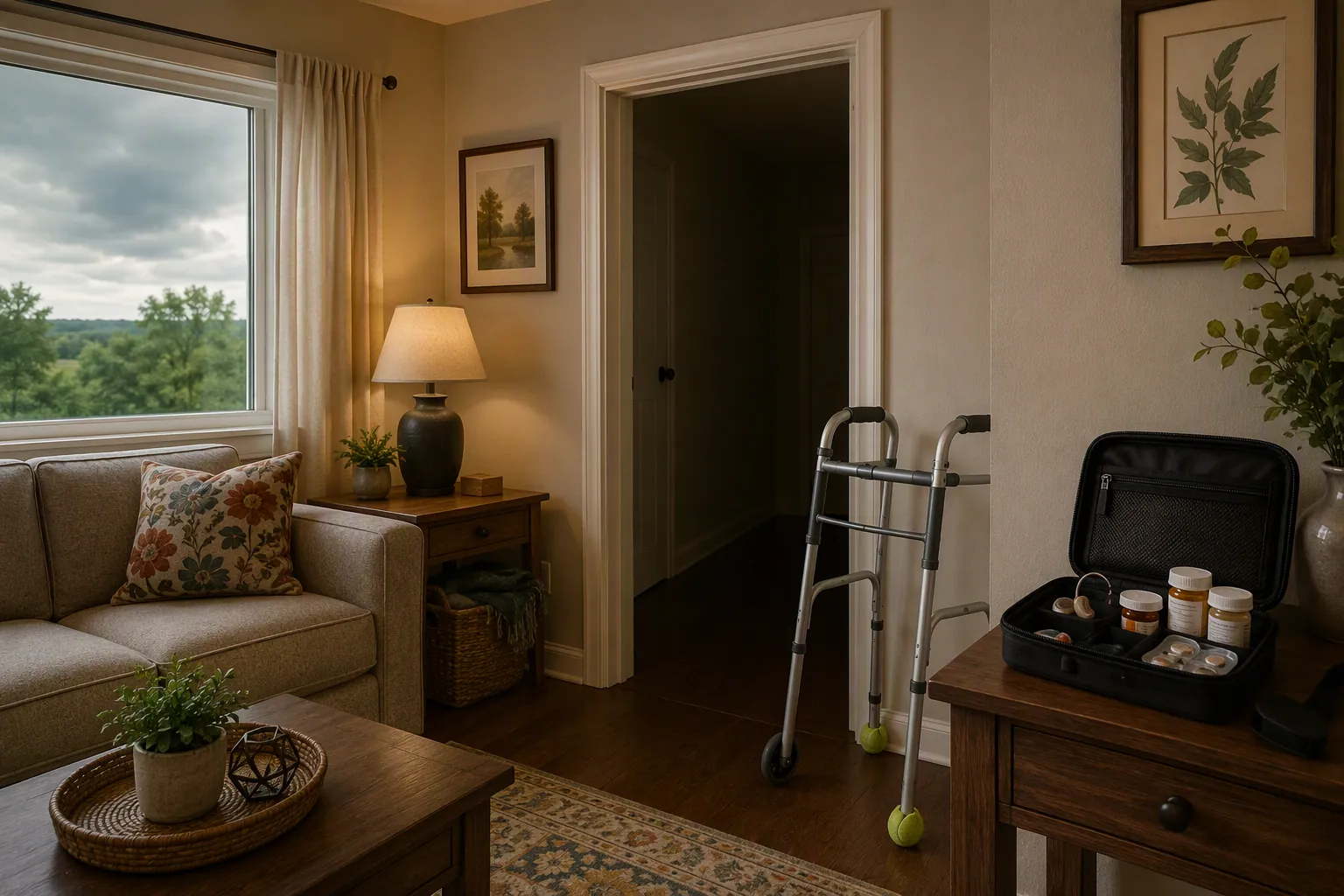
A warning does not arrive into a tidy household. It may come while supper is on the stove, after bedtime, during a shower, or when a phone is charging in another room. If you live alone, every extra step becomes part of the plan: standing up, finding glasses, fastening shoes, collecting a cane, reaching the shelter room, closing a door, and getting low enough to protect your head.
That is why the plan should begin by timing the route, not by buying anything. Walk from the chair where you watch television, from the bed, from the bathroom, and from the kitchen to the shelter spot you intend to use. Do it at your ordinary pace, with the cane, walker, rollator, oxygen tubing, brace, or wheelchair you normally use. If the route requires moving boxes, squeezing past a laundry basket, or reaching a door that sticks, the route is not ready.
This is not fussiness. Red Cross research with the American Academy of Nursing identified social isolation, dependence on assistive devices, medication concerns, and caregiver preparedness gaps as vulnerability factors for older adults after disasters.[2] Those are exactly the problems that turn a simple instruction into a private obstacle course.
Choose a Shelter You Can Reach Without Stairs
If you have a basement and can reach it quickly and safely, it remains a strong option. But a basement is not a plan if arthritis, balance problems, low vision, shortness of breath, or a stair lift power failure makes the trip uncertain. A safer plan you can use beats a perfect plan you cannot reach.
| Shelter option | When it works | What to fix before storm season |
|---|---|---|
| Basement | You can reach it quickly without falling and can stay there for a while | Clear the stairs, add handrails if needed, keep a chair and supplies downstairs |
| Same-floor interior room | You cannot safely use stairs or have only minutes to move | Choose a windowless bathroom, closet, hallway, or small interior room and keep the path open |
| Above-ground safe room | You have access to a built or installed room designed for severe wind protection | Keep it unlocked, uncluttered, and reachable with mobility aids |
| Pre-arranged nearby shelter | Your home is not sturdy enough, especially if you live in a mobile or manufactured home | Arrange early access to a neighbor, community room, or sturdy building before storms form |
| Fall-back position | You cannot reach any better shelter in time | Use the safest reachable interior spot and protect your head and neck |
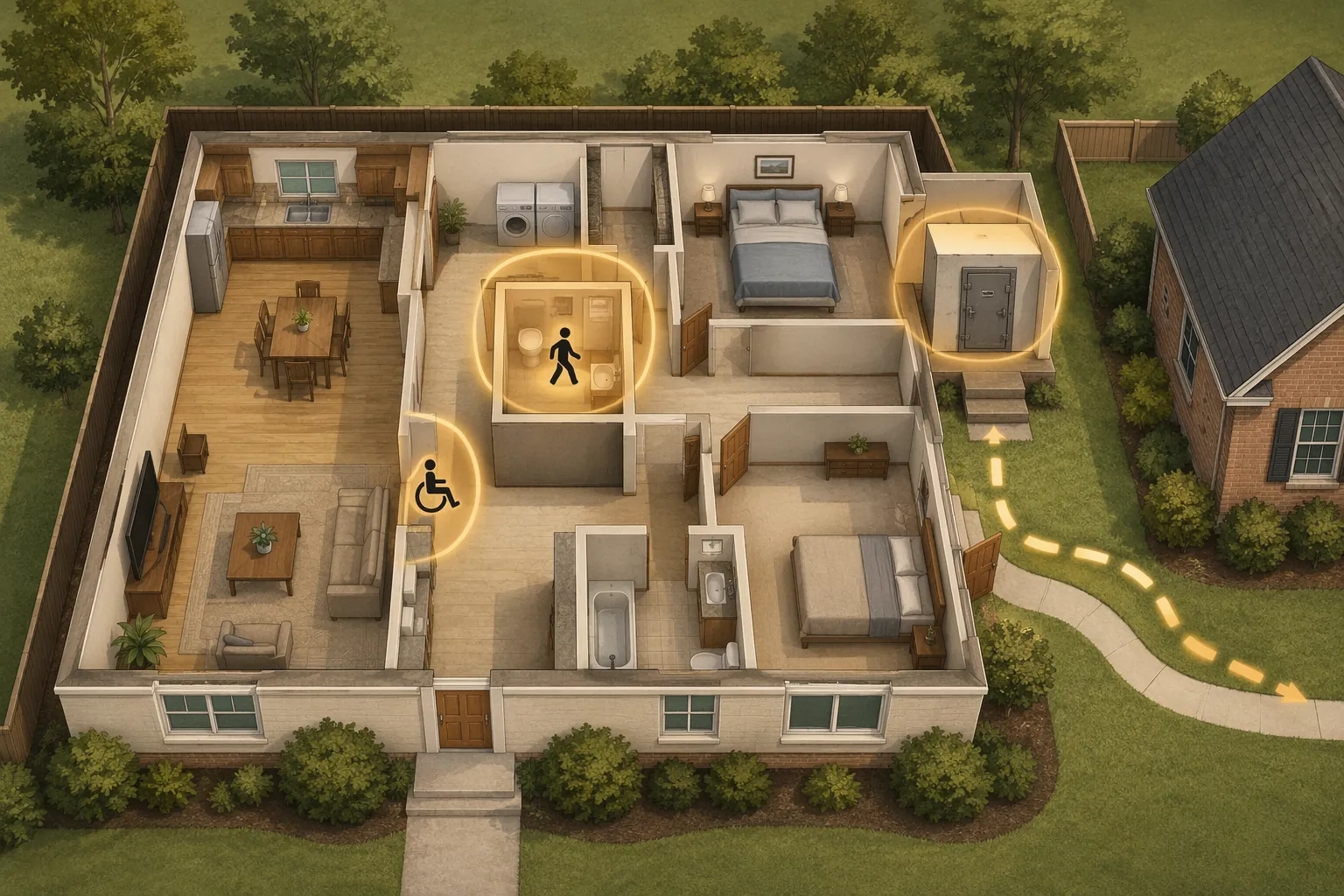
For many one-story homes, the practical shelter is an interior, windowless room on the same floor: a small bathroom, closet, central hallway, or laundry room away from exterior walls. CDC guidance says to go to the lowest level available, such as a basement or storm cellar, and if there is no basement, to use an interior room or hallway on the lowest floor while staying away from windows.[1] The words “available” and “interior” matter. For a person living alone with limited mobility, available means reachable under stress.
Make the Same-Floor Shelter Ready Before the Season
Do not leave the shelter room as a storage closet with a tornado label. Clear enough floor space for the person, the walker or wheelchair, and a small kit. If the room is a bathroom, check whether a walker can turn through the doorway. If the shelter is a hallway, decide exactly where to sit or brace, and keep that section free of shoes, throw rugs, plant stands, and pet bowls.
- Keep sturdy shoes near the bed and the favorite daytime chair, not only by the front door.
- Store a helmet, thick cushion, or folded blanket in the shelter area for head and neck protection.
- Place a chair in the shelter if getting down to the floor would make getting up impossible.
- Use battery lights that can be turned on with a large button or worn on the head.
- Tape a simple shelter-route note inside a cabinet or on the refrigerator for helpers who may arrive after the storm.
A headlamp deserves special mention. A flashlight is useful until both hands are needed for a walker, a cane, a door handle, a pet carrier, or a grab bar. A headlamp leaves the hands free and points light where the face turns. Choose one that can be operated without delicate finger work.
If You Use a Wheelchair or Cannot Transfer Quickly
The plan should not depend on a fast transfer to the floor unless that transfer has been practiced and is safe. If you use a wheelchair and cannot move to a lower position in time, move to the most interior reachable space, lock the wheels, cover your head and neck with your arms, a cushion, a folded blanket, or a helmet, and stay away from windows and exterior walls. If you can get beside a sturdy interior wall without risking a fall, that may be safer than trying to cross the house for a theoretically better spot.
This is also where medical reality belongs in the plan. Someone using oxygen, a powered wheelchair, a CPAP, refrigerated medication, or other equipment should talk with a clinician or home-health provider about what can safely be moved, what must stay plugged in, and what backup power is appropriate. For a fuller medical-device planning guide, see Power Outage Preparedness for Elderly with Medical Equipment.
If You Live in a Mobile or Manufactured Home
A mobile home changes the plan. CDC guidance says mobile homes are not safe during tornadoes and advises leaving for a nearby sturdy building or shelter if possible.[1] United Spinal Association, in guidance for the disability community, reports that 43% of tornado deaths over the prior 21 years occurred in mobile homes, though the guidance does not provide the original data source or exact date range.[3] Treat the number as a warning about structure, not as a personal failing.
The mobile-home plan has to start earlier than the warning. Decide where you will go when a tornado watch is issued or when severe storms are forecast: a neighbor's site-built house, a community storm shelter, a church, a fire station if locally designated, or another sturdy building you have permission to enter. If the first time you ask is when the siren sounds, the plan is already late.
Build the Support Network Before You Need Permission to Need It
For a senior living alone, the support network is not a courtesy. It is the substitute for the person who is not in the next room. AARP's disaster-resilience materials note that adults age 75 and older accounted for 50% of Hurricane Katrina deaths while making up 6% of the New Orleans population.[4] That disaster was not a tornado, and the statistic should not be stretched into a tornado prediction. It does show why age, isolation, transportation, health conditions, and delayed assistance deserve practical attention before an emergency.
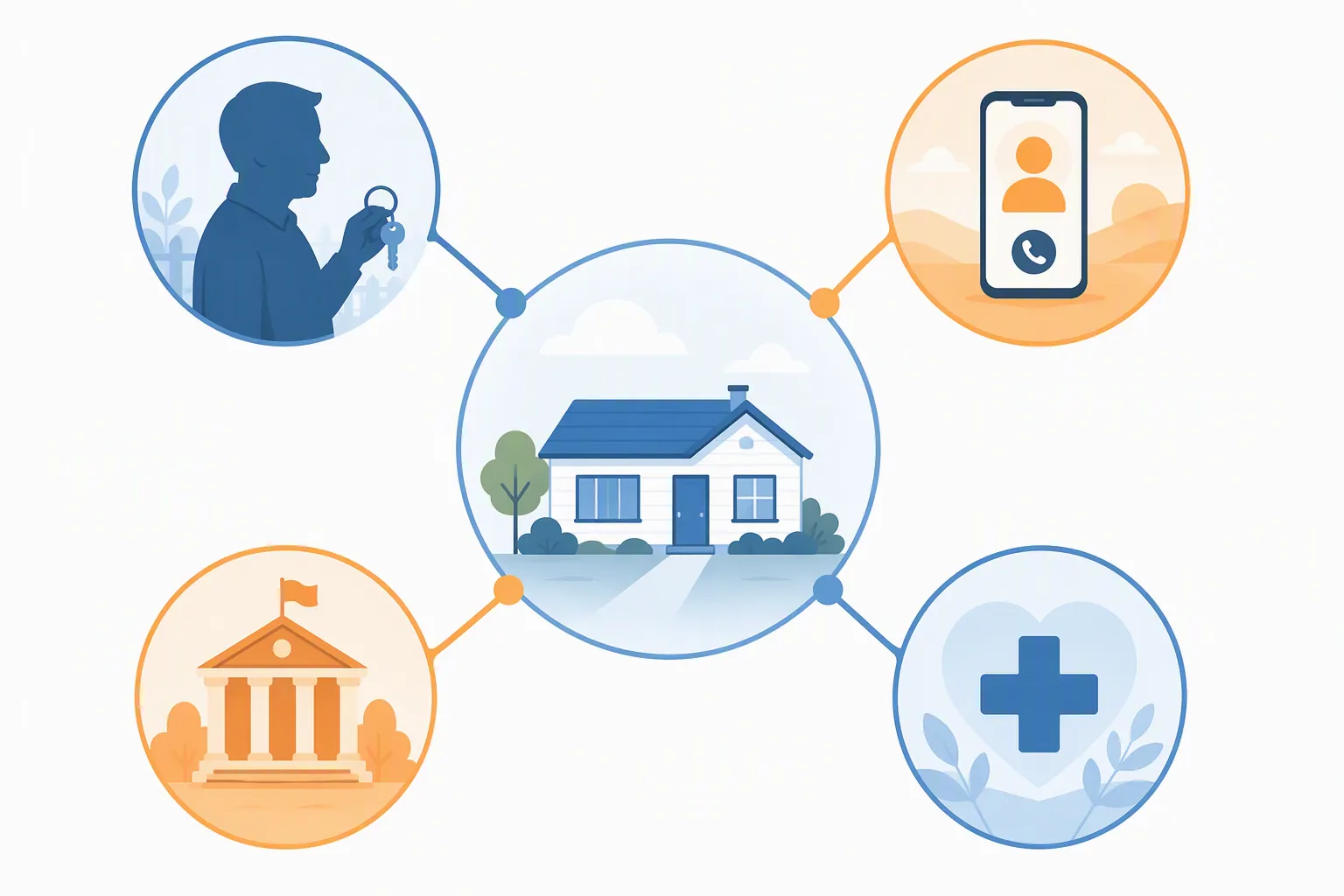
Ready.gov advises older adults to create a support network, share emergency plans, and consider how medical needs, transportation, and assistive devices will be handled during emergencies.[5] That sounds broad until names are attached. The plan should say who does what, in what order, and how they get in if the door is locked.
The Neighbor Buddy
Choose one nearby person who can act before an adult child has even seen the alert. This should be someone close enough to knock, call, or unlock the door after the storm, not merely someone kind. A next-door neighbor, a resident manager, a church friend on the same street, or a trusted relative nearby can fill the role.
- Give the buddy your preferred shelter location and the fastest safe route to it.
- Tell the buddy whether you want a call, a knock, or both when a tornado watch is issued.
- Share whether you use hearing aids, oxygen, a walker, wheelchair, service animal, or refrigerated medication.
- Decide what the buddy should do if you do not answer after the storm.
- Review the plan twice a year, preferably before spring and fall severe-weather seasons.
A spare key should not be left to improvisation. Use a lockbox, a coded smart lock if reliable during outages, or another arrangement you are comfortable with. The point is not to give up privacy. The point is to keep a trusted person from standing outside after a tornado, calling through a door you cannot reach.
The Out-of-Area Contact
Local phone lines and cell networks may be busy after a storm. Choose one person outside the immediate area who becomes the information hub. The neighbor buddy can report to that person. Adult children can call that person instead of all calling the senior at once. If there are several siblings, this prevents the familiar emergency pattern of five worried people making five separate guesses.
Write the out-of-area contact's name and number on paper in large print. Phones run out of battery, and contact lists are not useful if the device is locked, wet, missing, or across the room.
County Registries and Local Emergency Programs
Many counties, cities, or emergency-management offices offer voluntary registries or special-needs notification programs for residents who may need extra help during disasters. The details vary, and registration is not a guarantee of rescue. Still, it can help local officials understand where residents with mobility limitations, medical equipment, or transportation needs live.
Ask the county emergency-management office, aging services agency, area agency on aging, or local fire department what exists where you live. If an adult child is helping from another town, this is a useful phone call to make before storm season. Keep the registration confirmation, if any, in the emergency contact binder.
For families who need one document that tells helpers whom to call, where medication lists are kept, and who has a key, use How to Build an Emergency Contact Binder for Your Aging Parents as the companion task.
Caregiver Coordination From Another Town
A distant caregiver cannot be the first responder during a tornado warning. That does not make the caregiver useless; it changes the job. The caregiver can help set up the neighbor buddy, confirm the county registry, pay for a lockbox, replace expired supplies, label medications, and keep the contact list current.
The caregiver also needs a first-hour script: who to call first, when to call the neighbor, when to call local non-emergency numbers, and when not to clog 911 with a welfare check that a neighbor can perform safely. For a more detailed sequence, see The Long-Distance Caregiver's First-Hour Emergency Response Plan.
Pack for Solo Use, Not for a Catalog Picture
A kit for someone living alone should be reachable, light enough to move, easy to open, and divided by purpose. One bag by the door does not solve everything if the tornado shelter is in the hallway and the outage lasts into tomorrow.
| Kit type | Where it stays | What it is for |
|---|---|---|
| Go-Kit | Near the exit or evacuation route | Leaving early for a neighbor, community shelter, or sturdy building |
| Shelter Kit | Inside or beside the same-floor shelter spot | Getting through the warning minutes without leaving the room |
| Stay-at-Home Kit | Accessible storage area on the main floor | Power outage, blocked roads, delayed help, or several days at home |
The Go-Kit should not be so heavy that it stays behind. Put in copies of identification, insurance cards, medication list, emergency contacts, a phone charger, a small amount of cash, spare glasses if available, hearing aid batteries, and a short supply of essential items you can safely duplicate. If you evacuate to a neighbor before the storm, this is the bag that goes with you.
The Shelter Kit is smaller and more immediate: headlamp, whistle, charged power bank, hearing aid batteries, backup glasses if available, water, a simple snack if medically appropriate, a folded blanket or helmet for head protection, and a paper contact card. If you take time-sensitive medication, ask your clinician or pharmacist what belongs here and what must not be stored outside normal conditions.
The Stay-at-Home Kit carries the longer disruption: water, food that does not require cooking, sanitation supplies, batteries, radio if used, pet supplies, and medical backups. Keystone Health recommends that seniors keep at least a one-month supply of prescription medications and medical supplies when possible.[6] That may require insurance approval, prescriber help, or a pharmacist's advice; do not wait until a storm week to ask.
Medication, Hearing, and Mobility Details That Get Missed
- Keep a current medication list in large print, including doses, allergies, pharmacy, prescribers, and the location of refrigerated medication.
- Tape hearing aid batteries into the Shelter Kit and Go-Kit, and replace them on a schedule rather than after they fail.
- Store glasses in a hard case; a cracked lens after the warning is not a small inconvenience if debris is on the floor.
- Decide where the walker, cane, rollator, or wheelchair will be parked at night so it is never across the room during a warning.
- If you use oxygen or powered equipment, keep emergency instructions with the equipment and share them with the neighbor buddy.
People with disabilities are often described in preparedness materials as being at higher disaster risk. United Spinal Association cites the Partnership for Inclusive Disaster Strategies for the estimate that people with disabilities are two to four times more likely to die or be injured in a disaster than people without disabilities; the cited guidance does not provide a specific year or methodology for that estimate.[3] The careful lesson is still useful: equipment, transportation, communication, and assistance needs have to be planned as part of the safety route, not added after the siren.
Set Alerts for the Senses You Use Reliably
A weather radio in the kitchen does not help much if you cannot hear it from the bedroom. A phone alert does not help if the phone charges in another room overnight. Tornado alerts should match hearing, vision, sleep, and routine.
- Use multiple alert sources: phone alerts, NOAA weather radio if available, local TV or radio, and a neighbor call plan.
- Choose alert devices with loud, flashing, vibrating, or bed-shaker options if hearing loss is a concern.
- Keep the phone within reach overnight, charged, and set so emergency alerts are not silenced by sleep settings.
- Ask the neighbor buddy to call when a tornado watch is issued if you need extra time to move to a safer building.
- Write down the local county names used in weather warnings; storms do not always introduce themselves by your town.
For someone who needs more time to transfer, gather equipment, or leave a mobile home, the watch may be the action point. A warning may be too late for a safe relocation outside the home. The plan should say plainly: during a watch, move the walker beside the chair, put on shoes, check the phone, bring pets inside if safe, and be ready to use the shelter route.
During the Warning: Do Less, Earlier
When the warning is issued, the list should be short enough to remember and safe enough to perform alone. Go to the chosen shelter. Take the mobility aid. Bring the Shelter Kit only if it is already on the route or inside the shelter. Close doors if you can do so without delay. Protect your head and neck.
Do not cross the house for a purse, a favorite photograph, or a larger emergency bag. Do not try to drive away after the warning unless local officials have told you to evacuate earlier and you are already following that plan. Do not go under a mobile home. If you cannot reach the planned shelter, use the safest reachable interior place and protect your head.
Falls are a real part of tornado safety for older adults because the house may be dark, wet, noisy, or cluttered. The shelter path should already be cleared, and shoes should already be close. For room-by-room storm-season fall preparation, see How to Prepare for Storms and Prevent Falls in Elderly Adults.
A Short Warning Script
- Stand or transfer slowly enough not to fall.
- Put on shoes if they are within reach.
- Take the walker, cane, wheelchair, or rollator.
- Move to the selected shelter spot.
- Turn on the headlamp or shelter light.
- Cover your head and neck and stay there until the warning has passed.
Practice that sequence when the weather is calm. If step three and step four do not work smoothly, the plan needs changing, not the person.
After the Tornado: Wait for the First Safe Check-In
The danger does not end when the wind quiets. Broken glass, exposed nails, gas leaks, downed power lines, wet floors, and blocked doors are all more dangerous when someone is alone and trying to prove they are fine. Stay put until you are sure the warning has expired and it is safe to move. If the shelter area is safe, call or text the neighbor buddy and out-of-area contact before walking through the house.
- Use a flashlight or headlamp before stepping anywhere; do not walk barefoot.
- If you smell gas, hear hissing, or suspect a leak, leave if you can do so safely and call for help from outside.
- Do not touch downed wires or anything in contact with them.
- Let the neighbor buddy check exterior damage, blocked exits, or debris if you are unsteady.
- Report injuries, medication loss, damaged medical equipment, or unsafe housing quickly rather than waiting to see if it improves.
The first call does not have to be dramatic. It can be a simple script: “I am in the hallway. I am not hurt. The power is out. I have my walker. Please call my daughter and then come check the porch when it is safe.” A written version near the shelter helps when nerves are louder than memory.
Rehearse the Plan With the People Named in It
A tornado plan is not finished when supplies are bought. It is finished when the shelter route has been walked, the neighbor has the key arrangement, the out-of-area contact knows the role, the caregiver knows whom to call first, and the kit can be opened without scissors, searching, or panic.
A reasonable rehearsal takes less than an hour. Start from the bedroom, the usual chair, and the kitchen. Move to the shelter spot at ordinary speed. Sit or position yourself the way you would during a warning. Check whether the headlamp works, whether the phone has signal there, whether the walker fits, whether the door closes, and whether you can reach water, contacts, and hearing aid batteries.
Then call the neighbor buddy and the out-of-area contact as if the storm had passed. This is where awkwardness pays for itself. Better to discover on a quiet Saturday that the neighbor's number changed, the lockbox code sticks, or the adult child does not know the pharmacy name.
The standard is not a guarantee of safety. Tornadoes do not offer that. The standard is a plan that asks less of the warning minutes: fewer stairs, fewer decisions, fewer locked doors, fewer missing batteries, fewer people wondering who was supposed to call. For seniors living alone, that is the difference between being told to be safe and having a way to act.
References
- CDC Tornado Safety: Stay Safe During a Tornado, CDC.
- Older Adults More Vulnerable after Disasters, Red Cross, 2020.
- Tornado Preparedness for the Disability Community, United Spinal Association.
- AARP Disaster Resilience Tool Kit, AARP.
- Ready.gov — Older Adults, Ready.gov.
- Emergency Preparedness for Seniors, Keystone Health.
Related reading
Noticed something outdated or inaccurate on this page? Flag a correction. We review every report against CDC, NIA, and AARP HomeFit guidance before updating a page.
Part of the Fall Prevention section.