
STEADI: Intervene
A Wildfire Evacuation Checklist Built for Seniors
Standard wildfire checklists overlook critical needs for older adults. This checklist adapts the 7 Ps framework for seniors, covering medication continuity, power-dependent devices, mobility aids, and early evacuation timing.
A wildfire evacuation checklist for seniors has to answer a harder question than “What goes in the go-bag?” It has to answer who will move the walker, which oxygen battery is charged, whether the pharmacy can refill early, where the medication list actually is, and when an older adult should leave if waiting for an order means leaving too late.
CAL FIRE’s familiar 6 Ps framework — People and pets, Papers, Prescriptions, Pictures, Personal computer, and Plastic — is a useful starting scaffold for fast evacuation thinking.[1] For older adults, it needs one more P at the center of the plan: Power-dependent devices. A wheelchair, CPAP, oxygen concentrator, stair lift, hearing aids, refrigerated medication, or phone that is not charged can turn a clean checklist into a driveway problem.
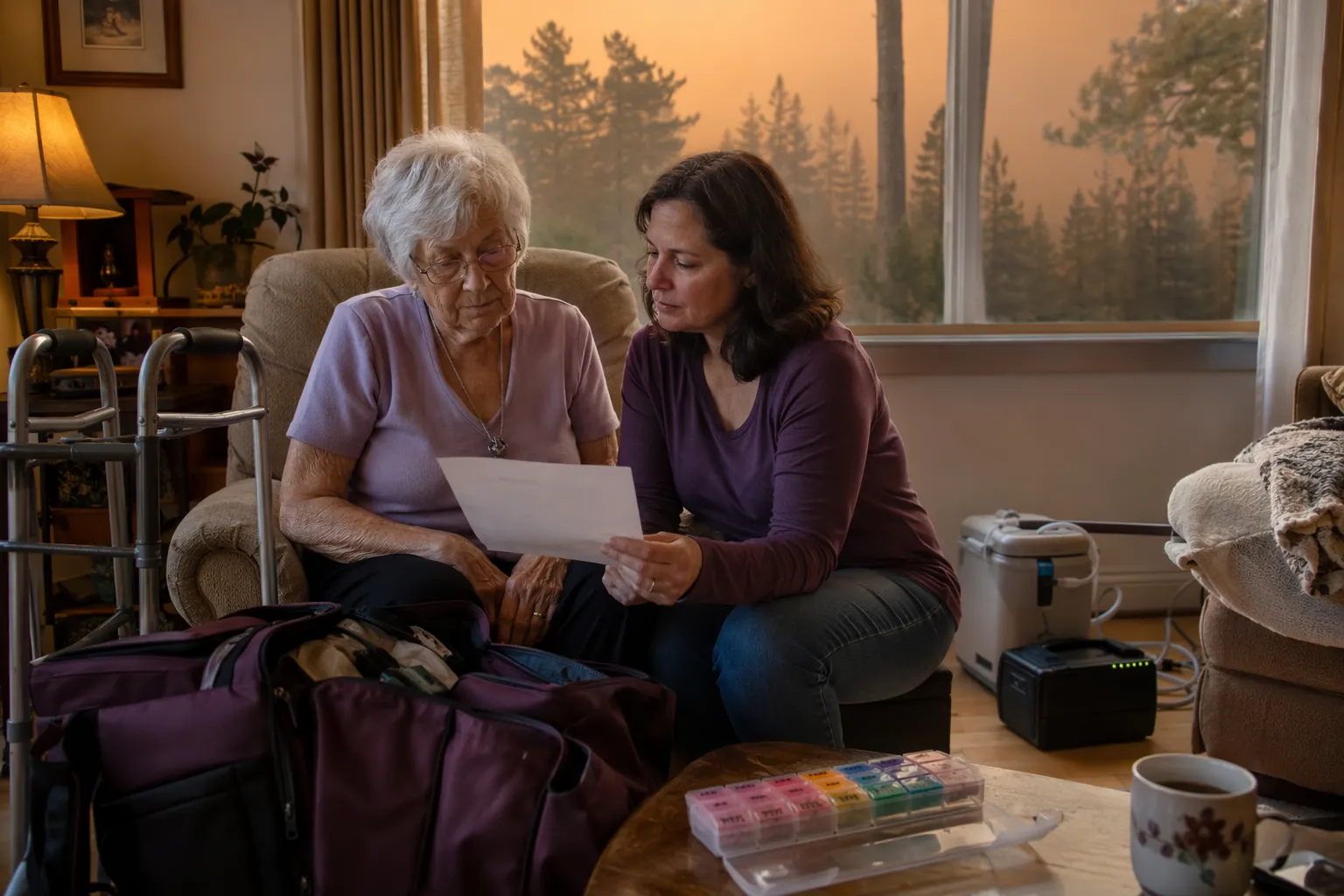
The Senior-Adapted 7 Ps Wildfire Checklist
Use this as the working version before fire season, not as something to discover while an evacuation warning is scrolling across a phone.
| P | What to prepare for a senior evacuation |
|---|---|
| People & Pets | Name the helpers, transportation, mobility route, pet carrier plan, and early evacuation trigger. |
| Papers | Pack IDs, insurance cards, advance directives, medication list, emergency contacts, physician contacts, durable power of attorney documents, and care instructions. |
| Prescriptions | Prepare a 7- to 30-day medication continuity plan, including current bottles, refill timing, pharmacy contacts, dosing instructions, and storage needs. |
| Pictures | Keep photos of the older adult, pets, assistive devices, medication labels, insurance documents, and home contents for identification and claims. |
| Personal Computer | Preserve communication access: phone, charger, tablet or laptop if used for telehealth, passwords or password-manager access, and backup contact methods. |
| Plastic | Carry payment cards, some cash, Medicare or insurance cards, transportation payment options, and a plan if the older adult cannot manage purchases alone. |
| Power-Dependent Devices | Inventory every device that needs electricity, its battery runtime if known, backup batteries, charging cords, car adapters, generator or power-station plan, and manual alternatives. |
Leave During the Warning Phase, Not the Last Possible Minute
For a healthy adult with a packed car, “be ready to go” may still leave room for judgment. For a parent who moves slowly, uses oxygen, cannot transfer without help, or becomes confused under stress, the warning phase is not a rehearsal. Alameda County tells older adults and people with access or functional needs to evacuate during the warning phase rather than waiting for a mandatory evacuation order.[2]
That guidance fits what dependency data shows. Research summarized in a scoping review on wildfires and older adults found that 53% of older adults depended on others to evacuate.[3] The word “depended” matters. It means the plan is not complete when the older adult has a bag by the door. It is complete only when someone has agreed to arrive, enter the home, help with mobility, load equipment, manage pets if needed, and keep going if the first route is blocked.
Older adults are also treated as a higher-risk group in residential fire death data, which is one reason a senior wildfire plan should be built around margin rather than speed.[4] The margin comes from leaving while roads are clearer, visibility is better, batteries are fuller, and the older adult still has enough physical reserve to tolerate the trip.
If the family is split across households, write the trigger in plain language: “If our zone receives an evacuation warning, Mom leaves with Carla or rides with neighbor James; we do not wait for an order.” That sentence is more useful than a beautiful checklist with no decision rule.
People & Pets: assign the work, not just the names
The People & Pets section should list jobs, not just contacts. One person may be the phone caller. Another may be the driver. Someone else may need to bring the wheelchair van, pick up the dog, or unlock the medication box. If an older adult has dementia or another cognitive impairment, decide who can speak calmly, redirect, and avoid turning the departure into an argument in the front hall.
- Primary evacuation helper: name, phone number, expected travel time, and backup if unreachable.
- Transportation: regular car, wheelchair-accessible vehicle, paratransit, neighbor vehicle, or facility transport.
- Mobility route: which exit works with the walker, wheelchair, oxygen tubing, or transfer chair.
- Pet handling: carrier location, leash, food, medication, vaccination records, and who loads the animal.
- Cognition support: short script, familiar coat or blanket, glasses and hearing aids, and a quiet explanation that leaving is the next step.
For a fuller evacuation planning template, use CareWise Guide’s emergency evacuation plan for an aging parent alongside this checklist. The wildfire version should keep the same household facts but set an earlier leaving rule.
Papers: make the folder useful to someone who is not you
The document folder is not for tidiness. It is for the paramedic, shelter intake worker, pharmacist, hotel clerk, or adult child who suddenly has to answer questions. Put paper copies in a waterproof pouch and store digital copies where a trusted helper can reach them.
- Photo ID, Medicare card, insurance cards, and pharmacy card.
- Medication list with drug name, dose, schedule, prescriber, pharmacy, allergies, and what each medication is for.
- Physician, specialist, home health, oxygen supplier, durable medical equipment supplier, and emergency contact numbers.
- Advance directive, POLST or similar medical order if used, health care proxy, and durable power of attorney documents.
- Care notes: transfer needs, dementia triggers, swallowing issues, oxygen settings, hearing or vision needs, and dietary restrictions.
Prescriptions: plan for the refill problem before the fire
Medication is where generic evacuation advice often gets too casual. “Pack prescriptions” does not say whether the pill organizer matches the current bottle, whether the insulin stays cold, whether the mail-order refill arrives after the evacuation, or whether the caregiver knows which pill was stopped last month.
The planning range is not perfectly standardized. FireHelpCenter recommends that seniors and caregivers prepare at least a 7- to 14-day supply of medications for wildfire evacuation.[5] The American Red Cross recommends that older adults keep a 30-day supply of medications, where possible.[6] Treat those as a practical range: 7 to 14 days may be the minimum target many households can realistically maintain; 30 days gives more protection when refills, roads, pharmacies, or insurance systems are disrupted.
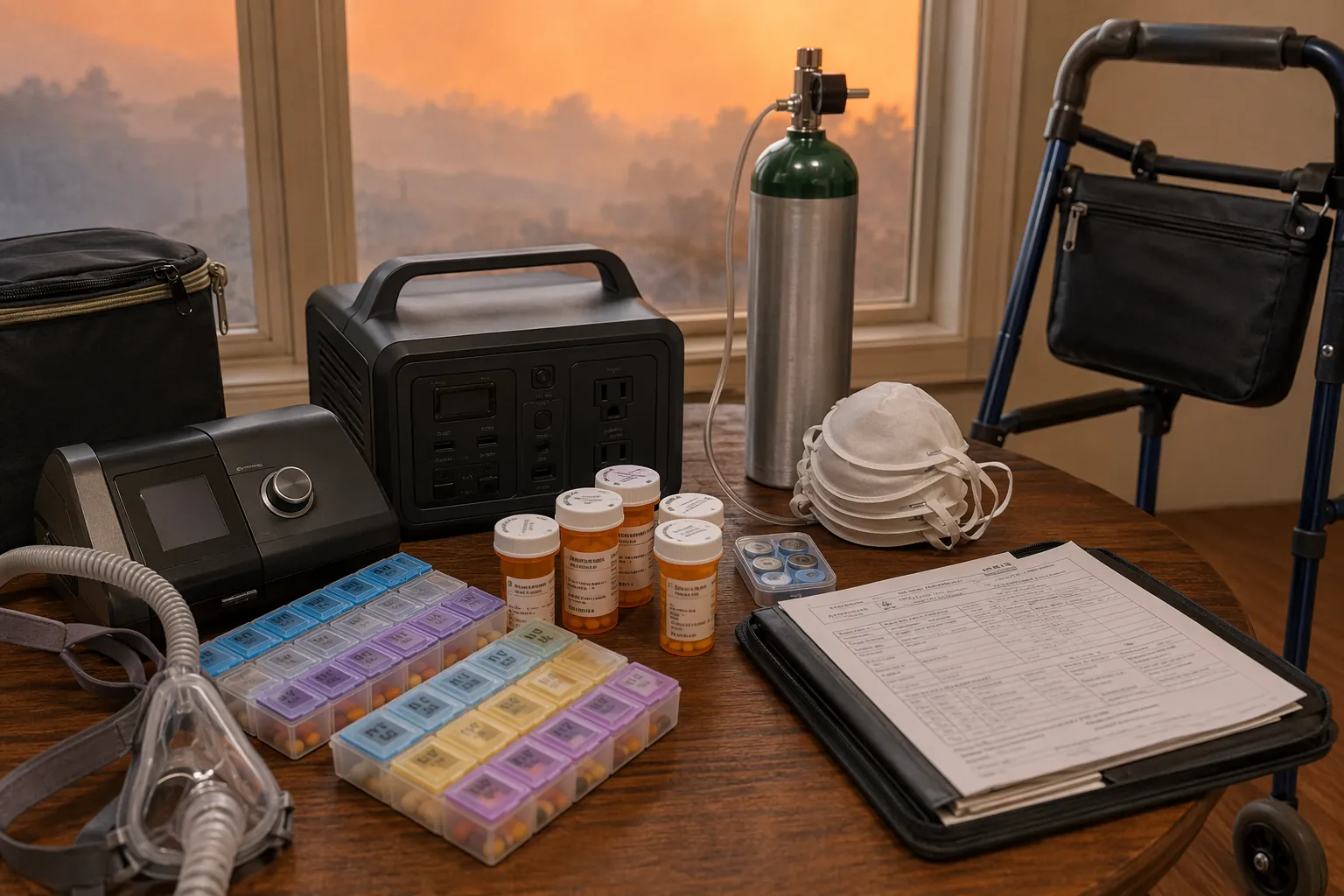
Do not build the medication kit from memory. Build it from the pharmacy profile and the bottles currently in use. If the older adult uses a pill organizer, keep the original labeled bottles available too; a shelter nurse or emergency clinician cannot safely identify every medication from a plastic compartment.
- Current prescription bottles, not expired duplicates from a bathroom cabinet.
- A printed medication list updated after every doctor or pharmacy change.
- A refill plan: which medications can be refilled early, which require prescriber approval, and which pharmacy can transfer them.
- Storage instructions for refrigerated, temperature-sensitive, liquid, injectable, or controlled medications.
- Supplies that make the medication usable: syringes, glucose meter strips, inhaler spacers, eye-drop aids, pill splitter, thickener, or measuring cups.
- A one-page note naming medications that cannot be missed without medical advice.
Ask the prescriber or pharmacist how to handle emergency refills before wildfire season. That conversation is especially important for controlled substances, insulin, oxygen-related medications, anticoagulants, seizure medications, transplant medications, Parkinson’s medications, and any drug where missed doses can cause rapid decline.
Power-Dependent Devices: list every plug, battery, charger, and fallback
Power-dependent devices deserve their own P because they fail in a different way from missing paperwork. A dead phone is inconvenient. A dead wheelchair, oxygen concentrator, CPAP battery, hearing aid, or powered recliner can decide whether someone can leave, breathe comfortably, sleep safely, communicate, or stand up.
FireHelpCenter’s senior wildfire guidance specifically includes backup batteries for oxygen, CPAP machines, wheelchairs, hearing aids, and related assistive equipment.[5] The Red Cross also tells older adults to include assistive items and supplies they rely on in an emergency kit.[6] The useful home version is an inventory that says what each device needs and what happens if it loses power.
| Device or need | What to verify before fire season |
|---|---|
| Powered wheelchair or scooter | Battery charged; charger packed; manual chair or transfer plan available; vehicle can load the device. |
| Portable oxygen | Backup tanks or batteries available; supplier contact in paper folder; evacuation destination can support oxygen needs. |
| CPAP or BiPAP | Machine, mask, tubing, distilled water if needed, power cord, battery or power station, and cleaning supplies packed. |
| Hearing aids | Extra batteries or charger packed; storage case labeled; caregiver knows where they are kept at night. |
| Phone or medical alert device | Chargers packed; car charger available; emergency contacts saved and written down; backup contact method identified. |
| Refrigerated medication | Cooler and cold packs ready; pharmacy or clinician advice documented for safe temperature limits. |
| Lift chair, stair lift, hospital bed | Manual transfer plan written; helper knows how to get the person up and out if house power fails. |
Battery runtime is easy to overestimate. If a device has a runtime estimate, write it down, then plan as if smoke, traffic, detours, shelter intake, and hotel check-in will take longer than expected. If the older adult cannot safely walk without a powered device, the transportation plan has to include the device or a safe alternative, not a vague promise that someone will “help them into the car.”
Power loss also changes fall risk. A dark hallway, unplugged lift chair, missing glasses, oxygen tubing, and hurried transfers are enough to cause the emergency after the emergency. CareWise Guide’s storm power outage fall prevention checklist is useful for checking lighting, transfer routes, and battery-backed safety items before wildfire season.
Pictures: use photos as proof and memory support
Pictures are not only sentimental. Take current photos of the older adult, pets, assistive devices, medication labels, insurance cards, and the home’s major contents. A photo of the exact walker, wheelchair, hearing aid model, oxygen equipment, or CPAP setup can help when a replacement is needed and nobody remembers the model number.
Personal Computer: preserve communication, telehealth, and account access
For many older adults, the “computer” is really a phone or tablet. Pack chargers, a car adapter, and any device used for telehealth, banking, pharmacy portals, or family communication. If a trusted caregiver may need to arrange refills, hotel stays, transportation, or insurance claims, decide how they will access the necessary accounts without searching for passwords during an evacuation.
- Save emergency contacts as favorites and print them in large type.
- Write down the pharmacy portal, insurance portal, and patient portal names.
- Keep two-factor authentication practical if the older adult’s phone may be lost, dead, or left behind.
- Pack hearing aid chargers, phone chargers, tablet chargers, and a labeled power strip if multiple devices travel together.
Plastic: make payment possible if the senior cannot manage it alone
Plastic means credit cards, debit cards, ATM cards, insurance cards, and payment access. For some seniors, it also means the adult child needs legal and practical permission to book a room, buy medication, replace equipment, or pay for transportation. Keep some cash in small bills, but do not assume cash solves everything; hotels, pharmacies, rides, and medical suppliers may need cards, IDs, or account information.
Smoke Belongs in the Evacuation Checklist
A senior wildfire checklist should not wait until flames are close. Smoke can degrade breathing, sleep, mobility, and decision-making before evacuation becomes mandatory. In a study of Medicare enrollees, high-smoke days from wildfire PM2.5 were associated with a 7.2% increase in respiratory hospital admissions.[7] That does not mean every older adult will be hospitalized on a smoky day, but it is enough reason not to treat smoke as a nuisance outside the “real” evacuation plan.
Pack well-fitting N95 masks if the older adult can wear them safely, but remember that masks do not replace cleaner indoor air or earlier relocation for someone with heart or lung disease. CDC wildfire guidance includes reducing smoke exposure, keeping indoor air cleaner, and using a clean-air room when appropriate.[8] For a senior-specific smoke plan, use CareWise Guide’s wildfire smoke safety checklist for older adults and its guide to how wildfire smoke affects seniors.
Smoke also affects families far from an active fire, so the checklist should not be stored away because the flames are not nearby. If the older adult uses oxygen, has COPD, asthma, heart disease, or becomes weak during smoke events, the decision may be to relocate earlier to cleaner air, not simply to wait indoors with a bag packed.
What to Verify Before Fire Season
The checklist only works if it is tested against the house and the person who lives there. Do the test on an ordinary afternoon, not when the sky is orange.
- Walk the exit route with the actual walker, wheelchair, cane, oxygen tubing, shoes, and pet carrier.
- Load the mobility device into the actual vehicle that will be used.
- Confirm the pharmacy refill plan and update the medication list.
- Charge every device and label every cord, battery, and adapter.
- Call the named helpers and make sure they still agree to their roles.
- Choose at least two destinations: one nearby and one outside the smoke or evacuation area.
- Review the local alert system, evacuation zones, and transportation options for people with access or functional needs.
Ready.gov’s older adult preparedness guidance also emphasizes building a support network and planning around medical, mobility, and communication needs.[9] That support network should be written directly into the wildfire checklist. A daughter three counties away is not the evacuation helper unless she can arrive before smoke, road closures, and power loss make the task unsafe.
A Practical Leaving Rule
For many older adults, the safest rule is simple: leave at the evacuation warning if the person needs help to leave, uses power-dependent medical or mobility equipment, has significant breathing risk, cannot drive, has cognitive impairment, or would need extra time to gather medications and devices. That rule follows the same logic as Alameda County’s warning-phase direction for older adults and people with access or functional needs.[2]
The family can still make exceptions for local conditions and official instructions, but the default should not require a frightened parent to move quickly through smoke while someone searches for the CPAP cord. The senior-specific checklist is ready when the bag, the helper, the medication plan, the batteries, the transportation, and the leaving trigger all point in the same direction.
References
- Ready for Wildfire, CAL FIRE.
- Older Adults, Alameda County Office of Emergency Preparedness.
- Wildfires and Older Adults: A Scoping Review, PMC.
- Older adult fire death statistics, USFA/FEMA.
- Wildfire Safety & Preparedness Guide for Seniors & Caregivers, FireHelpCenter.
- Older Adults Emergency Preparedness, American Red Cross.
- Particulate Air Pollution from Wildfires in the Western US under Climate Change, Epidemiology, 2017.
- Wildfire Safety, CDC.
- Older Adults, Ready.gov.
Related reading
Noticed something outdated or inaccurate on this page? Flag a correction. We review every report against CDC, NIA, and AARP HomeFit guidance before updating a page.
Part of the Fall Prevention section.