
STEADI: intervene
A Room-by-Room Fire Emergency Checklist for Seniors
Older adults face an elevated risk of dying in a home fire, but each room's checks can be verified by number in one walkthrough — smoke alarm placement and testing, 3-foot heater clearances, the 120°F water heater setting, walker-width doorways, an escape plan drilled twice a year, and a nightstand readiness kit.
Start at the front door with one job: verify what would happen before anyone smells smoke, wakes up confused, or has to find keys in the dark. A useful fire emergency preparedness checklist for seniors is not a lecture about being careful. It is a room-by-room pass where each item can be confirmed by placement, clearance, temperature, age, or cadence.
The reason to take the walkthrough seriously is simple. In the U.S. Fire Administration’s 2014–2023 mortality series, adults 65 and older had a fire-death risk about 2.5 times that of the general population, with 33.0 deaths per million people.[1] That statistic is not a reason to hover over an older adult’s life. It is a reason to stop guessing and start checking.
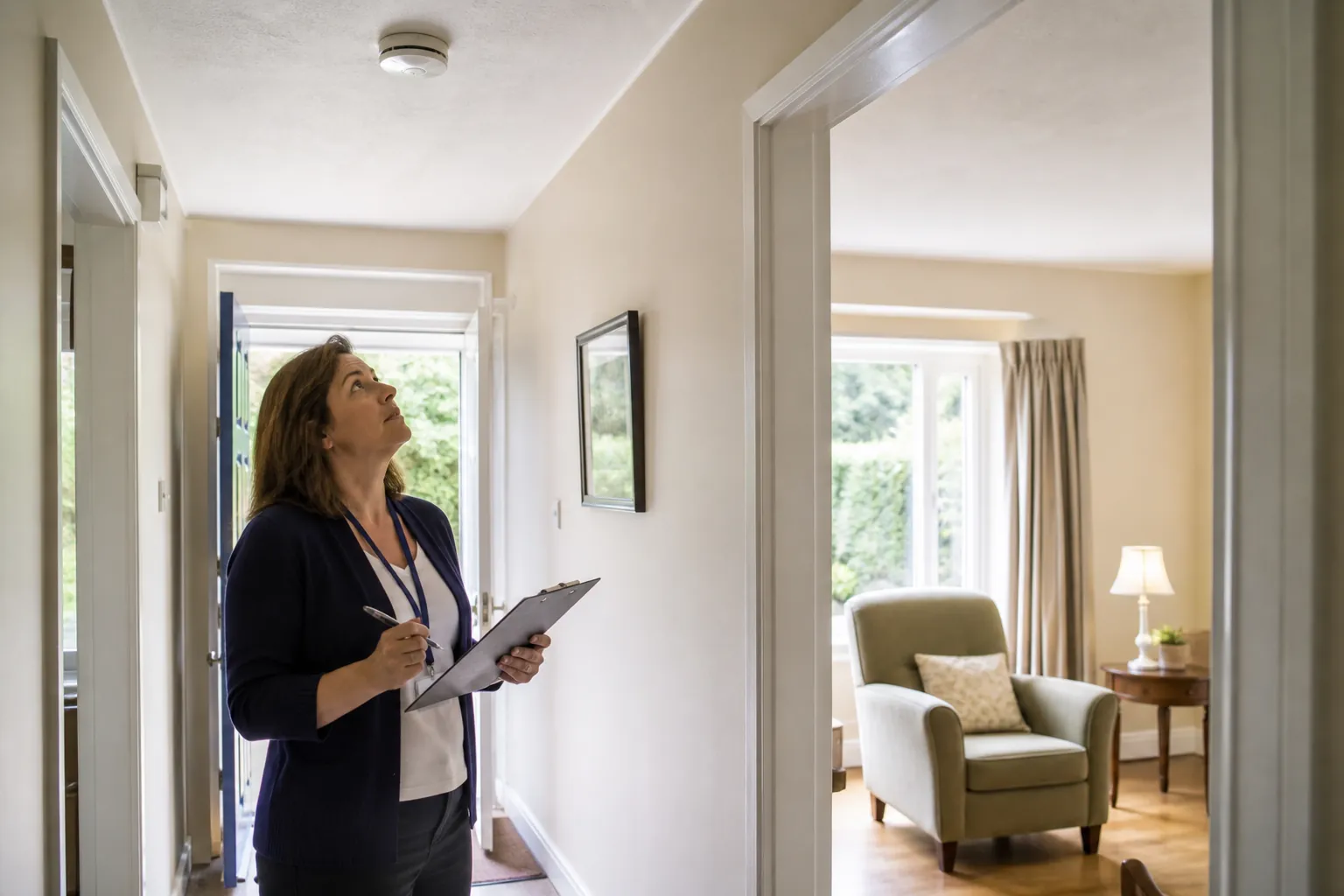
The one-pass walkthrough
Bring a tape measure if the home uses a walker or wheelchair, a phone to photograph alarm dates and blocked exits, and a pen for fixes that cannot be handled that day. The point is not to win an argument in every room. The point is to leave with proof: alarm coverage, clear heat sources, an escape path that works with the body that actually lives there, and a dated plan for testing and drills.
| Area | What to verify today |
|---|---|
| Front entry and halls | Clear route, working locks, smoke alarm coverage on every level, alarm age under 10 years |
| Bedrooms and sleeping areas | Smoke alarm inside each bedroom and outside sleeping areas, two ways out, nightstand kit, route wide enough for the actual mobility device |
| Kitchen | Stay-by-the-pan habits, timer use, pot handles inward, short sleeves, clear space around cooking area, no oven used for heat |
| Living room and heating areas | Three-foot clearance around heaters and heating equipment, no cords under rugs, no extension cords used as permanent wiring |
| Utility area | Water heater no higher than 120°F, CO alarm planning, annual professional heating inspection |
| Whole home | Named helper and backup, outside meeting place, drills twice a year at different times of day |
Smoke and carbon monoxide alarms: confirm coverage before discussing anything else
In each hallway and sleeping area, look up first. ESFI’s older-adult home fire safety guidance calls for smoke alarms inside every bedroom, outside sleeping areas, and on every level of the home.[2] If a parent sleeps with the bedroom door closed, an alarm only down the hall is not the same as an alarm in the room.
Then check whether the alarm is only present or actually maintained. ESFI recommends testing smoke alarms monthly, replacing batteries at least once a year, replacing the whole unit every 10 years, and using interconnected alarms so that when one sounds, they all sound.[2] The date stamped on the back of the alarm matters more than the fact that it is still attached to the ceiling.
- Press the test button on each smoke alarm.
- Photograph or write down the manufacture date.
- Mark a monthly test date on the calendar.
- Replace batteries at least yearly unless the model has a sealed long-life battery.
- Replace the full smoke alarm if it is 10 years old or older.
- Check local requirements for carbon monoxide alarms, especially where fuel-burning appliances, fireplaces, or attached garages are present.
Montgomery County Fire & Rescue says a working smoke alarm may reduce the risk of dying in a fire by as much as 60%.[3] ESFI separately notes that roughly two-thirds of home fire deaths occur in homes without working smoke alarms.[2] In practice, the alarm has to be in the right place, young enough to trust, loud enough to be heard, and tested on a schedule.
Kitchen: design around the minute someone steps away
The kitchen deserves more than a quick glance. USFA identifies cooking as by far the leading cause of home fires and home fire injuries. In 2021, there were 170,000 home cooking fires, and unattended equipment was the leading ignition factor at 37%.[4] The fix is not to shame anyone for making soup, tea, or toast. It is to make the cooking routine harder to interrupt.
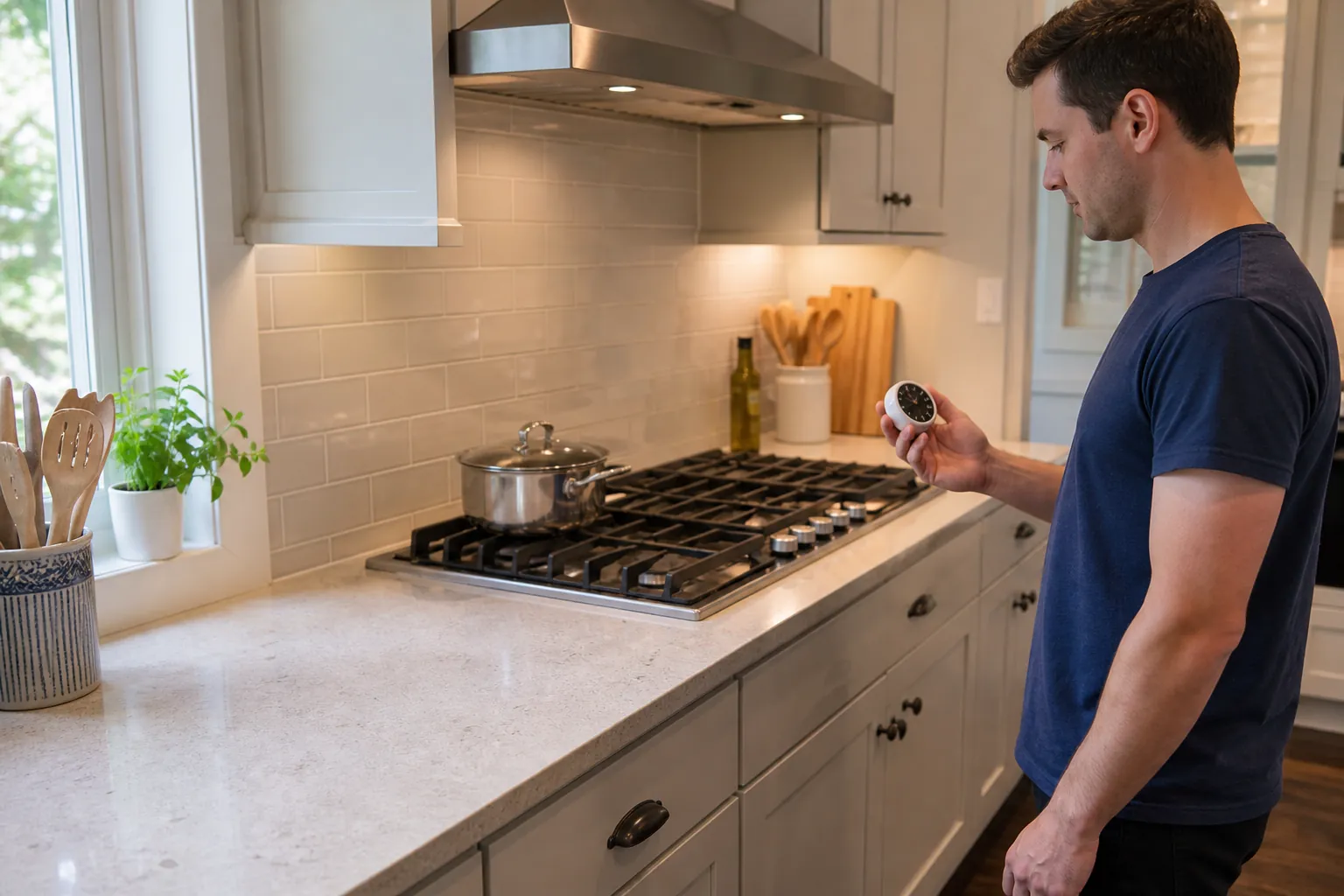
Stand at the stove and check what would happen if the phone rang, the doorbell sounded, or a caregiver called from another room. If the cook cannot stay near the pan, the burner should be turned off before leaving. A timer should be used even for familiar food, because familiar food is exactly the kind people stop watching.
- Turn pot and pan handles inward so they are not bumped by a hip, walker, sleeve, or visiting grandchild.
- Keep towels, mail, food packaging, paper plates, and oven mitts away from burners and hot surfaces.
- Use short sleeves or snug sleeves while cooking.
- Keep a timer where it will be heard from the chair or room where the person actually waits.
- Do not use the oven or stovetop to heat the home.
- If cooking is repeatedly left unattended, simplify the meal plan before relying on reminders alone.
The “stay by the pan” rule works best when the kitchen supports it. Put the chair, walker parking spot, phone charger, and recipe stand where they do not pull the person away from the stove. If the walker is always left between the stove and the exit, that is not a personality issue; it is a layout problem.
Living room and heating areas: clear three feet, then look for cord shortcuts
Heating-season fire safety often fails in ordinary places: the recliner pulled too close to a space heater, the basket of blankets that migrated beside the baseboard, the portable heater now serving as a small table. ESFI’s guidance is direct: keep anything that can burn at least three feet from heating equipment.[2]
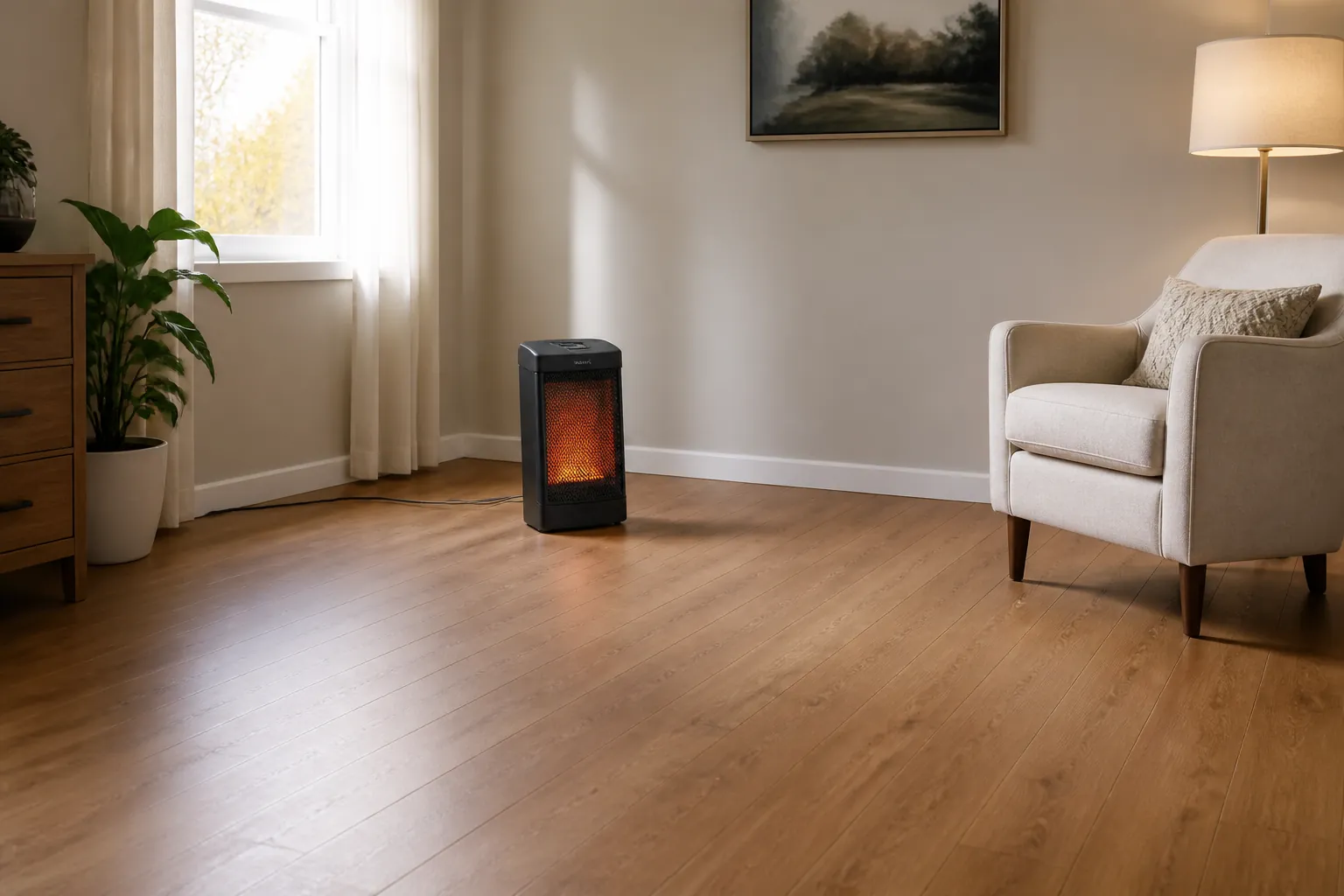
Measure it once instead of debating what “close” means. Use the same three-foot zone for blankets, curtains, newspapers, oxygen tubing if present, pet beds, and mail piles. If the room is too small to keep the clearance, the room is too small for that heater placement.
- Keep space heaters on a stable surface where they are not in the walking path.
- Do not stack mail, clothing, tissues, or blankets on or near heaters.
- Keep cords visible; do not run electrical cords under rugs.
- Do not use extension cords as permanent wiring.
- Arrange an annual professional inspection for heating equipment.
This is the overlap with winter safety. If the home uses portable heat, fuel-burning equipment, or rooms that run cold, pair this walkthrough with a measurable winter safety checklist for seniors at home so the same visit covers heater clearance and carbon monoxide planning without creating two separate arguments.
Bedroom: test the escape route as if it is 2 a.m.
The bedroom is where a tidy plan meets the body that has to carry it out. NFPA notes that sleeping on the ground floor can make escape easier for older adults, and that doors and windows must open easily from the inside.[5] That matters if stairs are slow, joints are stiff, vision is poor, or hearing aids are on the nightstand instead of in the ears.
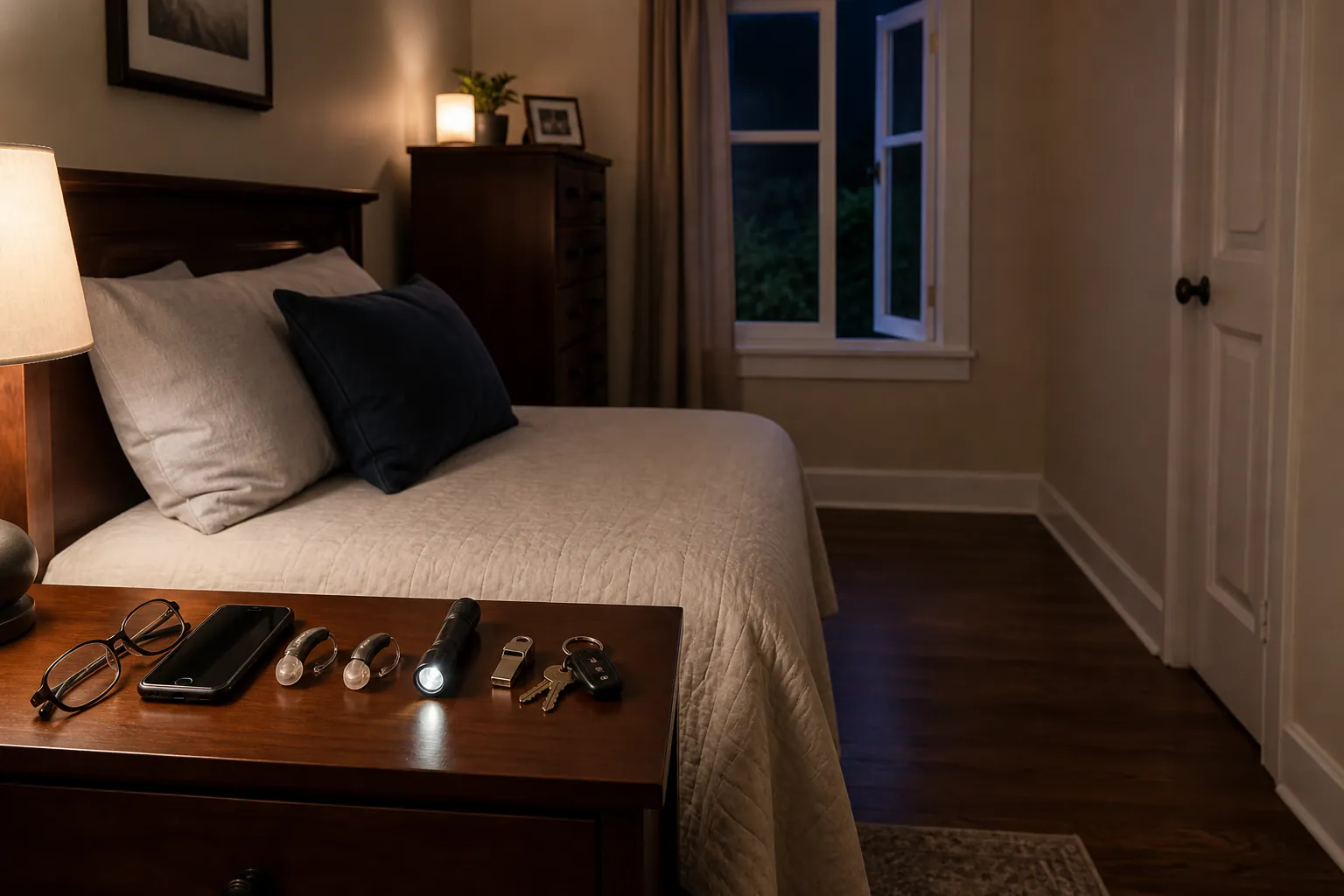
Do the bedroom check from the bed, not from the doorway. Sit or lie where the older adult sleeps. Can they hear the smoke alarm? Can they reach glasses, hearing aids, phone, flashlight, whistle, and keys without standing up first? Is the walker in the same place every night, or does it end up across the room because the nightstand blocks it?
- Place a smoke alarm inside the bedroom and another outside the sleeping area.
- Keep glasses, phone, hearing aids, flashlight, whistle, and keys on the nightstand.
- Keep the mobility device parked where it can be reached from the bed without crossing the room.
- Clear the path from bed to door and from bed to the second exit.
- Confirm the bedroom door opens fully with the walker or wheelchair in use.
- Confirm windows open from the inside and are not painted shut, blocked by furniture, or too hard to unlock.
If security bars are installed, they need emergency release devices; NFPA specifically flags this point for older-adult escape planning.[5] A locked home that cannot be opened from the inside is not safer in a fire. Check the actual release with the person who would have to use it, not just with the family member who installed it years ago.
Doorway width should be checked with the actual walker or wheelchair, at nightstand distance, with the door open the way it normally rests. The exact number depends on the device and the home, but the test is not theoretical: the person should be able to move from the bed through the doorway without turning sideways, lifting the walker, pushing clutter aside, or waiting for someone else to move a chair.
Every room needs two ways out, even if one is only a rescue route
Ready.gov tells households to identify two ways out of every room.[6] For an older adult, that does not mean pretending every window is equally usable. It means labeling the primary exit, confirming the backup, and being honest about whether the backup requires help.
- Bedroom: door to hall, plus window or another safe route identified in advance.
- Living room: main doorway, plus secondary door or window route.
- Kitchen: exit path that does not require passing directly beside the stove if fire starts there.
- Bathroom: door must open freely, and the route outside the bathroom must not be blocked by hampers, stools, or walkers parked in the hall.
- Basement or lower level: identify whether the second way out is realistic for the older adult, not just technically present.
Once the exits are named, assign people. Ready.gov and the Red Cross both emphasize practicing escape plans, and the Red Cross specifies practicing at least twice a year; Ready.gov also recommends practicing during the day and at night.[6][7] For a parent who may need help, write down one helper and one backup. A plan that depends on “someone will come” is not a plan yet.
Choose an outside meeting place that is far enough from the house to be safe but close enough to reach: a mailbox, a neighbor’s driveway, a light pole, or another fixed landmark. If the older adult lives alone, the companion piece Fire Safety and Escape Checklist for Seniors Living Alone is the better place to build the backup-contact layer around neighbors, family, and emergency access.
For families still sorting out who helps, who calls, and who practices the route, use an emergency evacuation plan checklist for elderly parents to turn the helper-and-backup conversation into names, phone numbers, and drill dates.
Utility area: set the water heater and flag the jobs that need a professional
The utility area is a short stop, but it is worth making. Montgomery County Fire & Rescue’s senior checklist recommends setting water heaters no higher than 120°F to help prevent scalds.[3] That setting is not a fire-escape item, but it belongs in the same home-safety pass because the caregiver is already standing near the equipment and writing down fixes.
- Confirm the water heater is set no higher than 120°F, or ask a qualified person to check it if the dial is unclear.
- Schedule annual professional inspection for heating equipment.
- Check whether local rules require carbon monoxide alarms and where they must be placed.
- Write down any damaged wiring, overloaded outlets, or confusing electrical issues for a licensed electrician rather than improvising a fix.
This article is practical home-safety guidance, not medical advice, electrical advice, or building-code advice. Smoke alarm, carbon monoxide alarm, electrical, rental-housing, and building-code requirements vary by jurisdiction. If the home has hardwired alarms, fuel-burning appliances, security bars, major electrical concerns, or accessibility modifications, check local code and use qualified professionals.
Keep the nightstand kit small enough to stay on the nightstand
A fire escape kit is not the same as a disaster bin in the garage. At night, the useful items are the ones reachable before standing: glasses, phone, hearing aids, flashlight, whistle, and keys. If the phone charges across the room because that is where the outlet is, move the charger or add a safe charging setup near the bed.
Medication lists, hearing-aid batteries, spare glasses, and continuity supplies may belong in a broader emergency kit, especially for storms and outages. For that layer, pair this fire walkthrough with a severe weather preparedness checklist for older adults. The nightstand version should stay lean, visible, and boring enough that it does not get moved to a drawer.
Leave with dates, not intentions
Before leaving, write the dates where people will actually see them: next monthly smoke-alarm test, next yearly battery replacement, any 10-year alarm replacement deadline, next heating inspection, and two fire-drill dates at different times of day. Photograph the list and share it with the older adult, the assigned helper, and the backup.
The remaining list should be short and specific: replace the expired hallway alarm, move the bedroom chair out of the walker route, ask the landlord about the painted-shut window, call an electrician about the extension-cord setup, verify local carbon monoxide alarm requirements, schedule the heating inspection. That is a better ending than “be careful,” because everyone knows what was verified and what still has to be fixed.
References
- Older Adult Fire Death Risk — U.S. Fire Administration
- Home Fire Safety for Older Adults Safety Awareness Program Toolkit — Electrical Safety Foundation International
- Fire Safety Checklist: Older Adults & Individuals with Special Needs — Montgomery County Fire & Rescue Service
- Prevent Fires: Cooking — U.S. Fire Administration
- Older adults — National Fire Protection Association
- Home Fire Escape Plan — Ready.gov
- Fire — American Red Cross
Related reading
Noticed something outdated or inaccurate on this page? Flag a correction. We review every report against CDC, NIA, and AARP HomeFit guidance before updating a page.
Part of the Fall Prevention section.