
STEADI: intervene
Phase-by-Phase Wildfire Evacuation Checklist for Seniors
Work through this phase-by-phase wildfire evacuation checklist for seniors — medication supply, assistive devices, transportation, and a named support network — before fire season, not during an evacuation order.
A wildfire evacuation preparedness checklist for seniors has to account for the things that slow an actual exit: a warning that is not heard, a ride that was assumed but never confirmed, a walker folded in the wrong room, a pill organizer without the prescription bottles behind it, a phone with no charger, or an older adult who needs extra time to stand, dress, and move safely.
That extra detail is not overplanning. The U.S. Fire Administration reported that adults 65 and older had 2.5 times the risk of dying in a fire compared with the total population in 2020.[1] In California’s 2018 Camp Fire, the average age of the 85 people who died was 72; in the 2017 Sonoma and Napa fires, the average age was 73.[2] A 2023 scoping review of older adults and wildfires also points to preparedness and social support as important protective factors, while studies it summarized found that some people delay evacuation even when risk is rising.[3]
This article is planning guidance, not medical, legal, or financial advice. Use it to organize the conversation with the older adult, their clinician or pharmacist, local emergency management office, and anyone who may be responsible for transportation or hands-on help.
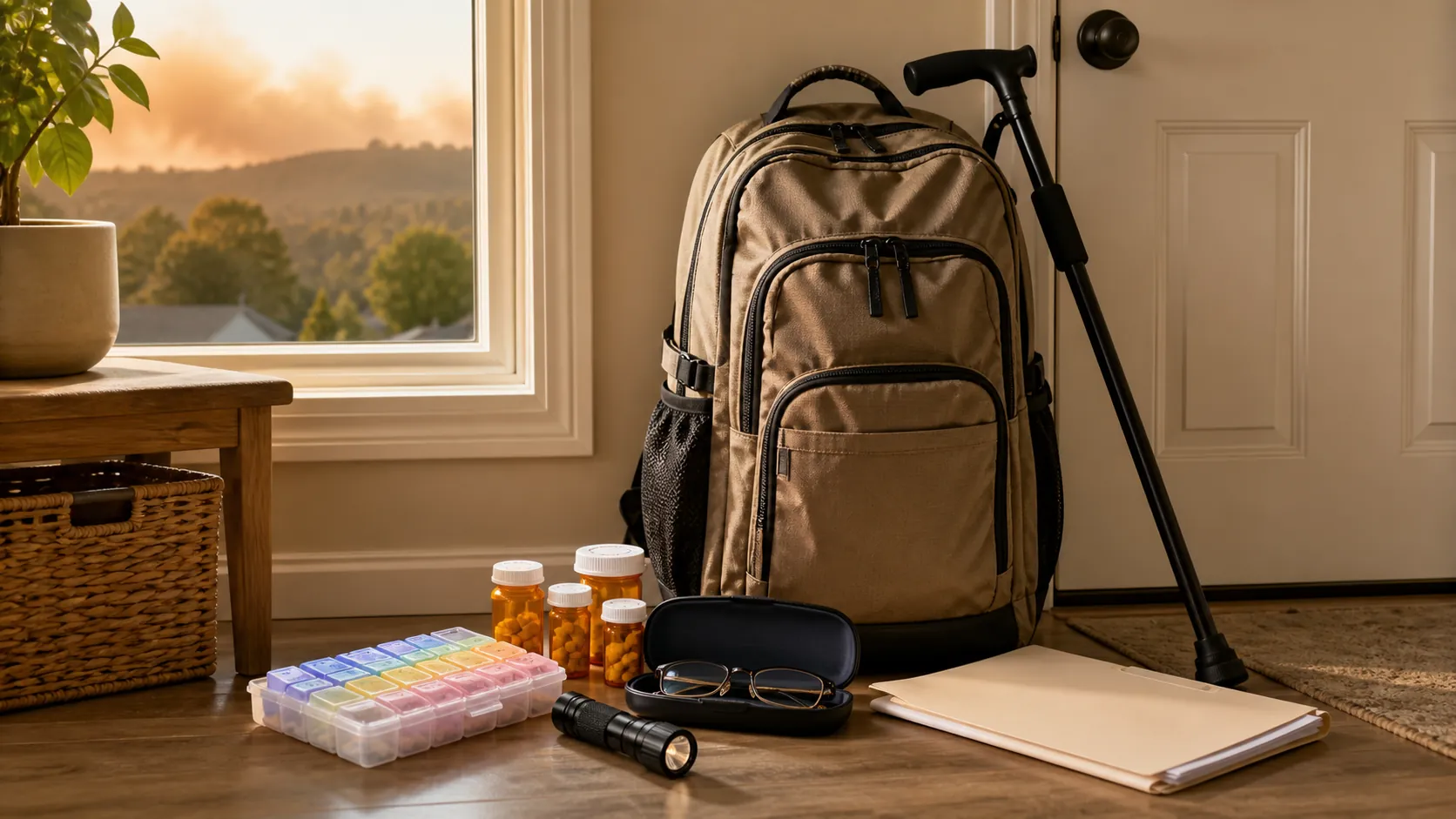
The phase flow: what changes as the fire gets closer
The plan works best when each phase has a different job. Before fire season is for decisions and practice. A warning is for moving early and narrowing the plan. An evacuation order is for leaving, not reorganizing. After leaving is for checking the medical, mobility, document, and communication pieces that can unravel once everyone is tired.
| Phase | What must already be clear | Main action |
|---|---|---|
| Before fire season | Medication plan, assistive devices, ride plan, support network, documents, power needs, exit route | Pack, assign, label, share access, and practice |
| Wildfire warning, evacuation warning, or nearby threat | Who is driving, where devices and medications are, how long dressing and moving takes | Leave early if mobility, oxygen, cognition, or transportation limits make waiting unsafe |
| Evacuation order | Primary and backup ride, packed go-bag, clear route to the car | Go immediately with the person, devices, medications, documents, phone, and chargers |
| After leaving | Where the person will stay and who is tracking care needs | Confirm medication, device power, contacts, documents, and follow-up help |
Before fire season: build the plan around the person’s real day
Start where the older adult actually starts the day: bed, bathroom, kitchen, medication station, favorite chair, garage, front door. A checklist that lives only in a folder will not help if the walker is behind a recliner, the house key is with one adult child who is out of town, or the person cannot safely carry a heavy bag while using a cane.
The basic emergency kit still matters. Ready.gov’s kit guidance includes 1 gallon of water per person per day, nonperishable food, a battery-powered or hand-crank radio, a flashlight, a first aid kit, and prescription medications; it also notes that about half of all Americans take a prescription medicine every day.[4] For a broader go-bag inventory, use this article as the wildfire-specific layer and cross-check it against the senior flash flood emergency kit checklist, where the kit contents are handled in more depth.
Medication: decide the supply, storage, and refill plan before smoke is in the air
Medication planning is one place where the public guidance does not collapse into a single neat number. The CDC advises people with chronic conditions to keep a 7- to 10-day supply of prescription medicines in a waterproof, childproof container when preparing for wildfire smoke.[5] The Red Cross advises older adults to keep at least 30 days of medications and medical supplies, along with extra assistive items such as a cane or eyeglasses.[6]
Do not treat those two figures as a blended consensus. Instead, build around the stricter reality of the person’s prescriptions: refill limits, controlled substances, mail-order timing, refrigeration, insulin or other temperature-sensitive supplies, pharmacy closures, oxygen or equipment vendors, and what the clinician or pharmacist says is safe and realistic.
- Keep a current medication list in the go-bag and with at least one support person. Include medication names, doses, timing, prescribing clinicians, pharmacy name, allergies, and emergency contacts.
- Store prescription bottles or pharmacy labels with the packed supply when possible, not only an unlabeled pill organizer.
- If a medicine must stay cold, write down exactly what will keep it cold during travel and where it can be refrigerated after arrival.
- Put a refill-review date on the calendar. A go-bag packed in spring can quietly become unsafe by late summer if medications expire or prescriptions change.
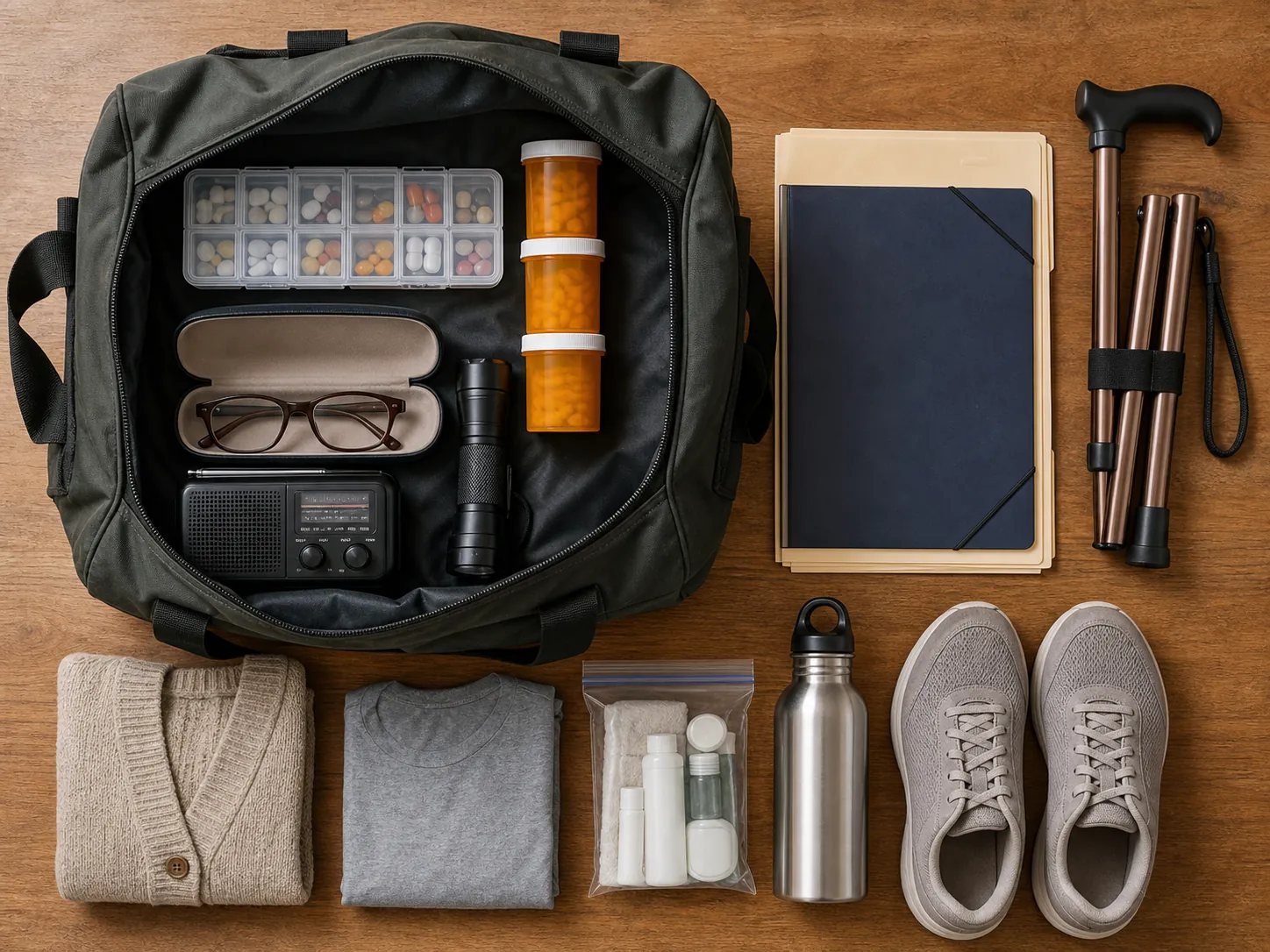
Assistive devices: pack the backups, not just the person
For a fall-prone older adult, a wildfire evacuation is also a mobility event: standing quickly, walking through dim rooms, stepping over thresholds, getting into a car, and entering an unfamiliar shelter or relative’s home. The plan should name the devices that must leave with the person and where each one is stored.
- Primary mobility device: walker, rollator, cane, wheelchair, scooter, transfer board, or gait belt.
- Backup items: spare cane tips, eyeglasses, hearing-aid batteries or charger, denture supplies, incontinence supplies, and any braces or orthotics used for safe walking.
- Power-dependent equipment: chargers, battery packs, extension cord, and the written plan for what happens if power is out.
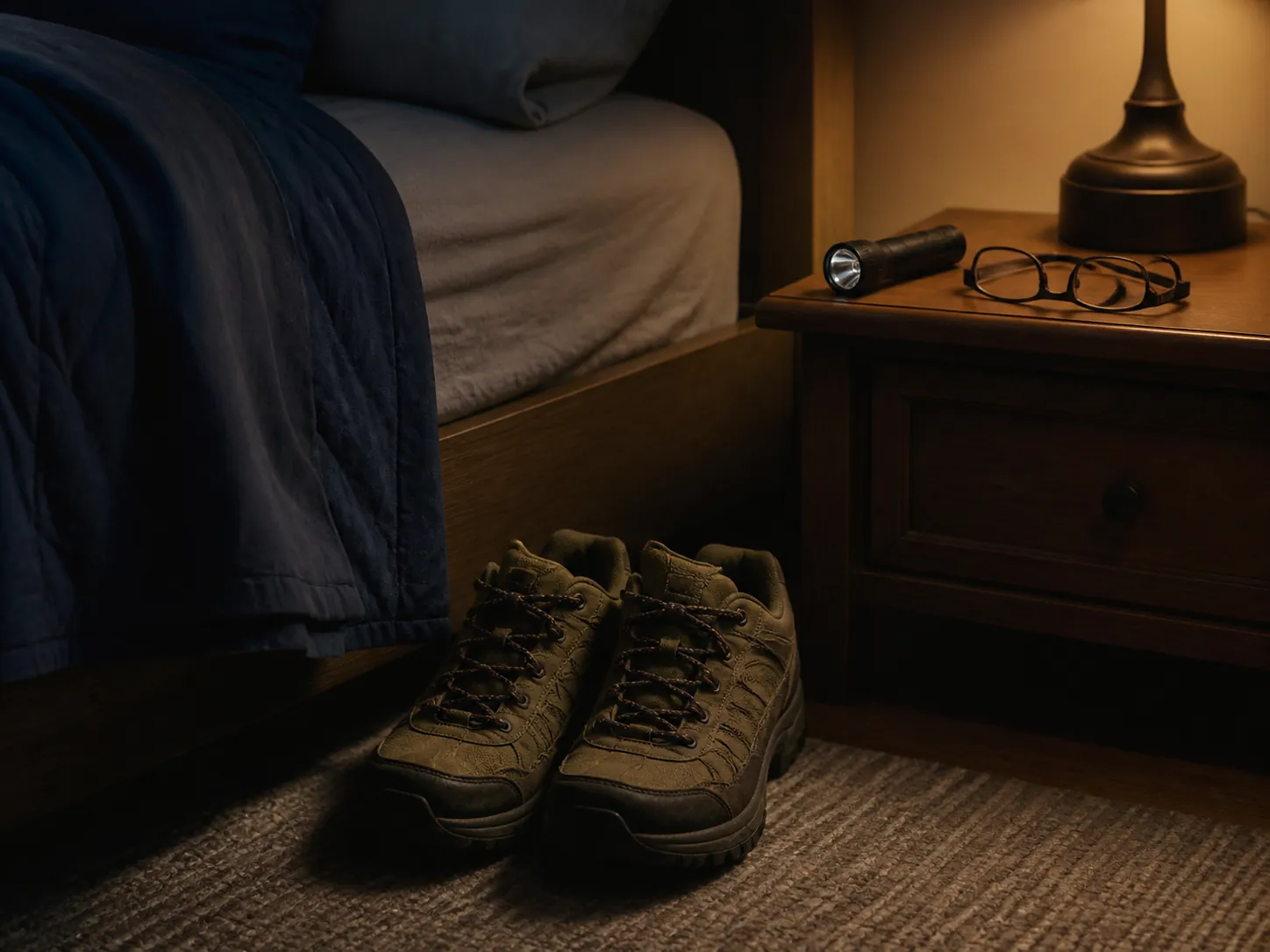
- Night exit items: sturdy shoes, flashlight, glasses, and phone placed where the person can reach them without crossing a dark room.
The Red Cross specifically tells older adults to plan for backup power for electrically dependent medical devices and refrigerated medicines.[6] That plan needs to be more concrete than “charge things.” Write down what must be charged, how long it usually lasts, which outlet or battery pack is used, who checks it, and what the backup is if the first destination loses power.
Documents and contacts: make them reachable to someone besides the older adult
A documents folder should be light enough to carry and obvious enough for a helper to find. Include copies of identification, insurance cards, medication and diagnosis lists, clinician and pharmacy contacts, emergency contacts, medical device information, and any documents the person’s clinician, attorney, or financial professional has advised keeping accessible.
This is where independence and safety can rub against each other. Some older adults do not want a child, neighbor, or friend to hold a key or see a medication list. That reluctance is real. So is the consequence of a locked door during an evacuation warning. Ready.gov’s older-adult guidance says at least one person in the support network should have an extra key, know where emergency supplies are kept, and know how to use lifesaving equipment or administer medicine.[7]

Transportation: replace “someone will come” with names and backups
Transportation is often written as a single checklist line. For an older adult, it needs its own decision tree. The University of Nevada, Reno Extension wildfire evacuation checklist advises keeping the gas tank full, parking the vehicle facing out, and arranging transportation in advance if the person does not drive.[8]
- Primary driver: name, phone number, usual location, and how they will be alerted.
- Backup driver: someone who can leave work, wake up at night, or reach the home if the primary driver cannot.
- Access plan: who has the key, garage code, gate code, or building entry instructions.
- Mobility fit: whether the walker, wheelchair, oxygen equipment, or scooter fits in the vehicle without blocking the older adult from getting in safely.
- Parking orientation: car facing out, driveway clear, and no stacked storage blocking the route from the house to the passenger door.
- No-driver option: paratransit, local emergency registry, neighbor agreement, community transportation, or local emergency management guidance written down before fire season.
If the older adult lives in assisted living, memory care, or another senior living setting, the transportation question belongs to the facility as well as the family. Use what to ask about a senior living facility’s evacuation plan to press for specifics instead of accepting “we have a plan” as an answer.
Support network: make it small enough to test
A useful support network is not a long phone tree. It is a short list of people with assigned jobs. One person may be the first call. One may hold a key. One may be the backup driver. One may know how the portable oxygen concentrator, medication schedule, or refrigerated medicine cooler works. The Red Cross also advises older adults to plan who will help them evacuate and to check whether local registries are available.[6]
| Job | Named person | What they must know or have |
|---|---|---|
| First call during warning | Write name and phone | How to reach the older adult if phone service is poor |
| Primary ride | Write name and phone | Key or access code, device list, destination |
| Backup ride | Write name and phone | Same access and device information as primary ride |
| Medication/device helper | Write name and phone | Medication list location, cooler plan, charger plan |
| Out-of-area contact | Write name and phone | Where the person went and who else must be updated |
Practice the exit twice a year
AARP’s caregiver guidance recommends practicing the evacuation drill every six months and reviewing emergency-kit contents every 3 to 6 months.[9] The drill does not need to be dramatic. Time how long it takes to put on shoes, collect the bag, pick up the walker or cane, lock the door if appropriate, and get into the vehicle. If the drill exposes a loose rug, a dark hallway, a bag that is too heavy, or a walker that does not fit through stacked garage storage, fix that during calm weather.
For a room-by-room method, adapt the route-clearing and timed-practice approach in fall-proofing a tornado shelter route. The hazard is different, but the body mechanics are familiar: stand, turn, walk, carry, transfer, and avoid rushing through clutter.
When a warning is issued: move earlier than the average adult might
A warning is the time to bring the plan down to the exit path, not to wait and see whether the order becomes mandatory. CAL FIRE’s evacuation guidance says to leave immediately when advised and not to wait for a mandatory evacuation order.[10] For an older adult with limited mobility, oxygen needs, cognitive changes, poor night vision, or no independent transportation, leaving early can be the safest version of following the plan.
At this phase, the checklist becomes short and physical:
- Call the primary ride and backup ride. Do not assume either person has seen the alert.
- Put the go-bag, medication supply, documents folder, phone, chargers, and assistive devices by the exit that will actually be used.
- Dress the older adult in evacuation clothes before fatigue, darkness, or smoke makes it harder.
- Move sturdy shoes, glasses, flashlight, and mobility device within reach of the bed if there is any chance of a nighttime exit.
- Check that the car is accessible, facing out if possible, and not blocked by another vehicle or storage.
- Confirm the destination and the route with the driver, then tell the out-of-area contact where the older adult is going.
CAL FIRE advises evacuation clothing that covers skin, ideally 100% cotton, and also recommends keeping shoes near the bed and using an N95 mask for smoke.[10] Smoke protection and indoor-air steps can become their own full checklist; use the heat and wildfire smoke safety checklist for seniors for that part rather than trying to solve indoor air quality while packing the car.
This is also the moment to use a go/no-go rule if the older adult is inclined to wait for one more update. The go/no-go outdoor safety framework for seniors in bad weather can help families set the decision line in advance: poor visibility, reduced mobility, no confirmed ride, nearby road closures, or a nighttime threat should all push the plan toward earlier movement.
When told to evacuate: leave with the plan you already made
An evacuation order is not the time to decide which papers matter or whether the walker will fit. Take the person, the go-bag, medications, mobility devices, medical equipment, documents, phone, chargers, glasses, hearing aids, wallet, and keys. If something was important enough to list before fire season, it should have a packed location or assigned person now.
Keep the movement simple. Use the practiced route. Turn on lights if visibility is poor. Let the driver or helper carry the heavy bag so the older adult can keep one hand free for a cane, walker, railing, or car door. Do not send someone with balance problems back through the house for one more item unless emergency officials have clearly said there is time and the route remains safe.
- If the primary driver does not answer, call the backup immediately.
- If neither ride is available, use the local emergency contact, registry process, or transportation option identified before fire season.
- If the older adult resists leaving, keep the conversation specific: the order has been issued, the ride is here, the medications and walker are packed, and the destination is already chosen.
- Once in the vehicle, call or text the out-of-area contact with the departure time and destination if service is available.
Evacuation can expose every weak point in a household’s fall-prevention plan. Wet leaves, ash, darkness, curbs, loose mats, and hurried transfers all matter. If the route from bedroom to car has not been practiced, the safest available helper should slow the exit enough to prevent a fall while still obeying the evacuation order.
After leaving: check the pieces that affect the next 24 to 72 hours
Once the older adult is out of the evacuation area, the checklist shifts from leaving the house to maintaining care. The first hour after arrival is a good time to find the medications, plug in devices, set up the mobility aid, and make sure the older adult can get to the bathroom without a fall hazard.
- Medication: confirm what was brought, what was missed, what must stay cold, and when the next dose is due.
- Devices: charge phones, hearing aids, medical equipment, scooter or wheelchair batteries, and backup batteries.
- Mobility: place walker, cane, glasses, shoes, flashlight, and bathroom path within easy reach.
- Documents: keep identification, insurance cards, medication lists, and clinician contacts together rather than scattered across bags.
- Contacts: update the support network and out-of-area contact with the location and any urgent needs.
- Follow-up: call the pharmacy, clinician, equipment supplier, home health agency, or local emergency office if medications, oxygen, refrigeration, mobility equipment, or care visits were disrupted.
Do not let the go-bag disappear into a corner after one successful exit. Keep it visible until medications, documents, chargers, and assistive devices have been reconciled against the written list. If the evacuation lasts longer than expected, that written list becomes the handoff tool for relatives, shelter staff, clinicians, pharmacists, or neighbors who are trying to help without guessing.
References
- Fire Safety for Older Adults — USFA — link
- How we analyzed the risk wildfires pose to older people — CalMatters — link
- Melton et al. 2023 scoping review — PubMed Central — 2023 — link
- Build A Kit — Ready.gov — link
- Wildfire Smoke and People with Chronic Conditions — CDC — link
- Older Adults Emergency Preparedness — Red Cross — link
- Older Adults — Ready.gov — link
- Wildfire Evacuation Checklist — University of Nevada, Reno Extension — link
- How Caregivers Can Build Emergency Plans for Loved Ones — AARP — link
- Ready for Wildfire Go Evacuation Guide — CAL FIRE — link
Related reading
Noticed something outdated or inaccurate on this page? Flag a correction. We review every report against CDC, NIA, and AARP HomeFit guidance before updating a page.
Part of the Fall Prevention section.