
STEADI: intervene
Hurricane Preparedness Checklist for Seniors Living Alone
A phased, fall-prevention-centered checklist that helps seniors living alone prepare for hurricanes — covering medication continuity, mobility aid backup, and a multi-person check-in system for before, during, and after the storm.
The hard part of a hurricane for a senior living alone may start long before water reaches the street. It can start in a dark hallway at 2 a.m., with the walker parked in the garage, the phone at 18%, the bathroom light out, and a throw rug curled where it has always curled. A standard hurricane list may say “have supplies.” That is not enough if the person has to cross a damp floor, open pill bottles on schedule, hear an alert, keep oxygen or a medical device powered, and answer a check-in call without anyone in the house to help.
Older adults are not a side note in hurricane planning. One widely cited disaster-preparedness review notes that about 80% of older adults have at least one chronic condition, and Hurricane Katrina remains a severe warning: adults 60 and older were about 15% of New Orleans’ population, while people over 65 accounted for 71% of deaths.[1] Falls deserve the same seriousness as wind and flood maps. The CDC reports that falls caused more than 38,000 deaths among adults 65 and older in 2021.[2] After a storm, familiar rooms can become fall traps: no lights, wet thresholds, extension cords, debris, swollen doors, spoiled food to carry out, and a body already tired from worry.
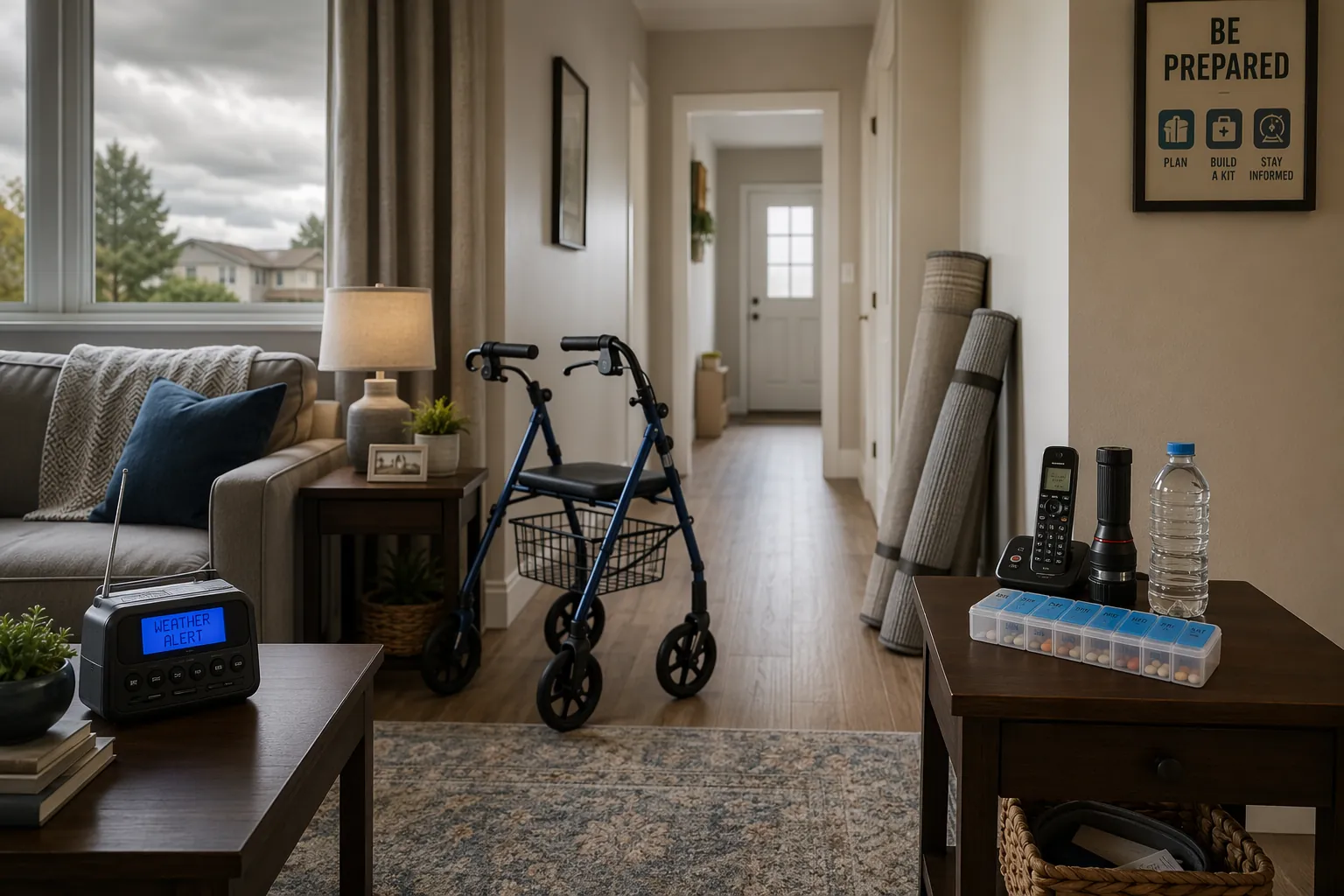
Before Hurricane Season: Build the Plan While Stores, Roads, and Pharmacies Still Work
The safest hurricane plan for a senior living alone is made before a storm has a name. This is when there is still time to register for help, refill prescriptions, move furniture, test batteries, and ask neighbors for specific jobs instead of vague favors.
Start with the parts of daily life that cannot pause for weather: medication, walking, toileting, food, cooling, communication, and medical equipment. If any one of those depends on electricity, transportation, one caregiver, or a pharmacy being open, it needs a backup.
Register before anyone is overwhelmed
If your county or city offers a special-needs, vulnerable-population, or evacuation-assistance registry, sign up before the season. Do the same for Smart911 where available and for any utility medical-needs registry if you rely on powered medical equipment. The Red Cross specifically advises older adults to sign up for local alerts and emergency registries before a disaster, not during one.[3]
A registry is not a private ambulance reservation, and it should not be treated as the whole plan. It gives emergency managers better information and may help prioritize contact, transportation, or power-restoration awareness depending on the local program. The rest of the plan still has to work inside the home.
Pack two kits, not one
For older adults, the Red Cross recommends both a 3-day Go-Kit and a 2-week Stay-at-Home Kit, along with at least 30 days of medication.[3] That distinction matters. A Go-Kit is for leaving quickly. A Stay-at-Home Kit is for the days when roads are blocked, stores are closed, and the safest choice is to remain inside.
| Kit | What it must cover for a senior living alone |
|---|---|
| 3-day Go-Kit | Medication list, copies of key documents, glasses, hearing-aid batteries, chargers, light source, water, ready-to-eat food, hygiene supplies, small first-aid items, emergency contacts, and a change of clothing |
| 2-week Stay-at-Home Kit | Water, shelf-stable food, manual can opener, medication supply, incontinence supplies if used, pet supplies, batteries, lighting, sanitation supplies, backup charging, and easy-to-reach walking routes to every item |
| Medical-device backup | Power plan for oxygen, CPAP, refrigeration needs, mobility-device charging, medical alert system, and a written instruction sheet for helpers |
Put kit items where the person can reach them without bending deeply, climbing, or crossing a cluttered room. A perfect kit on the top shelf is not a kit for someone with balance trouble. Store one flashlight by the bed, one by the main chair, and one near the bathroom route. If batteries are loose in a drawer, tape the right batteries to the device or store them in the same bin.
Make medication continuity boring
Medication planning should be settled before the first cone appears on the forecast map. Ask the pharmacy and prescribers what early-refill options are available during hurricane season. Keep a printed medication list in the Go-Kit and another near the main phone. Include the drug name, dose, schedule, prescribing clinician, pharmacy, allergies, and what each medication is for.
Pay special attention to medications that change bathroom timing, blood pressure, blood sugar, alertness, or hydration. A diuretic taken in a dark house with a blocked bathroom path is not a small detail. It changes the fall risk for the next several hours.
Walk the house as if the lights are already out
Before hurricane season, clear the routes that will matter when the person is tired: bed to bathroom, chair to bathroom, bedroom to exit, kitchen to main chair, and main chair to phone or charging station. Ready.gov advises older adults to plan around mobility and medical needs, and standard fall-proofing before a storm includes removing loose rugs, securing cords, installing nightlights, and clearing pathways.[4]
- Remove or tape down loose rugs; rolled edges become worse when feet shuffle or floors are damp.
- Move cords out of walking routes before lamps, phones, fans, and chargers multiply during an outage.
- Stage the walker, cane, wheelchair, or rollator inside the living space, not in the carport or garage.
- Place a stable chair along a long hallway if the person may need to rest.
- Keep shoes with backs and non-skid soles near the bed; slippers that slide are not storm footwear.
For a broader home-safety plan beyond storm season, the same living-alone weaknesses show up in ordinary weeks too: one person is managing mobility, meals, medication, social contact, and emergencies without an in-home witness. CareWise Guide’s Aging in Place Alone: A Safety and Connection Guide for Older Adults Living Solo at Home can help families see where the hurricane plan is really a daily safety plan under pressure.
Check the medical alert system before it is needed
Medical alert systems are useful, but they are not magic during a long outage. The National Council on Aging notes that some medical alert base stations have backup batteries lasting up to 32 hours.[5] “Up to” is the phrase to notice. The real plan should include the exact model, battery expectation, whether it works over cellular or landline service, how it is charged, and what to do if the base station dies.
Test the button from the bathroom, bedroom, and main chair. If the person does not wear it in the shower or at night, name that honestly. A device on the charger cannot call for help after a bathroom fall.
Build a check-in system with more than one person
One adult child calling from another county is not a hurricane check-in system. Phones fail. Caregivers evacuate. Bridges close. The National Council on Aging advises older adults to create a support network and emergency communication plan before disasters, and this is especially important for someone living alone.[6]
Choose at least three named contacts with different weaknesses: a nearby neighbor who can knock, a family member who can coordinate, and a church, senior center, building manager, or community volunteer who can escalate if calls fail. Give each person a job, not just a phone number.
| Person | Job before the storm | Job during and after |
|---|---|---|
| Nearby neighbor | Confirm porch furniture is secured and walker or cane is inside | Knock or call at agreed times if it is safe to do so |
| Family coordinator | Keep medication list, doctor contacts, insurance information, and evacuation destination | Track check-ins and call for welfare help if contact is missed |
| Community contact | Know whether the senior is registered for local assistance | Help escalate through local channels if family cannot reach the person |
Some older adults resist this because it feels like giving up privacy or becoming a burden. Keep the wording practical: “If I miss the 9 a.m. call, please try again, then call my daughter, then call the county non-emergency number.” That is not dependence. That is a written failure point, with a next step.
Isolation also changes behavior. People who are lonely or embarrassed may wait too long to ask for help, especially after a near fall or a missed meal. The same connection issues discussed in CareWise Guide’s holiday loneliness and fall risk guide matter during hurricanes, only with fewer services available.
When a Storm Is Forecast: Narrow the House to Safe Routes
Once a hurricane is forecast, the plan becomes smaller and more physical. The question is no longer “Am I prepared in general?” It is “Can I safely do the next 24 to 72 hours of life in this house if the power fails?”
- Move the walker, cane, rollator, wheelchair, and shower chair to the rooms where they will actually be used.
- Charge phones, medical alert devices, hearing aids, mobility devices, battery packs, and rechargeable lights.
- Fill water bottles and place some at waist height near the bed, chair, and kitchen.
- Set out the next several days of medications according to the usual schedule, without mixing pills into unlabeled bags.
- Move trash cans, plant stands, pet bowls, oxygen tubing, and decorative tables out of the main walking paths.
- Put a flashlight or lantern within reach from bed before lying down, not across the room.
Do not wait until rain bands arrive to decide where to sleep. If the usual bedroom is far from the bathroom or has a narrow route around furniture, consider setting up in a safer interior room with the clearest bathroom path. Keep the path wide enough for the mobility aid, not just for a person walking sideways.
Set the communication schedule before the phones are busy
Write down check-in times and what counts as a missed check-in. For example, a family coordinator may call at 8 a.m. and 8 p.m.; a neighbor may knock after the storm passes if there is no answer; a community contact may be called if two check-ins are missed. Use names and phone numbers on paper because a locked or dead phone can hide the contact list.
Texting may work when calls do not. Keep messages short: “I am home. Power out. No injury. Water OK.” A tired person should not have to type a full report while balancing a flashlight.
Decide early whether staying home is still safe
Evacuation decisions belong to local officials and the person’s medical reality. For a senior living alone, the decision should be made while transportation still exists. Leaving late with a walker, oxygen, medications, pets, and anxiety is harder than leaving early with a packed Go-Kit.
If staying home, bring outdoor items inside only if it can be done without rushing or lifting beyond safe limits. A patio chair is not worth a fall. Ask the neighbor assigned to the plan to handle what is too heavy or awkward.
During the Storm: Stay Put, Save Power, Keep the Walking Path Open
During the storm, the safest work is usually restraint. Stay away from windows, follow local emergency instructions, and do not go outside to check damage. Use battery lighting instead of candles when possible. Keep the phone on low-power mode and use it for scheduled check-ins, emergency alerts, and urgent calls.
Keep the bathroom route clear even if the rest of the room becomes crowded with supplies. If water leaks in, do not rush to mop it alone while winds are still dangerous. Put on sturdy shoes before walking, use the mobility aid, and move slowly enough to keep both hands available for balance when needed.
Never use a generator, grill, camp stove, or gasoline-powered device indoors, in a garage, or near windows and doors. The CDC warns that generator misuse after hurricanes can cause carbon monoxide poisoning, which can kill without warning signs a person will reliably notice in time.[7]
Power outages change the fall-prevention plan minute by minute. If the house goes dark, switch to the pre-placed lights rather than walking to a distant closet. CareWise Guide’s Power Outage Fall Prevention Checklist for Seniors gives more detail for setting up safe lighting, charging, and walking routes.
Right After Landfall: Do Not Let Cleanup Become the Emergency
The quiet after the wind can fool people. This is when many seniors start doing too much: dragging branches, opening a swollen garage door, carrying wet towels, climbing a step stool, or walking outside to “just look.” The Red Cross lists heart attacks among leading causes of death after hurricanes and warns about overexertion during cleanup.[8]
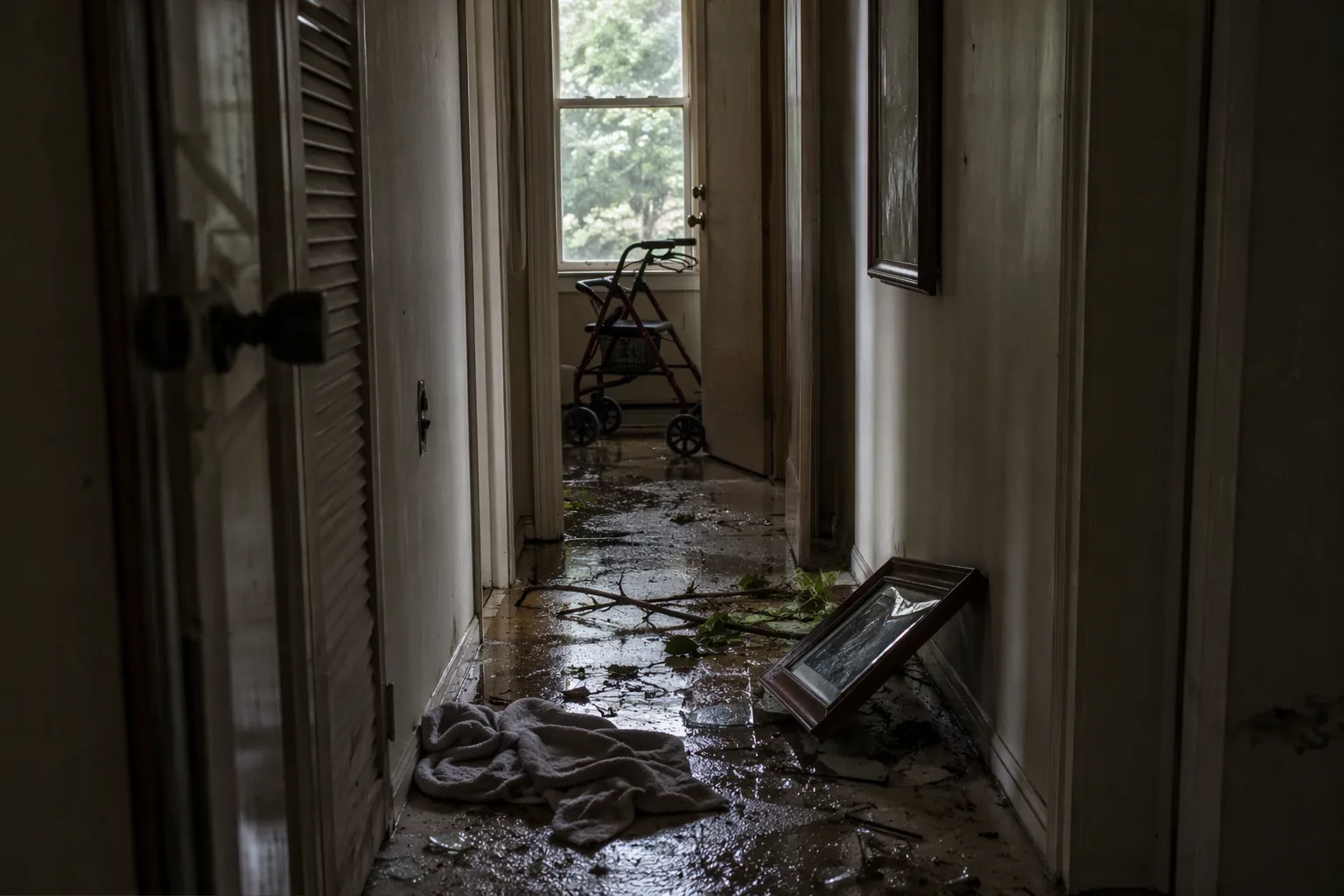
Before walking through the house, turn on a flashlight and look at the floor first. Watch for wet thresholds, broken glass, fallen picture frames, shifted rugs, pet bowls, extension cords, and debris that blew in under doors. Use the walker or cane even if the distance seems short. Pride has a bad habit of showing up right before a fall.
- Make the first post-storm check-in before beginning cleanup.
- Report injury, power status, flooding, medication supply, and indoor temperature.
- Do not move heavy debris alone; wait for the assigned helper or local guidance.
- Keep refrigerator and freezer doors closed until deciding what food is safe.
- Leave if officials order evacuation or if heat, flooding, medical-device failure, or structural damage makes the home unsafe.
Heat without air conditioning can become a fall risk
After a summer hurricane, heat can be as practical a danger as debris. A hot house can worsen fatigue, dizziness, dehydration, medication side effects, and confusion. Those are fall risks, not just comfort problems. If the power is out and the indoor temperature is climbing, the check-in system should shift from “Are you okay?” to “Where can you cool down, and who is taking you there?”
For more detail on cooling options that do not create new hazards, use CareWise Guide’s guide to keeping seniors cool without AC and preventing falls during heat waves. The same principles apply after hurricanes: hydrate, reduce exertion, avoid unnecessary trips outside, and move to a cooling site if home is no longer safe.
Food safety needs a decision, not a guess
Spoiled food becomes a problem in two ways. First, it can make a person sick. Second, cleaning it out can require bending, lifting, carrying leaking bags, and walking across slick kitchen floors. If there is any doubt, use official food-safety guidance and ask a helper to manage heavy disposal.
Older adults who already track food recalls may find the same habits useful here: identify the food, check the risk, and avoid tasting to decide. CareWise Guide’s food safety guide for aging parents is not a hurricane page, but its cautious approach fits the post-outage kitchen.
Before Re-Entering or Cleaning Up: Wait for the All-Clear and Bring Help
If the senior evacuated, re-entry should wait for official permission and a real look at the home’s condition. A familiar house can be unsafe after flooding, roof damage, mold, electrical problems, gas leaks, broken steps, or shifted furniture. The first person through the door should not be an older adult walking alone with a flashlight and a tote bag.
Ask a helper to check the entrance, flooring, bathroom route, bedroom route, refrigerator, medication storage, and power status before the senior resumes normal routines. If water entered the home, assume surfaces are contaminated until local guidance says otherwise. If there is a fuel smell, visible electrical damage, standing water near outlets, or structural damage, leave and call the appropriate authority.
- Do not climb ladders, step stools, or wet outdoor steps to inspect damage.
- Do not carry heavy debris, soaked rugs, or spoiled food bags alone.
- Do not restart medical equipment without checking power safety and manufacturer instructions.
- Do not sleep in the home if cooling, medication storage, bathroom access, or safe walking routes cannot be restored.
Emotional strain belongs in the plan too. A frightening storm, evacuation, home damage, or several days alone without power can leave a person shaken and less steady. The Disaster Distress Helpline is available at 1-800-985-5990, and people can text TalkWithUs to 66746 for support.[7]
A Senior-Specific Hurricane Checklist
Use this as a working checklist, not a decoration for the refrigerator. Names, dates, phone numbers, and locations should be filled in before the season.
- Before season: sign up for local alerts, special-needs or evacuation-assistance registries, Smart911 where available, and utility medical-needs programs.
- Before season: prepare a 3-day Go-Kit, a 2-week Stay-at-Home Kit, and a plan for at least 30 days of medication.
- Before season: clear bed-to-bathroom, chair-to-bathroom, kitchen, exit, and charging-station routes; remove rugs and cords from those paths.
- Before season: test medical alert devices, backup batteries, chargers, hearing aids, mobility-device charging, and backup lighting.
- Before season: assign at least three check-in people with written jobs and missed-contact steps.
- When forecast: refill prescriptions if needed, charge devices, stage mobility aids indoors, place water and lights within reach, and decide early whether to evacuate.
- During storm: stay inside, preserve phone power, use safe lighting, keep the bathroom route open, and follow the check-in schedule.
- After storm: check in before cleanup, inspect floors with a flashlight, avoid overexertion, prevent carbon monoxide exposure, monitor heat, and ask for help before re-entry or heavy cleanup.
The goal is not to make a senior less independent. It is to make independence less fragile. A good hurricane preparedness checklist for seniors living alone leaves the person with medication continuity, reachable lights, clear walking routes, backup communication, safe power habits, and several named people responsible for contact before, during, and after the storm.
References
- Disaster Preparedness and Response for Older Adults, National Center for Biotechnology Information.
- About Older Adult Fall Prevention, Centers for Disease Control and Prevention.
- Older Adults, American Red Cross.
- Older Adults, Ready.gov.
- The Best Medical Alert Systems, National Council on Aging.
- Emergency Preparedness 101: What to Do Before, During, and After Disaster, National Council on Aging.
- Stay Safe After a Hurricane or Other Tropical Storm, Centers for Disease Control and Prevention.
- Hurricane Safety, American Red Cross.
Related reading
Noticed something outdated or inaccurate on this page? Flag a correction. We review every report against CDC, NIA, and AARP HomeFit guidance before updating a page.
Part of the Fall Prevention section.