
STEADI: intervene
Wildfire Evacuation Checklist for Seniors Living Alone
This step-by-step checklist helps seniors living alone prepare for wildfire evacuation with a plan that accounts for limited mobility, medical dependencies, and the reality that help may not arrive in time. Covers pre-season prep, a senior-specific go-bag, building a support network, and what to do through the evacuation sequence to return home safely.
If you live alone, the usual wildfire evacuation checklist can fail at the exact moment you need it most. It may tell you to grab documents, load the car, and leave when ordered. It may not ask whether you can lift your oxygen equipment, hear a midnight alert without hearing aids in, fit a walker through the hallway while carrying a bag, or reach the neighbor who has the spare key.
That is not a small oversight. More than one-quarter of U.S. adults age 65 and older live alone, and among women over 75, the share rises to 43%.[1] As of early 2026, reporting on the January 2025 Los Angeles wildfires found that many victims were older adults or people with disabilities; one widely reported case involved Anthony Mitchell Sr., an amputee, who died with his son, who had cerebral palsy, after they waited for evacuation help that did not arrive in time.[2][3]
The lesson is not that no one cares. The lesson is that “help is coming” is not the same as “help is here.” A wildfire evacuation checklist for seniors living alone has to be built around that gap.
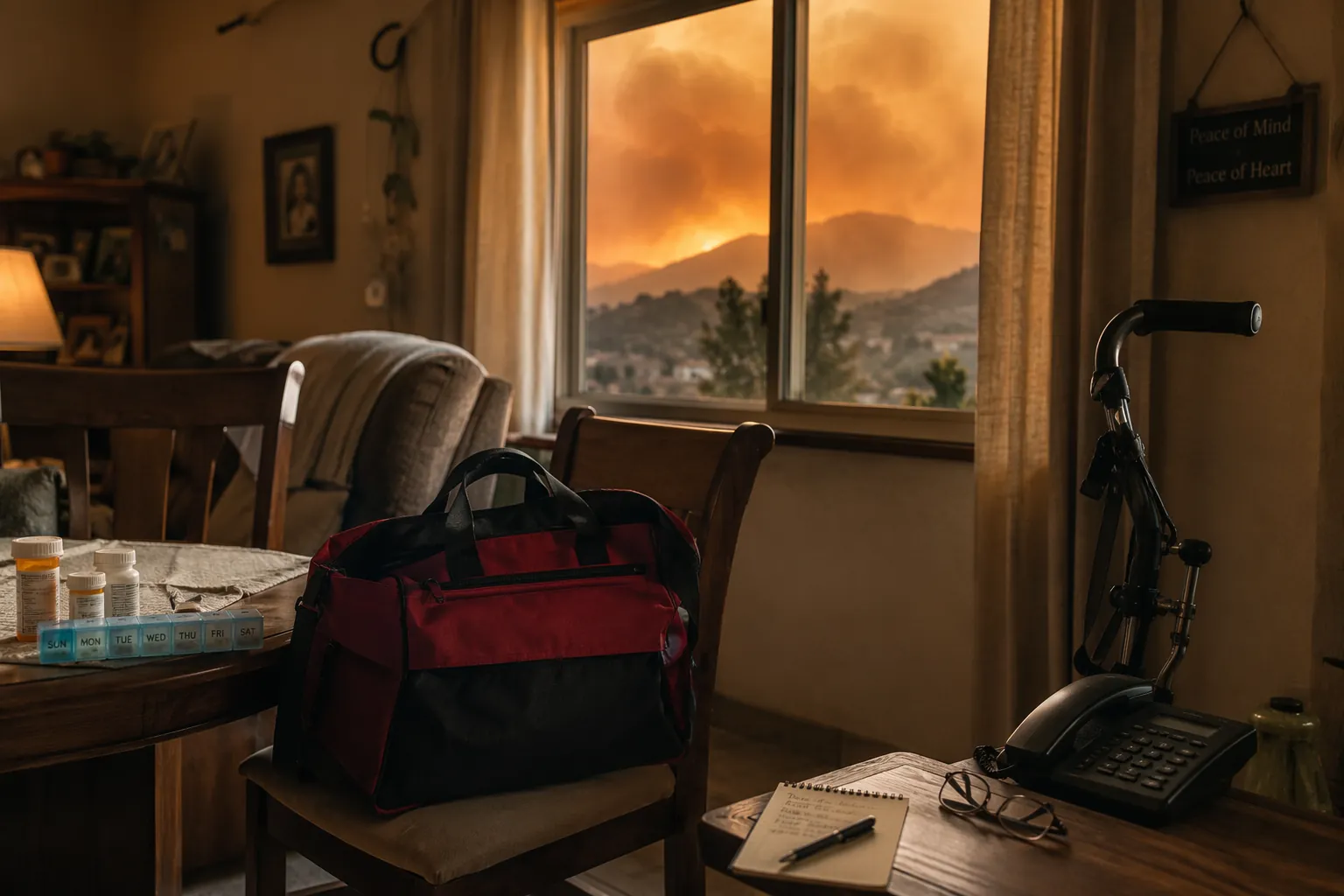
This article is informational, not medical, legal, or emergency-response advice. Use it to prepare questions for your doctor, pharmacist, local fire department, utility company, and emergency management office, especially if you use oxygen, CPAP, a power wheelchair, refrigerated medication, dialysis, or daily caregiver support.
The Rule That Changes the Whole Checklist
For an older adult living alone, the safest evacuation is usually the one that feels early. Western Fire Chiefs Association guidance describes three common evacuation levels: Level 1 means be ready, Level 2 means be set, and Level 3 means go now.[4] For seniors who need extra time, help with transportation, mobility equipment, medications, or a caregiver handoff, Level 3 is too late to begin the plan.
Treat Level 1 as the time to activate your helpers and load essential items. Treat Level 2 as the time to leave if you need assistance, do not drive at night, cannot move quickly, rely on power-dependent equipment, or live on a road that can clog with traffic. Do not wait for Level 3 just because the fire is not yet visible from your window.
There is disability data behind that caution. A landmark United Nations survey cited by Prism Reports found that only 20% of people with disabilities said they could evacuate immediately in a disaster, while 38% said they could evacuate if given enough time.[3] The numbers are dated, but the practical point still belongs at the top of the page: time is not a comfort item. Time is the accommodation.
Printable Wildfire Evacuation Flow for Seniors Living Alone
| When | What to do first | What not to leave undecided |
|---|---|---|
| Before fire season | Build the support network, medical go-bag, alert system, transportation plan, and key-sharing plan. | Who has keys, who drives, where you will go, and what happens if Helper 1 cannot come. |
| Red Flag Warning, fire weather watch, or nearby smoke | Charge devices, confirm helper availability, place go-bag by the exit, and move mobility equipment to the route out. | Whether you can leave without waiting for a formal evacuation order. |
| Level 1: Ready | Call or text Helper 1 and Helper 2, put on shoes and hearing aids, load the car or ask for pickup, and prepare to leave. | Medication supply, oxygen or CPAP backup, walker or wheelchair loading, pet transport. |
| Level 2: Set | Leave now if you need help, move slowly, do not drive comfortably, or depend on medical equipment. | Do not wait to see flames; do not wait for the first helper if the backup can come sooner. |
| Level 3: Go | Leave immediately by the safest open route; call 911 only for urgent rescue if you cannot leave. | Do not search for valuables, sort papers, or try to load heavy equipment alone. |
| While away | Track medication, symptoms, mobility, oxygen or power needs, and official return notices. | Refill options, charger access, replacement assistive devices, and where you will sleep safely. |
| Before returning home | Wait for official clearance, arrange a daylight inspection, and check for fall hazards before staying overnight. | Smoke damage, poor lighting, ash-slick floors, debris, displaced furniture, and exhaustion. |
Before Fire Season: Build the Plan Around Your Slowest Step
Start with the part that would slow you down most on a bad day. Not the part you can manage after breakfast with good lighting and no smoke in the air. The real plan has to work when your phone is low, the power is out, your knees hurt, the hallway is dim, and the person you called does not answer.
- Walk the route from bed to door with your walker, cane, wheelchair, or oxygen tubing exactly as you would use it during an evacuation.
- Move furniture, cords, throw rugs, pet bowls, and clutter that narrow the route or catch wheels and feet.
- Keep sturdy shoes, glasses, hearing aids, phone, flashlight, and go-bag where you can reach them without crossing the house.
- Test whether you can lift the go-bag, open the door, lock up if safe, and get to the car or pickup spot without carrying too much.
- Write down the one action that is impossible alone, then assign that action to a named helper or replace it with a lighter workaround.
Ready.gov tells older adults to make a plan that accounts for medical needs, transportation, assistive devices, and support networks.[5] The American Red Cross also emphasizes planning around medication, medical equipment, mobility, communication, and personal support needs.[6] Those points are useful only when they become household details: the key is under whose control, the walker folds which way, the oxygen tubing reaches how far, and the pickup spot is which side of the driveway.
For more detailed home setup from a fall-prevention angle, use CareWise Guide’s fall-safe wildfire evacuation preparation guide as a companion to this checklist.
Set Up Alerts You Can Actually Receive
One alert is not enough for someone who may be asleep, hard of hearing, away from the phone, or without power. Sign up for local emergency alerts, keep Wireless Emergency Alerts enabled on your mobile phone, and ask your county emergency management office whether it offers landline, text, email, or special-needs registry options. Keep a battery-powered radio where you can reach it.
- Phone alert: charged mobile phone with loud volume and vibration.
- Backup alert: landline, radio, weather radio, or neighbor call.
- Human alert: Helper 1 and Helper 2 both agree to call when a Red Flag Warning, Level 1, or nearby evacuation notice appears.
- Hearing workaround: bed shaker, flashing alert device, smartwatch vibration, or another alerting tool if ordinary sound is not reliable.
Build a Support Network Before You Need One
A support network is not “my neighbor knows I might need help.” It is two or more named people who know what they are responsible for, can enter the home if you cannot reach the door, and understand when they are supposed to act without waiting for you to ask.
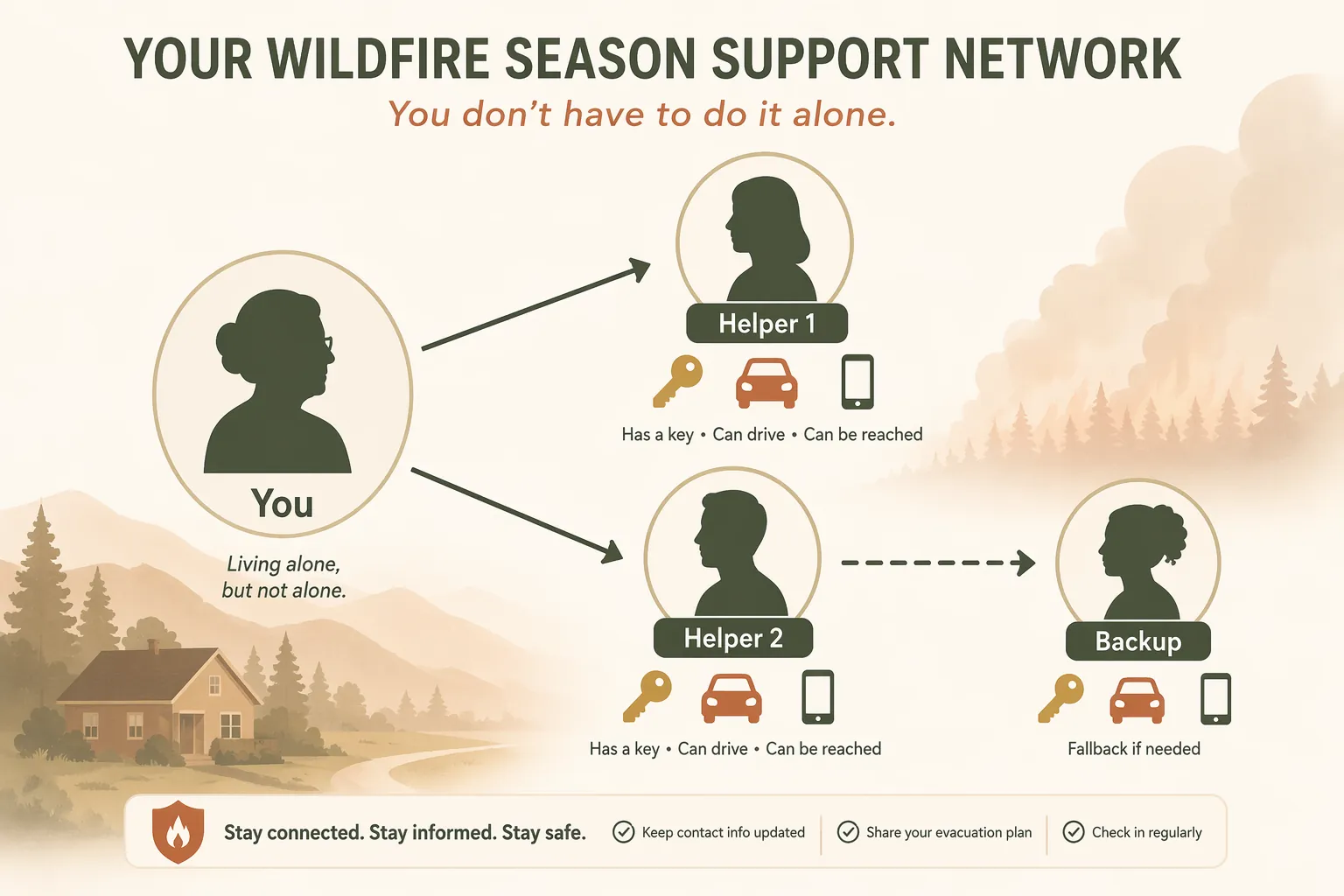
- Helper 1: the first person you call for pickup, loading equipment, pet transport, or checking that you left.
- Helper 2: the backup who is allowed to act if Helper 1 does not answer within the time limit you set.
- Key holder: at least one helper has a working house key, gate code, alarm code, and instructions for where to find the go-bag.
- Transportation lead: the person who knows whether you ride in a regular car, wheelchair-accessible vehicle, paratransit, taxi, community shuttle, or ambulance only.
- Remote contact: an adult child, relative, or friend outside the fire area who receives updates and can call pharmacies, insurance, shelters, or other relatives.
Write the contact order on paper and tape one copy inside a kitchen cabinet or near the main exit. Put another copy in the go-bag. If you use a lockbox, test that your helpers can open it. If the spare key is “somewhere near the porch,” fix that now. Smoke, darkness, and panic do not improve anyone’s memory.
The Call Script Should Be Short
Long explanations waste time. Use a script your helper recognizes.
Wildfire alert level: ___.
I am leaving now / I need pickup now.
Bring: walker / wheelchair / oxygen / pet carrier / medication cooler.
If you cannot come within ___ minutes, call Helper 2 and tell me.
The blank for minutes matters. If Helper 1 does not answer within that window, you do not keep calling the same phone while the road fills. You move to Helper 2, transportation backup, or emergency services if you are trapped or medically unsafe.
Pack the Go-Bag Around Medical Dependency First
Documents matter. A wedding ring matters. Photos matter. But in the first bag, medication and function come before valuables. A person who cannot hear, see, breathe comfortably, transfer safely, or take scheduled medication is not truly evacuated just because they are outside the fire zone.
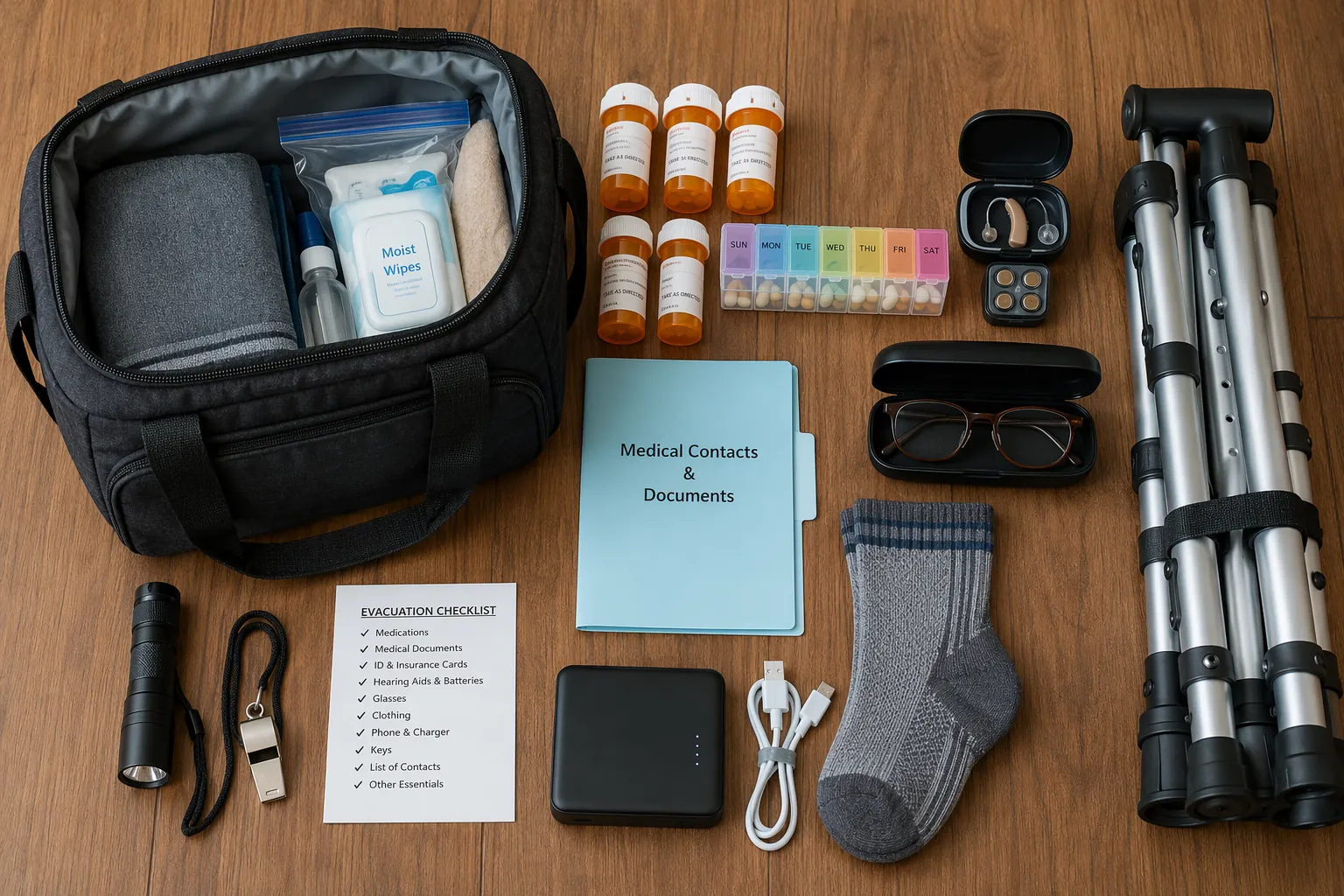
The Red Cross recommends that older adults prepare a one-month supply of medications when possible.[6] Fire Help Center guidance for seniors and caregivers recommends keeping at least 7 to 14 days of critical medications in an emergency kit.[7] If your insurance or pharmacy will not allow that much in advance, ask your doctor or pharmacist what is realistic, and write the answer into the plan.
| Pack first | What to include | Why it matters for living alone |
|---|---|---|
| Medications | Current medications, pill organizer, medication list, allergies, prescribing doctors, pharmacy phone number. | A shelter, hotel, or helper cannot safely guess what you take. |
| Prescriptions and refill proof | Photos or paper copies of prescription labels, insurance cards, Medicare or Medicaid card if applicable. | If medication runs out, documentation can speed conversations with pharmacies and clinicians. |
| Vision and hearing | Spare glasses, magnifier, hearing aid case, batteries or charger, written communication card if hearing is limited. | Instructions and alerts are useless if you cannot receive them. |
| Mobility | Cane, walker, wheelchair charger, transfer belt if used, braces, compression garments, non-slip shoes. | The device that gets you to the bathroom also gets you through the evacuation center. |
| Breathing and power-dependent equipment | Oxygen supplier contact, CPAP or BiPAP supplies, backup battery if available, extension cord, labeled equipment instructions. | Power outages and shelter conditions can interrupt routine equipment use. |
| Personal care | Incontinence supplies, wipes, skin care items, denture supplies, hearing or vision cleaning supplies. | Small disruptions can quickly become medical or dignity problems. |
| Basic emergency items | Water, snacks, flashlight, batteries, phone charger, portable power bank, whistle, mask, gloves. | These help during delays, traffic, smoke, or a long wait for pickup. |
| Documents | ID, insurance, emergency contacts, advance directive or POLST if used, pet records, copies of key documents. | Paper still works when a phone dies. |
| Comfort and orientation | Change of clothes, sweater, small blanket, familiar item, written address of destination. | Fatigue, cold, and confusion make falls and medication mistakes more likely. |
Keep the bag light enough to move. If it is too heavy, split it: one “leave now” bag with medication, contacts, hearing, vision, phone power, and ID; one second bag for clothing, documents, and extras that a helper can load if there is time. A go-bag that cannot be lifted is storage, not a plan.
Plan for Medication Disruption
Medication rules vary by state and emergency declaration. During the January 2025 Los Angeles fires, California authorized pharmacies to refill certain prescriptions without a new doctor’s order, according to CalMatters.[2] That kind of emergency flexibility is helpful, but it should not be the first layer of the plan. Keep medication lists current, photograph prescription labels, and ask the pharmacy before fire season what it can do during an evacuation.
Plan for Power-Dependent Equipment
If you use oxygen, CPAP, BiPAP, a power wheelchair, a stair lift, an electric hospital bed, refrigerated medication, or a device that must be charged, the plan needs a power section. Ask your utility whether it has a medical baseline, medical needs, or priority notification program. These programs differ by state and utility, and enrollment does not guarantee power during a wildfire or public safety shutoff.
- Write the equipment name, model, supplier, and emergency phone number on paper.
- Keep chargers, tubing, masks, adapters, and extension cords together.
- Ask the supplier how long backup batteries last and what to do during evacuation.
- Tell helpers which equipment must leave with you and which is too heavy or unsafe to move.
- Choose an evacuation destination that can support your equipment, not just one that has an available couch.
When a Watch, Warning, or Nearby Fire Appears
This is the quiet window when good decisions still look unnecessary. Use it anyway.
- Charge phone, hearing aid charger, wheelchair battery, oxygen backup, and portable power bank.
- Put the go-bag by the exit you will actually use.
- Place shoes, glasses, hearing aids, cane, walker, wheelchair, pet carrier, and keys within reach.
- Call or text Helper 1 and Helper 2: “Fire weather is active. I may need to leave early.”
- Check fuel, paratransit availability, ride options, and whether your chosen destination is outside the risk area.
- If you live on a narrow road, need accessible transportation, or cannot drive after dark, consider leaving before an evacuation level is issued.
CAL FIRE’s evacuation guidance tells residents to prepare a go-bag, know evacuation routes, and leave early when directed.[8] For someone living alone with medical or mobility needs, “early” often means before the direction feels urgent.
At Level 1: Ready Means You Start Moving
At Level 1, do not merely watch the news. Start the leaving sequence. The purpose is to make Level 2 simple and Level 3 avoidable.
- Put on shoes, glasses, and hearing aids.
- Use the bathroom, take scheduled medication, and put the next dose in the go-bag if it is not already packed.
- Call Helper 1 with the short script. If there is no answer within the agreed time, call Helper 2.
- Load the car if you can do it safely, starting with medical equipment, mobility devices, medication, pet supplies, and phone power.
- If you do not drive, confirm the pickup time and exact pickup location.
- Text the remote contact: “I am at Level 1. Plan is active.”
If smoke is already heavy, roads are crowded, the wind is rising, or you feel rushed and unsteady, do not wait for the next official level. A fall in the driveway can trap a person as effectively as a locked door. CareWise Guide’s wildfire evacuation fall-prevention guide covers route, footwear, lighting, and mobility details more deeply.
At Level 2: Set Means Leave if You Need Help
Level 2 is the serious threshold for seniors living alone. If you use a walker, wheelchair, oxygen, CPAP, memory support, daily medication that cannot be missed, accessible transportation, or help loading the car, Level 2 should usually mean leaving now.
- If Helper 1 is present: leave as soon as essential medical and mobility items are loaded.
- If Helper 1 is late: call Helper 2 and the remote contact; do not keep waiting without a time limit.
- If no helper answers: use the transportation backup, call local non-emergency services if available, or call 911 if you cannot evacuate safely and the threat is imminent.
- If you feel weak, dizzy, short of breath, confused, or unable to transfer: treat that as a medical barrier, not an inconvenience.
- If the only remaining task is valuables or extra clothing: leave without them.
Adult children and remote caregivers need to be plain here. “Mom has a plan” is not enough. Ask: Who has the key? Who is picking her up? What time does that person stop waiting and call the backup? Can she get the walker into the vehicle? Where is the oxygen supplier number? If the answers are vague during calm weather, they will not become clearer under evacuation pressure.
At Level 3 or If Conditions Worsen: Stop Packing
Level 3 means go now.[4] At that point, the checklist becomes very short.
- Take the medical go-bag if it is already within reach.
- Take the mobility device you need to move safely.
- Take your phone, keys, glasses, hearing aids, and oxygen or critical equipment if immediately reachable.
- Leave by the safest open route.
- Call 911 if you are trapped, cannot transfer, cannot breathe safely, or cannot leave without rescue.
Do not sort papers. Do not look for jewelry. Do not return for a second bag. Do not try to load equipment that you already know is too heavy. The plan was supposed to make those decisions earlier; Level 3 is no longer the time to negotiate with the house.
While Leaving: Protect Mobility, Breathing, and Communication
The trip out can be the most dangerous part for a person with balance problems, low vision, fatigue, or breathing difficulty. Smoke, hurry, uneven pavement, unfamiliar vehicles, pets, and other people’s panic all increase the chance of a fall or medical event.
- Use the mobility device, even if you usually “just hold the wall” at home.
- Let the helper carry bags so your hands stay free for balance.
- Wear closed-toe shoes with grip, not slippers or sandals.
- Keep phone, medication list, and emergency contacts on your body, not buried in the trunk.
- If smoke makes breathing difficult, tell the driver or dispatcher immediately.
- If you become separated from your helper, contact the remote person and state your location.
While Away: Track the Things That Keep You Stable
Once you are out, the emergency changes shape. You may be in a shelter, hotel, relative’s home, community center, or medical facility. The question becomes whether the place you reached can actually support your body for more than a few hours.
- Medication: note doses taken, doses missed, and how many days remain.
- Equipment: charge devices whenever power is available; do not wait until batteries are low.
- Mobility: ask for an accessible bathroom, clear path to bed, and chair height that allows safe standing.
- Breathing: tell shelter staff or hosts about oxygen, CPAP, smoke sensitivity, or respiratory symptoms.
- Communication: update the remote contact every day or whenever you change locations.
- Pets: keep leashes, carriers, food, medication, and vaccination records together.
A scoping review on wildfires and older adults found that older adults face health risks before, during, and after wildfire events, including risks connected to evacuation, smoke exposure, social isolation, and disruption of services.[9] That is why the away-from-home part of the checklist is not an afterthought. A safe evacuation includes the days when normal routines are broken.
Before Returning Home: Clearance Is Not the Same as Safety
Return only after officials say the area is open. Even then, do not make the first return alone if you can avoid it. A house can be standing and still be unsafe for an older adult who is tired, stressed, and carrying belongings back inside.
- Go in daylight, with a helper, phone, flashlight, mask, and sturdy shoes.
- Check lighting before walking through rooms or hallways.
- Watch for ash-slick floors, wet surfaces, cords, debris, broken glass, displaced rugs, and furniture moved during evacuation.
- Do not stay overnight until the bathroom path, bedroom path, medication area, and exit route are clear.
- If smoke odor, ash, spoiled food, heat damage, or electrical problems are present, ask local officials or qualified professionals what cleanup or inspection is needed before staying.
- Rest before unpacking. Fatigue after evacuation is a fall risk, not a character flaw.
For detailed fall precautions during evacuation and return, use CareWise Guide’s wildfire evacuation fall-prevention guide. If you want another disaster checklist built around fall safety, the fall-safe tropical storm checklist for seniors follows the same practical idea: the plan has to match the body that will use it.
For seniors living alone, evacuation safety is not a bigger version of a standard checklist. It is an earlier, medically centered, key-sharing, backup-driven plan built around the possibility that help may not arrive in time.
References
- Living Arrangements Varied Across Age Groups — US Census Bureau
- How Can CA Prepare Disabled Households for the Next Wildfire? — CalMatters
- Disabled and Elderly Residents Were Abandoned During LA Fires — Prism Reports
- Wildfire Evacuation Plan Checklist — Western Fire Chiefs Association
- Older Adults — Ready.gov / FEMA
- Older Adults Emergency Preparedness — American Red Cross
- Wildfire Preparedness Guide for Seniors & Caregivers — Fire Help Center
- Go Evacuation Guide — CAL FIRE / Ready for Wildfire
- Wildfires and Older Adults: A Scoping Review — PMC / National Library of Medicine
Related reading
Noticed something outdated or inaccurate on this page? Flag a correction. We review every report against CDC, NIA, and AARP HomeFit guidance before updating a page.
Part of the Fall Prevention section.