
STEADI: Intervene
How Older Adults Can Prepare for Flash Flood Season Without Falling
Flash flood preparation involves moving quickly in wet, dim conditions — a fall risk that older adults rarely anticipate. This guide maps fall-prevention steps to each phase: before a watch, during a warning, evacuation, and after water recedes.
A flash flood watch can make a quiet house suddenly feel busy. The phone sounds, the sky darkens, and an older adult starts doing sensible things: checking the back door, pulling a bag from the closet, moving a trash bin, looking for a flashlight. The first danger may not be water in the living room. It may be wet soles on tile, a hallway rug kicked up at one corner, a walker left near the door with muddy tips, or a person trying to carry medicine, a phone, and a flashlight in one trip.
That is why preparing for flash flood season as an older adult has to be judged by more than whether the emergency kit is complete. More than 1 in 4 older adults falls each year, so flood preparation begins on ground that is already uneven, physically speaking.[1] And the water does not have to look dramatic to become dangerous: the Red Cross warns that 6 inches of fast-moving water can knock a person off their feet.[2]
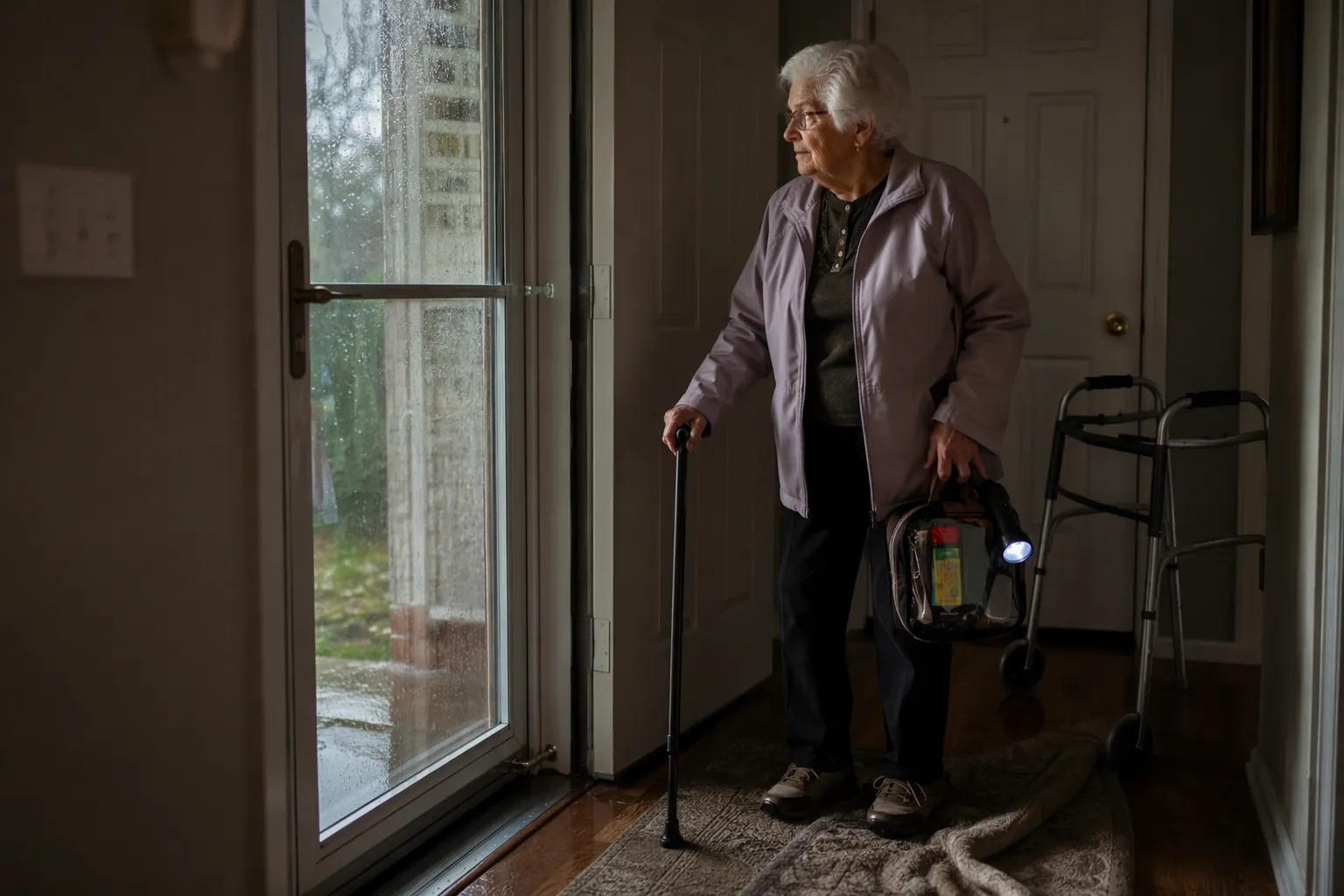
The injury risk does not end when the rain stops. A Harvard Chan School report published in 2025 found that flooding was associated with a 1.1% average increase in injury hospitalization rates for older adults, with the sharpest rise, up to 1.7%, in the fourth week after a flood.[3] The study analyzed data from 2000 through 2016, so it should not be treated as a current flood forecast. It is still useful for one plain reason: flood-related injury is not only a rescue problem. It is also a movement problem before, during, and after the water.
Before a Watch: Put the Plan Where the Body Can Use It
The best time to reduce fall risk is before anyone is listening to an alert and trying to move quickly. A flood kit stored on a high shelf, in a basement, or behind holiday boxes may look organized in April and become a hazard in August. For an older adult, the question is not only “Do I have it?” but “Can I reach it with one hand, without a step stool, without bending low, and without blocking my view while I carry it?”
Keep the main bag light enough to carry without leaning sideways. If medications, documents, water, batteries, and device chargers make one bag too heavy, divide them into smaller bags that can be moved separately or placed in a rolling tote that works on the home’s actual flooring. A rolling bag that tips at the threshold is not a safer bag.
The kit should include the ordinary items that keep feet steady: a working flashlight or lantern, extra batteries, non-slip shoes, spare socks, a towel for wet soles, and any cane or walker accessories the person already uses. For a more detailed kit built around balance rather than just supplies, see what to add to a hurricane kit to prevent falls. Adult children assembling supplies from scratch may also want the broader hurricane emergency kit checklist for an elderly parent.
- Store the main kit between knee and shoulder height, not on the floor and not overhead.
- Place a flashlight or battery lantern at the bed, the favorite chair, and the main exit.
- Keep non-slip shoes by the door used for evacuation, not in a bedroom closet across the house.
- Remove loose rugs, cords, stacked boxes, and low baskets from the route to the exit.
- Check cane tips, walker glides, brakes, and rubber feet before storm season, not during the warning.
Backup power deserves special attention when medical devices are involved. A 2020 survey of 2,256 older adults reported by PBS and The Conversation found that only 25% had a backup power source for medical devices.[4] That same survey reported that 60% of older adults had two or more chronic health conditions, which means an evacuation fall may also interrupt medication schedules, oxygen use, dialysis planning, wound care, or mobility routines.[4] The survey may not reflect every change in preparedness behavior since 2020, but it points to a weak spot worth fixing before storm season.
If a person uses oxygen, a powered bed, a lift chair, a CPAP machine, refrigerated medication, or an electric mobility device, the plan should be reviewed with a healthcare provider, equipment supplier, caregiver, or local emergency management office. This article can help organize the fall-prevention questions, but it is not medical advice and cannot replace an individualized fall-risk or evacuation assessment.
Assistive devices also need to be treated as part of the emergency system, not as an afterthought. The Red Cross Scientific Advisory Council identified dependence on assistive devices as a core vulnerability factor that can increase older adult casualties during disasters.[5] That does not mean a walker or cane is the problem. It means the plan fails if it assumes the person can move as though the device were not there.
Practice the Route When Nothing Is Happening
Walk the route from the bedroom, bathroom, kitchen, and favorite chair to the safest exit. Do it once in daylight and once with evening lighting. Notice the turns where a walker catches, the step where water pools, the chair that narrows the hallway, and the place where someone naturally reaches for a wall that has no grab bar.
This is also the time to decide who gets called first. A neighbor, adult child, church friend, building manager, or local volunteer group can be assigned a simple job: move the outdoor bin, bring the car closer, check whether the creek has crossed the driveway, or help carry the heavier bag. For older adults living alone, a written call tree belongs near the phone and in the kit; a companion hurricane preparedness checklist for seniors living alone can make that planning more complete.
When a Watch Is Issued: Stage, Light, Charge, Then Sit
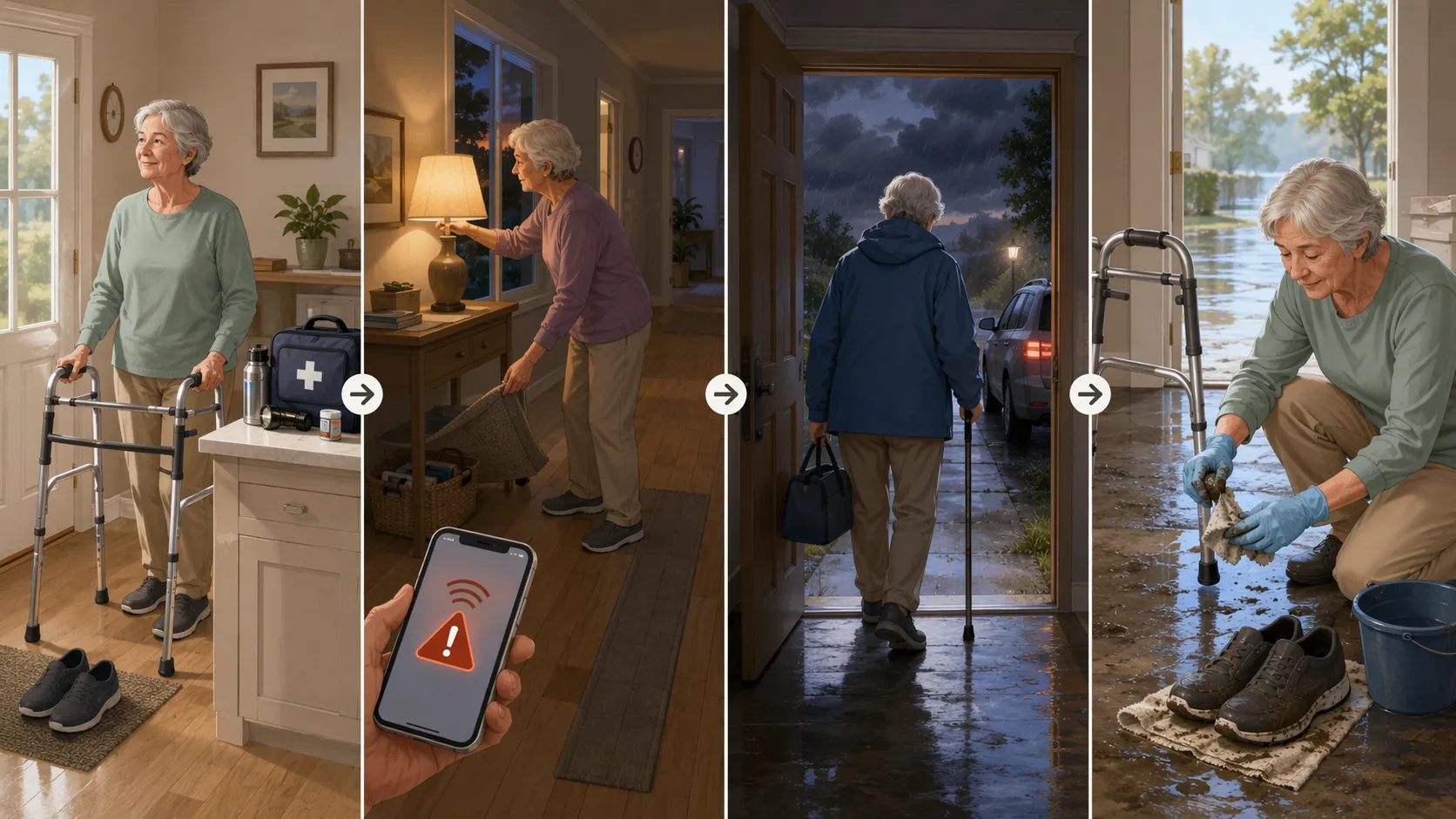
A watch is the time to stage the house so the warning does not turn into a scramble. Bring the kit to waist height. Put shoes on before floors get wet. Turn on lamps before the room is dim. Charge the phone and medical devices. Move the cane or walker to the side of the chair where the person normally stands, not across the room.
Then stop pacing. It is easy to check the window, check the phone, check the door, and check the window again. That repeated movement adds chances to trip over the same threshold or rug. Set one alert source within reach, keep glasses and hearing aids nearby, and use a stable chair while monitoring updates. For safer ways to follow storm information without wandering through the house, see how seniors can monitor hurricane updates safely.
| Action during a watch | Fall-prevention reason |
|---|---|
| Move bags to a counter or sturdy chair | Avoids bending, reaching, and lifting from the floor |
| Turn on lights before dusk | Reduces rushed movement in shadows |
| Put on non-slip shoes | Prevents stepping outside in socks, slippers, or loose sandals |
| Clear the exit route | Keeps walkers, canes, and feet from catching on clutter |
| Call the designated helper | Moves help into place before roads or footing worsen |
Footwear sounds small until the floor is wet. Shoes need backs, grip, and a fit that does not slide when the person turns. If storm season is also hot season, swollen feet and fatigue can change how steady a familiar shoe feels. Readers comparing safer everyday options may find fall-proof shoes for women over 50 useful, and those who become unsteady in heat should also consider how hot weather can increase fall risk for seniors.
During a Warning or Evacuation: Leave Before Movement Gets Hard
A warning changes the standard. This is not the moment to prove how much can be handled alone. If local officials advise evacuation, if water is approaching the home, or if the safe route may soon be cut off, the safer choice is often the earlier choice. AARP’s disaster resilience toolkit notes how severely older adults have been affected in past disasters: people age 75 and older were 6% of the population but accounted for 50% of deaths in Hurricane Katrina, and older adults were also disproportionately killed in the Camp Fire.[6] Those examples should not be used to frighten someone into every evacuation. They do show why waiting too long can be especially costly when mobility, medication, heat, power, and transportation all have to work at once.
The hardest decision is often whether to evacuate or shelter. That decision depends on local instructions, road conditions, flood risk, medical needs, caregiver availability, building safety, and the older adult’s ability to move without falling. A fall-risk-centered discussion of that choice is available in Evacuate or Shelter? How Fall Risk Shapes Your Storm Plan. For medical conditions, oxygen needs, cognitive changes, or limited mobility, the plan should be made ahead of time with a clinician or local emergency management contact.
If evacuation is the plan, reduce the job to the fewest safe movements. Put the phone in a pocket or crossbody pouch. Carry one light bag, or let the helper carry the heavier one. Use the usual mobility device, even for a short distance. Locking a walker in the trunk before walking across a wet driveway defeats the purpose of having it.
- Do not step into moving water to test whether it is shallow; 6 inches of fast-moving water can knock a person down.[2]
- Do not carry boxes, pet crates, or bags that block the view of the floor.
- Do not rush down steps because an alert tone sounds urgent; stop, hold the rail, then move.
- Do not leave a cane or walker behind because the car looks close.
- Do not drive through floodwater; follow local emergency instructions and safer routes.
Vehicle entry is its own fall point. Wet pavement, a high curb, a door that swings back, and a person turning while holding the roofline can all create trouble. Bring the car as close as safely possible, choose the flattest surface available, open the door fully, and let the person sit before swinging both legs in. If car design is part of the family’s longer-term planning, car door safety features that prevent falls for elderly drivers explains what to look for.
Ready.gov and the CDC both provide emergency preparedness and flood safety guidance for older adults and the general public.[7][8] Their advice is the starting frame: know alerts, follow evacuation orders, avoid floodwater, and prepare supplies. The extra layer for fall prevention is to ask, at every point, whether the person can do the task while tired, anxious, in low light, and possibly using a cane, walker, hearing aid, glasses, or medical device.
If Sheltering at Home, Shrink the Living Area
When officials say sheltering is appropriate, the safest setup is usually smaller, brighter, and less cluttered. Keep the older adult on one level if possible. Put water, medications, phone, charger, glasses, hearing aids, flashlight, shoes, and mobility device within reach of the same chair or bedside table. Use a commode plan if bathroom trips require crossing a dark hallway or stepping near a wet entry.
This is not about making the person helpless. It is about reducing the number of times they have to stand up, turn, carry, and decide under pressure. Many falls happen in those small transitions, not in the dramatic moment people imagine.
After Water Recedes: Treat Mud Like a Fall Hazard
The house may look calmer after water recedes, but the footing is often worse. Floors are slick, porch steps are coated, thresholds hold grit, and people are tired from poor sleep. The Ohio Department of Aging advises cleaning mud and moisture off shoes and walking aids immediately after coming in from wet conditions, because wet soles can be as dangerous as wet floors.[9] That guidance is written for Ohio, and flood patterns differ by state, but the traction principle travels well.
Clean the walker tips, cane base, shoe soles, and wheels before crossing into dry rooms. Use towels or mats that lie flat and do not bunch. Keep one dry pair of shoes inside if the outdoor pair is muddy. If debris may be hidden under standing water, do not walk through it to inspect damage; wait for help or official clearance.
Delayed injury matters, too. The Harvard report’s injury hospitalization increase peaked several weeks after flooding, not only during the flood itself.[3] That does not prove every later hospitalization came from cleanup or slipping, but it fits what families often see: the strain continues through damp floors, disrupted sleep, missed routines, unfamiliar shelter bathrooms, and repeated trips to move belongings.
What to Ask Before Flash Flood Season
NCOA and AgingCare both offer practical emergency preparedness checklists for older adults and caregivers.[10][11] Use those lists, but add a fall-prevention inspection before the first serious storm of the season.
- Can the older adult reach the emergency kit without a stool, deep bend, or overhead lift?
- Can they leave the bedroom, bathroom, and favorite chair with lights on and a clear path?
- Can they carry what must be carried while keeping one hand free for a rail, cane, walker, or car door?
- Are shoes, socks, cane tips, walker brakes, and flashlight batteries ready before a watch is issued?
- Has someone agreed to help early, before water, darkness, or fatigue make the job harder?
- Has a healthcare provider or local emergency contact reviewed needs involving oxygen, medications, mobility devices, cognition, or chronic conditions?
The safest flash flood plan for an older adult is not only about where to go and what to pack. It is whether the person can move through each phase without losing footing. Reduce hurry. Reduce carrying. Improve traction. Improve light. Decide earlier than pride may prefer.
References
- Older Adult Falls Data, Centers for Disease Control and Prevention, https://www.cdc.gov/falls/data-research/facts-stats/index.html
- Flood Safety, American Red Cross, https://www.redcross.org/get-help/how-to-prepare-for-emergencies/types-of-emergencies/flood.html
- Flooding increases hospitalization risks in older adults, Harvard T.H. Chan School of Public Health, 2025, https://hsph.harvard.edu/news/flooding-increases-hospitalization-risks-in-older-adults/
- Why it can be more difficult to evacuate older adults in a disaster, PBS NewsHour, 2020, https://www.pbs.org/newshour/health/why-it-can-be-more-difficult-to-evacuate-older-adults-in-a-disaster
- New Research: Older Adults More Vulnerable After Disasters, American Red Cross, 2020, https://www.redcross.org/about-us/news-and-events/news/2020/new-research-older-adults-more-vulnerable-after-disasters.html
- Disaster Risks to Older Adults, AARP, https://www.aarp.org/livable-communities/tool-kits-resources/info-2022/disaster-risks-to-older-adults.html
- Older Adults, Ready.gov, https://www.ready.gov/older-adults
- Floodwater Safety, Centers for Disease Control and Prevention, https://www.cdc.gov/floods/safety/index.html
- Falls Prevention in Every Season, Ohio Department of Aging, https://aging.ohio.gov/care-and-living/health-and-safety/fall-prevention/falls-prevention-in-every-season
- Emergency Preparedness 101: What to Do Before, During, and After Disaster, National Council on Aging, https://www.ncoa.org/article/emergency-preparedness-101-what-to-do-before-during-and-after-disaster/
- Prepare Elders for Emergencies, AgingCare, https://www.agingcare.com/articles/prepare-elders-for-emergencies-147770.htm
Related reading
Noticed something outdated or inaccurate on this page? Flag a correction. We review every report against CDC, NIA, and AARP HomeFit guidance before updating a page.
Part of the Fall Prevention section.