
STEADI: intervene
Flood Preparedness Checklist for Seniors and Caregivers
This article provides a complete flood preparedness checklist tailored to older adults with medications, mobility limitations, and power-dependent medical devices, covering critical gaps that generic emergency kits miss. Caregivers will learn how to build a senior-specific go-bag, plan evacuation with mobility aids, and secure essential documents.
Older adults do not face floods as a generic household. In Hurricane Katrina, people age 60 and older accounted for half of fatalities while making up 6% of New Orleans’ population; in Hurricane Ian, 61 of 87 confirmed deaths were among people age 60 and older.[1] Those numbers are not a reason to panic. They are a reason to stop pretending that “flashlight, water, radio” is a complete flood plan for someone who uses blood pressure medication, a walker, hearing aids, insulin, oxygen, a CPAP, or a printed care plan.
A flood preparedness checklist for seniors and caregivers has to answer a more practical question: what breaks first when the water rises, the power goes out, the pharmacy closes, the phone network is jammed, or the evacuation vehicle arrives without room for the walker? The safest plan is built around medication continuity, mobility, communication, power, documents, and fall safety—not around owning the biggest bin of emergency supplies.
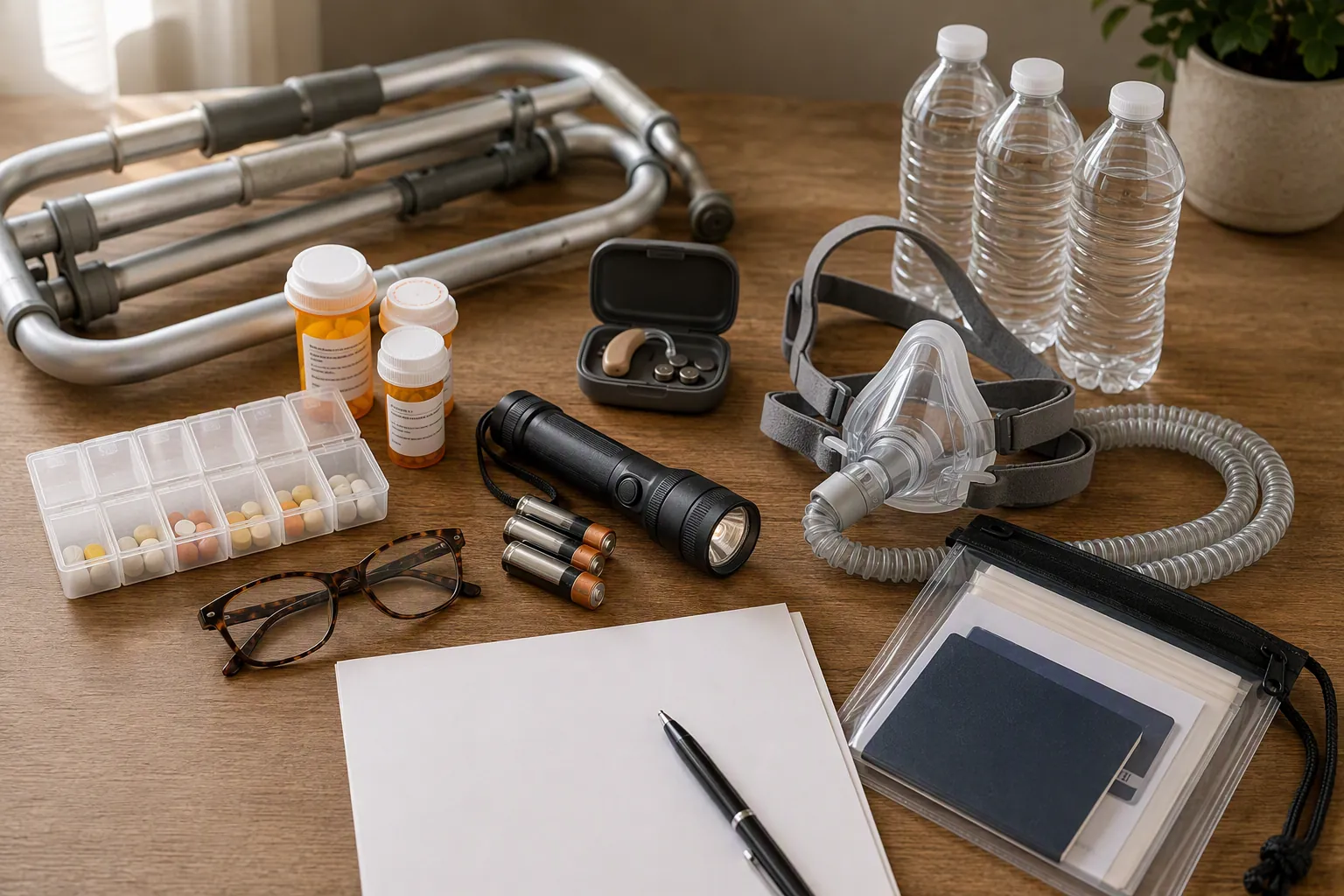
The Full Checklist at a Glance
| Planning area | What to prepare before flood week | Why it matters for older adults |
|---|---|---|
| Flood risk and insurance | Check FEMA flood maps, local evacuation zones, and whether flood insurance is active. | Standard homeowners insurance may not cover flood damage, and National Flood Insurance Program policies generally have a 30-day waiting period; confirm current rules before relying on that timing.[2] |
| Medication continuity | Keep a 7- to 30-day medication plan, printed dosage list, pharmacy contacts, and refrigeration plan. | A three-day kit fails quickly when roads, pharmacies, mail-order refills, or refrigeration are disrupted. |
| Power-dependent care | List every device that needs electricity, battery type, run time, charging method, and backup location. | CPAP machines, oxygen concentrators, power wheelchairs, feeding pumps, and refrigerated medications turn a power outage into a medical problem. |
| Mobility and evacuation | Plan accessible transportation, backup mobility aids, transfer help, shelter access, and pet or service animal needs. | A person using a cane, walker, wheelchair, or oxygen setup cannot simply “leave now” without equipment and assistance. |
| Sensory and cognitive supports | Pack hearing aid batteries, spare glasses, communication cards, written routines, and memory prompts. | Alerts, instructions, and shelter intake all fail if the person cannot hear, see, remember, or explain their needs. |
| Documents and contacts | Create a waterproof go-binder with IDs, insurance, medical cards, care authorizations, and emergency contacts. | Caregivers may have to speak for the older adult when offices, portals, or phone access are unavailable. |
| Post-flood fall safety | Do not re-enter until hazards are checked: wet floors, debris, damaged ramps, loose grab bars, mold, and electrical risks. | The flood danger does not end when water recedes. |
Start With the Flood Risk You Actually Have
Before buying more supplies, confirm whether the home is in a flood zone, an evacuation zone, or a place that floods from storm drains, creeks, saturated ground, or coastal surge. Ready.gov recommends that older adults build emergency plans around local hazards, support networks, and individual medical needs, not just a generic supply list.[2]
For a caregiver, this step is mostly administrative: look up the address on FEMA flood maps, save the county emergency-management page, write down the evacuation zone, and call the insurer before storm season. If the older adult rents, ask what the landlord covers and what the renter’s policy does not. If the home has a basement apartment, ground-floor bedroom, steep driveway, sump pump, or only one exit path, note that too. Flood risk is not just a map color; it is whether the person can get out when the safest doorway is blocked.
Money belongs in this part of the checklist because it changes what families can realistically do. Some households can buy flood insurance, backup batteries, duplicate walkers, and hotel rooms. Others have to choose. If funds are tight, prioritize the items that keep the person alive and reachable first: medications, device power, evacuation transport, paper documents, and phone access. Then add property-protection items as the budget allows.
Build the Senior-Specific Go-Bag Around Medication First
The medication section is where many ordinary emergency kits fall apart. A bottle of water and a granola bar do not help much if a parent leaves without blood pressure medication, insulin supplies, anticoagulants, seizure medication, inhalers, Parkinson’s medication, eye drops, or the list that tells a shelter nurse what was taken at 8 a.m.
- Current medication list: drug name, dose, timing, prescribing doctor, reason for use, and allergies.
- Pharmacy information: local pharmacy, mail-order pharmacy, prescription numbers if available, and after-hours phone numbers.
- Medication supply plan: ask the clinician or pharmacist what can be filled early, synchronized, or kept as an emergency reserve.
- Refrigerated medication plan: cooler, cold packs, thermometer if needed, and a written limit for how long the medication can safely remain out of refrigeration.
- Administration supplies: syringes, pen needles, alcohol swabs, glucose meter supplies, lancets, sharps container, pill cutter, pill crusher if approved, and dosing cups.
- Daily-use supports: pill organizer, written schedule, large-print instructions, and a note saying whether pills can be crushed or must be taken with food.
Ready.gov’s older-adult guidance tells people to plan for medical needs, prescriptions, and assistive devices as part of emergency preparation.[2] Senior-focused emergency-kit guidance also emphasizes medication lists, extra medical supplies, and personal-care items that are easy to overlook in a household kit.[8][9] The practical caregiver version is this: if you had to hand the bag to a neighbor, ambulance crew, or shelter worker, could that person understand the medication routine without calling you?
Do not rely on a phone photo as the only medication list. Phones die, get wet, lose service, and sit in glove compartments. Print the list, place one copy in the go-bag, one in the document binder, and one on the refrigerator. Date each copy so nobody wonders whether it is current.
Add the Supplies That Preserve Daily Function
A senior go-bag should include the ordinary items—water, shelf-stable food, flashlight, batteries, radio, phone charger, basic first aid, sanitation supplies—but the senior-specific layer is what keeps the person functioning after the first few hours.
- Hearing: hearing aids, labeled storage case, spare batteries or charger, cleaning tool, and written note explaining hearing loss.
- Vision: spare glasses, magnifier, large-print medication list, flashlight or headlamp, and sunglasses if eye disease makes glare difficult.
- Mobility: cane tips, walker glide caps if used, wheelchair charger, transfer belt if trained caregivers use one, and a lightweight backup cane or folding walker if available.
- Continence and hygiene: briefs, pads, wipes, barrier cream, disposable bags, gloves, hand sanitizer, and a change of clothing.
- Nutrition: medically appropriate foods, thickened liquids if used, feeding supplies, denture cup, denture adhesive, and easy-open utensils.
- Comfort and orientation: familiar sweater, family photo, written routine, simple calendar, and a card with preferred name, language, and calming instructions.
The point is not to duplicate the entire house. It is to preserve the parts of daily care that, when missing, create panic, falls, medication errors, dehydration, skin breakdown, or refusal to evacuate.
Make a Written Power Plan for Medical Devices
Power-dependent care needs its own page, not a line that says “extra batteries.” NCOA’s emergency-preparedness guidance tells older adults to plan for medical equipment, medications, and power needs before a disaster.[6] That planning has to be specific enough that someone else can act on it at 2 a.m.
| Device or need | Write down before a flood | Backup question to answer |
|---|---|---|
| CPAP or BiPAP | Model, pressure settings if available, mask type, tubing size, water chamber needs, power cord location. | How many hours will the backup battery run, and where can it be recharged? |
| Oxygen concentrator | Flow rate, continuous or pulse dose, supplier, emergency number, tank location. | Does the person have portable oxygen for evacuation, and who can lift or transport it? |
| Power wheelchair or scooter | Charger location, battery type, manual-release instructions if applicable. | Can the chair be loaded into the planned vehicle, or is accessible transport required? |
| Refrigerated medication | Medication name, safe temperature range if provided by pharmacist, cooler location. | How will it stay cold during evacuation, shelter intake, or a long outage? |
| Feeding pump or other device | Brand, settings, tubing, formula, supplies, clinician contact. | What is the no-power backup method, and who is trained to use it? |
Call the equipment supplier before flood season, not when the outage starts. Ask whether the device has an internal battery, how long it lasts under the older adult’s actual settings, whether a car adapter is approved, and what the supplier’s disaster policy is. If the person uses oxygen, ask how emergency tank delivery works when roads are closed. If the person uses a power wheelchair, ask whether the battery can be charged from a portable power station and what not to plug it into.
Generators and large backup batteries can help, but they are expensive and can create their own risks if used improperly. A lower-cost first step is still valuable: label every cord, keep chargers in one visible place, write the device plan on paper, and identify two places with power that the person could realistically reach—a relative’s home, dialysis center, medical shelter, cooling center, or hospital-designated charging location if local officials provide one.
Decide Early Whether Evacuation Is Safer Than Staying
Flood advice often says to evacuate when told. That is sound as a public-safety rule, but older-adult care adds a hard practical layer: evacuation can interrupt oxygen, dialysis, wound care, dementia routines, medication timing, and safe transfers. The answer is not to ignore evacuation orders. It is to decide earlier, with better information, before the choice becomes a rushed lift into a car in the rain.
Special-needs shelter access is one of the most important calls to make in advance. Many counties require advance registration for special-needs shelters, and trying to register during storm week may be too late.[3] Ask the local emergency-management office what the shelter provides, what caregivers must bring, whether a caregiver is required to stay, what medical devices are accepted, how oxygen is handled, and whether pets or service animals can come.
- If evacuating by family car: test whether the walker, wheelchair, oxygen, go-bag, documents, pet carrier, and caregiver all fit at the same time.
- If using paratransit or county transport: register before the season, confirm pickup rules, and ask how much notice is required.
- If using a wheelchair van: identify at least two providers and ask whether they operate during evacuation orders.
- If the older adult lives in assisted living or skilled nursing: request the facility’s flood evacuation plan, destination site, medication-transfer process, and family notification procedure.
- If staying with relatives: check the entry steps, bathroom access, sleeping surface, outlet location, pet rules, and space for medical equipment before it becomes the destination.
Caregiver emergency-preparedness guidance emphasizes planning for transportation, care responsibilities, pets, and support networks before a disaster.[4] California aging guidance also treats evacuation, communication, and older-adult support needs as planning issues that should be handled before an emergency.[5] In plain household terms: the plan is not real until the person, equipment, documents, medications, and caregiver can all move together.
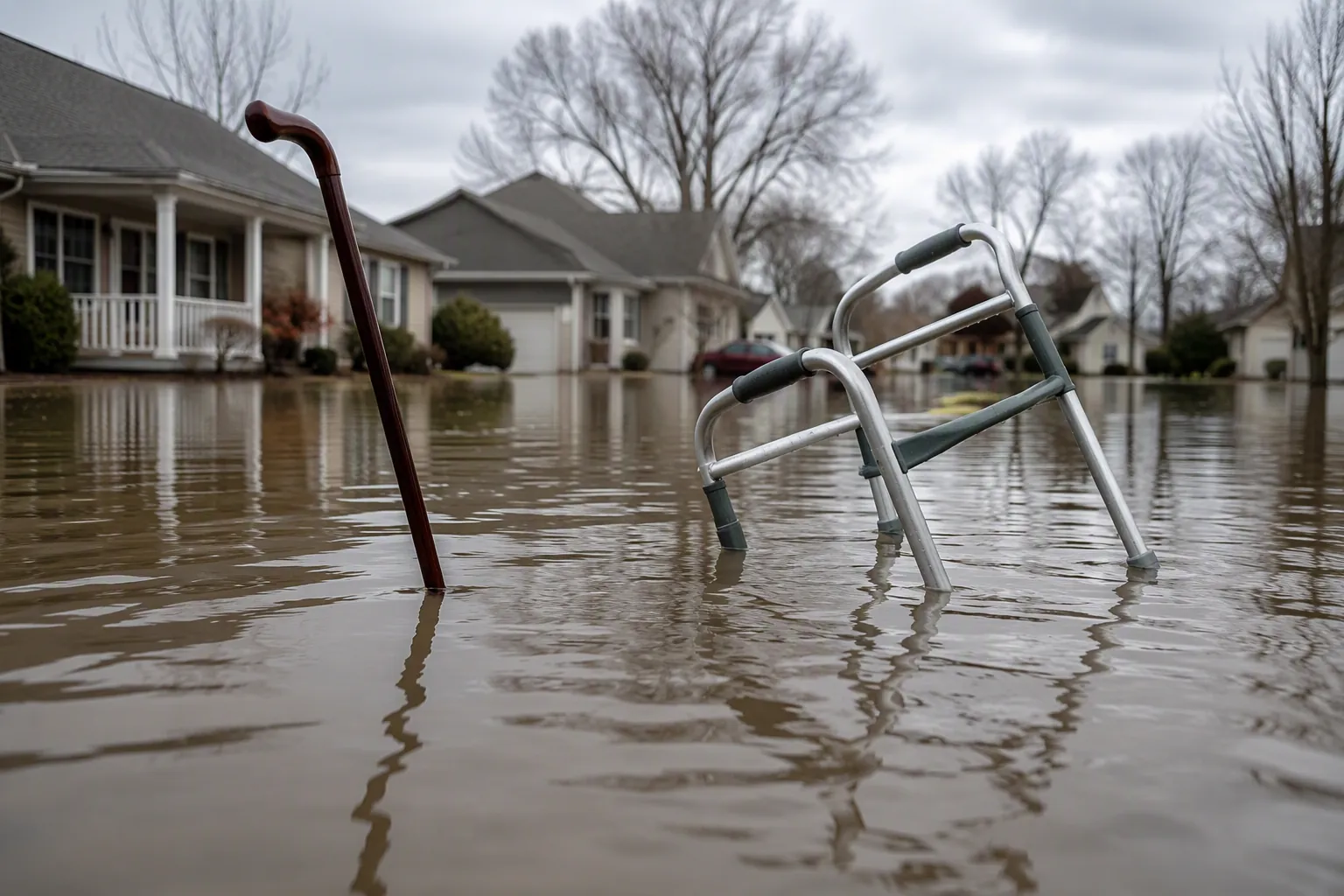
Do Not Test Mobility Against Floodwater
Emergency agencies warn that 6 inches of fast-moving floodwater can knock a person down, and 12 inches can carry away a vehicle. For someone balancing on a cane, pushing a walker, transferring from a wheelchair, or managing neuropathy, that is not a dramatic statistic; it is the difference between a cautious exit and a fall with no clean way to get up.
If the older adult uses mobility equipment, add these decisions to the plan: which exit has the least slope, who can help with transfers, where the backup cane or walker is stored, whether the wheelchair can pass through the chosen doorway, and what happens if the ramp is slick or underwater. A caregiver should not discover during evacuation that the walker is in the trunk, the wheelchair battery is low, and the only helper available cannot safely lift.
Prepare for Hearing, Vision, Memory, and Alert Gaps
Flood warnings are only useful if the person receives them, understands them, and can act on them. A smartphone alert does not solve much for someone who keeps the phone off, cannot hear it, cannot read the small print, does not have reliable internet at home, or becomes confused when routines change.
- Set up multiple alerts: Wireless Emergency Alerts, local emergency-management texts, weather radio, local TV or radio, and a caregiver call tree.
- Print key information: evacuation zone, shelter address, pharmacy contacts, equipment supplier, utility company, insurance numbers, and out-of-town family contact.
- Use large print: medication schedule, device instructions, address, phone numbers, and “what to take” list.
- Create communication cards: “I am hard of hearing,” “I use oxygen,” “I have dementia,” “I need my walker,” or “Call my daughter before changing medications.”
- Assign check-in roles: one person watches weather alerts, one calls the older adult, one confirms transport, and one contacts the pharmacy or equipment supplier if needed.
For an older adult with memory loss, the go-bag should include more than supplies. Add a simple one-page routine: usual wake time, meals, toileting cues, mobility limits, calming phrases, wandering risk, and what makes the person refuse care. In a shelter or relative’s home, that page may prevent an exhausted caregiver from having to explain the same thing repeatedly.
Make a Waterproof Go-Binder
AARP’s caregiving emergency-planning guidance recommends preparing important information and documents before a crisis.[7] For floods, those papers need to be portable, waterproof, and understandable to someone outside the family. A binder, document pouch, or zip-top waterproof bag is fine. The format matters less than whether it leaves the house with the person.
- Identification: driver’s license or state ID copy, Social Security card copy if appropriate, passport copy if available.
- Health coverage: Medicare card, Medicaid card, private insurance card, prescription plan card, dental or vision cards.
- Medical summary: diagnoses, surgeries, allergies, medications, pharmacy, doctors, specialists, equipment suppliers, and preferred hospital.
- Legal papers: power of attorney, health care proxy, advance directive, guardianship papers if applicable, and do-not-resuscitate documentation if used and valid in the state.
- Home and money records: deed or lease, homeowners or renters insurance, flood insurance if any, utility accounts, bank contact information, and vehicle insurance.
- Care contacts: family, neighbors, paid caregivers, home health agency, case manager, clergy, pet veterinarian, and out-of-town contact.
Keep one paper set in the go-bag and one digital set in a secure location a trusted caregiver can reach. If the older adult is uncomfortable sharing financial or legal documents, at least write down where they are and who has permission to access them. During a flood, “it is in the desk somewhere” is not a plan.
Prepare the Home for the Decision to Stay Put
Sheltering in place should be a deliberate decision, not a default caused by a missing ride. If local officials order evacuation, follow local instructions. If the forecast and local guidance allow staying home, the home still needs to be set up for power loss, water intrusion, medication timing, sanitation, and safe movement.
- Move medications, documents, chargers, and assistive devices above likely water level.
- Place flashlights where the older adult actually sits, sleeps, and walks—not in a utility drawer across the house.
- Charge phones, hearing aids, power banks, wheelchairs, scooters, and medical-device batteries before the storm.
- Fill clean water containers if instructed by local officials, and keep water reachable without bending or carrying heavy jugs.
- Clear paths from bed to bathroom, chair to exit, and medication area to phone.
- Put shoes with non-slip soles beside the bed; bare feet and flood debris are a bad combination.
If the person lives alone, arrange check-ins at set times. Do not leave it at “call if you need anything.” Many older adults will not call until the situation is already unsafe, especially if they do not want to worry their children or admit they cannot manage the stairs, the generator, or the wet hallway.
Plan for the First Walk Back Into a Flooded Home
The return home is a fall-prevention problem as much as a cleanup problem. Water can move rugs, loosen flooring, hide broken glass, damage ramps, warp thresholds, and leave mud where a walker tip or cane should grip. Grab bars, railings, raised toilet seats, shower chairs, and stair treads may look normal but no longer be secure.
- Do not let the older adult enter first; have a capable adult check floors, steps, lighting, odor, mold, and electrical hazards.
- Assume wet flooring is unsafe until cleaned, dried, and tested with the person’s actual mobility aid.
- Replace soaked cane tips, walker tips, wheelchair cushions, and transfer surfaces that cannot be cleaned safely.
- Check that bathroom supports are still anchored before anyone uses them.
- Keep medications away from floodwater, heat, and humidity; ask a pharmacist before using anything that may have been contaminated.
If the home no longer supports safe toileting, bathing, sleeping, medication storage, or device charging, the recovery plan has to include another place to stay. That may be frustrating and expensive, but a house that has technically reopened can still be unsafe for a person who needs stable flooring, clear paths, working outlets, and accessible bathrooms.
The One-Page Refrigerator Checklist
Print this page in large type and place it where emergency responders, neighbors, or family members can find it. Update it whenever medication, doctors, equipment, phone numbers, or living arrangements change.
- Name, date of birth, address, preferred language, and emergency contacts.
- Evacuation zone, nearest safe destination, special-needs shelter registration status, and transportation plan.
- Medication list with doses, timing, allergies, pharmacy, and prescribing doctors.
- Medical devices with power needs, suppliers, backup batteries, oxygen details, and charging locations.
- Mobility needs: cane, walker, wheelchair, transfer help, fall risks, and whether stairs are unsafe.
- Sensory and cognitive needs: hearing aids, glasses, dementia diagnosis, communication cards, and calming instructions.
- Pet or service animal plan, including carrier, food, medications, vaccination records, and shelter rules.
- Document binder location and waterproof go-bag location.
If you can only finish a few things this week, finish these: print the medication list, confirm medical-device power needs, register for special-needs shelter access if applicable, place document copies in waterproof storage, and post the refrigerator checklist. The rest of the kit can grow over time. Those five pieces close the gaps that most often turn an ordinary flood plan into a senior-care emergency.
References
- Disaster Resilience Tool Kit, AARP.
- Older Adults, Ready.gov.
- Disaster Preparedness for Older Adults and Caregivers, First Contact.
- Emergency Preparedness Checklist for Caregivers, Family Caregiver Alliance.
- Disaster Tip Sheets, California Department of Aging.
- Emergency Preparedness 101: What to Do Before, During and After a Disaster, National Council on Aging.
- Caregiving Emergency Plans, AARP.
- Flood Preparedness Resources and Tips for Seniors, All Seniors Foundation.
- Senior Emergency Kit, Keystone Health.
Related reading
Noticed something outdated or inaccurate on this page? Flag a correction. We review every report against CDC, NIA, and AARP HomeFit guidance before updating a page.
Part of the Fall Prevention section.