
Flood Recovery Creates Hidden Fall Risks for Seniors Living Alone
The weeks after a flood are the most dangerous time for seniors living alone — wet floors, debris, and hidden hazards multiply fall risk. This article provides specific steps to avoid injury during home recovery.
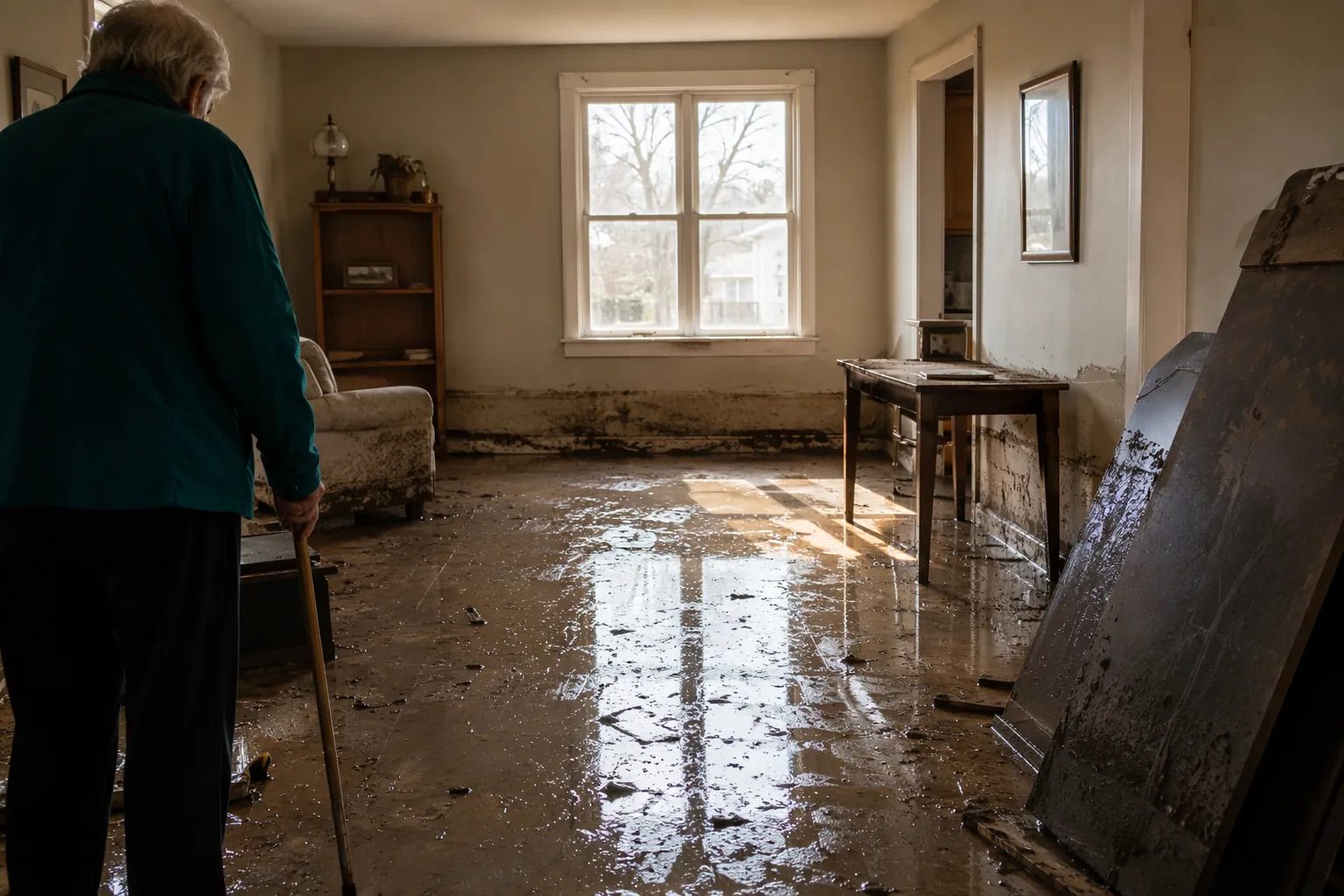
Once the water pulls back from the street, people like to say cleanup has started. That sounds tidy. Inside a flooded home, it is not tidy at all. For a senior living alone, the first hours and weeks after the flood can be when fall risk climbs fastest, because the house looks partly familiar while the floor, lighting, furniture, medications, and walking routes have all changed.
That is why flood safety tips for seniors living alone need to start after the water recedes, not only before the storm arrives. A 2025 Columbia and Harvard study of 4.5 million hospitalizations across 72 major U.S. flood events found that older adults’ hospitalization rates for injuries rose 1.1% in the four weeks after a flood, and hospitalizations for musculoskeletal diseases rose 1.3%. The study period covered 2000 through 2016, so it should not be stretched into a claim about every recent storm, but the recovery pattern matters: the injury problem does not end when the flood warning expires.[1][2]
Falls are already common before a flood. The CDC reports that about 1 in 4 older adults falls each year.[3] Flood recovery piles several known hazards into the same narrow hallway: wet flooring, mud, loose cords, displaced rugs, damaged thresholds, poor lighting, contaminated water, missing handholds, and fatigue. None of those sounds dramatic by itself. Together, they make an ordinary trip from the kitchen to the bedroom a different task.
The First Rule: Do Not Make Reentry a Solo Errand
A flooded home pulls people back in. They want the pill organizer, the family photos, the checkbook, the cat carrier, the favorite chair. That pull is real. It is also exactly when a senior living alone is most likely to say, “I’ll just go look.”
Do not let the first look be a solo trip. The first person through the door should be someone steady enough to stop at the threshold, look down before stepping, and leave if the house is not safe. If the older adult uses a cane, walker, wheelchair, oxygen tubing, or has poor balance on a normal day, they should not be the first person to test the floor.
| Condition at the home | What to do |
|---|---|
| Standing water, moving water, or water covering the entry path | Do not enter. Wait for local officials or qualified help. |
| Unknown electrical status, wet outlets, submerged cords, or appliances in water | Do not enter the affected area. Treat it as unsafe until power and electrical hazards are addressed. |
| Mud, debris, buckled flooring, or poor lighting on the walking path | Enter only with help, and only for a necessary task. |
| Dry, well-lit path with stable footwear, working phone, and another person present | Begin small tasks only; do not carry loads or move furniture. |
The Red Cross warns that 6 inches of fast-moving water can knock over an adult.[4] That warning is about moving water outside or around the home. Inside the house, a much smaller amount of water can still be enough to slide a cane tip, hide a threshold, soak a rug backing, or make a walker skid sideways.
Before Walking Through the House
The first pass through wet rooms is not cleanup. It is inspection. Keep the job small: decide whether the home is safe enough for short, supervised movement. If the answer is no, leave. The house can wait longer than a hip fracture can.
- Call or text someone before entering, and keep the phone on your body, not on a counter across the room.
- Wear closed-toe, firm-soled shoes with traction. Do not use slippers, loose sandals, or socks on wet flooring.
- Turn on a flashlight before stepping inside, even during daytime. Flooded rooms often have shadows where debris collects.
- Look for a clear path before moving. Do not step over piles, cords, wet towels, boxes, or loose rugs.
- Keep both hands free. If an item has to be carried, let someone else carry it out.
That last point is where many falls start. A person bends to pick up a soaked towel, tucks a photo album under one arm, keeps the cane in the other hand, and then has no hand left when the foot slides. Carrying wet belongings over wet flooring is not a small chore for someone with balance trouble. It is a fall setup.
What the Helper Should Check First
If an adult child, neighbor, church member, or aide can enter first, give that person a narrow assignment. They are not there to start hauling furniture. They are there to decide whether the older adult can safely move through the first few feet of the home.
- Is the entry step cracked, muddy, loose, or missing a handhold?
- Are rugs bunched, floating, or stuck to the floor?
- Are electrical cords, power strips, or appliances wet or submerged?
- Is there a dry chair near the entrance where the older adult can sit immediately?
- Is there enough light to see floor edges, thresholds, and debris?
If the helper cannot answer those questions without stepping into water, mud, or electrical uncertainty, the home is not ready for the older adult to enter.
Mobility Aids Need Their Own Safety Check
A cane, walker, wheelchair, or power chair that was safe before the flood may not be safe after it. The person has not changed much in one day, but the equipment and surface underneath it may have.
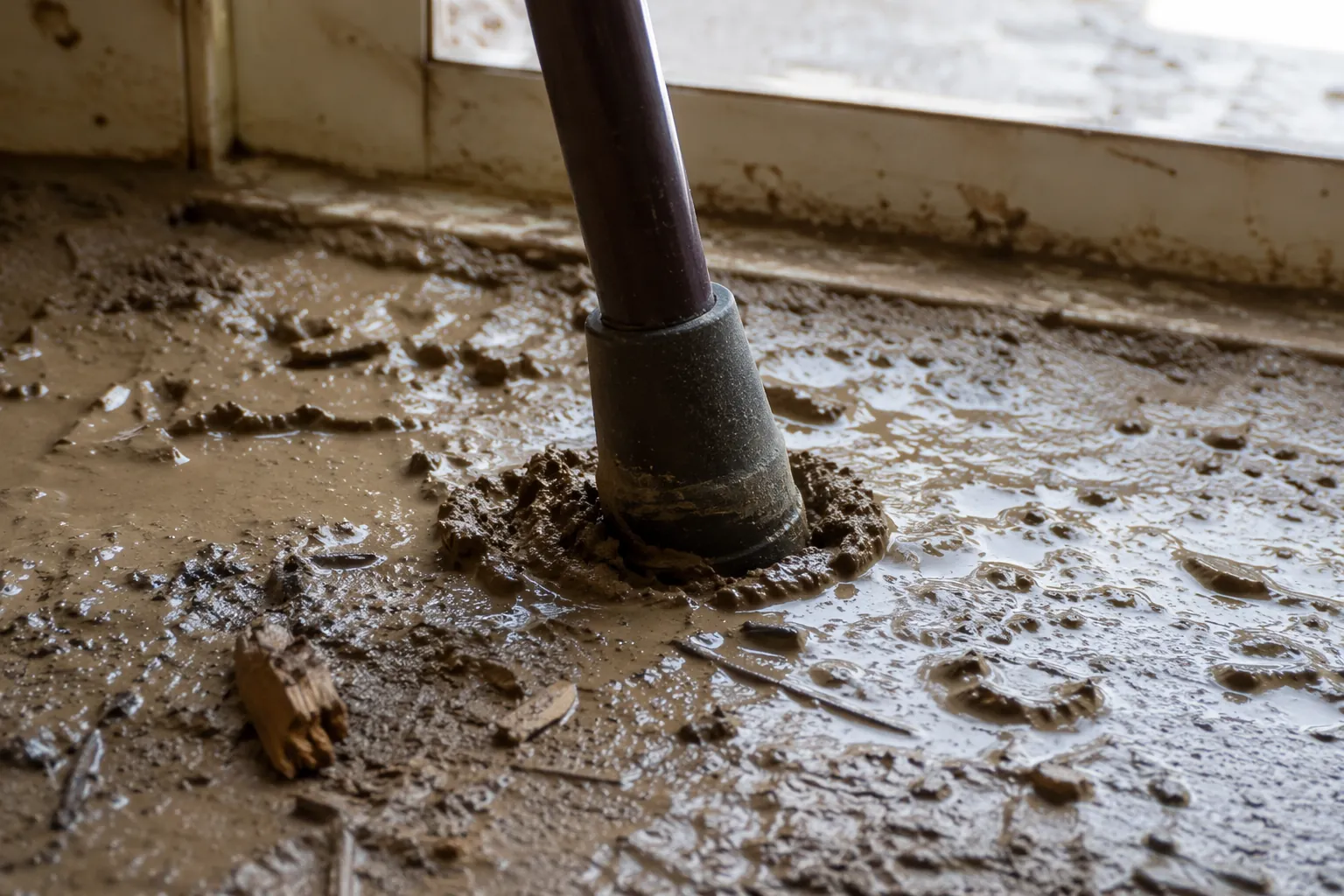
Rubber cane tips can pack with mud. Walker feet can sink into soft ground near the doorway. Walker wheels can skid on tile with a thin film of silt. Wheelchair wheels can track mud onto a floor that was just cleared. A power chair or scooter with submerged electrical components should not be used until it has been checked by someone qualified to assess that equipment.
| Device | Post-flood concern | Safer action |
|---|---|---|
| Cane | Rubber tip clogged, cracked, or sliding on mud | Clean and dry the tip; replace it if worn; avoid muddy routes. |
| Walker | Feet or wheels unstable on wet floors, thresholds, or debris | Have someone clear and dry the path before use; do not lift the walker over obstacles. |
| Manual wheelchair | Wet wheels spread mud and reduce traction | Use only on a cleared, dry route; have help at thresholds and ramps. |
| Power chair or scooter | Electrical parts or batteries may have been submerged | Do not operate until inspected; arrange alternate mobility support. |
This is not a reason to take away someone’s independence. It is the opposite. A senior keeps more control by refusing the task that can take control away: testing damaged flooring alone with damaged equipment.
Wet Rooms Change the Usual Map of the House
Most people move through their own homes by habit. They know where the rug edge is, how far the bathroom door swings, which chair arm they touch while turning. A flood breaks that map. Furniture shifts. Towels land in hallways. Boxes get stacked in the wrong place. A familiar shortcut becomes a narrow, wet passage.
Start with one route, not the whole house. The first safe route should run from the entrance to a stable chair, bathroom access if usable, medications if reachable, and an exit. Everything else can wait.
- Remove loose rugs from the route; do not try to flatten soaked rugs and walk over them.
- Move cords and oxygen tubing away from the walking path.
- Put a sturdy chair near the entrance so the older adult can sit while decisions are made.
- Mark or block off soft flooring, buckled boards, missing thresholds, and rooms with poor lighting.
- Use small trash bags or bins; heavy wet loads should be carried by someone else.
A person living alone may be tempted to clear “just one thing” each time they pass through. That is how the hallway fills with half-moved objects. Clear one path fully, then protect it. Do not turn every walking trip into a cleanup trip.
Contaminated Water and Electrical Hazards Are Fall Hazards Too
Floodwater is not just water in the wrong place. The CDC warns that floodwater can contain hazards such as sewage, chemicals, sharp objects, downed power lines, and other dangerous materials.[5] For an older adult, those hazards also change movement. People step awkwardly to avoid a dirty patch, rush to wash their hands, twist away from a smell, or carry contaminated items at arm’s length. Awkward movement on a wet surface is enough.
Electrical uncertainty should stop movement, not simply slow it down. Do not enter a wet room to unplug something. Do not step around a submerged cord. Do not use a wet appliance because it “looks fine.” The fall risk and the electrical risk are sitting in the same place.
If medications, glasses, hearing aids, dentures, oxygen supplies, or mobility equipment are inside a questionable room, ask someone else to retrieve them only if that person can do so safely. If not, call local emergency management, a utility company, a medical supplier, or a clinician’s office for the safest replacement route. A needed item is still not worth stepping into a dangerous room alone.
The Check-In Plan Has to Be More Specific Than “Call Me If You Need Anything”
Seniors living alone often do not call for help before the risky task. They call after they are tired, embarrassed, or already on the floor. A useful check-in plan removes some of that decision-making.
- Set fixed check-in times for the first several days, such as morning, afternoon, and evening.
- Use a simple phrase that means “stop and wait,” such as “Do not go past the kitchen until I get there.”
- Decide who enters first if new water, odor, darkness, or debris appears.
- Keep a neighbor’s number posted near the main sitting area and stored in the phone.
- Agree that no furniture, wet boxes, rugs, or appliances get moved alone.
For an adult child coordinating from a distance, the question is not, “Are you being careful?” Most people will answer yes. Ask what was done: “Did anyone check the electrical panel?” “Are the rugs out of the hallway?” “Is your walker rolling through mud?” “What room are you staying out of?” Specific questions catch specific hazards.
The First Four Weeks Deserve Different Rules
The Columbia and Harvard hospitalization findings looked at the four weeks after major floods, not only the day people returned home.[1][2] That matters because recovery fatigue builds. The first day may be full of help. By the second week, volunteers have gone back to work, adult children have driven home, and the older adult is still stepping around fans, boxes, missing flooring, and unfamiliar sleeping arrangements.
This is also when routines fail quietly. A person sleeps in a recliner instead of a bed. The bathroom path changes. The cane is left by the wrong chair. Blood pressure medicine is taken late. Meals are skipped because the kitchen is torn apart. The research does not prove that each of those details caused the hospitalization increase, and it should not be read that way. It does show that the recovery window is a measurable injury period, so the household rules should last longer than the first cleanup weekend.
- Keep one dry, lit walking route protected for the full recovery period.
- Recheck cane tips, walker feet, wheelchair wheels, and shoes after each muddy trip.
- Schedule heavier cleanup for times when another person is present.
- Do not restart normal chores until the normal route for that chore is safe again.
- Treat dizziness, weakness, shortness of breath, or new pain as a reason to stop cleanup, not push through.
What a Senior Living Alone Should Refuse to Do Alone
Refusing a task is not the same as giving up the house. Some jobs have too many failure points for one tired person with a wet floor underfoot.
- Do not enter rooms with standing water, wet electrical items, or unknown power status.
- Do not move wet rugs, mattresses, furniture, appliances, or boxes alone.
- Do not climb step stools, ladders, porch steps, or attic stairs during early cleanup.
- Do not carry laundry baskets, trash bags, or salvage bins across wet flooring.
- Do not test a damaged ramp, threshold, porch, or soft floor with a cane or walker.
- Do not use a power chair, scooter, lift chair, or other electrical mobility device that may have been wet until it is checked.
There are still useful first tasks. Sit in a dry chair and make calls. Sort medications on a stable surface. Write down damaged medical equipment. Photograph rooms from the doorway if it is safe to stand there. Ask one person to clear the entrance path and another to handle insurance photos. Small, seated, well-lit tasks preserve energy for decisions that matter.
Why Age Changes the Margin for Error
Older adults are not fragile in the same way, and age alone does not tell the whole story. Still, disaster outcomes show why recovery plans cannot assume the same margin for everyone. After Hurricane Ian in 2022, 61 of 87 fatalities were people age 60 or older, according to the AARP Disaster Resilience Tool Kit’s summary of disaster risks to older adults.[6]
That figure is about deaths during a specific disaster, not a count of post-flood falls. It belongs here for a narrower reason: older adults are often carrying more risk into the disaster and recovery period, including mobility limits, chronic conditions, living alone, transportation barriers, and dependence on medical equipment. Cleanup advice that assumes two strong adults and a dry, powered home misses the person most likely to be standing alone at the doorway.
If a Fall Happens During Flood Recovery
After a fall, do not hurry the person up just to get them out of the way of cleanup. Check for pain, head injury, dizziness, weakness, confusion, bleeding, or trouble bearing weight. If any of those are present, call emergency services. If there is any doubt, treat it as medical until a clinician says otherwise.
For a step-by-step response after someone is already down, use the site’s post-fall decision tree. Once immediate hazards are controlled, longer-term fixes such as grab bars, threshold ramps, better lighting, and non-slip flooring belong in the next round of planning, not in the first wet walk through the house. The broader fall-prevention work can start after the electrical questions, wet surfaces, debris, and broken routes are handled one at a time.
Flood recovery is not a test of toughness. The safest plan is slower than most people want: do not enter when the hazards are unknown, enter only with help when the walking route is changed, and begin only the small tasks that can be done from a dry, stable place.
References
- Large Study Uncovers Specific Impacts of Flooding on Older Adult Health, Columbia University
- Flooding increases hospitalization risks in older adults, Harvard T.H. Chan School of Public Health
- Facts About Falls, CDC
- Flood Safety, American Red Cross
- Flood Safety, CDC
- Disaster Resilience Tool Kit, AARP, 2022
Related reading
Noticed something outdated or inaccurate on this page? Flag a correction. We review every report against CDC, NIA, and AARP HomeFit guidance before updating a page.
Part of the Fall Prevention section.