
STEADI: intervene
Flood Safety Tips for Elderly Parents at Home: Room-by-Room Checklist
A room-by-room guide to preparing your aging parent's home for flood season, covering mobility hazards, medical device backup, and emergency supplies tailored to older adults.
Start this walkthrough in the place where a fall would be most predictable: the dark hallway between your parent’s bed and the bathroom. If floodwater reaches that floor, “a little water” is no longer a small problem. FEMA warns that 6 inches of moving water can knock a person down, which changes the risk calculation for anyone using a cane, walker, rollator, ankle weakness, poor balance, or bifocals in dim light.[1]
That is why flood safety tips for elderly parents at home should not begin and end with a plastic emergency bin. The bin matters. So do flashlights and bottled water. But the older-adult version of flood preparation is more physical than that: Can a walker turn without catching on a rug? Is the CPAP cord crossing the only path to the bathroom? Are prescriptions stored under a vanity that could take on water? Is the charger for a mobility scooter plugged into a garage outlet that may not work if the power fails?
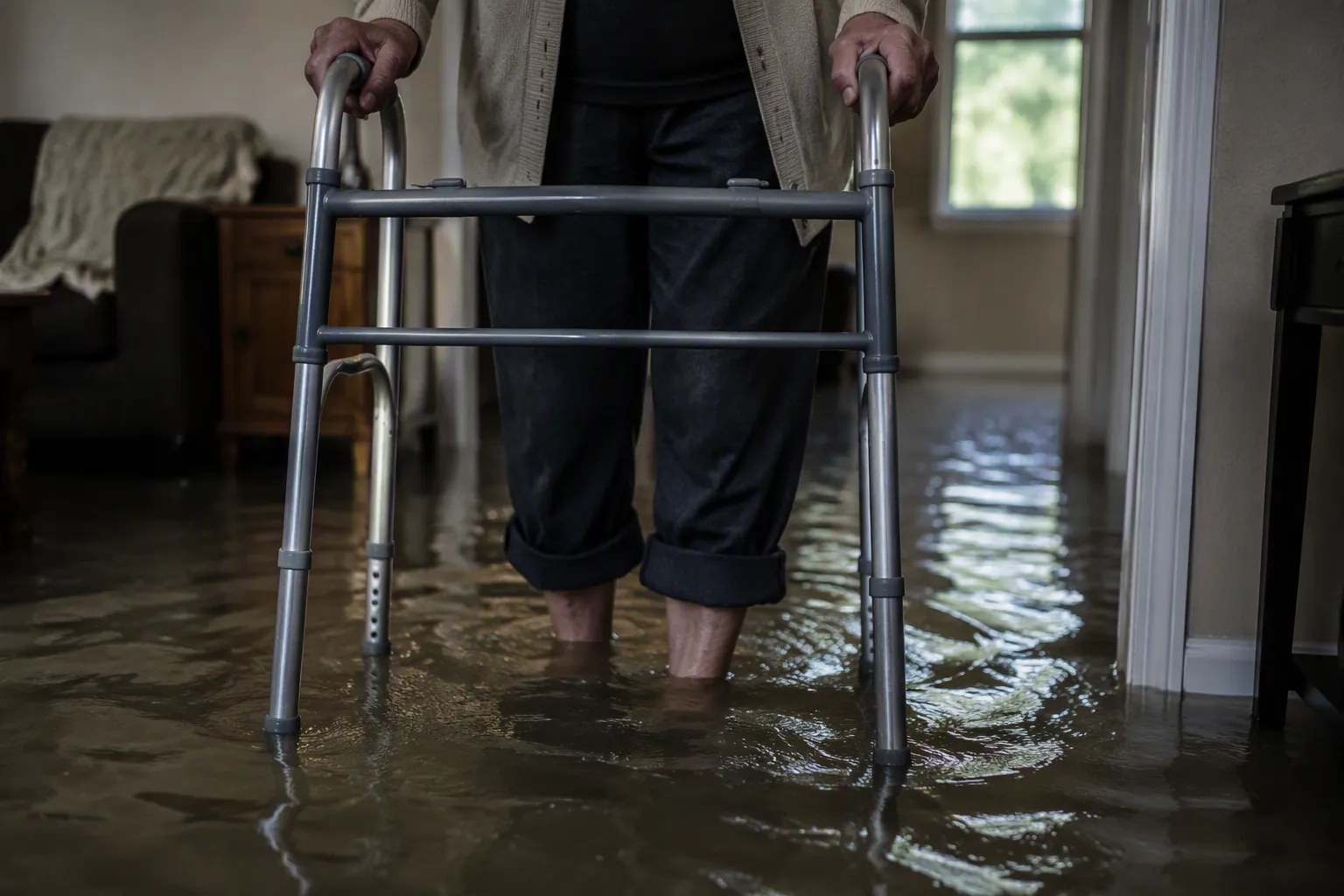
The stakes are not theoretical. AARP’s Disaster Resilience Tool Kit notes that people age 75 and older were about 6% of New Orleans’ population but accounted for 50% of Hurricane Katrina deaths; delayed action tied to mobility and medical dependence was a major factor.[2] That does not mean every storm becomes Katrina. It means the home should be checked before anyone is tired, wet, frightened, or trying to find a flashlight with one hand on a walker.
Plan on a 90-minute, room-by-room walkthrough before flood season, then repeat it about every six months. The daylight-saving time change is a useful reminder in many states. If your parent lives somewhere without daylight saving time, or somewhere with repeated tropical or flash-flood seasons, use a calendar reminder tied to the local flood pattern instead. This is a preparation walkthrough, not an evacuation decision tree, not a post-flood cleanup guide, and not a full severe-weather plan. For the broader storm-prep layer, use a general resource such as Severe Weather Safety Checklist for Seniors Living Alone alongside this room check.
The 90-minute walkthrough at a glance
Walk the house in the order your parent is most likely to use it during a wet, dark, stressful hour: sleeping area, bathroom, kitchen, exits, garage, basement, laundry, and stairs. Bring your phone, a charger, a small flashlight, painter’s tape, a trash bag, and a way to take photos. The photos are not for decorating. They are so you can see later whether the cane moved back to the garage door, the documents stayed low, or the hallway got crowded again.
| Area | What you are looking for | What should change before flood season |
|---|---|---|
| Bedroom and hall | Night walking route, cords, medical devices, reachable lights, document storage | Clear walker-width paths, move cords, add battery lighting, copy documents, confirm device backup |
| Bathroom | Medication location, wet-floor risks, grab-bar placement, night access | Move medicines high and dry, remove loose mats, add battery lighting, keep assistive devices reachable |
| Kitchen | Food and water access, counter paths, manual tools | Raise shelf-stable food, check manual can opener, keep water treatment supplies reachable |
| Entryway and garage | Water-entry points, flood barriers, mobility aids, posted contacts | Stage barriers safely, protect canes/walkers, post contacts, keep exit path clear |
| Basement, laundry, and stairs | Sump pump, stored valuables, stair lighting, low outlets | Test backup plans, move critical items upstairs, add battery lighting, clear stair edges |
Keep the pace practical. If a repair requires a contractor, note it and move on. If a box is sitting in a fall path, move it now. If a medication or device question needs a pharmacist, physician, durable medical equipment supplier, or utility company, write down the person to call. The point is not to solve the entire house in one heroic visit. The point is to stop obvious flood-and-fall risks from hiding in plain sight.
Bedroom and hallway: make the night route boring
The bedroom is where flood preparation becomes older-adult preparation. This is where sleep medication, urgency to reach the toilet, low light, slippers, oxygen tubing, CPAP hoses, phone chargers, rugs, and furniture legs can all meet in one narrow route. About 80% of older adults have at least one chronic condition, which is one reason disaster planning for this age group has to include medications, equipment, and daily routines rather than just food and water.[3]
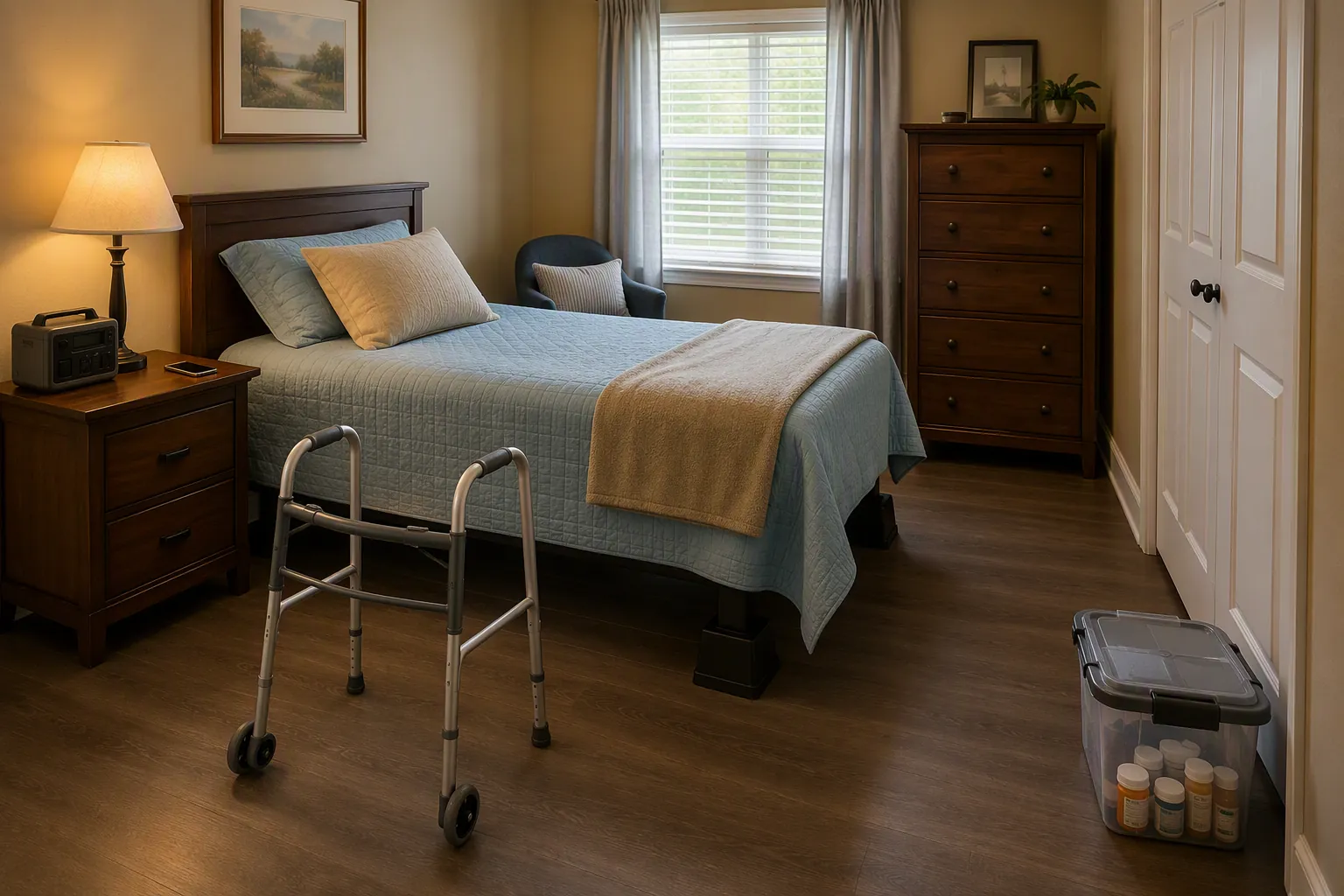
Stand at the bed and walk the route your parent would take at 2 a.m. with the lights out. Do it with the walker or cane in hand if they use one. A path that looks fine to an adult child in sneakers can be too tight for a rollator, especially if a dresser drawer is left open or a laundry basket drifts into the hall.
- Clear the bed-to-bathroom path of throw rugs, shoe piles, low baskets, pet bowls, extension cords, and decorative furniture.
- Check whether a walker can turn at the bed, doorway, bathroom entrance, and hallway corner without backing up.
- Move CPAP, oxygen, adjustable-bed, lift-chair, or phone cords away from the walking route. Do not solve one tripping hazard by stretching a new cord across the floor.
- Put a flashlight or battery lamp where your parent can reach it before standing. If they cannot operate small buttons easily, choose something with a large switch.
- Make sure glasses, hearing aids, cane, walker, shoes, and phone have a consistent landing place.
Medical-device backup belongs in this room check, not in a separate someday file. A study cited through NIA materials found that about 14.2% of older adults reported using a medical device that requires electricity, such as oxygen equipment, CPAP, electric beds, or powered mobility equipment.[4] If your parent uses any device that plugs in, write down four things: the device name, how long it can run without household power, who supplies it, and what the backup plan is if flooding causes an outage.
This article is not the place to cover every blackout hazard again. Floods often bring power failures, so use a separate power-outage fall guide such as Power Outage Fall Risks Every Senior Caregiver Should Know for the detailed lighting and appliance plan. Here, your job is simpler: identify every device your parent depends on and make sure nobody is guessing about power.
Documents should not live where water will look first
Bedroom closets and nightstands often hold the papers everyone will need under pressure: Medicare and insurance cards, medication lists, advance directives, power-of-attorney documents, device supplier numbers, and physician contacts. Put copies in a waterproof pouch or container above likely water level. The American Association for Geriatric Psychiatry recommends keeping a second copy of important information with a support-network member, which is especially important if the person at the house cannot retrieve documents quickly.[5]
- Copy the medication list, including dose, timing, prescribing clinician, and pharmacy.
- Copy insurance cards, Medicare or Medicaid information, identification, advance directives, and emergency contacts.
- Photograph medical-device labels, serial numbers, and supplier stickers.
- Give one waterproof or digital copy to the person most likely to answer the phone during a storm.
Bathroom: move the medicine before you admire the grab bars
Bathrooms get praised when they have grab bars, shower chairs, and raised toilet seats. Good. Keep them. But in a flood walkthrough, the first question is not whether the bathroom looks adapted. It is whether the bathroom becomes slick, dark, crowded, and medicine-damaging when water enters or power fails.
Start under the sink. If prescriptions, glucose strips, wound-care supplies, hearing-aid batteries, incontinence products, or spare eyeglasses are stored in the vanity, move them. A low cabinet is convenient on an ordinary Tuesday and a bad place for critical supplies when water backs up or seeps in.
- Store daily and backup medications in a high, dry, easy-to-reach container—not in a basement, garage, or low bathroom cabinet.
- Remove loose bath mats that can float, bunch, or slide. If a mat is necessary, choose one that stays flat and can be lifted quickly before a storm.
- Check whether grab bars, toilet rails, or shower-chair legs could trap debris or create ankle-level obstacles if water enters.
- Place battery-operated lighting near the bathroom path, not only inside the bathroom.
- Keep a towel and dry footwear reachable outside the wet zone so your parent is not stepping onto tile in socks.
The medication target should be more serious than a three-day kit if your parent depends on prescriptions. The American Red Cross advises older adults to keep a 30-day supply of medications, if possible, as part of emergency preparedness.[6] That phrase—“if possible”—matters. Insurance plans and pharmacies may limit early refills. Do not solve that by quietly rationing medication or building an unlabeled stash. Ask the prescribing clinician and pharmacist what emergency refill, vacation override, mail-order, or disaster policy applies before flood season.
AARP’s 2023 survey gap is the part families tend to recognize in themselves: 60% of adults age 50 and older felt prepared for a disaster, but only about 1 in 3 had stockpiled extra prescription medicine, and fewer than half had emergency phone chargers.[2] Confidence is not the same as a labeled medication container on a high shelf and a charged backup battery where someone can find it.
For lighting, the California Department of Aging’s disaster tip sheets include practical senior-specific items such as battery-operated touch lamps and hearing-aid battery planning.[7] Those are not fancy purchases. They are the difference between reaching the toilet with both hands available and fumbling for a tiny flashlight while half awake.
Kitchen: keep food useful, not just present
The kitchen check can be brisk, but it should not be skipped. Standard emergency-kit advice covers water, food, flashlights, radios, batteries, first aid, sanitation supplies, and phone charging.[8] For an older parent at home, the question is whether those supplies are reachable, openable, and usable if the floor is wet or the power is out.
- Move shelf-stable food and water off the lowest shelves. Do not store the only backup food where minor flooding, pests, or a wet mop bucket can ruin it.
- Check for a manual can opener, then make sure your parent can actually use it. Arthritis can turn a technically correct item into decoration.
- Keep a water purification method or sealed backup water in a place that does not require bending to the floor.
- Clear the route between refrigerator, sink, counter, table, and exit so a walker does not have to squeeze past trash cans, stools, or pet dishes.
- Place frequently used utensils and cups between waist and shoulder height. Flood prep is not improved by making someone climb or crouch.
If your parent has diabetes, swallowing difficulty, kidney disease, heart failure, or another condition that affects diet or fluids, do not improvise a disaster menu from generic canned goods. Put the diet constraints on the emergency contact sheet and ask the clinician or dietitian which shelf-stable foods belong in the house.
Entryway and garage: do not let the flood barrier become the fall hazard
The entryway and garage decide whether the safer rooms stay safer. This is where sandbags, temporary barriers, umbrellas, wet shoes, extension cords, scooters, recycling bins, and stored tools tend to gather. It is also where a parent may try to “just check something” during rain.
Look first at the actual exit path. If a walker user has to step over a threshold, squeeze beside a parked car, or navigate around stacked supplies, the emergency plan is already weaker than it looks on paper. Flood barriers should slow water without blocking the route your parent may need with a mobility aid.
- Identify which doors are realistic exits for your parent, not just which doors exist.
- Stage sandbags or flood barriers so they do not force your parent to step over them during normal movement.
- Move canes, walkers, rollators, scooter chargers, and spare cushions away from spots where water commonly enters.
- Protect fabric walker seats or cushions with waterproof covers or bags if they are stored near a door.
- Post emergency contacts at standing eye level near the main exit and refrigerator, not buried in a phone app your parent may not open under stress.
- Check that the phone charger, backup power bank, and car charger are present and reachable.
This is also the place to mark the line between preparation and evacuation. If local officials issue an evacuation order, if water is rising, or if the only safe route may close, a pre-flood room checklist is no longer the right tool. A caregiver-specific disaster plan should identify transportation, mobility help, pets, oxygen, medications, and destination options in advance.[9] The room-by-room walkthrough makes that decision easier later; it does not replace it.
Basement, laundry, and stairs: assume nobody should be carrying boxes in the rain
Basements and laundry rooms are where families store the things they cannot afford to lose and the things nobody wants to sort. For an older parent, they are also where stairs, damp concrete, low lighting, sump pumps, extension cords, detergents, and heavy baskets combine badly.
Do not make the plan depend on your parent going downstairs during a storm. If the sump pump, breaker panel, water shutoff, or stored documents are in the basement, decide now who checks them and how. If that person is not your parent, put the name and phone number on the contact sheet.
- Move medications, legal documents, photo drives, insurance papers, hearing-aid supplies, and device manuals upstairs.
- Check the sump pump before flood season and note whether it has battery backup or another backup plan.
- Add battery lighting at the top and bottom of basement stairs. A flashlight stored downstairs does not help someone standing in a dark kitchen.
- Clear laundry baskets, detergent jugs, shoes, and stored items from stair edges and landings.
- Raise electrical items, chargers, and stored supplies off the floor where practical.
- Label shutoffs or panels in large print if a helper may need to find them quickly.
Cleanup is deliberately outside this checklist. Floodwater can contain sewage, chemicals, sharp objects, and other contaminants, and the CDC gives separate safety guidance for contact with floodwater after a disaster.[10] The Red Cross also gives post-flood drying guidance, including the need to dry out affected areas promptly after flooding.[11] For this visit, the practical move is to reduce what can be ruined downstairs and reduce the chance that your parent feels responsible for going down there.
If cognition has changed, simplify the plan further
Flood preparation gets harder when a parent has dementia, delirium risk, poor short-term memory, or trouble following multi-step instructions. A plan that depends on remembering which drawer holds the flashlight, which door has the barrier, or which neighbor to call may fail even in a minor storm.
The AAGP disaster preparedness guidance flags cognitive impairment as a factor in planning for older adults.[5] In the home, that means fewer hiding places, fewer choices, more visible labels, and more responsibility shifted to the support network. If your parent has cognitive changes, pair this walkthrough with A Room-by-Room Safety Checklist for Alzheimer’s Caregivers so flood prep does not accidentally create new confusion hazards.
- Use large-print labels for medications, lights, emergency contacts, and device backup steps.
- Keep emergency supplies in one or two obvious locations rather than scattering them across rooms.
- Avoid rearranging the bedroom or bathroom so much that the parent cannot navigate familiar space.
- Add comfort items to the go-bag or supply area if agitation is likely during storms; California’s senior disaster tip sheets specifically include comfort items for people with dementia.[7]
- Assign a real person to call or visit when watches and warnings are issued, instead of relying on the parent to interpret alerts alone.
For long-distance caregivers, do a shorter video audit
An in-person walkthrough is better because you can feel the rug slide, see the cord angle, test the lamp, and notice that the walker no longer fits beside the laundry basket. If you cannot visit before flood season, do a video call anyway. It will not catch everything, but it can catch enough to justify a neighbor visit, handyman call, pharmacy question, or weekend trip.
- Ask your parent or a local helper to start at the bed and slowly show the route to the bathroom.
- Have them point the camera under bathroom sinks, inside medication storage, at chargers, and toward the main exit.
- Ask to see where the flashlight, phone charger, emergency contacts, and insurance documents actually are.
- Take screenshots only if your parent is comfortable with it, then label them by room.
- End the call with no more than three assigned fixes. A twenty-item remote list is how nothing gets done.
What to write down before you leave
The house will drift back toward normal. The cane will migrate. A new prescription will arrive. Someone will put a box in the hallway. The value of the 90-minute walkthrough is that it gives you a dated baseline, not a one-time feeling of being prepared.
- Date the walkthrough and list the rooms checked.
- Photograph the bedroom path, bathroom medication storage, main exit, sump pump area, and posted contact sheet.
- Write down which medications still need refill-policy clarification with the pharmacist or prescriber.
- Write down each electrical medical device and who is responsible for confirming backup power.
- Give copies of key documents and the medication list to one support-network member.
- Schedule the next review for six months from now, or sooner if the local flood season requires it.
If the power is already out, the water is already rising, or your parent is already unsafe, switch from prevention to crisis guidance such as What to Do During a Power Outage for an Elderly Person or local emergency instructions. If you are still ahead of the storm, finish the walkthrough, move what needs moving, charge what needs charging, copy what needs copying, and put the next review on the calendar.
References
- 7 Flood Safety Tips — FEMA
- Disaster Resilience Tool Kit — AARP
- What Older Adults Can Do If Disaster Strikes — NCOA
- Statistics on older adult medical device dependence — AJPH study cited via NIA
- Older Adults and Disaster: Preparedness and Response — AAGP
- Older Adults Emergency Preparedness — American Red Cross
- Disaster Preparedness Tip Sheets for Seniors — California Department of Aging
- Build A Kit — Ready.gov
- How to Create Disaster Preparedness Plans — AARP Caregiving
- Safety Guidelines: Floodwater — CDC
- Flood Safety — American Red Cross
Related reading
Noticed something outdated or inaccurate on this page? Flag a correction. We review every report against CDC, NIA, and AARP HomeFit guidance before updating a page.
Part of the Fall Prevention section.