
STEADI: intervene
Severe thunderstorm safety checklist for elderly parents
A preventive checklist for adult children to prepare an elderly parent's home before severe thunderstorm season. Focuses on the specific fall risks that spike when power goes out, including motion-sensor lighting, secured rugs, grab bars near shelter areas, and flashlight caches.
Severe thunderstorm safety for elderly parents starts before the sky turns ugly. The most dangerous part is often not the thunder, the siren, or even the warning on the phone. It is the first dark minute after the power drops, when a parent stands up from a chair or bed, reaches for something that is not there, and starts moving through a house that has suddenly changed.
More than 1 in 4 older adults falls each year, according to the CDC, and a blackout does not create one new hazard so much as it multiplies the old ones in every room at once: rugs, cords, stair edges, narrow hallways, bathroom thresholds, and furniture corners all become harder to read in the dark.[1][2] That is why this checklist stays focused on the house itself. Alerts, radios, and emergency contacts matter, but they do not help much if the first trip from the recliner to the hallway begins with a loose rug.
Walk the route your parent will actually use
Do the walkthrough in order, starting where your parent is most likely to be when the power fails. For many people, that is a bed, recliner, kitchen chair, or bathroom. Do not begin with the basement shelves full of bottled water. Begin with the first foot that touches the floor.
| Place to check | First dark-minute question | Fix before storm season |
|---|---|---|
| Bed or favorite chair | Can they stand, orient, and reach light without stepping first? | Put a flashlight and backup light where the hand naturally lands. |
| Hallway | Can they walk without catching a rug edge, cord, or furniture corner? | Clear the path, secure rugs, and add motion-sensor lighting. |
| Bathroom | Can they enter, turn, and steady themselves without guessing? | Add night lighting, non-slip surfaces, and properly placed support. |
| Stairs | Can they see the first step and hold a rail before weight shifts? | Add stair lighting, non-slip treads, and sturdy handrails. |
| Shelter area | Can they get there and sit or stand with support? | Clear the route and add grab bars or rails near transition points. |
The National Institute on Aging recommends looking at fall risks room by room, including floors, stairs, bathrooms, bedrooms, and lighting.[3] That room-by-room approach is useful, but for severe storms I would tighten it further: follow the route from the body’s starting point to the safer place in the home. Anything outside that route can wait until the main path is no longer a trap.
Put light where the hand reaches before the foot moves
A flashlight in a kitchen drawer is not a storm plan if your parent wakes up in a dark bedroom. A lantern in the garage is not helpful if the breaker clicks off while they are in the bathroom. The right place for backup light is not “somewhere in the house.” It is on the nightstand, beside the recliner, beside the toilet route, near the stair landing, and at the entrance to the shelter area.
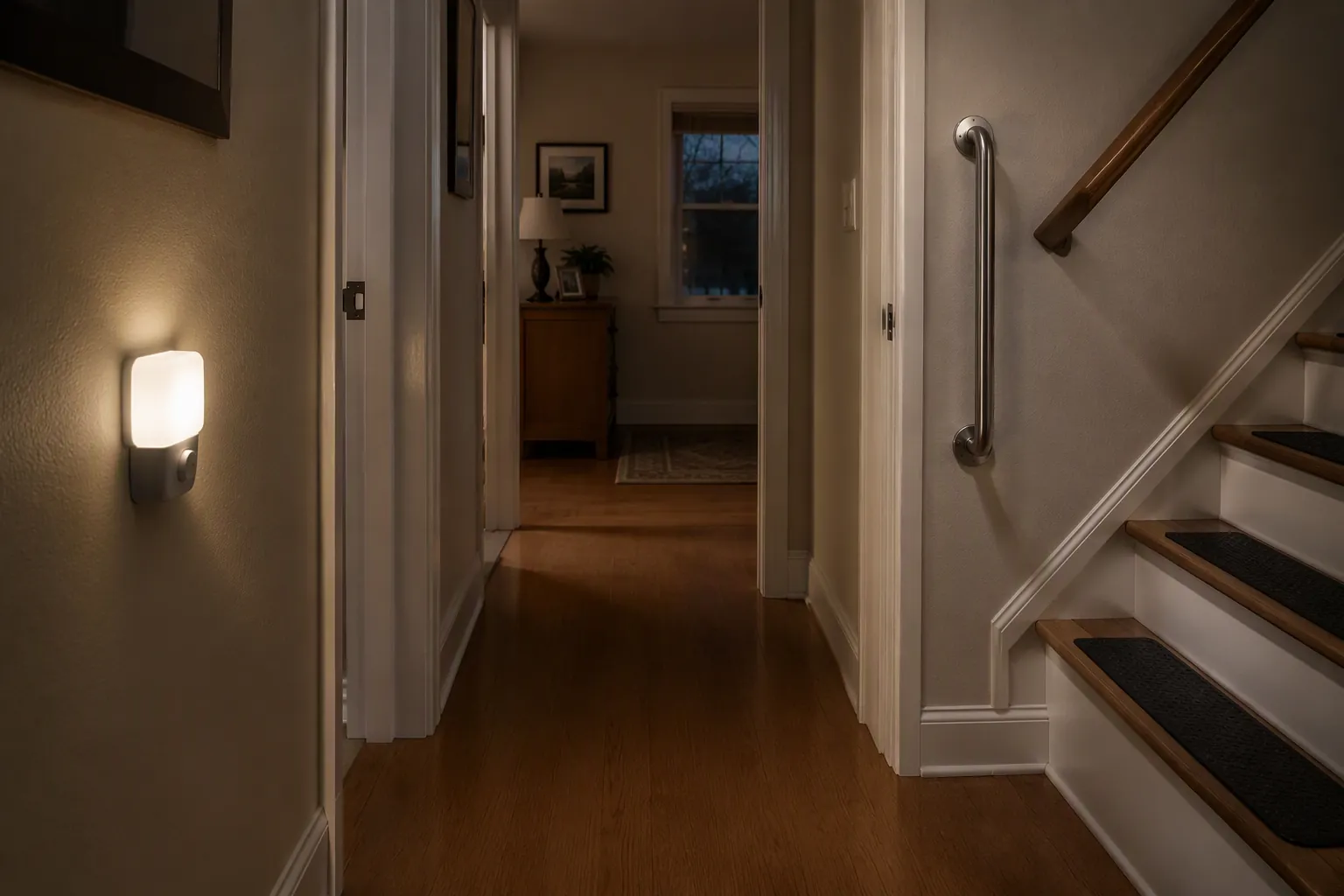
Use two kinds of lighting. First, place flashlights where a hand already goes: the nightstand edge, the side table by the chair, the bathroom counter, the hall shelf, the basement-door hook if that door is part of the shelter route. Second, install automatic lighting that turns on before your parent has to search for a switch. Motion-detector lights are commonly recommended for older adults because they reduce the need to walk through dark spaces while reaching or fumbling for switches; one senior-safety guide suggests placing motion lights around 48 inches high in relevant locations so the sensor can detect movement effectively without being blocked by furniture.[4]
- Place a flashlight within arm’s reach of the bed, not across the room.
- Put another light at the chair where your parent watches TV or reads.
- Use motion-sensor night lights along the route to the bathroom and shelter area.
- Avoid lights that require bending, twisting, or crossing the room to reach.
- Test the route at dusk with the regular lights off; if you hesitate, fix that spot.
Battery maintenance is boring until the moment it is not. Keep spare batteries with the device or use rechargeable emergency lights that remain plugged in and turn on when power fails. The goal is not to own lighting equipment. The goal is for light to appear before balance is tested.
Clear the path as if no one will be fully awake
A hallway that is manageable at noon can be a different hallway at midnight in a thunderstorm. Remove the little decisions: step over the cord, angle around the basket, lift the toe over the rug, squeeze past the plant stand. Those are not character-building obstacles. They are fall mechanisms waiting for bad lighting.
Start with rugs. If a rug is loose, curled, thick at the edge, or easy to slide with one foot, take it out of the storm route or secure it with a non-slip backing that actually holds. Tape that peels up at the corners creates another problem. If your parent hates losing a familiar rug, move it to a place where it is not part of the night path, bathroom route, stair approach, or shelter route.
Then look for cords. Phone chargers, oxygen tubing, lamp cords, extension cords, and power strips should not cross the walking path. If a cord must reach an outlet, route it along a wall and secure it so it cannot loop into the path. During a storm, people also tend to plug in phones, charge devices, and move lamps. Do that setup now, while the house is bright, not when everyone is trying to preserve battery life.
- Remove loose rugs from the bed-to-bathroom route and the route to the shelter area.
- Move low stools, baskets, plant stands, and magazine racks out of hallways.
- Keep shoes or non-slip slippers in the same place every night.
- Clear both sides of doorways so walkers, canes, and hands do not snag.
- Do not store storm supplies on the floor of the walking route.
This is the part many adult children skip because it feels too ordinary. It is also the part that changes the first minute most directly. A parent should not have to remember where every hazard is while the room is dark and the weather is loud.
Treat stairs and thresholds as decision points
If stairs are part of the path to a safer interior room or basement, they deserve more attention than the emergency tote. The first step is the dangerous one because it asks for judgment before the body has adjusted: where is the edge, which foot goes first, where is the rail, is the landing clear?
Add non-slip stair treads if the surface is slick or hard to see. Make sure the edge of each step is visually distinct enough for your parent’s eyesight, not yours. Check the handrail with body weight, not a polite tug. A rail that wiggles under pressure is a decoration, not support.
Thresholds need the same inspection. Bathroom entries, bedroom transitions, garage doors, basement doors, and carpet-to-floor changes can all catch a toe. If your parent uses a cane or walker, watch the device cross the threshold. The problem may not be the foot; it may be the front wheel, rubber tip, or cane base catching exactly where the light is weakest.
Put support near the shelter route, not just in the bathroom
Grab bars are often treated as bathroom equipment. For storm preparation, think of them as transition support. Where does your parent turn from hallway to interior room? Where do they step down into a basement? Where do they stand while opening a heavy door? Where would they pause if the lights went out halfway there?
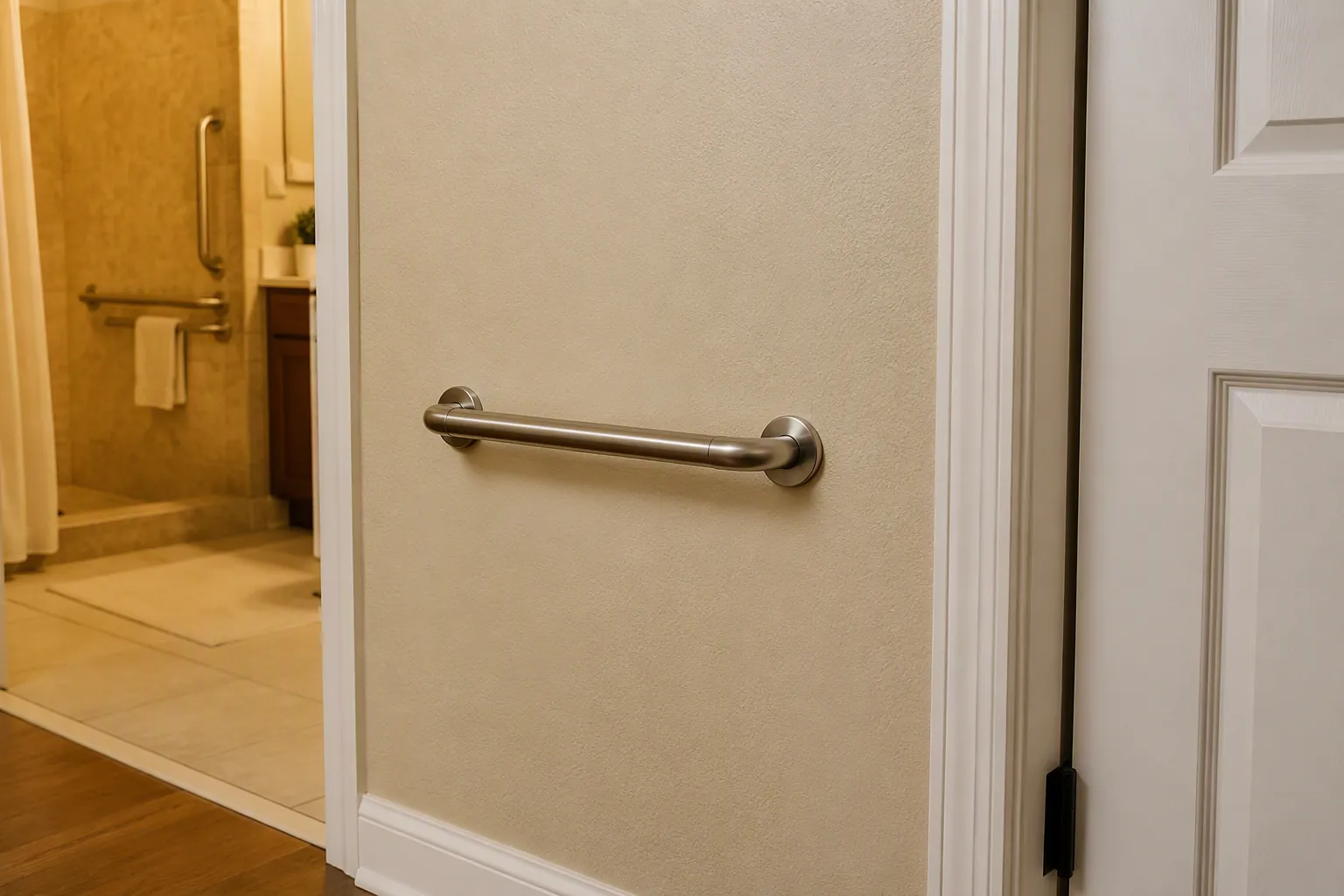
Common accessibility references often cite a 33- to 36-inch height range for grab bars, but height alone is not the whole job. Wall structure, fasteners, bar angle, hand size, approach direction, and whether the person is standing, turning, or stepping all matter. Use manufacturer instructions, local accessibility guidance, or a qualified installer rather than guessing with a stud finder and good intentions.
For the shelter route, look for places where balance changes: rising from a chair, turning into a hallway, crossing a threshold, descending stairs, entering a small interior room, or lowering onto a seat. A well-placed rail or grab bar at one of those points may do more than a box of storm supplies placed neatly in a closet your parent cannot safely reach.
A quick support check
- Can your parent reach support before stepping onto stairs?
- Is there something solid to hold while turning into the shelter area?
- Can support be used with the stronger hand if one side is weaker?
- Is the bar or rail mounted into structure strong enough to bear weight?
- Does the support help the actual route, or was it installed where it was easiest?
Do not let the bathroom become the side trip that causes the fall
Storm checklists often send everyone toward the safest interior space, but older adults still need the bathroom. That route may happen before going to shelter, during a long warning period, or after the power fails. The NIA specifically calls out bathroom hazards such as wet floors, tubs, showers, and the need for grab bars and non-slip mats as part of home fall prevention.[3]
Put a motion night light near the bathroom entrance and another inside if the room has a dark corner. Use non-slip mats that do not bunch or slide. If there is a tub or shower on the route, keep the floor outside it dry and clear; even if no one plans to bathe during a storm, wet towels and bathmats can still shift underfoot.
If your parent uses a walker, check whether it can enter and turn. Many bathrooms are arranged as if the person will walk in empty-handed, reach the sink, and steady themselves on porcelain. That is not support. Sinks, towel bars, and shower doors are not substitutes for properly mounted grab bars.
Keep emergency supplies reachable without creating clutter
Ready.gov advises older adults to prepare for emergencies by considering medical needs, support networks, supplies, and communication plans.[5] That belongs in the larger severe-weather plan. Inside the house, the fall-prevention version is simpler: do not make your parent cross a dark room, bend to the floor, or climb a step stool to get the things meant to keep them safe.
Store a small storm kit at waist-to-chest level near the shelter area or another safe, reachable spot. Keep it off the walking path. If water bottles, medication lists, phone chargers, or backup batteries are part of the plan, give them a stable shelf or bin that does not require crouching. A neat pile on the floor is still an obstacle.
If your parent uses medical equipment that depends on power, that planning needs its own instructions from the equipment provider, clinician, or local emergency-management resources. Do not bury that issue inside a fall checklist. This walkthrough is about reducing the chance that your parent is injured while trying to move through the home in the dark.
Run the drill before the first warning
After the fixes are in place, ask your parent to walk the route in normal conditions. Do not turn it into a performance. Watch quietly for the reach, the pause, the hand on the wall, the toe catching the threshold, the moment they look down because the lighting is not enough. Those small hesitations are the checklist.
Then test the same route in dim light if it is safe to do so. Keep someone close enough to help. The point is not to scare anyone or prove a point. The point is to find the exact place where the plan depends on memory, balance, or luck.
- Start at the bed or favorite chair.
- Reach for light before standing.
- Walk the bathroom route.
- Walk the shelter route.
- Check every turn, threshold, stair, and place where a hand searches for support.
- Move anything that narrows the path or asks for a step-over.
If your parent can stand, orient, reach light, move along a clear path, and hold real support near the shelter route before anyone has to improvise, the highest-risk part of the storm has already been reduced.
References
- Facts About Falls, CDC.gov
- Power Outage Preparedness for Seniors & Elderly, PowerOutage.us
- Preventing Falls at Home: Room by Room, National Institute on Aging
- How Motion Detector Lights Can Help Seniors Avoid Falls, Lifeline
- Older Adults, Ready.gov
Related reading
Noticed something outdated or inaccurate on this page? Flag a correction. We review every report against CDC, NIA, and AARP HomeFit guidance before updating a page.
Part of the Fall Prevention section.