
STEADI: intervene
Florida Heat Advisory Senior Safety Checklist
A scannable, printable checklist that bridges NWS heat advisory criteria with fall prevention for Florida seniors. Covers pre-advisory prep, during-advisory actions, and warning signs, with Florida-specific thresholds, medication risks, and county cooling resources.
When the National Weather Service names a Florida heat advisory, treat it as more than an uncomfortable-weather alert for an older adult living alone. It is a fall-prevention trigger. Heat speeds up fluid loss; dehydration can worsen a blood-pressure drop when someone stands; that dizziness can turn a hallway, bathroom, or front step into the place where the fall happens.
For much of Florida, a heat advisory is tied to a forecast heat index in the 108°F to 112°F range. Miami-Dade and Broward are different: the advisory threshold is lower, at 105°F or higher for at least 2 hours. NWS criteria can vary slightly by forecast office, so the safest caregiver habit is simple: check the alert for the specific county, then move from “remind Mom to drink water” to scheduled actions for cooling, hydration, medications, transportation, and check-ins. [1]
| Florida area | Heat advisory trigger to watch for | What it means for a senior safety plan |
|---|---|---|
| Most Florida counties | Heat index generally in the 108°F–112°F range [1] | Start the fall-risk checklist before the hottest part of the day. |
| Miami-Dade and Broward | Heat index of 105°F or higher for at least 2 hours [1] | Do not wait for the higher threshold used elsewhere in the state. |
| Any county | Local NWS forecast office or county emergency notice | Verify cooling centers, transportation options, and special needs registry information locally. |
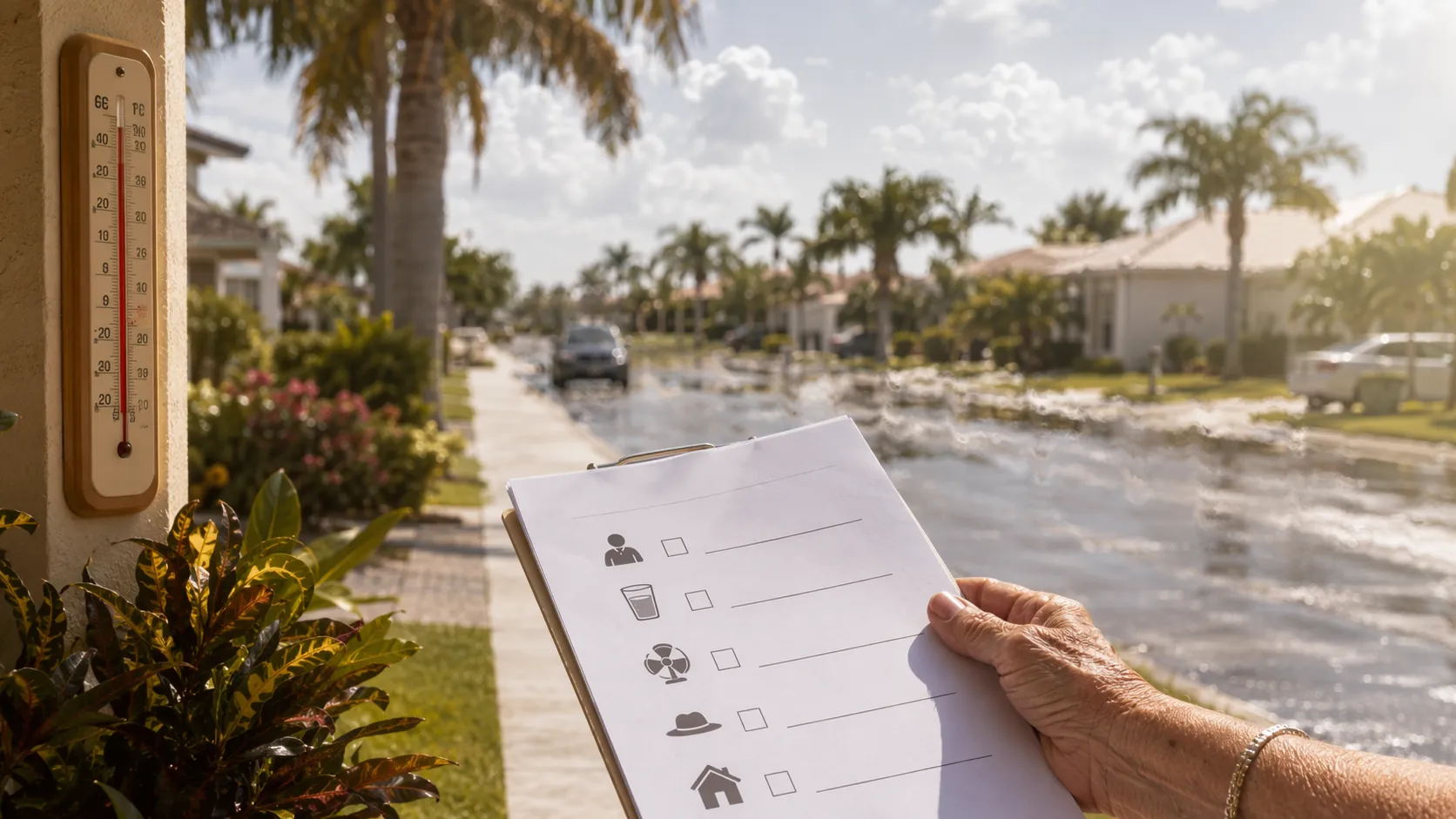
Print this first: the Florida heat advisory senior safety checklist
Use the full checklist if the advisory starts tomorrow. If the advisory is already in effect, skip directly to the “during the advisory” items and the emergency warning signs.
| Timeframe | Caregiver actions | Fall-prevention reason |
|---|---|---|
| Before the advisory | Confirm air conditioning works; plan for power loss; identify cooling locations; arrange transportation; review heat-sensitive medications with a clinician or pharmacist; set check-in times. | The safest fall is the one prevented before dizziness, weakness, or confusion begins. |
| During the advisory | Use scheduled hydration; keep the person in cooled indoor space; avoid errands during peak heat; limit outdoor movement to before 10 AM or after 6 PM when possible; use buddy check-ins. | Routines reduce the chance that thirst, fatigue, or pride delays action. |
| Call 911 | Call for emergency help if there is confusion, loss of consciousness, or body temperature above 103°F. | These are heat-stroke warning signs, not a “cool off and see” situation. [2] |
Why heat advisories belong in fall prevention
Florida recorded 3,848 fatal falls among residents age 65 and older in 2021. That number does not mean every heat advisory causes falls, and it should not be stretched that far. It does mean that when a predictable condition increases dizziness, weakness, or unsafe movement, caregivers should treat it as part of fall prevention rather than as ordinary summer discomfort. [3]
The dehydration link is real, but it needs to be handled carefully. In a Mayo Clinic Proceedings study of 30,634 older adults, 37.9% were dehydrated at baseline, and dehydration was associated with higher odds of falls, with an odds ratio of 1.13. That is a modest association, not a dramatic prediction. The study was a single retrospective cohort, and its population was 94.6% white non-Hispanic in a Midwestern setting, so it does not perfectly represent Florida’s diverse older-adult population. Still, it gives caregivers a practical reason to put hydration inside a fall-risk plan instead of treating it as a wellness footnote. [4]
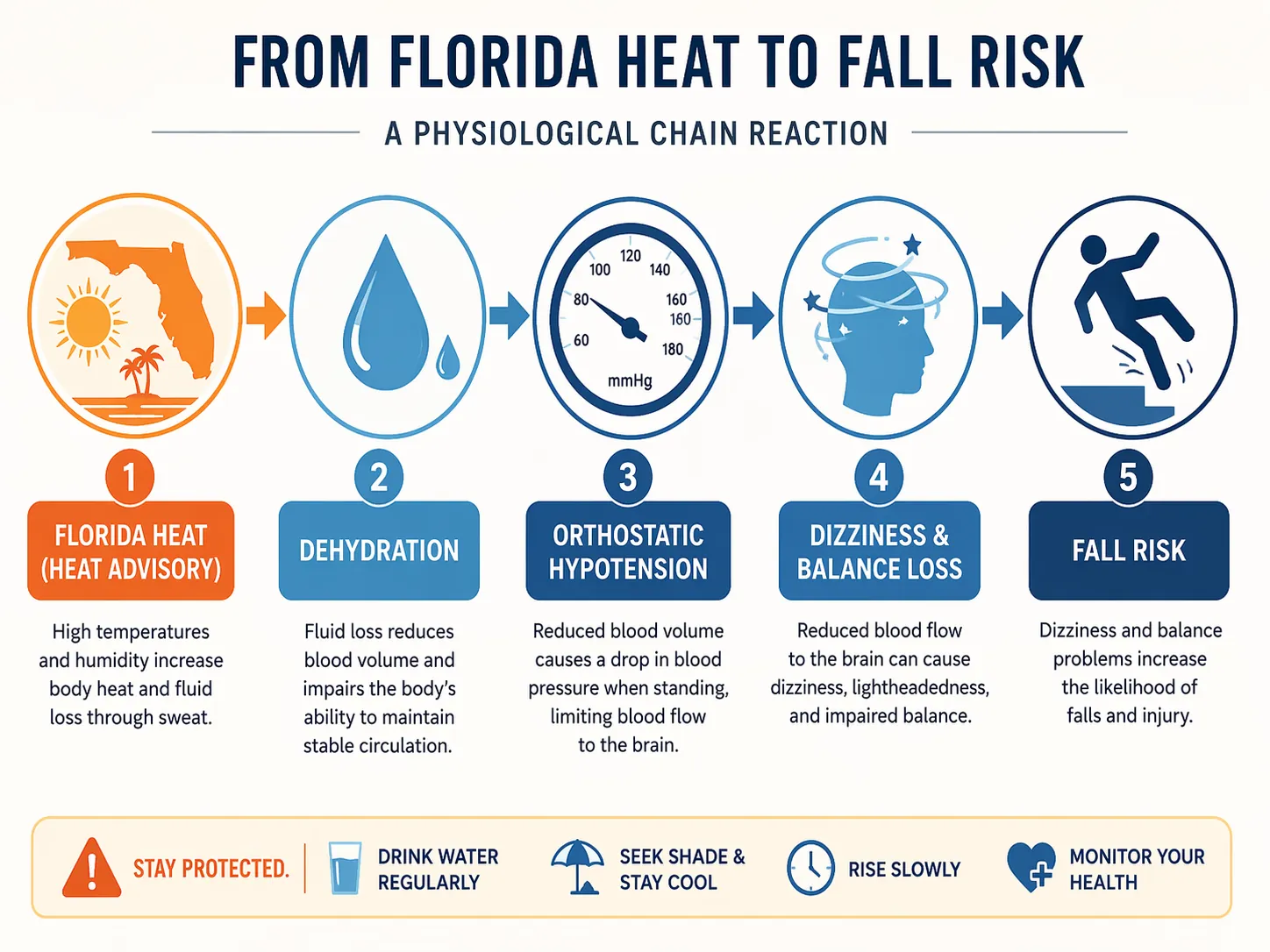
The pathway matters because it is ordinary. An older adult gets up from a recliner after a hot afternoon, walks toward the bathroom, feels lightheaded, reaches for a towel bar instead of a grab bar, and loses balance. No one needs to be outside mowing the lawn for heat to become a fall hazard.
Before the advisory: make the cooling plan boring and specific
The day before a heat advisory is when the caregiver has the most leverage. Once the indoor temperature rises, the car is too hot, the senior feels weak, or the adult child is trying to coordinate from work, every decision takes longer.
Check the air conditioning before it is needed
- Ask the older adult to confirm that cool air is coming from the vents, not just that the thermostat is “on.”
- Make sure the filter is not obviously clogged and the return vent is not blocked by furniture, boxes, or curtains.
- If the home has rooms that stay warmer than others, choose the coolest safe room as the daytime base: chair, phone charger, water, medications, glasses, walker, and bathroom path all nearby.
- If the older adult says, “I’m fine with the windows open,” do not stop there. During an advisory, the test is whether the indoor space is actually cool enough to prevent heat strain.
Fans deserve special caution. The National Weather Service warns that fans can become counterproductive when temperatures are in the high 90s and may worsen heat stress. A fan can move air around a cooled room; it should not be treated as the cooling plan when the home itself is hot. [5]
Write down the power plan
Florida heat advisories often overlap with thunderstorm season. A senior who uses oxygen equipment, a powered hospital bed, a lift chair, a CPAP device, an electric scooter, or refrigerated medication needs a power-loss plan before the lights flicker.
- Put utility account information, medical equipment details, and emergency contacts in one visible place.
- Charge phones, medical alert devices, hearing aids, mobility scooters, and backup batteries.
- Ask the county emergency management office about the special needs registry before the emergency. Pre-registration is easier than trying to enroll during an outage or evacuation.
- Choose the person who will drive, call, or pick up the older adult if the home loses cooling.
Do not assume one Florida county’s resource is another county’s promise. Cooling centers, transportation, hours, pet rules, and registration procedures are local details. Check the county emergency management page, not a statewide memory of what happened last summer.
Orange County is a useful example of why local checking matters. In June 2026, Orange County lowered its cooling-center activation threshold to a 103°F heat index and announced free LYNX bus rides to cooling locations. That is actionable for Orange County residents; it is not a statewide guarantee for every Florida caregiver. [6]
Do a medication heat-risk review without changing medications on your own
A heat advisory is a good reason to call the pharmacist, primary care office, or prescribing specialist and ask, “Which of these medicines could increase dehydration, dizziness, low blood pressure, sedation, or heat intolerance during the advisory?” It is not a reason to stop a prescribed medication without medical direction.
In the Hamrick study, several medication classes were associated with higher odds of falls or death, including diuretics with an odds ratio of 1.26, antidepressants with an odds ratio of 1.61, and anticholinergics with an odds ratio of 1.24. Those figures do not tell you what to stop; they tell you what to flag for review before heat and dehydration add another layer of risk. [4]
- Diuretics: ask whether fluid-loss symptoms, weight changes, or blood-pressure changes should trigger a call.
- Antidepressants, anticholinergics, and antihistamines: ask about dizziness, sedation, dry mouth, constipation, and confusion.
- Beta-blockers and Parkinson’s medications: ask what signs of heat intolerance, low blood pressure, or mobility change should be watched closely.
- Any medication with fluid restrictions: ask what “drink more water” should mean for this person, because a generic hydration instruction may be unsafe for some heart, kidney, or endocrine conditions.
Medication classes such as beta-blockers, antihistamines, and Parkinson’s medications are commonly included in senior heat-safety guidance because they can affect heat response, alertness, blood pressure, or movement. Use that as a prompt for a clinician or pharmacist conversation, not as medication advice from a checklist. [7]
Answer the four rapid questions before the heat arrives
The CDC’s rapid assessment for older adults asks whether the person is drinking enough water, has access to air conditioning, knows how to keep cool, and knows the signs of heat stress. Those four questions work well because they expose the usual weak spots: the senior has water but is not drinking it, owns an air conditioner but avoids using it, knows heat is dangerous but does not know when to call for help. [2]
| Question to ask | What a useful answer sounds like |
|---|---|
| Are you drinking enough water? | “I have a drink next to my chair, and I’m drinking at planned times.” |
| Do you have access to air conditioning? | “The AC is working, and I know where I’ll go if it stops.” |
| Do you know how to keep cool? | “I’ll stay in the cooled room, avoid errands, and use cool showers or cloths if I feel overheated.” |
| Do you know signs of heat stress? | “If I’m confused, faint, or very hot, I won’t wait it out.” |
During the advisory: turn good intentions into timed actions
During a Florida heat advisory, a senior should not have to remember every safety step from scratch. Put the day on rails.
Use scheduled hydration, not thirst
Thirst is a poor manager during heat, especially when an older adult is trying to avoid extra bathroom trips or does not want to be fussed over. Set drink prompts for the day: morning, late morning, lunch, midafternoon, dinner, and evening. If the person has been told to restrict fluids, follow the clinician’s limit and ask what heat-advisory adjustments are safe.
- Place water or an approved drink where the person already sits, not across the room.
- Pair drinking with existing habits: morning pills, TV news, lunch, afternoon phone call, dinner, evening medication.
- Watch for fewer bathroom trips, dark urine, dry mouth, new fatigue, new dizziness, or a sudden “I just feel off.”
- Do not push large amounts of fluid at once if the person has heart failure, kidney disease, or another condition with fluid limits. Get individualized instructions.
Keep the walking path short and cooled
Heat risk and fall risk meet in movement. The goal is not to keep an older adult motionless all day. The goal is to remove unnecessary hot, dizzy, rushed walking.
- Move the daytime chair, phone, water, medications, walker, and glasses into the coolest usable room.
- Clear the route to the bathroom before the advisory: no loose throw rugs, cords, laundry baskets, pet bowls, or shoes in the path.
- Encourage slow position changes: sit up, pause, stand, pause, then walk.
- Use the walker or cane even inside the home if the person is weaker than usual. Heat-advisory days are not the day to prove independence by skipping the device.
For deeper home setup after the heat event, continue with the site’s home modification guides and medication-review resources in the fall-prevention section. Those projects matter, but the heat-advisory day itself calls for the shortest safe path and the least improvisation.
Move errands out of peak heat
If an errand can wait, let it wait. If it cannot, aim for before 10 AM or after 6 PM, and arrange curb-to-door help whenever possible. That includes pharmacy pickups, groceries, lab work, religious services, mailboxes, trash bins, and pet walks. The dangerous trip is often the “quick one” no one thought to cancel.
- Move trash and mail tasks to a cooler hour or have someone else do them.
- Use delivery, drive-through, curbside pickup, or a neighbor handoff for prescriptions and groceries.
- Do not let a senior sit in a hot parked car while someone “runs in quickly.”
- If transportation to a cooling location is needed, confirm the ride before symptoms begin.
Use buddy check-ins with questions that catch trouble
A check-in that only asks “Are you okay?” is too easy to answer with “I’m fine.” Use questions that make the older adult report conditions and actions.
- What room are you sitting in right now?
- Is the air conditioner blowing cool air?
- What have you had to drink since breakfast or lunch?
- Have you felt dizzy when standing?
- Have you used the bathroom normally today?
- Are you planning to go outside for mail, trash, pets, or errands?
For a senior who resists being monitored, make the plan reciprocal and short: “I’m going to call at lunch and dinner during the advisory. Just answer these six things so I don’t have to keep bothering you.” It is not perfect, but it is better than a vague reminder text sent during the hottest part of the day.
Heat exhaustion versus heat stroke: what to do
Caregivers do not need a medical lecture in the middle of a heat advisory. They need to know when to cool, when to call, and when not to negotiate.
| What you see | Likely urgency | Action |
|---|---|---|
| Heavy sweating, weakness, nausea, cramps, headache, dizziness, or feeling faint | Possible heat exhaustion | Move to air conditioning, loosen clothing, use cool cloths or a cool shower if safe, give sips of water if allowed, and call a clinician or urgent line if symptoms do not improve or the person is high risk. |
| Confusion, loss of consciousness, or body temperature above 103°F | Possible heat stroke | Call 911. Begin cooling while waiting for help if you can do so safely. Do not wait to see if the person “comes around.” [2] |
| A fall, near-fall, or new inability to stand or walk safely | Fall-risk event even if the person says they are fine | Do not rush the person up. Check for injury, call for help if needed, and treat heat exposure as part of the event. |
Confusion is especially important. An older adult who is suddenly disoriented, unusually sleepy, combative, or unable to answer normal questions is not simply being stubborn about the heat. That is the moment emergency care may need to take over.
Use county information, not statewide assumptions
Before each advisory, verify the county alert, cooling-center status, transportation options, and special needs registry instructions. Florida is too varied for one cooling-center sentence to cover Miami-Dade, Broward, Orange, the Panhandle, the Keys, and inland rural counties accurately.
- Start with the NWS alert for the county.
- Check the county emergency management or county government page for cooling locations and hours.
- Confirm whether transportation is available and whether it requires a specific route, ID, fare waiver, or pickup arrangement.
- If electricity supports medical equipment, complete the county special needs registry before the next emergency.
- If the older adult is traveling outside Florida, use a location-specific heat plan rather than carrying Florida thresholds into another region.
For comparison outside Florida, see Is Your Parent Safe in Extreme Heat? A Kansas City Fall Prevention Guide. For travel planning, continue with Summer Destinations Where Heat Puts Seniors at Highest Fall Risk. If the heat advisory overlaps with storm season planning, pair this with A Room-by-Room Severe Storm Safety Checklist for Seniors.
References
- Daily Heat Index, National Weather Service.
- Heat and Older Adults, Centers for Disease Control and Prevention.
- Older Adult Falls Prevention, Florida Department of Health.
- Association Between Dehydration and Falls, Mayo Clinic Proceedings, 2020.
- Heat Safety, National Weather Service.
- Orange County Lowers Cooling Center Activation Threshold, Orange County Florida Newsroom, June 2026.
- Senior Heat Safety, Horizon Care Services.
Related reading
Noticed something outdated or inaccurate on this page? Flag a correction. We review every report against CDC, NIA, and AARP HomeFit guidance before updating a page.
Part of the Fall Prevention section.