
STEADI: intervene
Your 72-Hour Heat Dome Fall Prevention Checklist for Parents
When a heat dome is forecast, standard heat advice isn't enough — overnight cooling denial multiplies fall risk. This 72-hour plan gives you sequenced steps from medication review to twice-daily check-ins, tailored to protect an aging parent from heat-triggered falls.
When a heat dome forecast shows up three days out, the question is not just whether your parent will feel hot. The safer question is: will their body get a real chance to cool down overnight? Heat domes matter for fall prevention because they can keep bedrooms, hallways, bathrooms, and apartment corridors warm after sunset, which means an older adult may start the next day already tired, mildly dehydrated, and less steady.
That is how the ordinary chain starts: a warm room, less thirst than expected, a medication taken on schedule, dizziness when standing, a late bathroom trip, one hand on the counter instead of the grab bar. The 2021 Pacific Northwest heat dome showed how dangerous that chain can become for older adults; reporting after the event found that 78% of people who died were 60 or older, and in Multnomah County the average age was 70.[1][2]
If you are trying to interpret whether this is an advisory, warning, or something more unusual, a quick companion explainer on heat advisories versus warnings for seniors can help. But once a heat dome is in the forecast, do not wait for the alert language to feel dramatic. Use the next 72 hours to make the fall-risk pathways visible and assignable.
Why Heat Raises Fall Risk Before Anyone Looks Sick
Heat-related falls are not only a problem after someone collapses. They can start earlier, when dehydration lowers blood volume, standing up causes dizziness, fatigue slows reaction time, and coordination gets worse. A 2025 study in npj Climate and Atmospheric Science found that each 1°C above the local minimum-mortality temperature was associated with a 1.48% increase in fall-related mortality risk, based on 860,724 fall deaths across 31 Chinese provinces.[3]
That number should not be lifted into a precise U.S. prediction. Air-conditioning access, housing, health care, and local response systems differ. What it does support is the mechanism caregivers already see at home: heat can make balance, blood pressure, hydration, alertness, and safe movement worse at the same time.
The CDC treats adults 65 and older as a higher-risk group during extreme heat and advises caregivers to check on older adults at least twice a day, including whether they are drinking enough water, have access to air conditioning, know how to keep cool, and show signs of heat stress.[4] That twice-daily check is not a courtesy call. During a heat dome, it is the backbone of fall prevention.
The 72-Hour Sequence
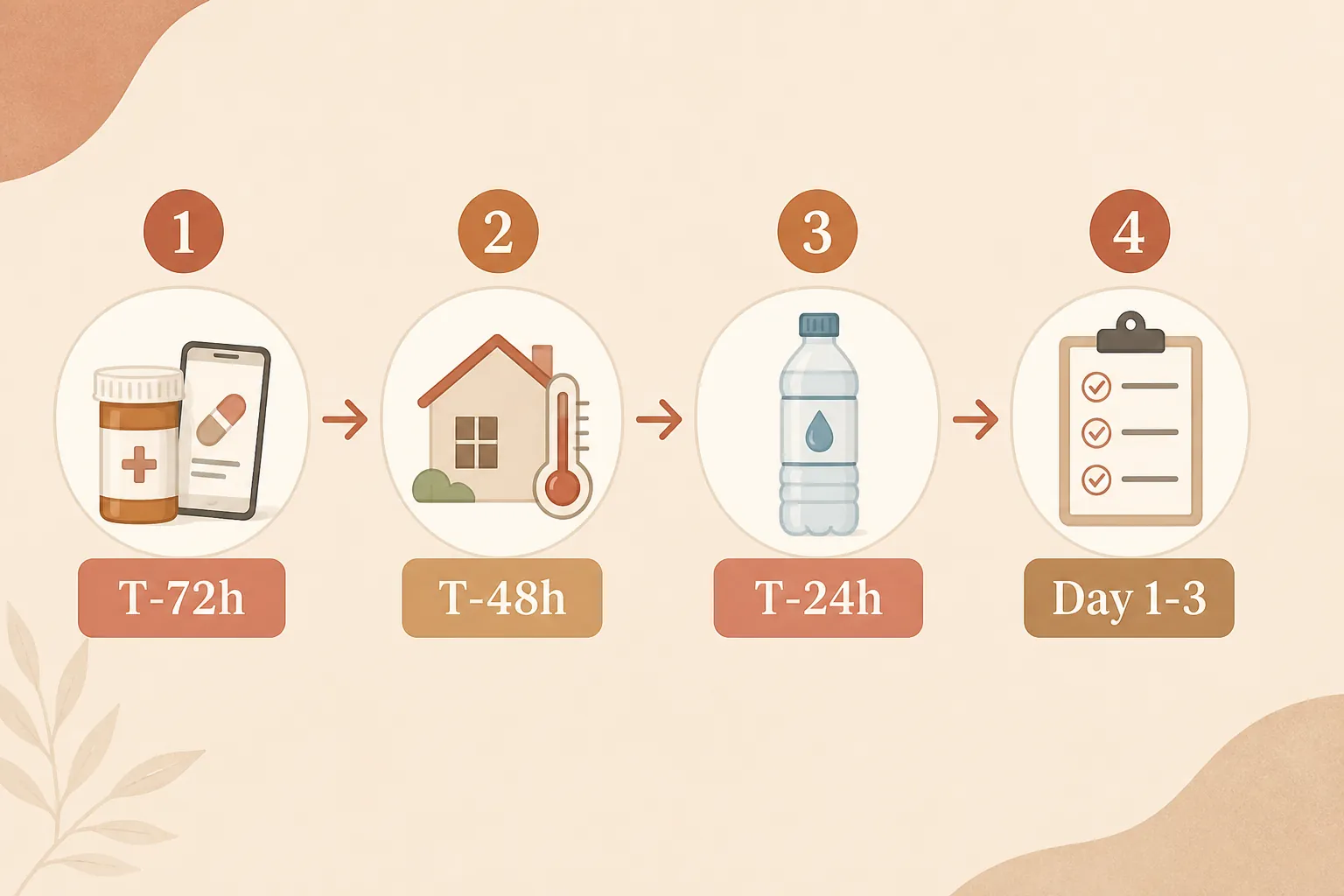
| Timing | Main job | What must be verified |
|---|---|---|
| T-72h | Medication and vulnerability review | Doctor or pharmacist contacted; heat-sensitive medication categories identified; no prescriptions changed without medical guidance |
| T-48h | Cooling audit | Bedroom cools at night; cooling room identified; fan used only when appropriate; backup plan exists if power or AC fails |
| T-24h | Hydration and mobility setup | Water is reachable where the parent sits and sleeps; bathroom route is clear and lit; walking aids are in place |
| Days 1-3 | Twice-daily monitoring | Hydration, cooling access, symptoms, steadiness, and emergency thresholds checked every morning and evening |
If siblings, neighbors, aides, or building staff are involved, give each person one part of the sequence. “Someone should check on Mom” is how everyone assumes someone else did it. “Eli calls the pharmacy today, Renee checks the bedroom thermometer tomorrow, I do morning video calls, and the neighbor knocks at 7 p.m.” is a plan.
T-72h: Call About Medications Before the Heat Arrives
Start here because this is where well-meaning families can do harm. Do not stop, skip, halve, double, or “hold for a hot day” any prescription unless the doctor, pharmacist, or prescribing clinician tells you to. Heat planning is not an invitation to improvise with blood pressure pills, diuretics, sedatives, diabetes medications, or anything else in the pill organizer.
The CDC’s clinician guidance says some medications can increase heat sensitivity through mechanisms including reduced thirst sensation, volume depletion with increased risk of fainting and falls, sedation, impaired sweating, and electrolyte imbalance.[5] AARP’s medication review similarly highlights drug classes that can make heat harder to handle, including diuretics, some blood pressure medications, antihistamines, antidepressants, antipsychotics, stimulants, and certain diabetes medicines.[6]
Your job at T-72h is not to diagnose the risk. Your job is to get the medication list in front of someone qualified before the first dangerously hot night.
- Make a current medication list: prescription drugs, over-the-counter sleep aids, allergy pills, pain relievers, supplements, and any “as needed” medications.
- Mark anything that affects blood pressure, urination, alertness, sweating, electrolytes, or blood sugar, then ask the pharmacist or clinician whether the heat dome changes monitoring needs.
- Ask what symptoms should trigger a same-day call: dizziness on standing, confusion, faintness, unusual sleepiness, vomiting, poor urination, or a fall.
- Ask whether the parent should monitor blood pressure, weight, blood sugar, or fluid intake differently during the event, if they already use those tools.
- Write down the answer, the name of the person who gave it, and the after-hours number. Do not rely on memory during the hottest evening of the week.
This call also helps with family friction. A parent who resents being managed may accept, “The pharmacist said we should watch for dizziness when you stand,” more easily than, “I read something and now I’m worried about your pills.”
T-48h: Audit the Cooling, Especially the Bedroom
Do not ask only whether the house has air conditioning. Ask where your parent will actually spend the afternoon, where they will sleep, and whether those rooms cool down after dark. A window unit in the living room does not protect a bedroom that stays hot until morning.
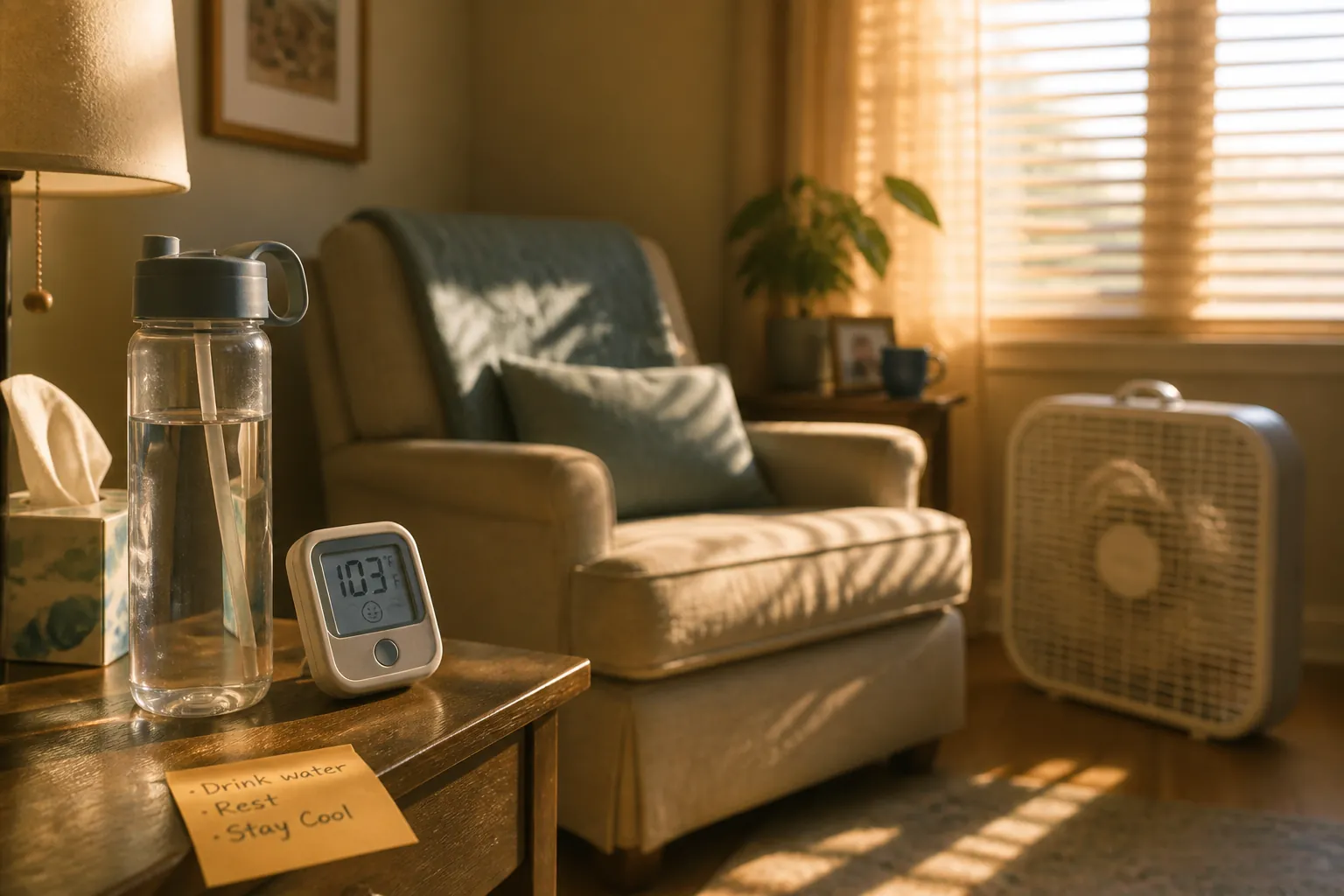
- Put a thermometer in the bedroom and the main sitting area. If you are remote, ask someone to send a photo of the reading, not a verbal “it feels okay.”
- Identify the coolest room and move the favorite chair, phone charger, water, medications, glasses, and walking aid there before the heat peaks.
- Check whether blinds, curtains, and doors can be managed without climbing, reaching awkwardly, or standing on a chair.
- Confirm that the bathroom route from the cooling room and bedroom is short, lit, and free of throw rugs, cords, laundry baskets, pet bowls, and low furniture.
- Name a backup cooling location: a relative’s home, a senior center, a library, a cooling center, or another air-conditioned place the parent is willing and able to reach.
This is also the moment to plan for power trouble. Heat domes can strain the grid, and a dark, hot apartment creates two fall risks at once: overheating and unsafe movement. If outages are plausible in your area, use a backup plan from a power outage fall-risk checklist: charged phone, reachable flashlight, battery lantern near the bed, transportation option, and a person assigned to check in.
The Fan Rule Deserves Its Own Check
A fan can feel like a safety device because it moves air. During high heat, that assumption can be wrong. The CDC says fans should be used only when indoor temperatures are below 90°F; above that, a fan can make dehydration worse by blowing hot air across the body.[7]
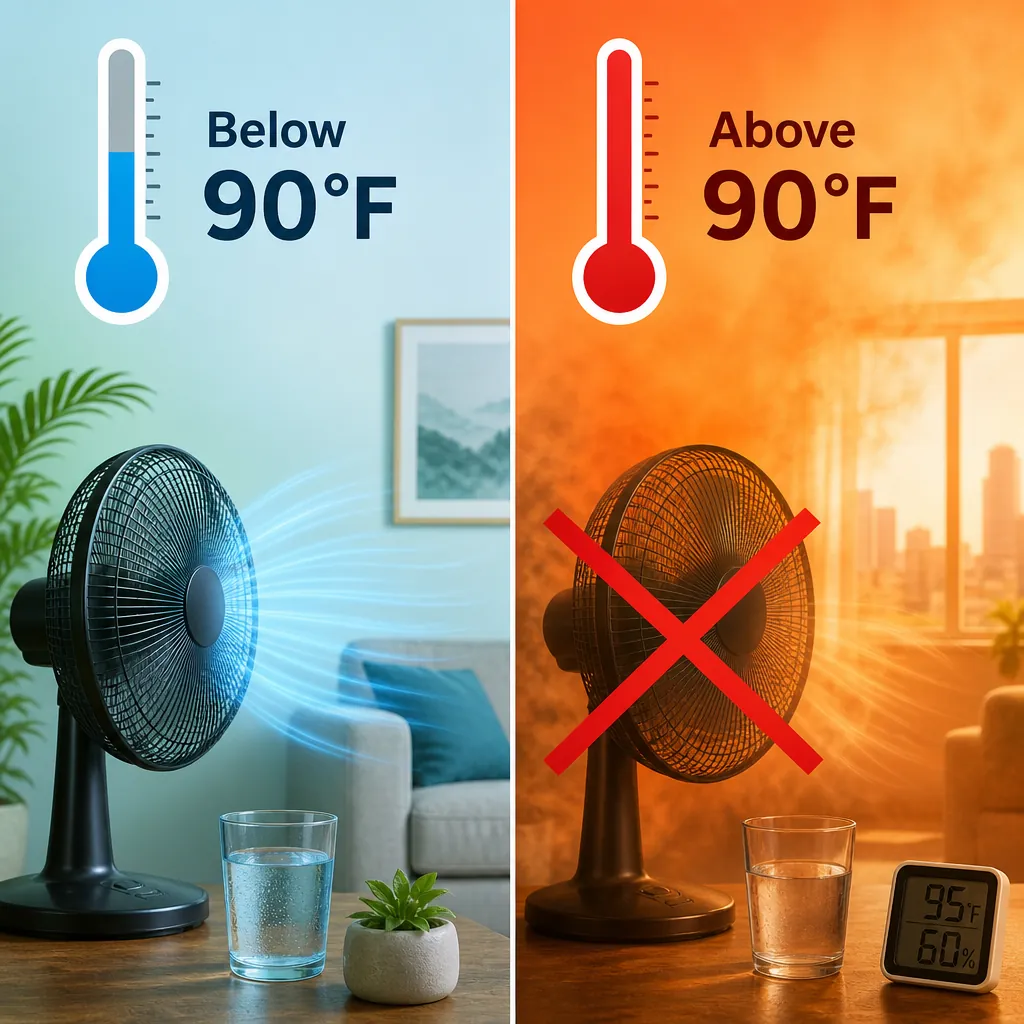
So the fan question is not “Does Dad have one?” It is “What is the room temperature when he uses it?” If the room is above 90°F, the plan needs air conditioning, relocation, a cooling center, or another cooling method, not just more airflow.
For readers in hot-climate states, the Florida heat advisory senior safety checklist is useful as a companion, but keep the heat dome focus sharper: verify overnight cooling, not just daytime comfort.
T-24h: Put Water and Safe Movement Where Life Actually Happens
Hydration advice usually fails because it is written as a virtue instead of a setup. “Drink more water” does not help much if the water is in the kitchen and your parent spends the afternoon in a recliner trying not to get up.
- Place water where the parent sits, sleeps, takes medication, and watches TV. Use bottles or cups they can open and lift easily.
- Pair drinks with existing routines: morning pills, lunch, evening news, bedtime medication, and every phone check-in.
- Set out light, loose clothing and remove heavy robes, slippery socks, and shoes that become unstable when feet swell.
- Move the walker, cane, or rollator to the side the parent naturally reaches for when standing, not where it looks tidy.
- Put nightlights on the route from bed to bathroom and from the cooling room to bathroom. Test them after dark.
- Ask directly about bathroom urgency. Heat planning often increases fluids; more trips to the bathroom can mean more chances to fall.
If your parent lives alone, do one extra pass through the home as if it were 2 a.m. and they were half-awake: phone within reach, glasses in the same place, floor clear, bathroom light visible, and no need to cross a hot dark room to get water. A broader severe weather checklist for seniors living alone can help if you are also dealing with storms, outages, or limited local support.
Days 1-3: Check Twice Daily, and Check the Right Things
During the heat dome, make the check-ins boring, specific, and documented. Morning matters because a hot night can leave someone starting the day depleted. Evening matters because fatigue, medication timing, and bathroom trips tend to collide after sunset.
| Check | Ask or verify | Fall-prevention reason |
|---|---|---|
| Hydration | What have you had to drink since waking or since lunch? Where is the next drink? | Dehydration can worsen dizziness, weakness, and standing tolerance. |
| Cooling access | What is the room temperature? Are you in the coolest room? Did the bedroom cool last night? | A warm room can keep fatigue and heat strain building. |
| Cooling knowledge | What will you do if the room gets too hot or the power goes out? | The backup plan must be usable before confusion or weakness sets in. |
| Standing symptoms | Any dizziness, faintness, wobbliness, headache, nausea, confusion, unusual sleepiness, or trouble walking? | These are the symptoms that can turn a hallway or bathroom trip into a fall. |
| Mobility route | Is the path to the bathroom clear and lit right now? | Heat planning fails if the safest room creates a new unsafe route. |
| Escalation | Who is coming over if symptoms appear? Who calls the doctor? Who calls 911? | No one should be negotiating roles during a possible heat emergency. |
If you are checking by phone, listen for the small things: slower answers, irritation that is out of character, a parent saying “I’m fine” but breathing hard after walking to the phone, or a vague “I just feel off.” If you can use video, ask them to stay seated while you talk. This is not the time to make someone perform a balance test on camera.
If someone can visit in person, have them look at the room, not just the parent. Is the water untouched? Is the fan running in a room that feels hot? Are blinds open to direct sun? Is the walker across the room? Are there new towels, cords, or laundry in the path to the bathroom? The fall hazard is often visible before the parent admits anything is wrong.
When to Escalate
Call the doctor, pharmacist, nurse line, or local urgent guidance source promptly for new dizziness, faintness, confusion, vomiting, worsening weakness, very low fluid intake, reduced urination, or any fall. Do not wait to see whether the next glass of water fixes it if the person is unsteady or not thinking clearly.
Call 911 for suspected heat stroke or severe symptoms, including a body temperature of 103°F or higher, confusion, loss of consciousness, seizures, or hot, red skin; CDC and Red Cross guidance both use 103°F as an emergency threshold.[4][8]
If the parent refuses help, lower the argument. Offer a specific next step instead of a lecture: “I’m not asking you to leave the house. I’m asking you to sit in the cooler room until dinner and keep the phone beside you.” If they will not do that and symptoms are present, treat the symptoms as the issue, not the disagreement.
For Long-Distance Caregivers
Distance does not prevent preparation, but it does punish vague assignments. In the first call, decide who has eyes on the home, who has medication authority, who can drive, and who can enter if there is no answer. If no family member is nearby, consider a neighbor, building manager, faith community contact, paid aide, or local aging services office.
- Ask for photos: thermostat, bedroom thermometer, water setup, bathroom route, medication list, and phone charging location.
- Set two daily call times and a missed-call rule: if there is no answer after a set number of tries, the local contact checks in.
- Keep the pharmacy number, clinician number, building office, neighbor, and local emergency line in one shared note.
- Arrange transportation to a cooling location before the parent needs it. Heat, dizziness, and last-minute rides are a bad combination.
The plan does not have to be elegant. It has to be verifiable. During a heat dome, “I checked” means you know the room cooled, the water is reachable, the medication question was asked, the bathroom path is clear, and someone will notice if steadiness changes.
References
- The Effects of Heat on Older Adults, Harvard Medicine Magazine
- Extreme Heat Waves Pose Deadly Risk to Older Adults, AARP
- Age inequality in temperature-related fall mortality, npj Climate and Atmospheric Science, 2025
- Heat and Older Adults (Aged 65+), CDC
- Heat and Medications Guidance for Clinicians, CDC
- 8 Types of Medications That Can Make It Harder to Handle the Heat, AARP
- About Heat and Your Health, CDC
- Extreme Heat Safety, American Red Cross
Related reading
Noticed something outdated or inaccurate on this page? Flag a correction. We review every report against CDC, NIA, and AARP HomeFit guidance before updating a page.
Part of the Fall Prevention section.