
STEADI: intervene
Why Earthquake Preparedness for Elderly in Japan Is Fall Prevention
Most earthquake preparedness and fall prevention guides address the same home modifications separately. This article shows why caregivers in Japan can treat one action plan as both—and how failing to connect them costs older adults their lives.
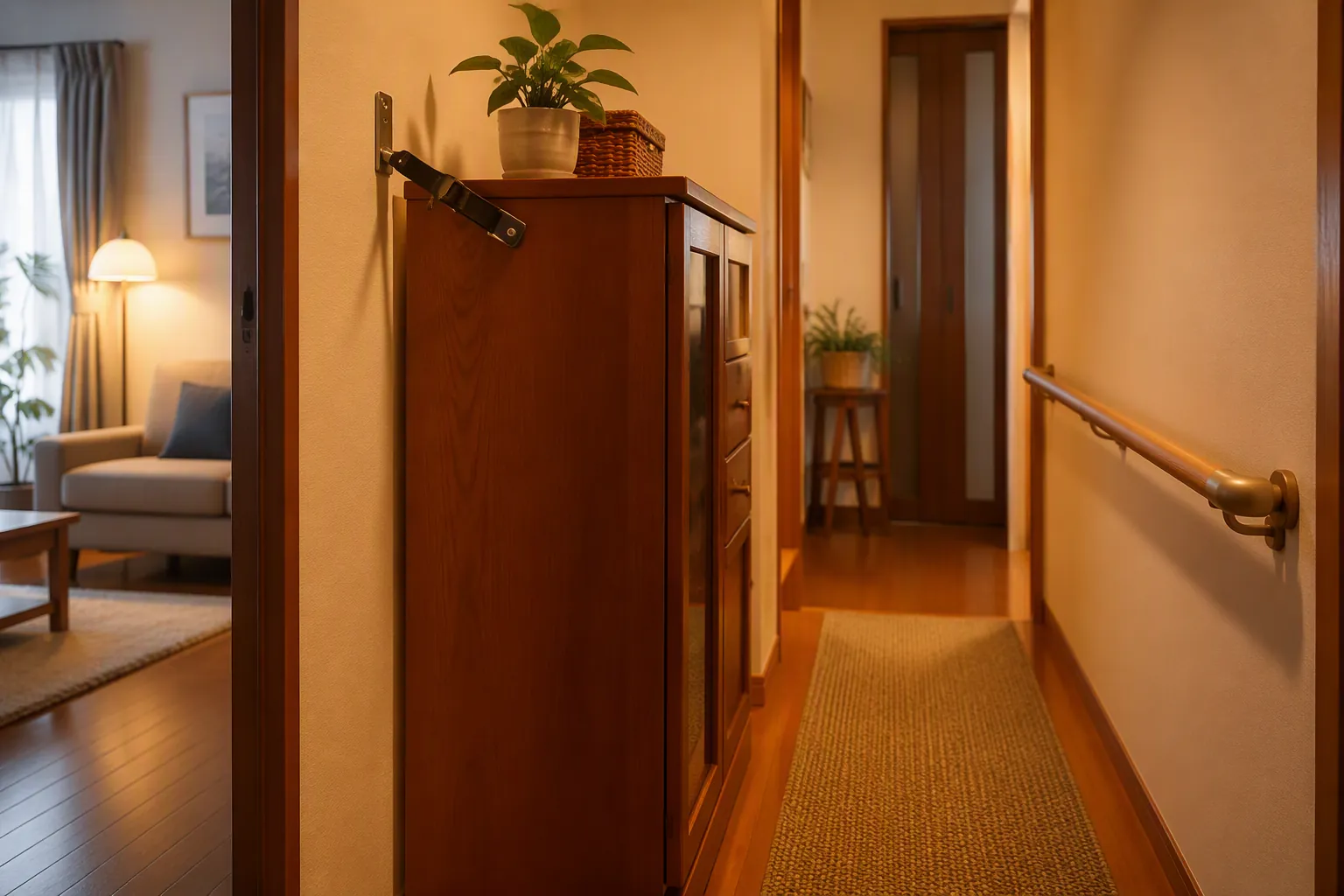
A family can be handed one guide for fall prevention and another for earthquake preparedness for elderly in Japan, as if the apartment politely separates those risks. It does not. The same low cabinet narrows the night path to the toilet and becomes an obstacle after shaking. The same tall wardrobe that “has always been there” can tip forward. The same dark hallway makes a parent hesitate on an ordinary evening and lose orientation when the power is out.
So the first useful correction is simple: for older adults, earthquake preparedness is fall prevention. The work is not mainly about imagining a dramatic disaster scene. It is about whether someone can stay uncrushed, upright, oriented, and mobile when the home stops behaving like the home they know.
The risk does not end when the shaking stops
The age pattern in Japanese disasters is too stark to treat as a side note. In the 2011 Great East Japan Earthquake, people aged 65 and older accounted for 56.1% of fatalities, even though they were 23% of the affected population, according to reporting that drew on Japanese National Police Agency data cited by UNDRR.[1] That disaster included tsunami deaths, so it should not be flattened into a lesson about every inland earthquake. But it still shows the uncomfortable point caregivers already recognize: older bodies pay more for delayed movement, disrupted surroundings, and interrupted support.
The 2024 Noto Peninsula Earthquake makes the post-disaster part harder to ignore. An ICMA article, citing Ishikawa Prefecture data published in December 2025, reported that 94% of disaster-related deaths were among people aged 70 and older.[2] Another analysis of Noto deaths reported that 456 of 684 total deaths were disaster-related, meaning they were attributed to conditions after the earthquake rather than to direct impact from the quake itself.[3]
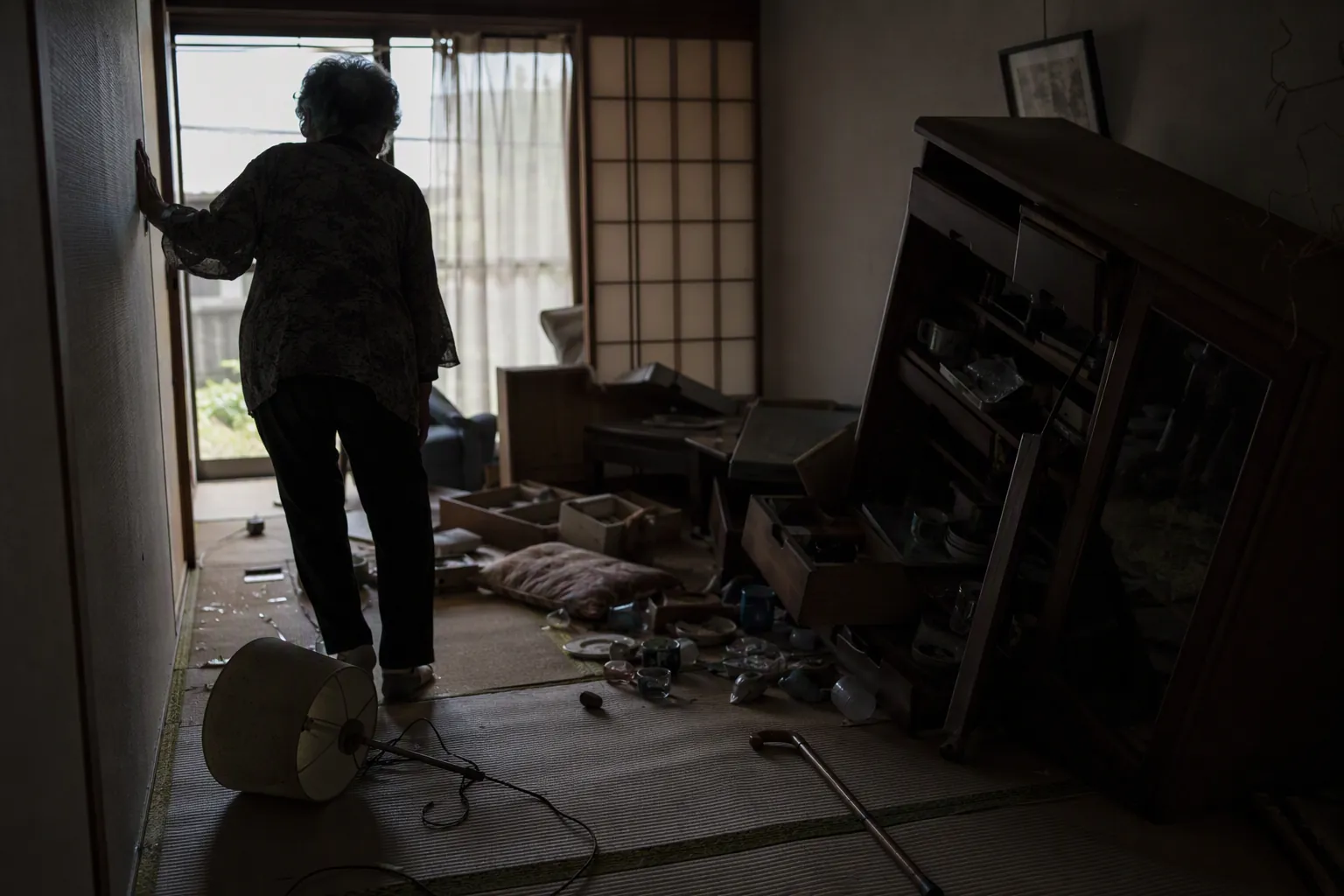
That distinction matters inside a real apartment. Direct earthquake injury is one danger. The damaged environment afterward is another: no light, furniture shifted across a walkway, spilled contents underfoot, a toilet that is difficult to reach, a shelter floor that is low and unfamiliar, or a return home where the older person moves with more fear than before. A preparedness plan that stops at “survive the shaking” is too short for the person who still has to stand up afterward.
Home damage can become fall risk for years
The strongest reason to combine the two checklists comes from the Japan Gerontological Evaluation Study, or JAGES. A 9-year follow-up study of older adults after the 2011 Great East Japan Earthquake and Tsunami examined how disaster damage, financial hardship, and community conditions related to fear of falling and recurrent falls over time.[4]
The study found that financial hardship after the disaster was associated with 75% higher odds of fear of falling, with an odds ratio of 1.75. Home destruction was associated with 168% higher odds of recurrent falls, with an odds ratio of 2.68. Social cohesion showed a protective association, with lower odds of fear of falling and falls.[4]
Those numbers do not prove that every damaged home directly caused every later fall. The study concerns a coastal earthquake-and-tsunami disaster, and the pattern may differ in an inland earthquake without tsunami damage. But the mechanism is not mysterious. When a home is damaged, repaired slowly, rearranged, crowded with temporary items, or replaced by unfamiliar housing, the older person is not walking through the same risk environment anymore. Fear of falling can also change behavior: a parent may stop going out, lose strength, hesitate more, or rely on unsafe handholds because the safer ones are not where their body expects them to be.
This is where separate advice becomes wasteful. Fall prevention literature tells families to reduce trip hazards, improve lighting, support balance, and keep essential routes clear. Earthquake advice tells them to secure furniture, prevent objects from falling, and preserve an evacuation path. In an older person’s home, these are not competing projects. They are the same physical corrections viewed from different dates on the calendar.
Start with what can fall, slide, block, or disappear in the dark
The most practical plan is not organized by “fall prevention day” and “earthquake day.” It is organized by home function: sleeping, standing, walking, toileting, reaching medication, and exiting. Anything that interferes with those functions deserves attention before the next printed checklist is added to the folder.
| Home condition | Everyday fall-prevention value | Earthquake-preparedness value |
|---|---|---|
| Tall furniture secured to a wall or stabilized with appropriate devices | Reduces tipping, bumping, and unstable support surfaces | Reduces crushing risk and keeps exits less obstructed |
| Clear path from bed to door and bed to toilet | Reduces night trips, cane obstruction, and side-stepping | Preserves a route after shaking, darkness, or scattered belongings |
| Grab bars or stable handholds near toilet, bath, entry, and steps | Supports transfers and balance during daily movement | Helps standing, waiting, and moving when the floor or surroundings feel unreliable |
| Lighting that can be reached from bed and along the toilet route | Reduces hesitation and missteps at night | Helps orientation during outages, aftershocks, or evacuation |
| Frequently used items stored low and forward | Prevents climbing, overreaching, and sudden loss of balance | Reduces falling-object hazards and frantic searching after a quake |
Furniture anchoring deserves to be first because it is so easy to postpone. The wardrobe is heavy. The wall is thin. The apartment is rented. Someone worries about drilling. Someone else says the cabinet has survived many earthquakes already. Meanwhile, it may also be the thing a parent touches for balance because there is no proper handhold nearby.
A commonly cited lesson from the 1995 Hanshin-Awaji Earthquake points in exactly this direction: roughly 90% of deaths were from crushing by falling furniture rather than building collapse. The useful takeaway is not historical drama. It is that unsecured furniture is not “only” an earthquake problem. In an older adult’s home, it is also a daily mobility problem waiting to become heavier.
For caregivers, the question is not whether every item can be perfectly fixed in one weekend. It is which objects can injure someone in bed, block the route out of the room, or become the wrong thing to grab during a loss of balance. Start there. Tall cabinets, bookcases, wardrobes, refrigerators, microwave shelves, and stacked storage near sleeping areas matter more than decorative perfection.
Rental walls are a real obstacle, not an excuse to do nothing
In Japan, many older adults live in apartments where drilling into walls feels complicated, especially in rentals or older buildings. That resistance is not imaginary. A daughter or son may also be trying not to make a parent feel inspected in their own home. Still, “we cannot drill today” should lead to the next safest stabilizing option, not to another year of accepting a tall cabinet beside the bed.
Depending on the wall, floor, furniture, and lease conditions, families may need landlord permission, professional installation, tension devices, non-slip pads, relocation, or removal. Commercially sold earthquake devices vary, and product guidance is often easier to find through English-language or commercially oriented sources than through the original Japanese materials. That is a reason to be careful, not passive. The safety decision is still physical: can this object tip, slide, spill, or block the person who needs to move?
The route from bed to toilet is an evacuation route too
If only one route in the home gets serious attention, make it the route from bed to door and bed to toilet. Older adults fall at night because they are sleepy, hurried, medicated, in pain, or trying not to wake anyone. After an earthquake, the same route may include broken glass, shifted storage, a fallen lamp, a door that does not open cleanly, or a cane that has rolled under bedding.
A clear route means more than a tidy room. It means the walking path is wide enough for the actual mobility aid used in that home. It means no low stool near the futon, no seasonal bedding piled beside the wardrobe, no power cord crossing the path, no shopping bags waiting “just for today,” and no small furniture placed where someone must turn in the dark.
This is also where earthquake preparedness becomes less theoretical. If a parent uses a cane, walker, or furniture for support, the aid must be reachable after shaking. A cane leaning loosely against a cabinet may not be there when needed. A walker stored in the genkan may be useless to someone who must first cross a cluttered bedroom. The safer plan keeps mobility support beside the person, not somewhere that looks neat in daylight.
After a quake, the first inspection should also be a fall-risk inspection: what shifted, what spilled, what is now underfoot, what door is jammed, what handhold is gone. A more detailed post-shaking walkthrough belongs in a separate checklist, but the principle is the same: do not let the home reopen to an older person until the walking routes have been checked as walking routes, not just as property damage. See the post-earthquake fall prevention checklist for seniors for that after-the-shaking step.
Grab bars are not a luxury upgrade
Grab bars are easy to treat as a later aging modification, especially when a parent still insists they are “fine.” But balance often fails in predictable places: standing from the toilet, stepping into the bath, changing shoes at the entry, turning in a narrow hallway, or moving from a futon or low bed to standing. During aftershocks or evacuation, those are still the places where the body needs help.
The important distinction is between a real handhold and furniture that happens to be nearby. A towel rack is not a grab bar. A sliding door frame may not hold body weight. A cabinet handle can pull open. A shoe cupboard may move. If the home already shows where the older person reaches, that is useful evidence. It tells the family where support is missing.
In a rental, permanent bars may require permission. In some homes, a professional may be needed to find a safe mounting surface. Where permanent installation is not immediately possible, the interim measure should still be chosen by load and stability, not by how harmless it looks online. A temporary aid that slips is not a compromise; it is a new hazard wearing a helpful label.
Lighting decides whether a safe route is actually usable
Many homes technically have a flashlight. It is in a drawer, behind towels, inside an emergency bag, or under seasonal bedding. That does not help a person who wakes in the dark after a tremor and needs to sit up without stepping onto broken or shifted objects.
Lighting should be placed where movement begins, not where storage is convenient. A reachable bedside light, a motion light along the toilet route, and a light source near the entry can reduce ordinary night falls and make the first minutes after shaking less confusing. The question is not “Do we own a flashlight?” It is “Can this person reach light before standing?”
This matters even more for people with poor vision, dizziness, cognitive changes, or anxiety after aftershocks. Darkness turns small obstacles into decisions. Older adults should not have to identify a safe place to step by memory when the furniture may no longer be where memory says it is.
Shelters and temporary housing continue the same fall problem
Evacuation does not move an older adult into a risk-free space. It often moves them into a more difficult one: unfamiliar toilets, crowded floors, poor sleep, low bedding, steps, lines, dim routes at night, and fewer private places to steady themselves. The Noto disaster-related death pattern is one reminder that the survival problem extends into the days and weeks after the first event.[2][3]
For a caregiver, this changes what belongs in the plan. Medication lists and emergency contacts still matter, but so do mobility aids, glasses, hearing aids, continence supplies, a small light, non-slip footwear, and a way to communicate that the person needs help with transfers or toileting. Shelter fall prevention is not a separate specialty topic. It is the same balance problem moved into a public place.
For more on that specific phase, use the guide to post-earthquake fall prevention for older adults in shelters. The pre-quake home work still comes first because it determines whether the person can get out, bring the right aids, and avoid an injury before reaching help.
Underprepared younger residents are a warning, not the main story
Preparedness gaps are not limited to older households. A 2023 survey of international students in Japan found that only 12.3% had attached fall-prevention devices to furniture.[5] That sample should not be treated as a measure of older Japanese households. Students are a different group, with different housing, money, language access, and risk perception.
Still, the result is a useful warning. If younger residents living in Japan often do not secure furniture, it is not realistic to assume that older households will complete a longer, more complicated plan unless the plan is made clearer. A combined fall-and-earthquake approach removes duplication. It says: fix the physical hazards that will hurt this person in ordinary life and in a damaged room.
A caregiver plan by function, not by disaster category
A good plan can be short if it changes the apartment. Walk the home with the older person if possible, not as an inspection but as a test of daily movement. Where do they reach? Where do they pause? What do they step around? Which object would block them if it moved half a meter? Which light can they reach before standing?
- Sleeping: secure furniture near the bed, keep shoes or slippers reachable, place a light and mobility aid within arm’s reach, and clear the route out of the room.
- Toileting: add a reliable handhold where standing and turning happen, light the route, remove mats that slip, and keep the path wide enough for the actual mobility aid.
- Entry and exit: keep the genkan from becoming storage overflow, stabilize shoe-changing support, and make sure the door route is not blocked by cabinets or stacked supplies.
- Kitchen and storage: move frequently used items lower, prevent heavy objects from falling, and avoid high shelves that require reaching or climbing.
- After shaking: check walking routes, lighting, glass, spilled contents, shifted furniture, toilet access, and handholds before assuming the home is safe to move through.
If the older adult has limited mobility, the usual “drop, cover, and hold on” advice may also need adaptation. The important point is to decide in advance what the person can actually do from the chair, bed, toilet, or walker they use. The guide on what to do during an earthquake swarm as a senior covers that movement question in more detail.
There will be emotional resistance. A parent may hear “grab bar” as decline, “furniture anchoring” as criticism, or “clear the hallway” as someone else taking over the home. That deserves tact. But tact should not turn into pretending the low cabinet is harmless. The better conversation is concrete: this change helps you get to the toilet at night, and it also keeps the route open after shaking. One reason, two protections.
Caregivers do not need to choose whether they are doing fall prevention or earthquake preparedness first. Secure what can fall. Clear what blocks movement. Add handholds where balance fails. Improve lighting where disorientation begins. In an older person’s Japanese home, that is already both lists.
References
- Japan quake took toll on women and elderly, UNDRR.
- Disaster Planning for Aging Communities: Lessons from Japan’s Noto Earthquake, ICMA.
- Characteristics of disaster-related deaths, PubMed.
- Disaster Damage and Longitudinal Changes in Older Adults’ Fear of Falling and Falls, Innovation in Aging, 2023.
- Disaster Preparedness among International Students in Japan, JMA Journal, 2024.
Related reading
Noticed something outdated or inaccurate on this page? Flag a correction. We review every report against CDC, NIA, and AARP HomeFit guidance before updating a page.
Part of the Fall Prevention section.