
STEADI: intervene
What to Do When a Tree Falls on Your Elderly Parent's Home
When a tree falls on an aging parent's home, standard emergency steps aren't enough. This guide walks adult children through the immediate actions, senior-specific hazards, insurance coordination, and assistance programs that apply after tree damage to an elderly person's home.
First 15 minutes: move your parent before you inspect the house
If a tree has fallen on your elderly parent's home, start with the person, not the roof. The house can wait long enough for a safe evacuation. Your parent may not be able to.
If you are on the phone with them, ask the first question plainly: "Are you out of the house?" If the answer is no, do not ask them to describe the damage in detail. Ask where they are standing, whether they can move safely, whether they have their walker, cane, wheelchair, glasses, hearing aids, or oxygen tubing, and whether there is smoke, fire, a gas smell, sparking, water coming through the ceiling, or blocked exits.
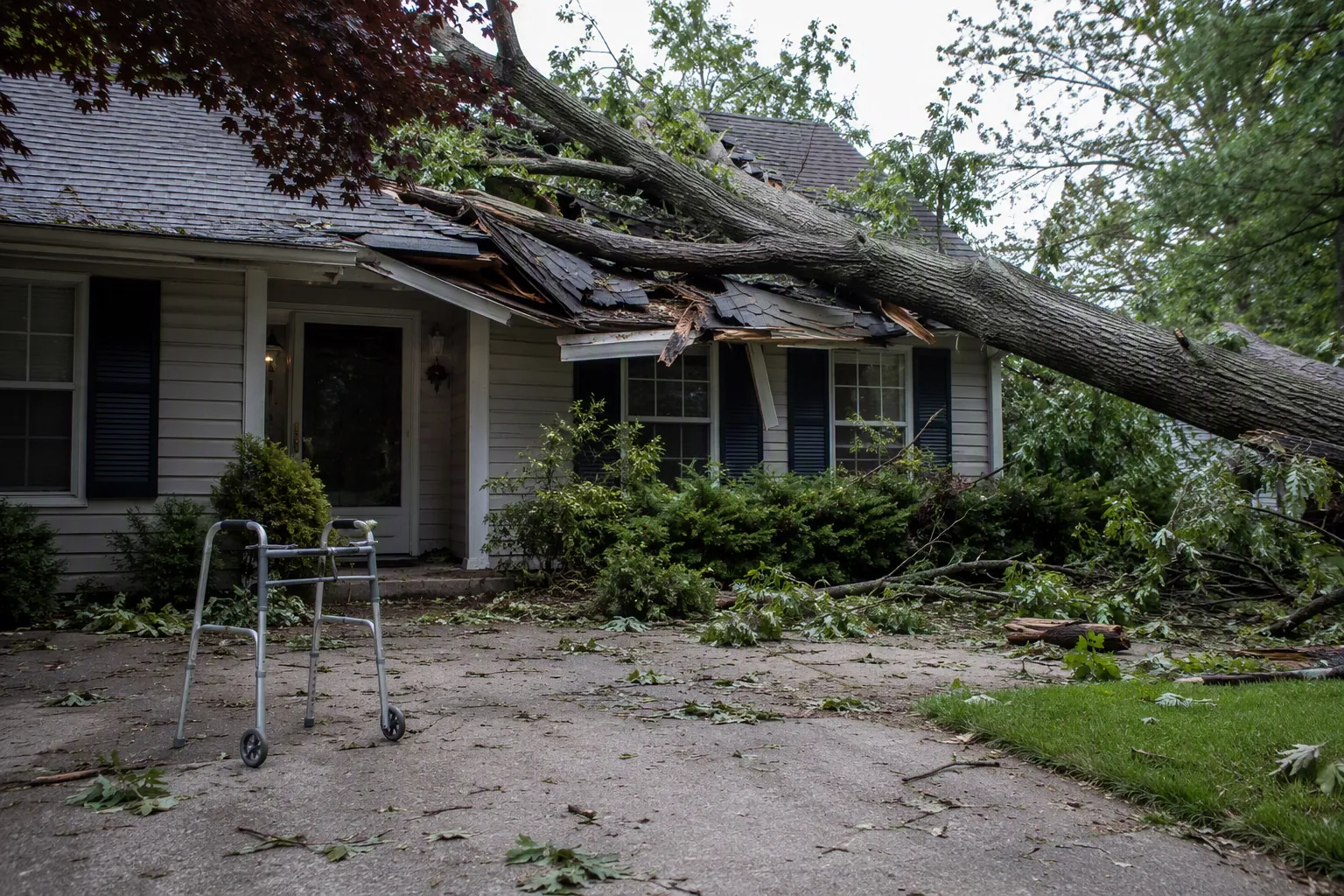
- Call 911 immediately if there is injury, anyone is trapped, the roof or wall looks unstable, there is fire or smoke, a gas smell, downed power lines, exposed wiring, flooding near electrical outlets, or no safe exit route.
- Get your parent out slowly, using the mobility aid they normally use. Do not rush them across wet flooring, broken glass, loose rugs, branches, or a dark hallway.
- Move them at least 50 feet away from the damaged structure, and farther if there are downed lines, unstable trees, gas odor, or emergency responders ask for more distance. Restoration and emergency guidance commonly use a 50-foot minimum distance after a tree strike on a home. [1][2]
- Do not send them back inside for a purse, medication, photographs, a phone charger, a pet, or paperwork. If something essential is still inside, tell the dispatcher or first responders.
- If utilities need to be shut off, do it only from a safe location and only if you can reach the shutoff without stepping through debris, standing water, or damaged areas. Otherwise wait for emergency personnel or the utility company.
For an older adult, "getting out" may mean bringing the walker to the safest exit before moving them, clearing one chair or branch from the path, turning on a flashlight, or having a neighbor stand beside them while they cross the threshold. It may also mean stopping a well-meaning parent from doing the one thing they are most likely to do: going back in because they do not want to be a bother.
If you are not nearby, assign roles instead of trying to manage everything yourself. One person calls 911. One trusted neighbor checks whether your parent is outside and physically away from the house. One person stays on the phone with your parent. One person starts driving if you need to be there. A parent who is frightened, hard of hearing, or trying to prove they are fine may not reliably describe danger over the phone.
| What you learn | What to do next |
|---|---|
| Parent is injured, trapped, confused, short of breath, or cannot walk safely | Call 911 or keep 911 on the line. Ask neighbors not to move your parent unless staying put is more dangerous. |
| Tree is on the roof, wall, chimney, porch, or attached garage | Treat the structure as unsafe until emergency responders or qualified professionals say otherwise. |
| There are downed lines, sparks, gas smell, smoke, or water near electrical areas | Keep everyone away. Call 911 and the utility company. Do not touch wires, branches touching wires, or metal fencing nearby. |
| Parent is outside but standing near the house, driveway debris, or emergency equipment | Move them to a neighbor's home, a vehicle parked safely away, or another dry, well-lit place with a chair. |
| Parent says they need medication, glasses, oxygen equipment, or a mobility aid from inside | Tell responders exactly what is needed and where it is. Do not let your parent re-enter. |
Keep them out of the fall zone, not just out of the house
A tree strike creates a second emergency that is easy to miss: the damaged home and yard become a fall hazard. More than one in four older adults falls each year, according to CDC STEADI materials, and the conditions after tree damage stack several known hazards at once: poor lighting, cluttered pathways, wet floors, loose objects underfoot, and the need to step around obstacles. [3]
That matters even if the structural damage looks limited. A small ceiling opening can leave insulation, plaster, rainwater, and glass across a hallway. A limb through a window can push a chair into the walking path your parent uses every night. A hallway that was safe yesterday may now require side-stepping, bending, or lifting a walker over debris. Those are not cleanup inconveniences for an older adult; they are reasons to prevent re-entry.
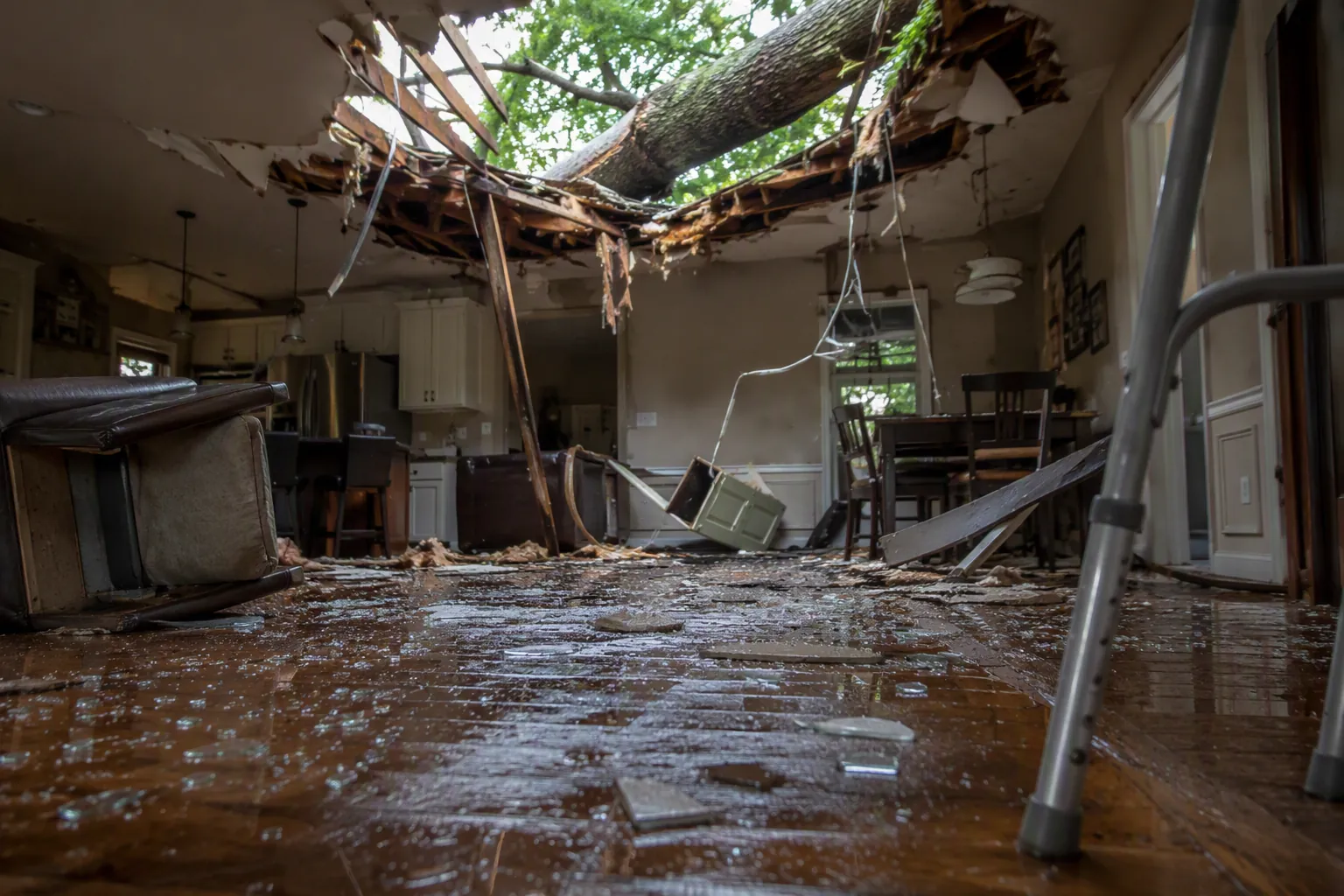
How to triage hazards without walking your parent through them
- Photograph from outside first: roofline, fallen tree, broken windows, blocked doors, porch damage, wet entryways, and visible electrical or utility hazards.
- If responders allow limited access later, send a steadier adult inside, not your parent. The person entering should wear shoes with traction and avoid rooms with ceiling sagging, water near outlets, or unstable debris.
- Mark the unsafe areas in plain language for everyone helping: "Do not use the back door," "Hallway floor is wet," "Glass near recliner," "Power line by driveway," or "Bathroom route blocked."
- Move your parent to a waiting place with a chair, bathroom access, light, heat or cooling, and space for their walker or wheelchair. A curb, garage step, or crowded driveway is not a safe waiting room.
- If they insist on staying to supervise, give them a specific safe job away from the house: holding a phone list, sitting with the pet in a neighbor's living room, or speaking with the insurer from a safe chair.
Do not underestimate pride. Many older parents will minimize the risk because the damage is "only in the den" or because they have lived in the house for decades and know every step. But the house they know has changed. The route to the bathroom, bedroom, pillbox, and front door may no longer match their memory.
Secure medications, devices, and daily routines before the night gets away from you
Medication continuity belongs in the safety plan, not in the "we'll handle it later" pile. The Red Cross recommends that older adults prepare for emergencies with at least a 30-day supply of medications and medical supplies, along with backup mobility equipment, eyeglasses, hearing aid supplies, batteries or chargers, and oxygen-related supplies when needed. [4]
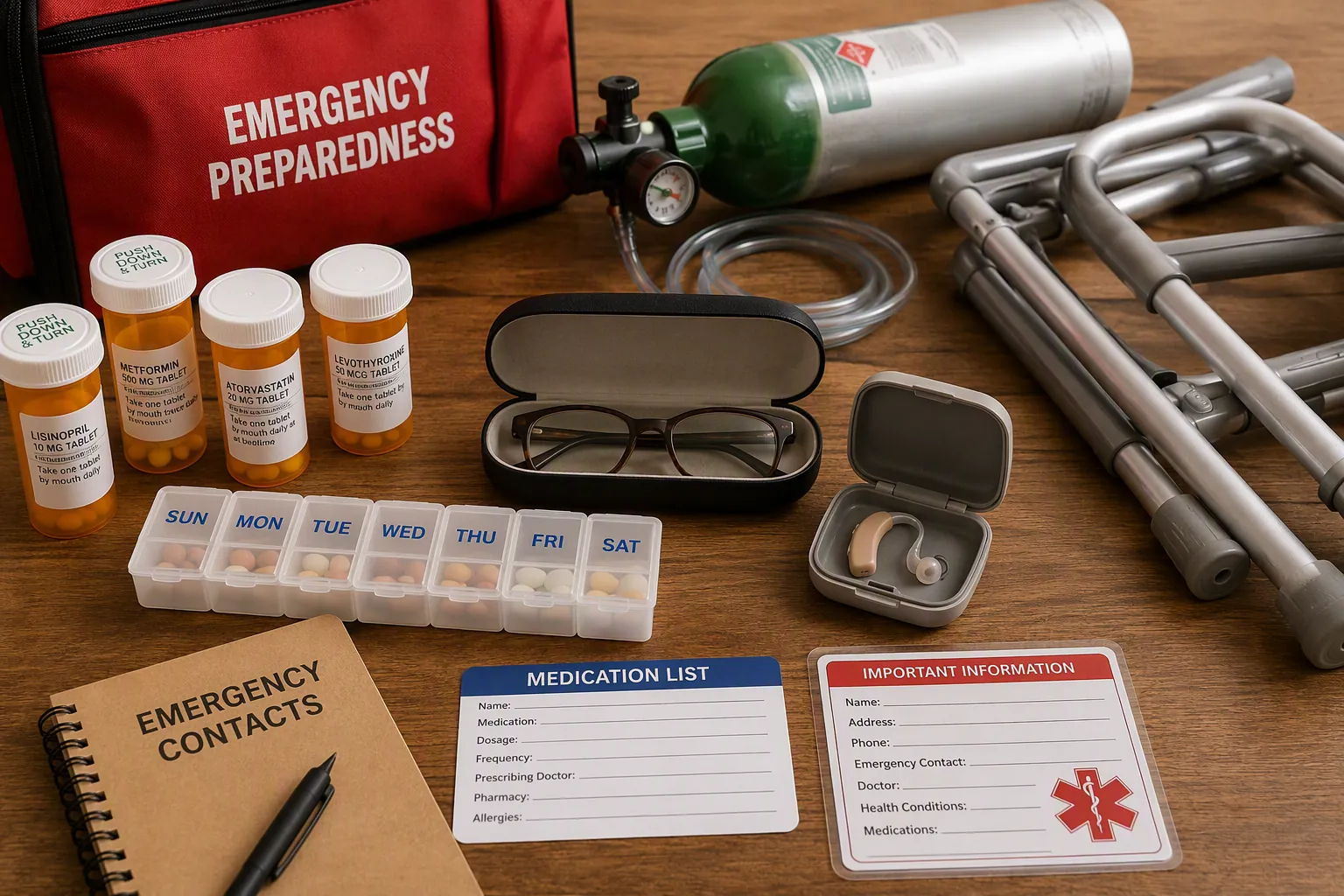
If those items are already out of the house, put them in one bag and keep the bag with your parent. If they are still inside, do not send your parent back for them. Tell first responders or the restoration lead what is essential and where it is likely located: "weekly pill organizer on the kitchen counter," "oxygen tubing by the recliner," "hearing aid charger on the nightstand," "spare glasses in the bedroom drawer."
Items to account for before choosing temporary housing
- Current medications, pill organizer, pharmacy information, prescriber names, and insurance cards
- Walker, cane, wheelchair, rollator, shower chair, raised toilet seat, or transfer aids
- Eyeglasses, magnifiers, hearing aids, hearing aid charger, spare batteries, and phone charger
- Oxygen concentrator, portable oxygen, tubing, CPAP machine, nebulizer, power cords, and backup power needs
- Dentures, incontinence supplies, wound care supplies, diabetic testing supplies, and refrigeration needs for medication
- Emergency contacts, advance directives if readily available, and the name of a regular physician or home health agency
If the tree fell during a broader disaster, medication rules may be different from an ordinary one-house claim. In presidentially declared disasters, Medicare Part D plans must make a 30-day emergency supply available for covered Part D drugs when normal access is disrupted, but that protection is tied to disaster conditions and does not mean every isolated tree strike qualifies. [4][5]
For a non-declared event, call the pharmacy anyway. Ask about emergency refills, lost or contaminated medication, delivery to a hotel or relative's home, and whether the pharmacist can contact the prescriber. If medication was exposed to water, debris, heat, or glass, do not guess. Ask the pharmacist whether it should be replaced.
After life safety: document damage and call the insurer
Insurance comes after evacuation, not before it. Once your parent is safe, start the claim process from wherever you can sit down with a phone and notebook. You do not need perfect documentation before calling the insurer. You need enough information to open a claim and ask what the policy will pay for next.
General homeowner guidance says standard policies commonly cover tree damage to the structure even when the tree came from a neighbor's property, and the homeowner usually files with their own insurer. Restoration and construction sources summarizing Insurance Information Institute guidance also note that tree removal from a damaged structure is often subject to a stated limit, commonly described as $500 to $1,000, and that wind or hail deductibles may be percentage-based, often described as 1% to 5% of dwelling coverage. Treat those figures as policy questions, not promises. [1][6]
| Ask the insurer | Why it matters for an elderly parent |
|---|---|
| Is the home considered uninhabitable? | That answer affects whether temporary housing costs may be covered. |
| Does the policy include Additional Living Expenses or Loss of Use coverage? | This may help pay for hotel, meals, laundry, and other added costs when the home cannot be lived in. |
| Is tree removal covered, and what is the limit? | Removal from the structure may be handled differently from cutting up a tree that only fell in the yard. |
| Does a wind or hail deductible apply? | A percentage deductible can be much larger than the flat deductible your parent remembers. |
| Can emergency tarping, board-up, or water mitigation begin now? | Fast mitigation can reduce further damage, but the insurer may have preferred documentation or vendor rules. |
| Can the adult child speak on the parent's behalf? | The insurer may need verbal permission, power of attorney, or another authorization before discussing claim details. |
Take photos and video before cleanup if it is safe to do so. Include wide shots of the tree and house, close-ups of roof or wall damage, interior water intrusion, damaged furniture, broken windows, blocked entries, and any medical equipment or mobility equipment damaged by the incident. Keep receipts for hotel rooms, meals, laundry, tarping, emergency repairs, prescription replacement, mobility device rental, transportation, and pet boarding if those costs are caused by displacement.
Additional Living Expenses, often called Loss of Use, can cover costs such as hotel stays, restaurant meals, and laundry when a covered loss makes the home uninhabitable. Tree-damage repair timelines are commonly described in the range of 2 to 8 weeks, and average repair costs are often estimated at $5,000 to $25,000, but both depend heavily on roof damage, structural damage, water intrusion, contractor availability, and policy terms. [1][6]
Choose temporary housing by mobility, not just by vacancy
The nearest hotel is not automatically the right hotel. Before booking, ask about the entrance, elevator, bathroom setup, bed height, parking distance, lighting, space for a walker, and whether oxygen or powered medical equipment can be used safely. If your parent uses a wheelchair, ask for an accessible room and then ask what that means in practical terms: roll-in shower or tub, grab bars, toilet height, doorway width, and whether the room is actually available tonight.
A relative's guest room may feel emotionally easier, but it can create new hazards: stairs to the bedroom, a low toilet, no night light, pets underfoot, cluttered hallways, and a shower that requires stepping over a high tub wall. If the stay will last more than a night, walk through the daily routine: bed to bathroom, bathroom to kitchen, medication storage, phone charging, oxygen tubing path, laundry, meals, and transportation to appointments.
- Ask for a ground-floor room or reliable elevator access.
- Bring night lights or plug-in motion lights if the space is unfamiliar.
- Keep the walker, cane, glasses, phone, and medication within reach from the bed.
- Use one consistent place for keys, wallet, hearing aids, and charger.
- Keep pathways clear of luggage, cords, oxygen tubing, shoes, and laundry bags.
- If home health aides or visiting nurses are involved, notify the agency of the new address immediately.
When FEMA or senior assistance may help
FEMA help is not triggered by every tree that hits a house. FEMA Transitional Sheltering Assistance can cover temporary hotel lodging when a survivor cannot live in the home after a presidentially declared disaster, but it applies only in eligible declared disaster areas and only when the program is activated for that event. Ready.gov and the National Council on Aging both describe disaster assistance pathways for older adults, but eligibility depends on the declaration, location, loss, and program rules. [5][7]
If the tree strike happened during a declared disaster, check DisasterAssistance.gov or FEMA's disaster information, then help your parent gather identification, insurance information, proof of occupancy or ownership, photos, receipts, and a safe mailing address. If it was an isolated neighborhood incident with no federal declaration, the more likely first sources are the homeowner policy, family support, local nonprofits, and community aging services.
Places to check without assuming they will pay
- Area Agency on Aging: ask for emergency housing referrals, transportation help, home-delivered meals, benefits counseling, caregiver support, and local repair or chore-service programs.
- 211: ask about local disaster relief, senior services, utility help, temporary shelter, food, transportation, and volunteer cleanup groups.
- FEMA Individual Assistance: check only if the area is part of a presidentially declared disaster and your parent's loss fits the program rules.
- HUD-related housing and repair programs: ask local housing agencies or aging-service navigators whether any emergency home repair, accessibility, or low-income homeowner programs are available.
- Municipal or county tree programs: some localities and senior-service networks describe free or reduced-cost tree removal options, but they are location-specific and should be treated as leads to investigate, not standard benefits. [8]
- Tree service senior discounts: some companies advertise senior discounts, but the availability, amount, and emergency applicability vary by company and location. [8]
When you call these programs, use concrete language. "My 82-year-old mother cannot return home because a tree damaged the roof and water entered the house. She uses a walker and needs help finding temporary housing and safe transportation." That is more useful than "We had storm damage." It tells the person on the other end that this is a housing, mobility, and health-continuity problem, not only a tree problem.
What to keep doing during the first week
The first week is where a safe evacuation can quietly unravel. People get tired. Receipts scatter. A parent wants to "just check one thing" inside. Contractors, adjusters, neighbors, and relatives all start giving advice. Keep the sequence simple: no re-entry until the structure and utilities are safe, no walking through debris, no missed medications, no temporary housing that creates a new fall risk.
- Confirm daily medications were taken and refills are arranged.
- Check whether hearing aids, glasses, mobility aids, oxygen equipment, CPAP, and chargers are working and within reach.
- Keep all claim numbers, adjuster names, contractor contacts, receipts, photos, and temporary housing records in one shared folder.
- Ask the insurer before authorizing major work beyond emergency mitigation.
- Reassess temporary housing after the first night; what works for one evening may not be safe for several weeks.
- Arrange transportation for medical appointments, pharmacy pickup, claim meetings, and any safe access visits to the property.
- If your parent is confused, unusually weak, dizzy, short of breath, or has fallen or nearly fallen since the incident, call their clinician or seek urgent care.
The crisis is not over when the tree is cut off the roof. For an elderly parent, the response has worked only if they are safely housed, medicated, mobile, and kept out of a newly hazardous home while the claim and repairs move forward.
References
- What to Do If a Tree Falls on Your House, RestoPros
- What to do if a tree falls on your house, FOX Weather
- Check for Safety: A Home Fall Prevention Checklist for Older Adults, Centers for Disease Control and Prevention
- Older Adults, American Red Cross
- Older Adults, Ready.gov
- Tree Fell on House? What To Do, Ridgeline Construction
- Disaster Assistance: 6 Helpful Programs for Older Adults, National Council on Aging
- Can Seniors Get Free Tree Cutting Service?, Strobert Tree Services
Related reading
Noticed something outdated or inaccurate on this page? Flag a correction. We review every report against CDC, NIA, and AARP HomeFit guidance before updating a page.
Part of the Fall Prevention section.