
STEADI: assess
What Seniors Need to Know About Heat Domes vs Heat Waves
Learn how a heat dome's extended duration eliminates nighttime cooling and creates cumulative dehydration that directly increases fall risk for older adults, and discover practical steps caregivers can take before and during the event to prevent falls.
The difference is not just hotter air. It is less recovery.
When a forecast says heat wave, the usual meaning is a period of abnormally hot weather lasting at least two days. A heat dome is different in the way it behaves over a home: a strong ridge of high pressure traps hot air in place for an extended period, keeping heat from escaping and limiting the nighttime drop that usually gives the body and the house a break.[1]
For an older adult, that missing overnight reset is the part that changes the fall-prevention problem. A single hot afternoon may call for shade, fluids, and less exertion. Several days and nights of trapped heat can turn a bedroom, hallway, bathroom, and kitchen into places where dehydration quietly accumulates before anyone looks visibly ill.
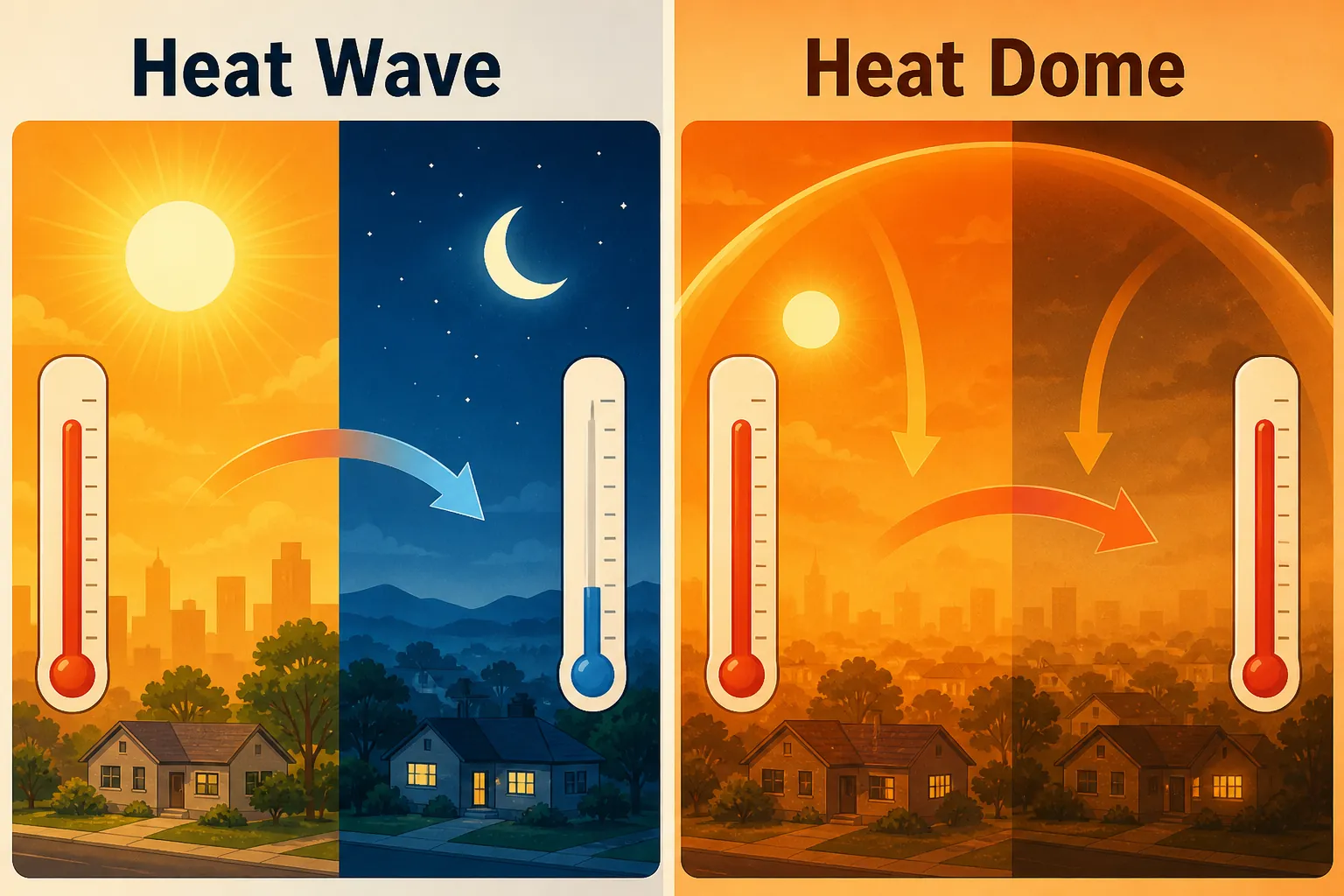
That is the practical difference seniors and caregivers need to know. The meteorology matters only because it changes what caregivers should watch: not only the afternoon temperature, but whether the person and the home cooled down overnight.
Why older adults can seem fine until they stand up
Older bodies do not handle sustained heat as efficiently as younger ones. A 2025 systematic review of 24 studies found that adults age 60 and older tend to accumulate more core heat, release heat more slowly, and may have impaired thermal perception, meaning they may not accurately sense how much strain the heat is placing on them.[2]
That last point is easy to underestimate at home. The older adult may say the room is “a little warm” and still answer the phone normally. They may not feel thirsty. They may not complain. Then they get up from a chair, walk toward the bathroom, step into a warm shower, or stand at the sink after skipping lunch, and the risk shows itself as lightheadedness.
Dehydration does not have to look dramatic before it affects movement. The same 2025 review reported that even about 1.5% body mass loss from dehydration can measurably reduce physical performance and increase perceived fatigue in older adults.[2] In a heat dome, that loss can build across days because the body is not getting the usual nighttime cooling period.
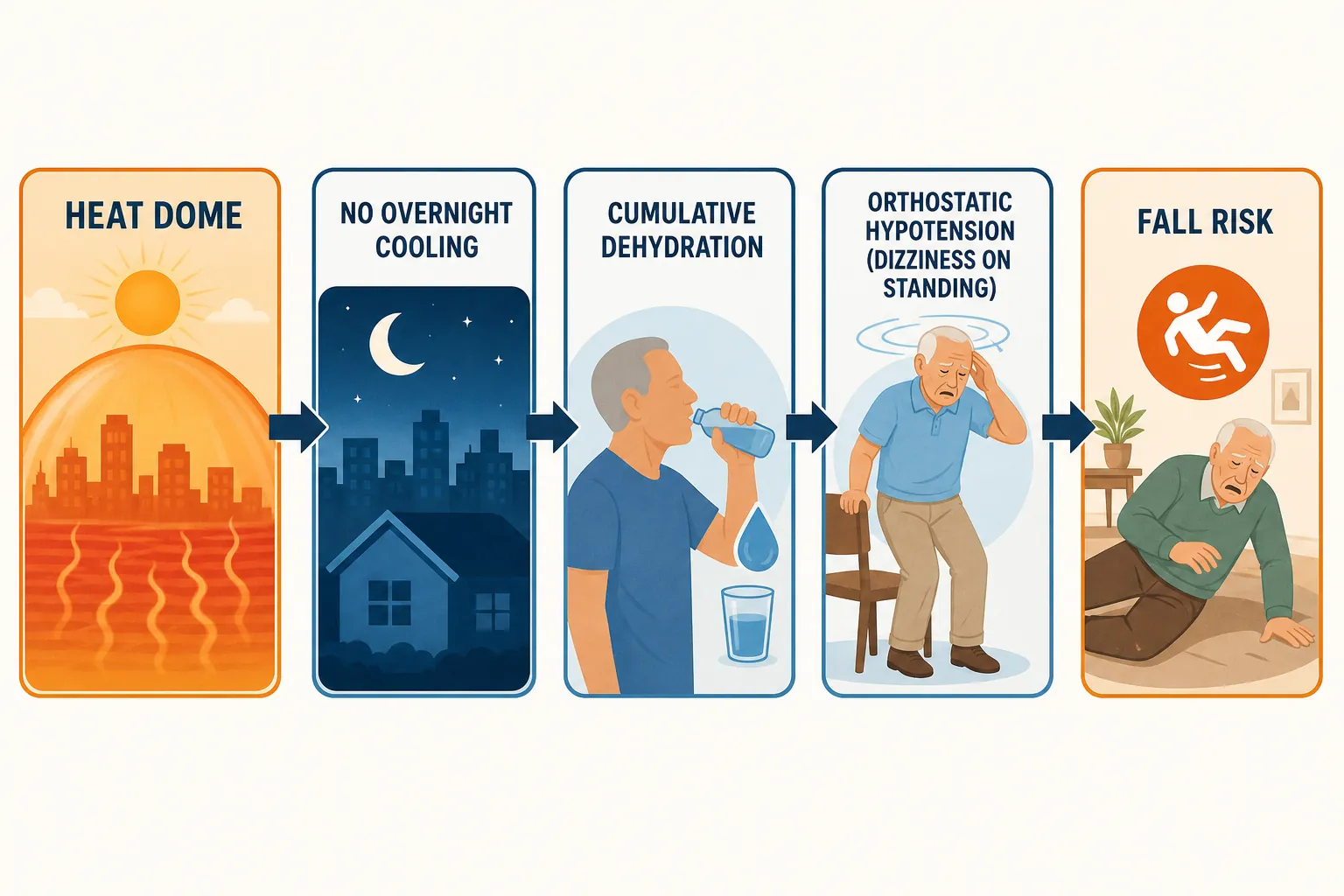
The fall-risk chain is straightforward: sustained heat increases fluid loss; dehydration can lower blood volume; lower blood volume can contribute to orthostatic hypotension, the drop in blood pressure that happens when someone stands; dizziness or weakness then makes a short walk more dangerous. Injury-prevention guidance for older adults also connects hot weather and dehydration with dizziness and falls, especially when people are moving through ordinary home routines.[3]
This is why the risky moment may be morning, not noon. If the bedroom stayed hot all night, the person may wake already behind on fluids. The first trip to the bathroom can combine dehydration, standing quickly, low morning food intake, medication effects, and a tight walking path. A rug or threshold still matters, but the forecast has changed the body crossing that threshold.
Medication lists turn the forecast into a care plan
A heat dome is a good reason to look at the pill organizer, not to panic over it. The CDC warns that several common medication groups can affect heat tolerance, hydration, sweating, kidney function, blood pressure, or temperature regulation. Its clinical guidance includes diuretics, beta blockers, calcium channel blockers, ACE inhibitors, selective serotonin reuptake inhibitors, and anticholinergic medications among the categories clinicians may need to consider during heat events.[4]
AARP gives similar consumer-facing warnings that some medications can make heat harder to tolerate or make dehydration more likely, including drugs used for blood pressure, mood, allergies, bladder symptoms, and other common conditions in later life.[5]
The important caregiver move is not to stop or adjust prescriptions independently. It is to ask the prescriber or pharmacist a specific heat-event question: “During a multi-day heat dome, does anything on this list increase dehydration, dizziness, or heat intolerance, and what should we watch for?” That question is more useful than a general request to “review medications,” because it ties the review to standing, walking, showering, and hydration.
- Diuretics may increase fluid loss, which can matter more when the body is already losing water through heat.
- Blood-pressure medications may contribute to dizziness for some people, especially around position changes.
- Anticholinergic medications can interfere with sweating or heat regulation.
- Some antidepressants and other nervous-system medications can affect temperature regulation, alertness, or balance.
- Any medication plan should stay with the clinician or pharmacist; the caregiver’s role is to notice timing, symptoms, and patterns.
The 2021 Pacific Northwest heat dome showed who gets missed
The 2021 Pacific Northwest heat dome is not useful only because it was extreme. It is useful because it showed the domestic pattern of danger: older people indoors, often alone, with limited mobility or inadequate cooling. Harvard Medicine, citing Climate Central data, reported that more than 80% of the estimated 12,000 annual heat-related deaths in the United States occur among people over 60.[6]
During the 2021 event, 78% of deaths in Multnomah County were among people age 60 and older, and people over 65 accounted for three-quarters of Washington’s deaths. Reporting on the event emphasized that many people died indoors, alone, and without sufficient cooling or mobility to escape the heat.[6][7]
Those numbers should not make every hot forecast feel like a disaster. They should make caregivers less casual about the phrase “they’re inside, so they’re fine.” Inside is only protective if the indoor environment actually cools the person down.
A caregiver plan before and during a heat dome
The CDC and National Weather Service HeatRisk Dashboard gives caregivers a practical way to decide when to increase check-ins. It shows heat risk by location and is designed to communicate health risk, not just temperature.[8] For an older adult with fall risk, a higher HeatRisk level should trigger temporary changes at home before the first dizzy spell.
| Caregiver action | What it is meant to interrupt |
|---|---|
| Check HeatRisk and local forecast for consecutive hot days and warm nights | Assuming the concern ends when the sun goes down |
| Confirm where the person can cool down, including overnight | Cumulative heat exposure in a bedroom or main living area |
| Ask a clinician or pharmacist about heat-sensitive medications | Medication-related dehydration, blood-pressure drops, or heat intolerance |
| Set hydration and meal prompts around normal routines | Waiting for thirst or obvious distress |
| Arrange check-ins at morning, late afternoon, and evening | Missing the times when dizziness and indoor heat may peak |
| Reduce high-risk walking moments | Falls during bathroom trips, showers, stairs, and quick position changes |
Before the event: find the cooling gap
Before buying anything, find out whether the home actually cools at night. Ask for the bedroom temperature in the early morning, not only the living-room temperature during the day. If the person says they slept poorly, woke sweaty, moved to a chair, or kept getting up for water or the bathroom, that is useful information. It tells you the body did not get a clean recovery period.
If air conditioning is available, the question is whether the older adult will use it and whether it reaches the room where they sleep. Some people ration cooling out of habit or cost concern. Some close doors that block cooled air. Some keep the thermostat higher than their body can comfortably handle because they do not feel the danger accurately. The conversation can stay respectful: “Let’s keep the bedroom cooler this week so standing up in the morning is safer.”
If the home cannot cool enough, plan the cooling location before the heat dome settles in: a relative’s house, a cooling center, a library, a senior center, or another place the older adult can realistically reach and tolerate. A perfect plan that requires too much walking, driving, or waiting may fail at the exact moment it is needed.
During the event: do not wait for thirst
Older adults may not feel thirsty early enough to prevent heat-related dehydration. That does not mean pushing large amounts of fluid on everyone; some people have heart, kidney, or fluid-restriction issues that require medical guidance. It does mean hydration should be tied to a routine rather than to thirst alone.
- Place drinks where the person already sits, takes medication, and eats.
- Pair fluids with breakfast, lunch, medication times, and evening check-ins.
- Watch for skipped meals, because low intake can worsen weakness and lightheadedness.
- Ask about urine color, new confusion, unusual fatigue, headache, and dizziness when standing.
- For anyone on fluid restrictions, ask the clinician in advance what heat-event hydration should look like.
The point is not to turn the day into a medical interrogation. It is to replace the vague question “Are you drinking water?” with observations that catch the chain earlier: Did you eat? Have you had something to drink with your pills? Are you dizzy when you stand? Did the bedroom cool down last night?
Make the bathroom and morning routine temporarily safer
Bathroom safety deserves extra attention during a heat dome because it combines several stressors: standing from bed, walking while groggy, humidity from bathing, slippery surfaces, and sometimes a locked door. A person who manages the bathroom safely most of the year may need more margin for a few days.
- Encourage sitting at the edge of the bed before standing, especially in the morning.
- Keep a clear, well-lit path from bed to bathroom.
- Move water, phone, glasses, and walking aid within reach before bedtime.
- Suggest lukewarm rather than hot showers, and avoid showering when already dizzy or overheated.
- Use grab bars, a shower chair, or a handheld shower if those are already part of the home plan or can be added safely.
This is also a good time to reduce unnecessary trips. Put commonly used items on one level. Bring laundry, trash, mail, and heavy groceries out of the older adult’s path. If stairs are optional for a few days, make them optional. Heat-related fall prevention is often less about a new device and more about removing the walk that did not need to happen.
Check-ins should protect dignity, not erase independence
A heat dome may justify more contact, but not constant surveillance. The most useful check-ins are timed to the risk: morning after a hot night, late afternoon after cumulative heat exposure, and evening before sleep. A short call can cover cooling, fluids, food, dizziness, and plans for the next bathroom or shower without turning the older adult into a project.
For long-distance caregivers, the check-in plan may need a second person nearby: a neighbor, building manager, relative, home aide, faith-community contact, or local service that can knock on the door if the older adult does not answer. The plan should be agreed on before the heat dome, not improvised after a missed call.
The language matters. “I’m worried you’ll fall because the house stayed hot overnight” is more concrete than “I’m checking on you because you’re old.” It names the temporary risk and leaves room for the older adult to participate in the plan.
When to treat heat as a fall-risk escalation
A heat dome forecast should change the fall-prevention setting in the caregiver’s mind. The home does not need to become an emergency room, and the older adult does not need to be managed every minute. But for several days, the risk calculation is different.
Escalate the plan when hot nights are expected to continue, the home is not cooling, the person lives alone, mobility is limited, air conditioning is absent or not being used, medications raise concern, meals are being skipped, or dizziness appears with standing. Any fainting, confusion, chest pain, severe weakness, inability to keep fluids down, or signs of heat illness warrants urgent medical help.
The practical threshold is simple: when a heat dome is forecast, treat it as a temporary fall-risk escalation, not only a comfort problem. The questions become domestic and specific. Did the bedroom cool overnight? Has the person had fluids with meals and medications? Are they standing slowly? Is the bathroom path clear? Does someone know to check before the chain reaches dizziness, a missed step, and a fall?
References
- During a Heat Wave, National Weather Service
- Physiological responses of older adults during heat exposure: a systematic review, PubMed Central, 2025
- Beat the heat this summer, Injury Matters
- Heat and Medications – Guidance for Clinicians, Centers for Disease Control and Prevention
- Medications That Can Make You More Sensitive to Heat, AARP
- The Effects of Heat on Older Adults, Harvard Medicine
- Extreme Heat Is Especially Dangerous for Older Adults, AARP
- HeatRisk Dashboard, Centers for Disease Control and Prevention
Related reading
Noticed something outdated or inaccurate on this page? Flag a correction. We review every report against CDC, NIA, and AARP HomeFit guidance before updating a page.
Part of the Fall Prevention section.