
STEADI: intervene
How Seniors at Home Can Reach Tornado Shelter Without Falling
A fall-prevention checklist for seniors and their caregivers to prepare a safe, clear path to tornado shelter — steps for path clearing, emergency lighting, mobility-aid positioning, and footwear to prevent the injury that happens before the storm arrives.
The tornado alert sounds, the house goes dim, and the first danger may be the trip from the recliner to the shelter door. For many older adults at home, a useful tornado safety checklist for seniors at home starts before the basement, closet, bathroom, or safe room. It starts with standing up, finding the cane or walker, getting shoes on, crossing the hallway, and entering the shelter without catching a rug edge or stepping over a cord.
CDC tornado guidance still matters: move to a basement or an interior room on the lowest floor, stay away from windows, and protect yourself from debris if a tornado is near.[1] The Red Cross also tells older adults to prepare around mobility, medical, and support needs before an emergency, not while the emergency is already unfolding.[2] That is the part many household plans skip. “Go to the basement” is not a plan if the walker is behind a door, the stairwell light is out, and the only shoes nearby are loose slippers.
If you are still in the watch phase and need a broader preparation list, use the Tornado Watch Safety Checklist for Seniors. This article is narrower on purpose: it is about the physical route from chair or bed to shelter, because that short route is where a preventable fall can happen.
Walk the shelter route from the place the senior actually starts
Do not begin the checklist at the shelter. Begin where the older adult is most likely to be when the warning arrives: the recliner, the bed, the kitchen chair, the bathroom, or the porch chair. Then walk the exact route to shelter at the person’s normal speed, using the same cane, walker, rollator, glasses, hearing aids, and shoes they would use in real life.
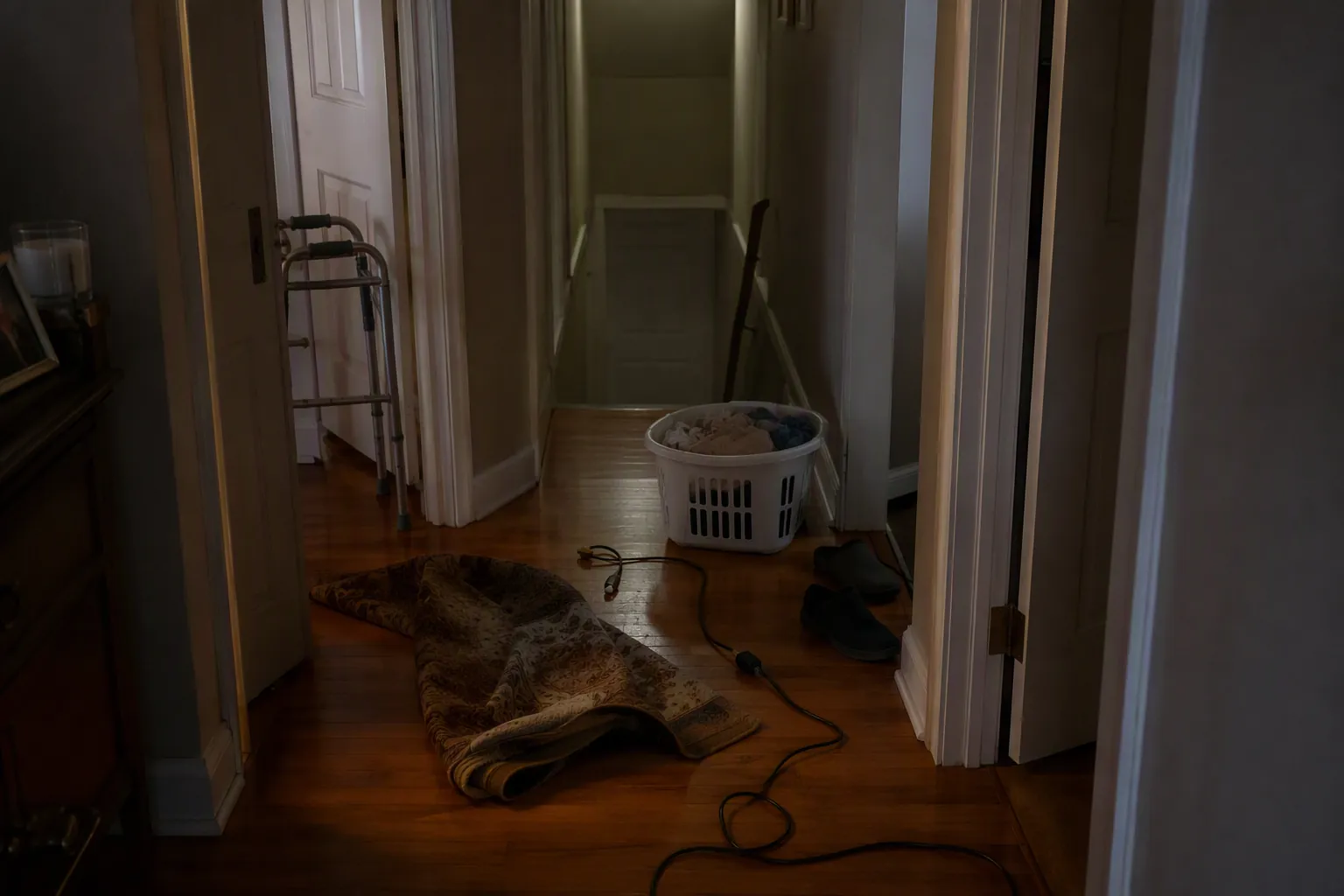
A caregiver should not “inspect” the route from standing height and call it good. Sit in the chair. Reach for the walker. Stand up. Turn. Start toward the doorway. That is when the problems show themselves: the side table is too close, the walker catches on a rug, the hallway narrows where a laundry basket lives, or the basement door swings into the space where the person needs to turn.
| Part of the route | What to check before tornado season | A simple fail test |
|---|---|---|
| Starting point | Cane, walker, glasses, phone, flashlight, and shoes are reachable without standing first | The person has to take unsupported steps to get the item |
| First turn | Enough space to stand, pivot, and place a mobility aid straight ahead | The walker or cane hits furniture, a basket, or a door |
| Hallway or room crossing | No cords, rug edges, pet bowls, shoes, laundry, boxes, or low furniture in the walking line | The person has to step over, around, or remember an obstacle |
| Lighting | Battery, plug-in backup, or motion lighting shows the whole walking surface during power loss | The person can see the doorway but not the floor |
| Shelter entrance | Doorway, threshold, stairs, handrails, and floor surface are usable with the person’s actual mobility aid | The shelter is safe in theory but cannot be entered calmly |
The route should be rehearsed in ordinary weather. Not as a drill with everyone rushing. Just a slow walk that reveals what the house is asking the person to do. If the person needs a caregiver’s arm, a transfer belt, or a chair placed halfway along the route, that belongs in the plan. If the person cannot get there without stairs that are already unsafe on a quiet afternoon, the shelter choice needs another look.
Clear the walking line as if the lights will be low and balance will be worse
The most important part of the route is usually the least dramatic: the floor. Clear it before storm season and keep it clear. A tornado warning is not the time to move the vacuum, pick up the throw rug, shift the laundry basket, or ask someone to “just step over” the cord by the doorway.
- Remove throw rugs from the shelter route, especially small rugs with curled corners or thick edges.
- Reroute or secure extension cords so they never cross the walking path.
- Move laundry baskets, shoes, pet bowls, oxygen tubing slack, plant stands, and decorative tables out of the route.
- Widen tight turns where a walker or rollator has to swing through a doorway.
- Keep the shelter door area empty. A clear hallway is not enough if the final three feet are blocked.
This is where many families get too polite with the house. The rug is pretty. The basket is usually fine. The cord has been there for months. The older adult knows where everything is. None of that helps when the weather radio is loud, the room has gone darker, and someone is trying to move faster than their balance allows.
For a person using a walker, the route also has to be wide enough for the device, not just the body. A cane user needs space for the cane tip to land on a stable surface, not on a rug edge or a pile of shoes. A person with low vision needs contrast and predictability. The same path should feel the same every day, because an emergency is a poor time to discover that a box was set by the basement door.
Test the route in storm lighting, not showroom lighting
A hallway that looks safe at noon can become a fall hazard when the power flickers. CDC tornado guidance includes taking protective action during severe weather, and that guidance assumes people can actually get to the safer location.[1] For an older adult, visibility along the route is part of the shelter plan, not a nice extra.
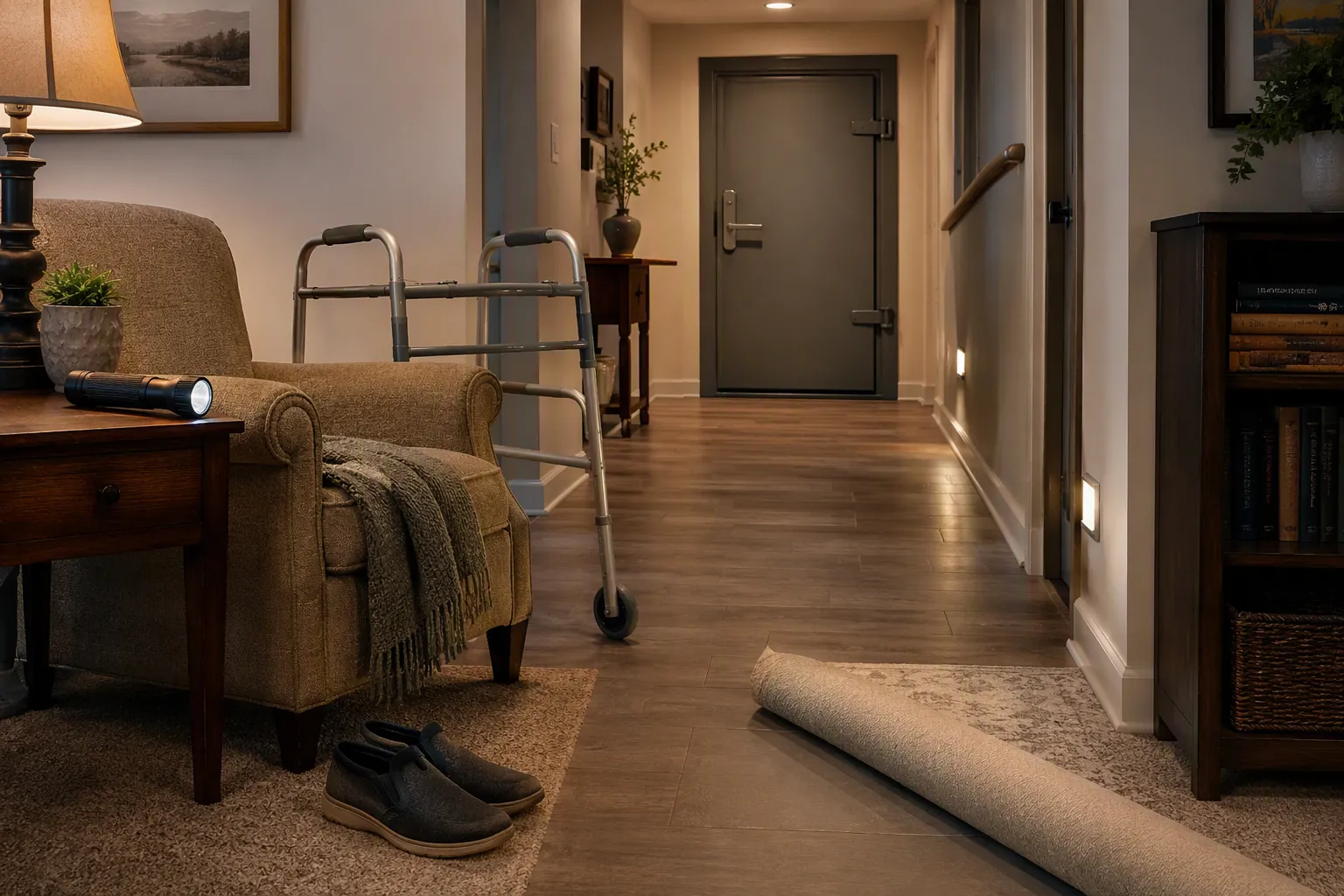
Do one evening test with the normal lights off. Do not make it theatrical; just turn off the lights you would lose in a power outage and see what the person can identify from the starting chair or bed. Can they see the walker handles? The floor? The threshold? The first stair? The shelter door handle? If the answer is “sort of,” fix the lighting.
- Place a flashlight on the side table or nightstand, not inside a drawer.
- Use battery-powered, motion-sensor, or plug-in backup lights along the route, especially at turns and thresholds.
- Put lighting low enough to show the floor, not only the walls.
- Check batteries on a routine schedule tied to something the household already does, such as changing smoke alarm batteries.
- Avoid relying on a phone flashlight as the only light if the person also needs both hands for a walker or handrail.
The phone flashlight is a good backup for many people. It is a bad primary plan for someone who needs one hand on a cane and the other on a rail. If the person uses a walker, both hands are already spoken for. Put light into the route itself so the person is not trying to carry safety in one hand and balance with the other.
For more detail on keeping an older adult safe when the house loses power, see What to Do During a Power Outage for an Elderly Person. The tornado version is less about comfort and more about the first few minutes of movement.
Put mobility aids where anxious hands will reach, not where the room looks tidy
The Red Cross advises older adults to plan for personal support needs, including mobility needs, before emergencies.[2] In a home tornado plan, that means the cane, walker, rollator, wheelchair, glasses, hearing aids, and needed braces should be placed for use, not storage.
The walker parked neatly across the room may look better. It is also a setup for furniture-walking. If the senior has to take three unsupported steps to reach the device, the plan has already failed. Keep the aid on the side of the chair or bed where the person normally stands. If the person transfers better to one side, respect that side. If a door blocks the walker when opened, change the furniture, the door stop, or the parking spot.
- At the recliner: park the walker beside the stronger transfer side, with brakes locked if it is a rollator.
- At the bed: keep the cane or walker reachable before the person’s feet hit the floor.
- At the bathroom: do not let the walker live outside a doorway if the person may be inside when the alert arrives.
- At the shelter: make sure the mobility aid can fit through the entrance or that a safe, practiced transfer plan exists.
This is also where pride and safety need a careful truce. Many older adults do not want to be handled like cargo. A better plan gives the person as much control as possible: the aid is where they expect it, the path is clear, the light comes on, and the caregiver’s job is specific. “I’ll meet you at the basement door” is clearer than hovering and grabbing.
Choose storm shoes before the warning
Bare feet, socks, and loose slippers are common in the exact places where tornado warnings find people: beside the bed, near the recliner, in the kitchen after dinner. They are also poor choices for a rushed walk over thresholds, stairs, or garage-safe-room floors.
The goal is not a perfect outdoor shoe. The goal is a shoe the person can put on quickly without bending too far, fighting laces, or shuffling in an open back. For many older adults, that means a sturdy slip-on shoe with a closed heel, a firm sole, and enough grip for smooth flooring. If the person uses a long-handled shoehorn, keep it with the shoes. If they cannot safely put shoes on during a warning, decide whether the shoes stay on during watch conditions or whether a caregiver helps before the warning arrives.
Do not store the storm shoes in the closet “so they don’t clutter the room.” Place them where the route begins. A pair by the recliner and another by the bed may look repetitive. It is less repetitive than a fall.
The shelter itself has to be reachable, not just technically safer
Basements and below-ground shelters are often treated as the obvious answer, but access can decide whether they are usable. KCUR reported on the problem many families already know from experience: common tornado shelters may have steep stairs that make them inaccessible to people with ambulatory disabilities.[3] If an older adult cannot safely manage those stairs on a quiet day, the warning will not make the stairs safer.
FEMA safe-room guidance is useful here because it treats safe rooms as physical spaces people must enter and use, not just labels on a floor plan. FEMA P-361 addresses accessibility features such as doorway width and non-slip surfaces for safe rooms.[4] Those details are not cosmetic for a senior using a walker. A narrow entry, raised threshold, slick floor, or awkward turn can turn the final step into the hardest step.
Check the entrance in the same practical way you checked the route:
- Can the person open the shelter door, or will someone else always need to do it?
- Can the walker, rollator, or wheelchair pass through the entry without folding, lifting, or turning sideways?
- Is the threshold low and visible enough for the person’s feet and mobility aid?
- Are stairs equipped with secure handrails, lighting, and enough time for slow movement?
- Is the floor surface non-slip when shoes are wet or dusty?
- Is there room inside for the person, the mobility aid, and any caregiver without forcing a risky transfer?
Above-ground safe rooms may be easier for some older adults to enter than below-ground shelters, especially when stairs are the main barrier. But be cautious with sales material that makes above-ground units sound like the simple senior answer. Shelter manufacturers have a commercial reason to emphasize access and fall reduction. Start with FEMA and local emergency-management guidance, then evaluate whether a particular shelter can be entered and used by the person who actually lives in the house.
Mobile homes deserve a separate warning. United Spinal Association’s tornado preparedness guide notes that 43% of tornado deaths occur in mobile homes, and it also warns that many emergency shelters do not have durable medical equipment on site.[5] For a senior in a mobile home, the fall-safe plan may include leaving earlier during watch conditions for a sturdier accessible location rather than waiting for the last-minute warning. That decision has to be made locally, with transportation, mobility aids, oxygen, medications, and caregiver availability already worked out.
Rehearse once, then maintain the route
A route that is cleared once can quietly fill back in. The laundry basket returns. A grandchild leaves shoes in the hall. The flashlight migrates to a kitchen drawer. The walker gets moved for vacuuming and stays there. Tornado preparation fails in ordinary ways.
Build the route into household habits. During tornado season, check the walking line once a week and after visitors leave. If severe weather is forecast, do a faster reset: shoes in place, flashlight visible, mobility aid reachable, hallway clear, shelter door accessible. If thunderstorms alone tend to create anxiety, the same fall-prevention thinking applies; see How to Prevent Falls During a Severe Thunderstorm for a broader storm-safety approach.
Caregivers should also decide who does what if help is needed. One person may call the older adult when a warning is issued. A neighbor may help unlock the safe room. An adult child may come over during a tornado watch rather than during a warning. If an evacuation to another location is part of the plan, use the same fall-prevention logic from How to Help Your Elderly Parent Evacuate Without Falling: fewer rushed transfers, fewer improvised steps, and fewer moments where someone has to choose between speed and balance.
There is an important evidence boundary here. The sources used for this article do not directly quantify how many seniors are injured by falls while moving to tornado shelter. The case for this checklist is a practical synthesis: emergency agencies tell older adults and people with mobility needs to remove barriers and plan ahead; disability-access reporting shows that common shelter routes can be physically inaccessible; FEMA safe-room guidance treats access details as part of safe-room design; and fall-prevention practice says clutter, poor lighting, rushed transfers, unsafe footwear, and awkward stairs are exactly the conditions to remove before stress rises.
The best tornado plan for an older adult at home is not just knowing where the shelter is. It is maintaining and rehearsing the short, well-lit, uncluttered, mobility-aid-ready path that gets them there without a fall.
References
- Stay Safe During and After a Tornado, CDC.
- Older Adults, American Red Cross.
- Many Tornado Alley Residents With Disabilities Lack Safe Options In A Storm, KCUR, February 18, 2020.
- Safe Rooms for Tornadoes and Hurricanes: Guidance for Community and Residential Safe Rooms, FEMA.
- Tornado Preparedness for the Disability Community, United Spinal Association.
Related reading
Noticed something outdated or inaccurate on this page? Flag a correction. We review every report against CDC, NIA, and AARP HomeFit guidance before updating a page.
Part of the Fall Prevention section.