
STEADI: intervene
When the Heat Index Is Dangerous, Falls Risk Rises Too
This guide explains how dangerous heat index levels increase fall risk for older adults through dehydration, medication effects, and fatigue, and provides two action paths: an immediate crisis-response sequence and a plan-ahead home-readiness checklist to prevent heat-related falls.
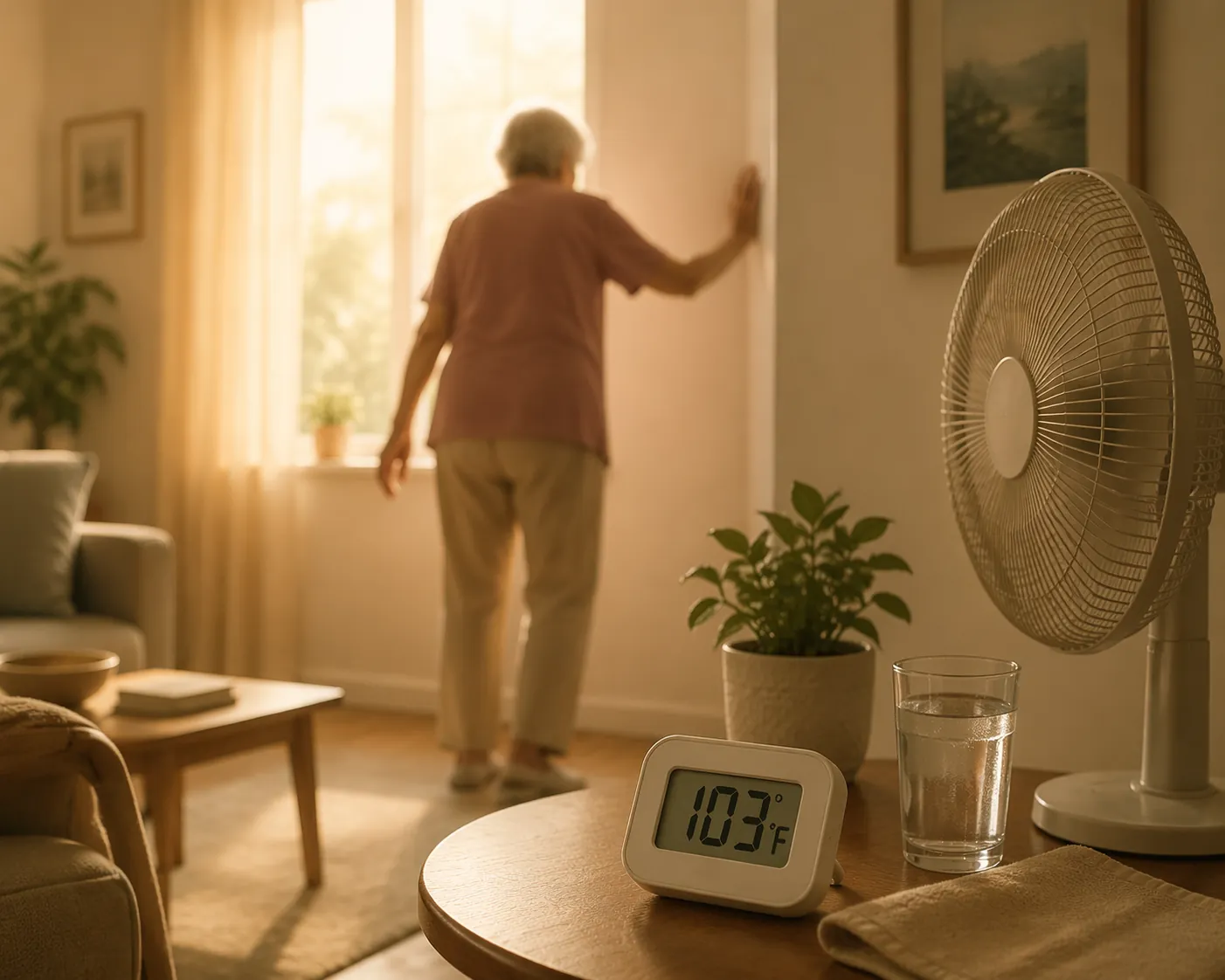
When the heat index is dangerous for an older adult and they are dizzy, confused, very weak, unusually tired, or newly unsteady, treat the next few minutes as both a heat emergency risk and a fall risk. The National Weather Service places a heat index of 103°F or higher in its “Danger” range; the heat index matters because humidity makes it harder for the body to cool itself through sweating. [1]
For adults 65 and older, do not wait for the forecast to reach that formal Danger range if symptoms have already started. Older adults are more vulnerable to heat-related illness because aging, chronic medical conditions, and some medications can interfere with cooling and hydration. [2] A person who says they are “fine” but is holding the wall, shuffling, slower to answer, or newly reluctant to stand is already giving you useful information.
The first few minutes: cool the person without creating another fall
Start close to the person, not across the room giving instructions. Heat symptoms and balance problems often arrive together, and the unsafe moment is usually ordinary: standing from a chair, turning toward the bathroom, stepping over a rug, or walking to adjust the thermostat.
- Stop the solo walk. Ask the person to sit if they are standing, or stay seated if they are already down. If they are on the floor, do not rush them up.
- Move them out of heat only if you can do it safely. Aim for shade, air conditioning, a cooler room, or a cooler building. Clear the path first, use a sturdy chair as a pause point, and avoid pulling them quickly by the arm.
- Look for emergency warning signs: confusion, fainting, seizure, loss of consciousness, very hot skin, or symptoms that do not improve with cooling. Heat stroke is a medical emergency. [3]
- Call 911 when heat stroke is possible, when the person is confused or cannot stay awake, when they cannot drink safely, or when you are unsure whether this is heat exhaustion or something more serious. [3][4]
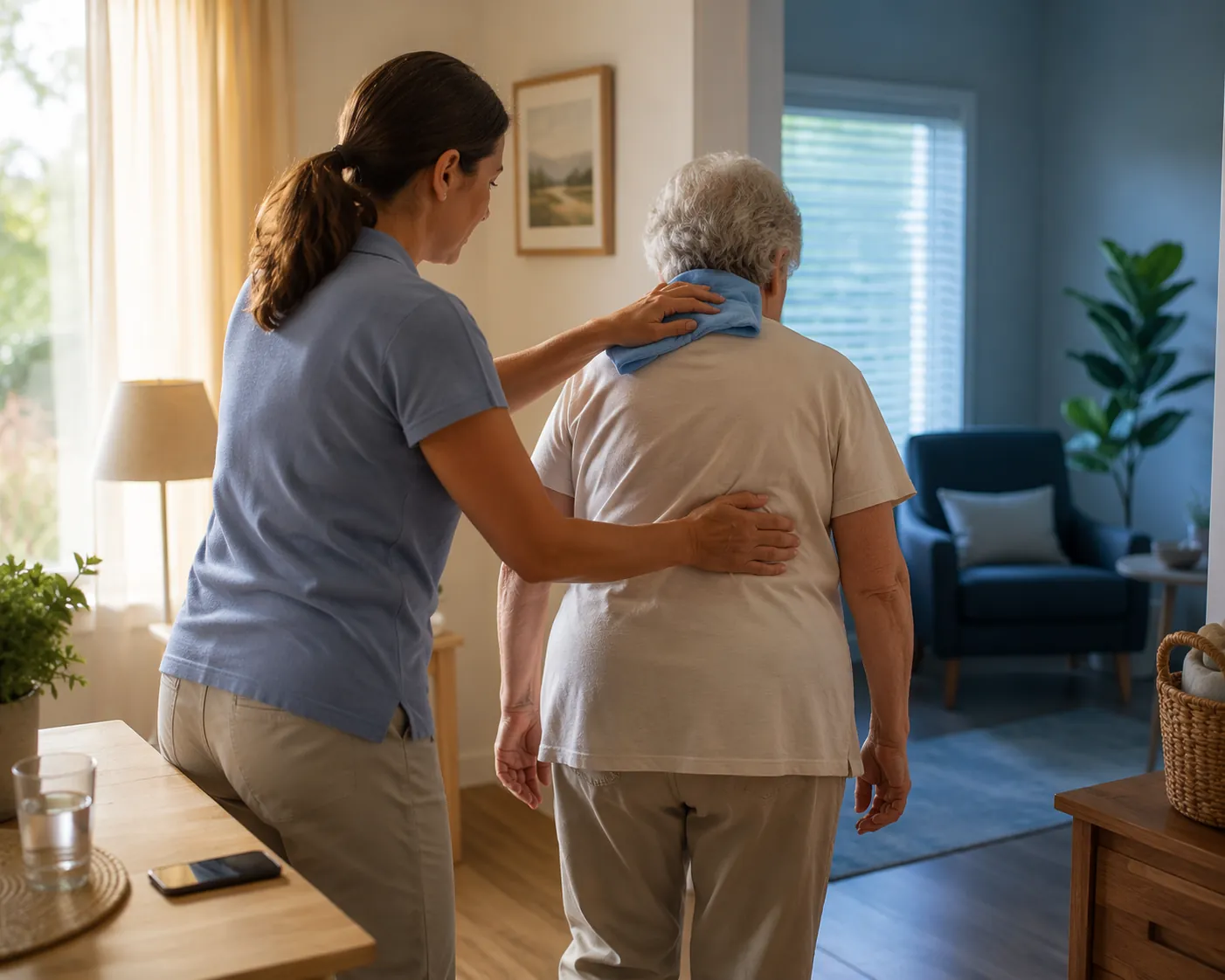
- Begin rapid cooling while help is on the way: use cool water, a cool shower or bath if it can be done safely, spray or sponge the skin, apply cold wet cloths, and place ice packs or cold packs at the neck, armpits, and groin. [3][4]
- Do not give oral fluids if heat stroke is possible, if the person is confused, vomiting, very drowsy, or cannot swallow safely. [3]
A fan is not enough once indoor heat is high. The CDC warns that when indoor temperatures are above 90°F, a fan can become ineffective or may increase body temperature instead of cooling the person. [2] If the room is that hot, the useful question is not whether the fan is running; it is where the person can cool down safely.
If you are choosing between watching and calling
Call. Heat stroke can damage the brain and other organs, and first-aid guidance does not ask families to diagnose it perfectly at home. [3] A cautious call is not overreacting when the person is older, overheated, and newly confused or unsteady.
| What you see | What to do next |
|---|---|
| Dizziness, weakness, heavy sweating, nausea, or unusual fatigue, but the person is awake and speaking clearly | Move to a cooler place, reduce walking, begin cooling, offer small sips only if they can drink safely, and monitor closely. |
| Confusion, fainting, seizure, loss of consciousness, very hot skin, or worsening symptoms | Call 911, cool rapidly, and do not give oral fluids. |
| New unsteadiness, wall-walking, shuffling, or trouble standing during heat | Treat it as a fall warning. Keep the person seated or supported while you cool the space and decide whether urgent help is needed. |
Why heat makes falls more likely
Heat does not have to cause collapse to cause trouble. It can make an older adult slower, weaker, less coordinated, and less steady before anyone uses the word emergency. That is why a dangerous heat day can turn a normal walk to the bathroom into the riskiest part of the afternoon.
The scale of heat harm is not small. Harvard Medicine Magazine reports that more than 80% of the estimated 12,000 annual heat-related deaths in the United States are among adults over 60. [5] For a caregiver standing in a hallway, that number matters because it confirms what the body may already be showing: older adults have less margin when heat stress starts to build.
Dehydration is one part of the fall chain. When fluid levels drop, dizziness, weakness, reduced coordination, and poorer concentration can follow; those are not abstract symptoms when someone is turning, reaching, or standing from bed. [6][7]
Medications can narrow the safety margin further. Diuretics can contribute to fluid loss; beta-blockers can affect the body’s response to heat; ACE inhibitors and ARBs can complicate blood pressure and hydration issues; and antidepressants, antihistamines, and Parkinson’s medications may also interfere with heat tolerance or thermoregulation. [2][6][7] That does not mean stopping medication during a heat wave. It means asking the prescribing clinician, before severe heat arrives, what signs should prompt a call, how to handle hydration if there are fluid restrictions, and whether any medication increases heat sensitivity.
Fatigue finishes the chain. Heat-related tiredness slows reaction time and makes transfers less reliable: standing from a sofa, stepping into a shower, walking down a hallway at night, or bending to pick up a dropped item. Injury prevention guidance for older adults links hot weather with dehydration, dizziness, weakness, reduced coordination, and increased fall concern. [8] The exact size of heat’s effect on fall rates varies by study and setting, so the practical conclusion should stay narrow: heat symptoms and new unsteadiness belong in the same safety conversation.
The home plan before the next dangerous heat day
The best heat plan for an older adult is not only a cooling plan. It is a walking plan, a bathroom plan, a medication question plan, and an emergency contact plan. Build it on a normal day, because the person who is already overheated should not be negotiating clutter, cords, rugs, and phone chargers.
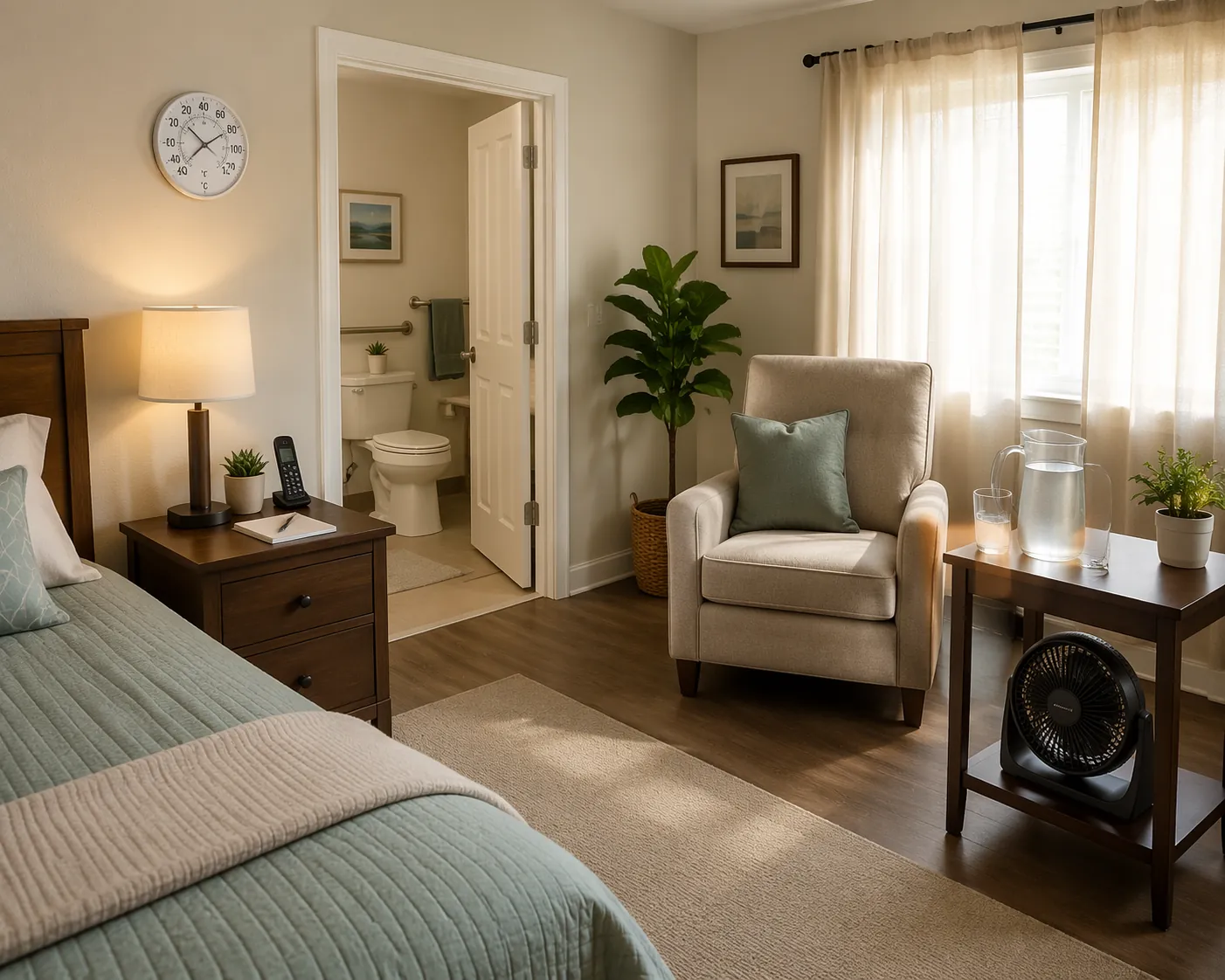
- Use an indoor thermometer, not guesswork. Check the room where the older adult actually spends time. If indoor temperature is above 90°F, do not rely on a fan as the main safety measure. [2]
- Choose the safest cool room. It should have the best available cooling, a chair with arms, a clear path to the bathroom, a phone within reach, and enough light for evening movement.
- Clear the heat-day walking routes. Focus on bed to bathroom, chair to bathroom, kitchen to chair, and chair to exit. Remove throw rugs, cords, laundry baskets, shoes, pet bowls, and low tables from those paths.
- Set rest points. Place sturdy chairs along longer routes so the older adult does not have to choose between pushing through dizziness and sitting on an unsafe surface.
- Make night bathroom trips boring. Use night-lights, keep footwear easy to put on, place mobility aids where they are actually reachable, and avoid leaving cooling equipment cords across the walking path.
- Plan hydration prompts around the person’s medical situation. Some older adults need reminders to drink; others have heart, kidney, or medication-related fluid limits. Ask the clinician what is safe before the heat wave, not while symptoms are unfolding.
- Review heat-sensitive medications in advance. Bring a current medication list to the prescribing clinician or pharmacist and ask which medicines may affect sweating, hydration, blood pressure, alertness, or heat tolerance. [6][7]
- Keep the phone reachable in the cool room, bedroom, and bathroom area if possible. Post emergency contacts in large print. If the person uses a medical alert device, make sure it is charged and worn.
- Decide where to go if the home cannot stay cool. A relative’s home, a public cooling location, or another air-conditioned place should be chosen before the forecast becomes severe. [4]
One small test: walk the heat-day route
Before the next heat wave, walk the route the older adult will use most: bed to bathroom, favorite chair to bathroom, or chair to kitchen. Do it at the same time of day when the room is usually warmest. Look for the places where a person would reach for a wall, turn without support, step over something, or pause because there is no chair nearby.
Home safety guidance for heat and humidity often points to the same practical issue: the environment can become less forgiving just as the person becomes less steady. [9] Fixing the route is not cosmetic. It buys time when dizziness, fatigue, or urgency pushes someone to move before they should.
Use two pathways, not one heat rule
For the forecast, know the formal danger point: a heat index of 103°F or higher is in the National Weather Service “Danger” range. [1] For the person in front of you, act sooner if they are older, medically fragile, taking heat-sensitive medications, living in a hot indoor space, or showing dizziness, confusion, weakness, unusual fatigue, or new unsteadiness.
The crisis pathway is simple: stop unsafe walking, move to cooler conditions if safe, check for emergency signs, call 911 when heat stroke is possible, cool rapidly, and avoid oral fluids when the person cannot drink safely. The plan-ahead pathway is just as practical: cool the living space, measure indoor temperature, prepare the safest room, clear walking routes, plan hydration questions, review medications, and keep help reachable.
This is fall-prevention and heat-safety guidance, not individualized medical advice. Dangerous symptoms in an overheated older adult need urgent professional help.
References
- What is the heat index? — National Weather Service — link
- Heat and Older Adults (Aged 65+) — CDC — link
- Heatstroke: First aid — Mayo Clinic — link
- Extreme Heat Safety — Red Cross — link
- The Effects of Heat on Older Adults — Harvard Medicine Magazine — link
- Extreme heat endangers older adults — Harvard Health — July 16, 2025 — link
- How Older Adults Can Stay Safe in Extreme Heat — Hackensack Meridian Health — July 23, 2026 — link
- Supporting older adults to beat the heat — Injury Matters — link
- How Heat and Humidity Can Impact Senior Safety at Home — Oakley Home Access — link
Related reading
Noticed something outdated or inaccurate on this page? Flag a correction. We review every report against CDC, NIA, and AARP HomeFit guidance before updating a page.
Part of the Fall Prevention section.