
STEADI: intervene
The Overlooked Fall Risk in Severe Weather Driving for Seniors
This article explains why the highest-stakes moment for a senior driver in bad weather is entering or exiting the vehicle, and how to reduce that fall risk with simple pre-trip checks and in-the-moment techniques.
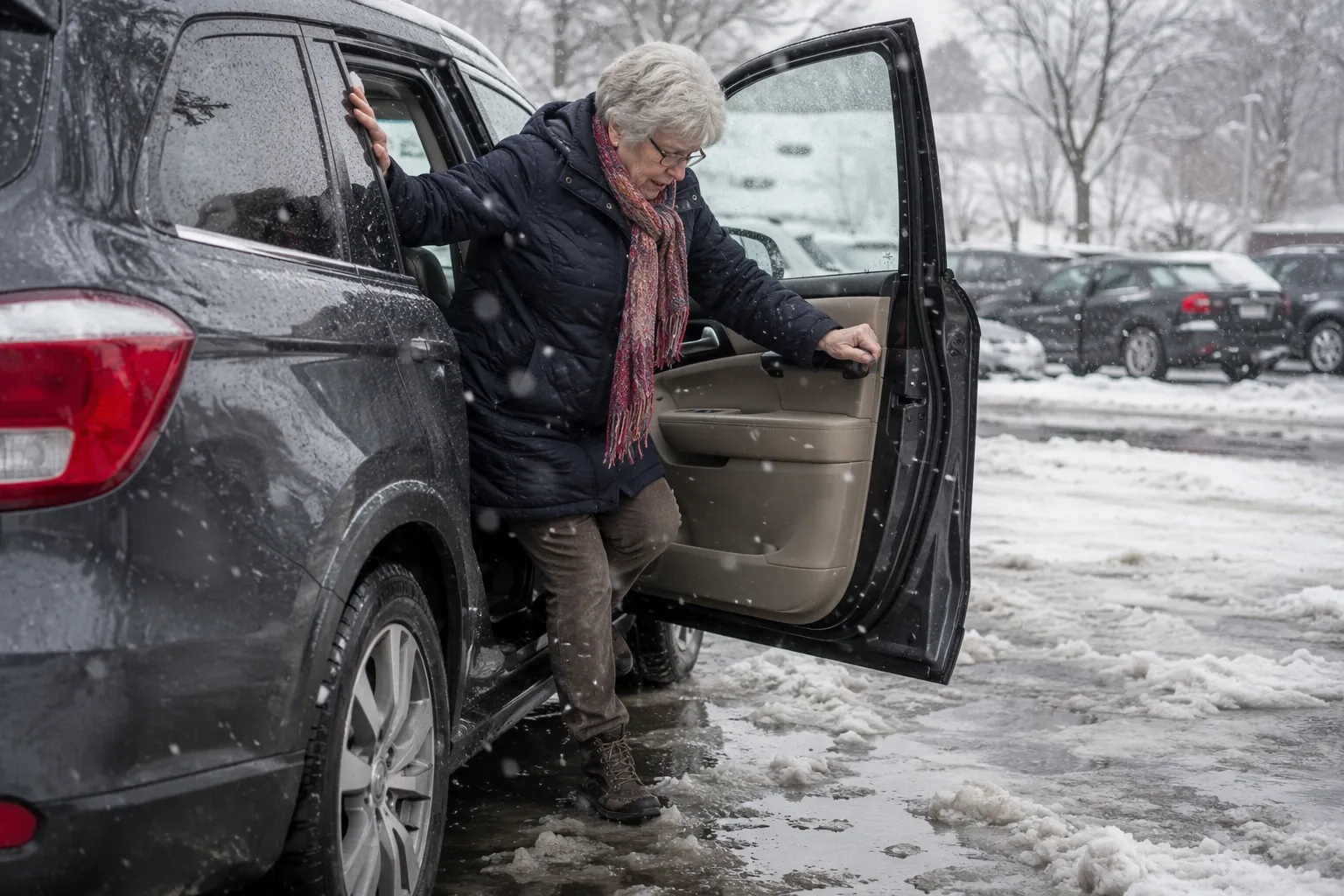
The risky part of a bad-weather trip often comes after the car is already in park. An older driver arrives at a clinic, a grocery store, or home after dark. The wipers are still ticking. The door opens into rain, slush, or packed snow. One foot searches for pavement that cannot quite be seen under the door. One hand is on the cold door frame, the other may be holding keys, a purse, a cane, or the edge of a bulky coat. For a few seconds, the driver is neither seated nor standing.
That is where severe weather driving safety tips for seniors need to begin. Slowing down, increasing following distance, keeping wipers in good condition, and avoiding flooded roads all matter. But for many older adults, the trip is not safely finished until the body has transferred from the vehicle to the ground, turned, closed the door, and walked away without losing balance.
The Car Door Deserves More Attention Than It Gets
A Journal of the American Geriatrics Society study published in 2008 estimated that 37,000 older adults were treated in U.S. emergency departments each year for injuries sustained while entering or exiting a vehicle. The study analyzed 2001–2003 NEISS-AIP data, so the number should not be treated as a current count. Still, the pattern it found is hard to ignore: roughly 40% of those injuries were caused by falls, adults 65 and older had a hospitalization rate 10 times higher than younger adults, and injuries occurred more than twice as often while getting out of a vehicle as while getting in.[1]
The age of that dataset matters. Cars, parking lots, and older-driver patterns have changed since the early 2000s. But the problem has not become irrelevant. The CDC reports that the number of licensed older drivers has increased substantially since 2004, and its older-adult driving guidance treats mobility planning as something that includes the whole trip, not only crash avoidance once the vehicle is moving.[2]
That is the useful shift: the doorway is not a minor inconvenience attached to driving. It is a transfer point. In bad weather, that transfer point combines poor footing, limited hand support, reduced visibility, hurried movement, and the social pressure of not wanting to look helpless.
Bad Weather Turns Ordinary Transfers Into Balance Tests
Falls are already common among older adults. The CDC reports that about 1 in 4 older Americans falls each year, and about 3 million older adults are treated in emergency departments annually for fall injuries.[3] A car exit in winter or heavy rain adds several small hazards at once: slick pavement, wet running boards, icy door handles, snow piled near the curb, low light, and a door that may swing or resist in wind.
Winter creates the clearest fall-prevention concern. Snow and ice are associated with large numbers of fall injuries, and cold-weather guidance for older adults commonly emphasizes traction, footwear, and avoiding unnecessary exposure to icy surfaces.[4][5] Cold can also make the body less forgiving. For people with diabetes, arthritis, poor circulation, or reduced foot sensation, a foot placed on slick ground may not send quick, reliable feedback before weight shifts.
Heavy rain is not the same as ice. It does not bring every cold-specific problem. But it can still make painted lines, curbs, metal thresholds, smooth garage floors, and parking-lot puddles treacherous. It also changes behavior: people hurry, look down through water on their glasses, carry umbrellas, and keep one hand occupied when they most need it for balance.
Three Moments That Need a Plan
The safest routine is not complicated, but it has to match the movement that is actually happening. Most advice fails when it assumes the older adult is standing on stable ground with both hands free. At the car door, that is often exactly what is not true.
1. Before Weight Moves Onto the Pavement
The first foot placement is the one to slow down. Before standing, the driver should open the door only as far as needed, look at the landing area, and clear what can be cleared from the seated position. If snow has drifted against the door, if a curb is hidden, or if the ground slopes away from the car, the safest choice may be to stay seated and ask for a different parking spot, a cleared path, or help with the surface rather than help with the body.
The practical test is simple: do not commit full weight to ground you have not checked. Touch the surface with the foot first. Feel whether the shoe slides. Notice whether the pavement is wet, icy, uneven, or lower than expected. A bulky winter coat can block the view of the foot and the edge of the curb, so looking once from inside the car may not be enough.
Footwear matters here, not as a fashion detail but as equipment. Winter fall-prevention guidance from NCOA recommends shoes or boots with good traction and discusses traction devices such as ice cleats when conditions call for them.[4] For some older adults, non-slip shoe covers or ice-gripper cane tips may be appropriate for specific icy conditions. They are not magic, and they can be awkward or unsafe on indoor floors, so they need to be chosen for the actual route: driveway, parking lot, clinic entrance, and the walk back.
2. While the Body Is Half In, Half Out
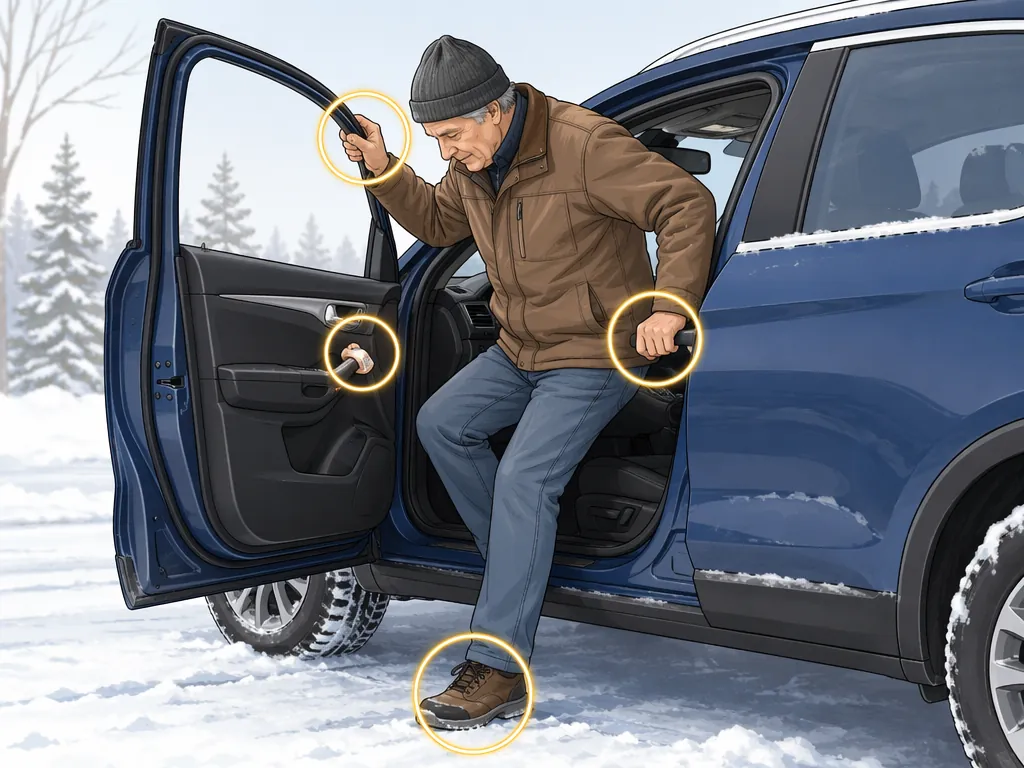
The doorway is a balance problem because the body turns, rises, and shifts weight at the same time. A safer exit keeps three points of contact whenever possible: one foot planted, one hand on a stable part of the vehicle, and another hand or foot still supported before the next movement begins. The door itself can be useful, but it can also move. A door frame, roofline, fixed grab point, or properly fitted transfer handle is often steadier than leaning on the outer edge of a swinging door.
Aftermarket grab handles can help some drivers and passengers, especially when a vehicle sits high off the ground. They should be selected and installed with care, because a handle that shifts, sits at the wrong angle, or encourages pulling against an unstable posture can create a different hazard. The point is not to buy a device for every car. The point is to identify where the hand can go before the body rises.
Closing the door deserves its own pause. Many falls happen after the person is technically out of the car, when one hand reaches back, the torso twists, and one foot pivots on wet or icy ground. A safer sequence is to stand fully, settle both feet, face the door, then close it without stepping backward into unknown pavement. If the door is heavy, icy, or caught by wind, it is better to reposition than to fight it while balanced on one leg.
3. When Bags, Canes, Umbrellas, and Keys Take Over the Hands
A hand that is holding a grocery bag is not available for balance. A hand gripping an umbrella may keep rain off glasses but leave the person with no stable contact point. Keys, phones, handbags, canes, and takeout containers all compete for the same hands needed to exit the car.
The fix is mostly staging. Put bags on the seat closest to the exit instead of in the trunk if the parking surface will be slick. Use a crossbody bag or backpack when appropriate so the hands stay free. Place the cane within reach before opening the door, not behind the seat. If an umbrella is needed, open it after both feet are stable unless someone else can hold it. If there is a passenger or caregiver, the most useful help may be taking the bag, clearing the landing spot, or holding the door steady rather than grabbing the driver’s arm.
That distinction matters for dignity. Many older adults will refuse a hand on the elbow but accept a cleared patch of pavement, a bag carried ahead, or a reminder to plant both feet before turning. The goal is not to make the person feel managed. It is to remove the extra task that steals balance at the worst moment.
A Before-During-After Routine for Bad-Weather Trips
A safer severe-weather driving plan starts in the driveway or garage, not at the first stop sign. The routine can be short enough to use on an ordinary morning.
| When | What to Check | Why It Matters |
|---|---|---|
| Before leaving | Shoes, cane tip, bags, weather at the destination, and the path around the parked car | The driver needs traction and free hands before the first transfer |
| Before getting in | Ice, slush, puddles, curb height, door clearance, and whether the seat or floor mat is wet | The same hazards that make exit risky can also make entry unstable |
| Before getting out | Landing surface, handhold, door movement, and where bags will go | Most vehicle entry/exit injuries in the JAGS study occurred during exit, not entry |
| After parking | Whether the driver can walk away from the car without rushing or carrying too much | The trip is not complete until the person is safely away from the vehicle |
One habit is especially useful before deciding whether to drive: take a short test walk. Step onto the driveway, walkway, or parking area with the same shoes, cane, coat, and bag planned for the trip. If that short walk feels unstable, the drive may only move the same problem to a less familiar parking lot.
The destination matters as much as the driveway. A cleared garage at home does not guarantee a cleared medical-office lot. A grocery store may have wet tile just inside the entrance. A curb cut may be hidden under slush. Calling ahead to ask about drop-off, accessible parking, snow removal, or entrance conditions is not overcautious when the hardest part of the trip may be the last 20 feet.
- Wear shoes or boots with reliable traction before leaving the house, not dress shoes carried to the car.
- Clear the area beside the driver’s door, including the spot where the first foot will land.
- Move bags so the driver can exit with at least one hand free.
- Identify the handhold before standing, especially in high vehicles.
- Delay the trip if the pavement, footwear, or hand support is not safe enough for a controlled transfer.
Falls and Driving Safety Are Not Separate Problems
It is tempting to separate fall risk from driving risk: one belongs to the sidewalk, the other to the road. Older-driver research does not let the separation stay that neat. The AAA Foundation’s LongROAD study found that older adults who had fallen were 40% more likely to experience a subsequent motor vehicle crash.[6]
That finding does not mean a fall causes a crash in every case, and it does not mean that every older adult who falls should stop driving. It does mean that falls can signal changes that matter behind the wheel too: strength, reaction time, vision, medication effects, confidence, or the ability to turn the head and body comfortably. A fall at the car door is not just a household safety issue that happens to occur near a vehicle.
This is where a caregiver conversation can stay useful instead of becoming a fight about keys. The first question does not have to be, “Are you still safe to drive?” It can be, “Can we make getting in and out of the car safer in this weather?” That leaves room for independence while still taking the risk seriously.
What to Do When the Weather Is Already Bad
If the trip cannot be postponed, the entry and exit plan should become more deliberate. Park where the driver’s door opens onto the flattest, clearest surface available, even if that means walking a shorter but slightly different route. Avoid parking beside snowbanks, deep puddles, steep curbs, or areas where plows have pushed slush into ridges. If visibility is poor, use the car’s interior light or a small flashlight before stepping down.
When arriving somewhere unfamiliar, wait before opening the door fully. Look for ice shine, moving water, uneven pavement, and traffic beside the vehicle. If a passenger is present, that person can step out first, check the ground, take bags, and stand where they can steady the door without pulling the driver off balance.
If conditions are bad enough that the driver cannot keep a stable handhold, place both feet deliberately, and walk away from the car without rushing, choose a different way to complete the errand. The answer may be waiting for maintenance to salt the lot, using a drop-off entrance, asking staff to meet the driver, changing the appointment, or accepting a ride where someone else can manage the parking and door-side hazards.
In bad weather, a safe senior driving plan begins before the engine starts and is not complete until the driver is safely away from the car. If the doorway, pavement, footwear, and handholds are not safe, the trip is not yet safe.
References
- Journal of the American Geriatrics Society, 2008, Fall Injuries in Older Adults from an Unusual Source: Entering and Exiting a Vehicle
- Older Adult Drivers, CDC, Older Adult Drivers
- About Older Adult Fall Prevention, CDC, About Older Adult Fall Prevention
- Winter Fall Prevention Tips, NCOA, Winter Fall Prevention Tips
- Snow and Ice Fall Injury Statistics, Allied Services, Snow and Ice Fall Injury Statistics
- LongROAD Study, AAA Foundation, LongROAD Study
Related reading
Noticed something outdated or inaccurate on this page? Flag a correction. We review every report against CDC, NIA, and AARP HomeFit guidance before updating a page.
Part of the Fall Prevention section.