
STEADI: intervene
How Extreme Heat Increases Fall Risk for Seniors Living Alone
Learn how heat and dehydration silently increase fall risk in older adults living alone, and discover a practical self-monitoring system with measurable thresholds to prevent falls before symptoms appear.
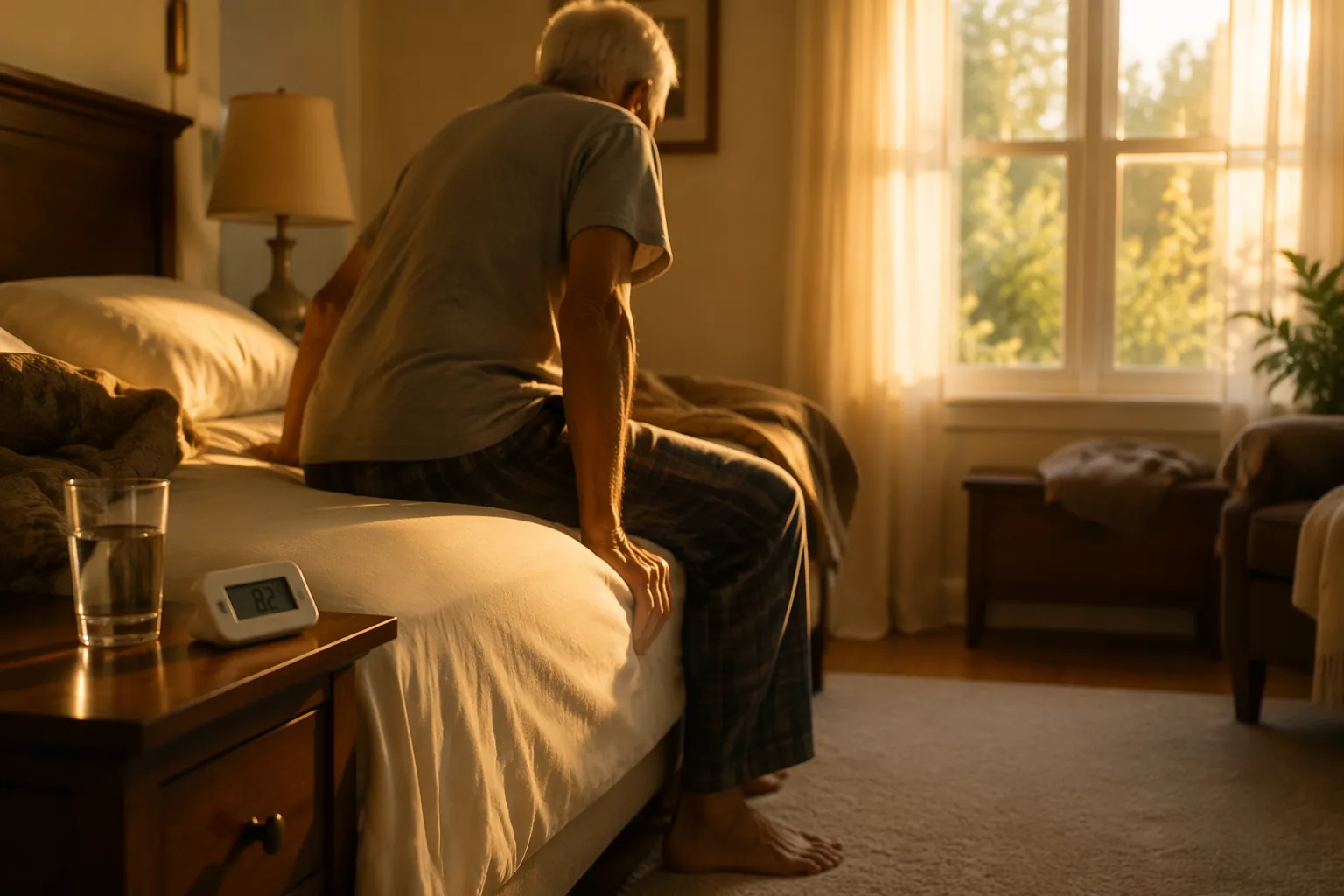
The risky moment on a hot day may arrive before breakfast, before the forecast warning, and before anyone would say you look ill. The bedroom is already warm. You do not feel thirsty. You sit up, swing your legs over the side of the bed, and stand. That first standing movement asks your body to manage blood pressure, balance, fluid reserve, sweating, and medication effects all at once.
For seniors living alone, heat-related falls often begin before obvious heat illness. Dehydration in older adults may show up as lethargy, confusion, dizziness, and falls rather than thirst, which means “I’ll drink when I’m thirsty” is too late for some people on hot mornings. A geriatric review by Schols and colleagues also identifies daily weight loss greater than 3%, or more than 1 kg in a day, as an objective warning sign of dehydration risk when thirst is unreliable [1].
That is the practical problem behind heat safety tips for seniors living alone: the danger is not only heat stroke at the dramatic end of the story. It is the quiet cascade over several hot days—less fluid in reserve, a warm room, medication effects, a slower blood-pressure adjustment when standing, then a dizzy step with no one nearby to catch it.
Why thirst is a poor heat alarm after 65
Thirst is a feeling. A fall is a mechanical event. The trouble is that the feeling may not arrive in time to protect the mechanics.
When you are dehydrated, there is less circulating fluid available to keep blood pressure steady as you stand. Heat adds another demand: your body tries to move blood toward the skin and produce sweat to cool itself. If the fluid reserve is low, standing can produce a short drop in blood pressure. That drop may feel like lightheadedness, but it may also feel like ordinary morning sluggishness, a foggy head, or “I just need a minute.” In an older adult, those softer signs deserve respect because lethargy, confusion, dizziness, and falls are recognized dehydration signs in geriatric care [1].
Living alone makes this more consequential. There may be no spouse in the kitchen to notice that you are slower than usual, no neighbor in the hallway to hear you say the room is spinning, and no adult child watching you walk from bed to bathroom. That does not make independent living unsafe. It means the observer has to be built into the routine: scale, thermometer, urine color, and a pause before standing.
What heat changes in your balance system
Balance is not just an inner-ear issue. On a hot day, balance depends on whether your circulation can keep your brain supplied while your body is also trying to cool itself.
- Heat exposure increases the need for cooling through sweating and changes in blood flow.
- Sweating and low intake can reduce fluid reserve.
- Lower fluid reserve can make blood pressure less stable when you sit up or stand.
- Certain medications can make one part of that adjustment harder.
- Dizziness, confusion, or a weak first step can appear before anyone would label the situation a heat emergency.
This is why the bathroom trip after waking can be a high-risk moment. You have gone hours without drinking. The room may already be warm. If you take a diuretic, blood pressure medication, or medication with anticholinergic effects, your body may have less margin for heat and standing changes. None of that means the medication is wrong. It means hot weather deserves a medication-aware plan.
Medication pathways are specific, and they matter
The CDC’s clinician guidance on heat and medications describes several medication classes that can affect heat response, hydration, sweating, thirst, kidney function, or blood pressure regulation. This is clinical guidance, not a reason to stop a medication on your own. The useful takeaway is narrower and safer: bring your medication list to a prescriber or pharmacist before the hottest part of the season, and ask which medicines need a heat-day plan [2].
| Medication class | Heat-related pathway to ask about | Why it can affect fall risk |
|---|---|---|
| Diuretics | Can contribute to fluid loss and electrolyte imbalance [2] | Less fluid reserve can make standing dizziness more likely, especially after overnight hours. |
| Beta blockers | Can interfere with normal cardiovascular heat response and blood-flow adjustment [2] | The body may have less flexibility to respond to heat and position changes. |
| ACE inhibitors and ARBs | Can affect blood pressure, kidney function, and heat-related fluid balance; CDC also notes medication-related issues with thirst and hydration pathways [2] | A person may not get a strong internal cue to drink before blood pressure or balance is affected. |
| Anticholinergic medications | Can reduce sweating [2] | If sweating is limited, the body may have more trouble cooling, which can worsen weakness, confusion, or dizziness. |
Do not skip, split, or stop a prescribed medicine because the weather is hot unless your prescriber tells you to. A better question is: “On days above 80°F, should I change when I weigh myself, how I monitor fluids, or when I should call you?” If you already have a fall-risk discussion scheduled, a Medicare wellness or fall-prevention visit can be a reasonable time to raise this; CareWise Guide’s overview of Medicare fall-prevention services explains what kinds of reviews may fit into that conversation.
Living alone removes the outside observer
Social isolation is not just an emotional concern during extreme heat. Reviews of heat-related mortality have identified social isolation as a risk factor, which makes sense in ordinary household terms: no one else is there to notice confusion, refill a glass, open a cooler room, or say, “Sit down before you walk” [3].
HealthInAging, from the American Geriatrics Society, notes that more than 600 Americans die each year from heat-related health problems and that most are over age 50 [4]. Those figures should not be used to frighten an independent person into giving up privacy. They should be used to justify a small, repeatable system that does not require someone else to hover.
If isolation itself is becoming part of the fall-risk picture—fewer check-ins, fewer reasons to move around, less chance that anyone sees a change—CareWise Guide’s piece on loneliness and fall risk may help separate the safety issue from the shame people often attach to asking for contact.
A morning heat-check system for seniors living alone
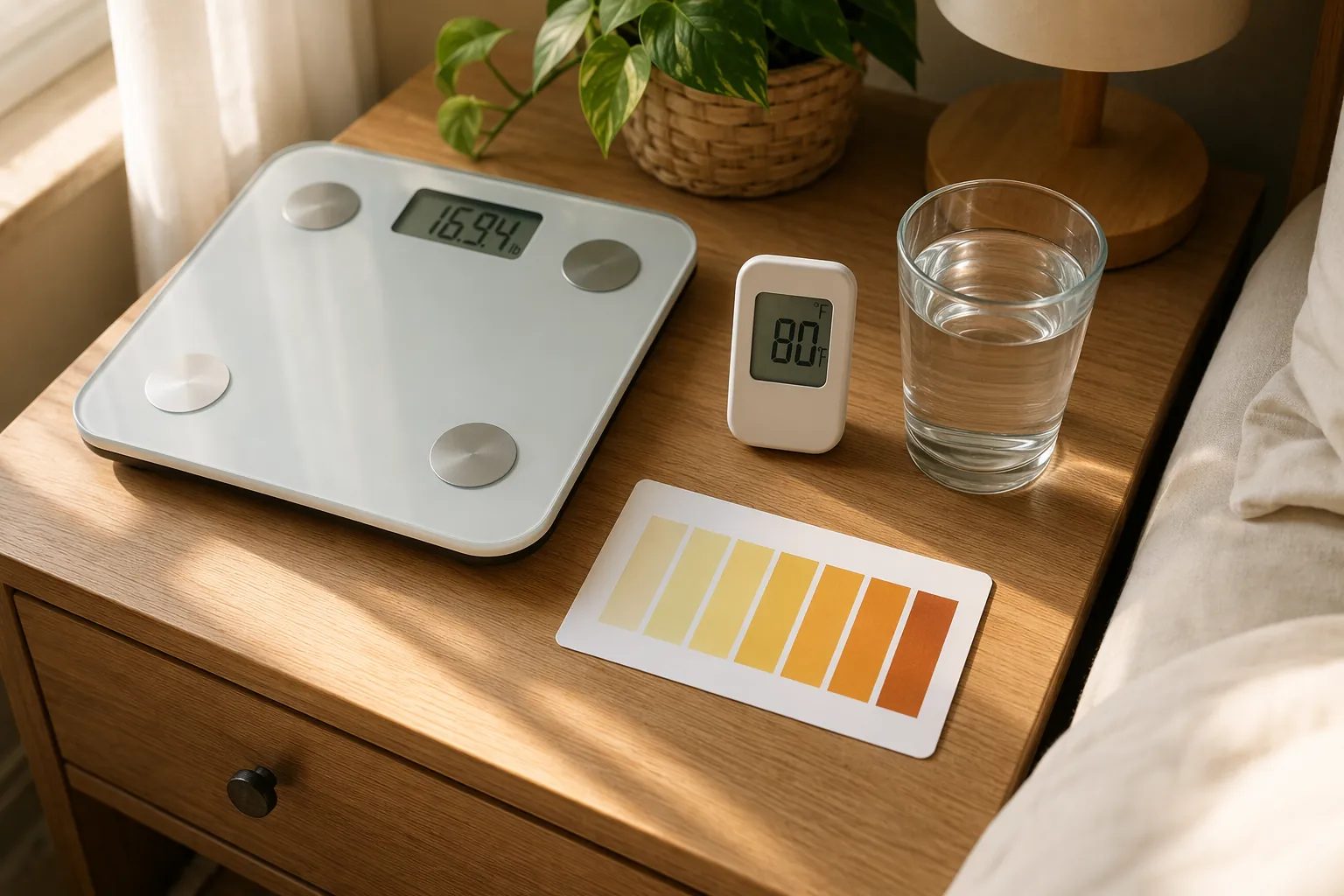
A good heat routine should be short enough to do when you are sleepy. It should not feel like turning your home into a clinic. Think of it as a morning safety ritual: check the room, check your body’s fluid trend, drink before the first walk if you are allowed fluids, and decide whether the day needs extra caution.
The order matters. Do the first part before you stand and rush toward the bathroom or kitchen.
| When to check | What to measure or notice | Action threshold |
|---|---|---|
| Before standing from bed | Sit up, drink a few sips of water if fluids are not restricted, and pause before standing. | If you feel dizzy, unusually weak, foggy, or unsteady, sit back down. Use a phone, medical alert button, or planned check-in before walking. |
| At the bedside or in the main room | Check the room thermometer. Use 80°F as an activation point; HealthInAging flags temperatures above 80°F as a concern for older adults [4]. | At or above 80°F, start the heat-day routine: lighter activity, earlier hydration, cooler room choices, and more deliberate standing. |
| After using the bathroom, before breakfast | Weigh yourself under similar conditions each morning if your clinician agrees this is appropriate. | A loss greater than 3% of body weight, or more than 1 kg in one day, is a dehydration warning sign in older adults [1]. |
| Each bathroom trip | Look at urine color. Pale yellow is generally more reassuring; darker yellow or amber is a visible cue to pay attention. | Dark urine plus heat, dizziness, weakness, confusion, or low intake should trigger fluids if allowed, cooling steps, and a call to a clinician or trusted contact if symptoms persist. |
| Any time during the day | Watch for lethargy, confusion, dizziness, or a new fall or near-fall. | Treat these as possible dehydration or heat-related warning signs, not as ordinary aging or stubbornness [1]. |
Pre-hydration before standing is deliberately simple. Keep water within reach of the bed. When you wake, sit up first. Take a few sips if you are not on fluid restriction. Move your ankles or feet for a moment. Then stand in stages. This is not fussy. It is a way to give your circulation a fair chance before you ask your legs to carry you.
Use the scale as a trend, not a judgment
Some people dislike daily weighing because it feels tied to dieting, discipline, or being watched. For heat safety, the scale has a different job. It is not there to grade your body. It is there to catch a fast fluid shift that thirst may miss.
If daily weighing is part of your plan, make it consistent: same scale, similar time, similar clothing, and a written number. A sudden drop is the issue. The geriatric dehydration review’s warning threshold—greater than 3% body-weight loss or more than 1 kg in a day—gives you a clear reason to stop treating the day as ordinary [1].
For someone who weighs 150 pounds, 3% is 4.5 pounds. That example is only to show how the calculation works; your own threshold should be based on your actual weight and your clinician’s advice, especially if you have heart failure, kidney disease, swelling, or a prescribed fluid limit.
What the 80°F threshold should do
A thermometer reading near or above 80°F should not start a panic. It should start a protocol. HealthInAging’s hot-weather guidance uses temperatures above 80°F as a point of concern for older adults [4]. For a person living alone, that number is useful because it removes negotiation. You do not have to decide whether you “feel hot enough” to take precautions.
The exact hottest hours vary by location, building, sun exposure, and whether the home holds heat into the evening. Some apartments are worse at 7 p.m. than at 2 p.m. Treat heat risk as a daylong and multi-day issue, not just an afternoon problem.
If your main problem is how to cool the home without central air, CareWise Guide’s practical companion on cooling seniors without AC during heat waves has room-by-room cooling tactics.
Urine color is crude, but useful
Urine color is not a perfect medical test. Vitamins, foods, and some medications can change color. Still, it is visible, private, and available several times a day. On a hot day, darker urine should make you ask: Have I had enough fluid? Is the room too warm? Am I slower or more lightheaded than usual? Did my weight drop?
The point is not to make one bathroom check carry the whole decision. The point is to combine clues. Dark urine plus a warm room plus dizziness is more meaningful than any one clue by itself.
How much should you drink?
Fluid advice gets muddled because different guidelines count different things. The Schols geriatric review cites a Dutch Nutrition Centre minimum beverage intake of 1.7 liters per 24 hours; that figure refers to beverages, not total water from all food and drink [1]. U.S. Institute of Medicine guidance uses higher total-water adequate intake values—about 2.7 liters per day for women and 3.7 liters per day for men—because it includes water from foods as well as beverages [5].
So do not turn 1.7 liters into a universal personal prescription, and do not compare it directly with total-water numbers as if they measure the same thing. Your safer target depends on your medical conditions, medications, kidney and heart status, diet, and activity. If a clinician has told you to limit fluids, follow that plan and ask specifically what to do during heat.
For many independent older adults, the practical improvement is not a giant water bottle at noon. It is spreading fluids earlier and more evenly: bedside sips before standing, a drink with morning medications if allowed, fluid with meals, and a check after any episode of sweating, diarrhea, poor appetite, or extra time outdoors.
When a threshold is crossed
A threshold is only helpful if the next step is plain. If your room is above 80°F, slow the morning down. If your weight drops sharply, treat the day as a possible dehydration day. If urine is dark and you feel foggy or unsteady, do not test your balance by pushing through chores. If confusion, fainting, chest pain, severe weakness, or a fall occurs, seek urgent help.
For adult children or neighbors helping from a distance, the goal is not surveillance. Ask for one or two measurable check-ins: “What was the room temperature this morning?” or “Was your weight stable?” is more respectful and more useful than “Are you drinking enough?” A person can answer those questions without defending their independence.
This article is educational and does not replace medical advice. Heat illness, dehydration, blood-pressure problems, and medication side effects can overlap. If you have chronic medical conditions, a history of falls, or a prescribed fluid limit, ask your clinician how these thresholds should be adjusted for you.
The pre-fall routine
On hot mornings, keep it simple: thermometer, water, slow standing, bathroom check, weight trend. Above 80°F, activate the heat routine before symptoms appear. If weight drops more than 3% or more than 1 kg in a day, take it seriously. If dizziness, confusion, lethargy, or a near-fall shows up, do not wait for thirst to confirm the problem.
And before the next heat wave, put your medication list in front of a prescriber or pharmacist and ask what heat changes for you. That one conversation can turn a vague warning—“be careful in the heat”—into a plan you can actually use before your feet hit the floor.
References
- Preventing and treating dehydration in the elderly during periods of illness and warm weather. Journal of Nutrition, Health & Aging. 2009.
- Heat and Medications – Guidance for Clinicians. Centers for Disease Control and Prevention. September 2025.
- Risk Factors for Heat-Related Mortality: A Systematic Review and Meta-Analysis. PLOS ONE. 2015.
- Tip Sheet: Hot Weather Safety Tips for Older Adults. HealthInAging.org.
- Dietary Reference Intakes for Water, Potassium, Sodium, Chloride, and Sulfate. Institute of Medicine. 2005.
Related reading
Noticed something outdated or inaccurate on this page? Flag a correction. We review every report against CDC, NIA, and AARP HomeFit guidance before updating a page.
Part of the Fall Prevention section.