
STEADI: intervene
Preventing Heat Stroke in Seniors Starts With Medications
Reduced sweating, delayed thirst, and common prescriptions like diuretics and beta blockers can silently raise heat stroke risk in seniors. A medication review plus a written cooling and hydration plan, built before a heat wave arrives, is the highest-leverage prevention.
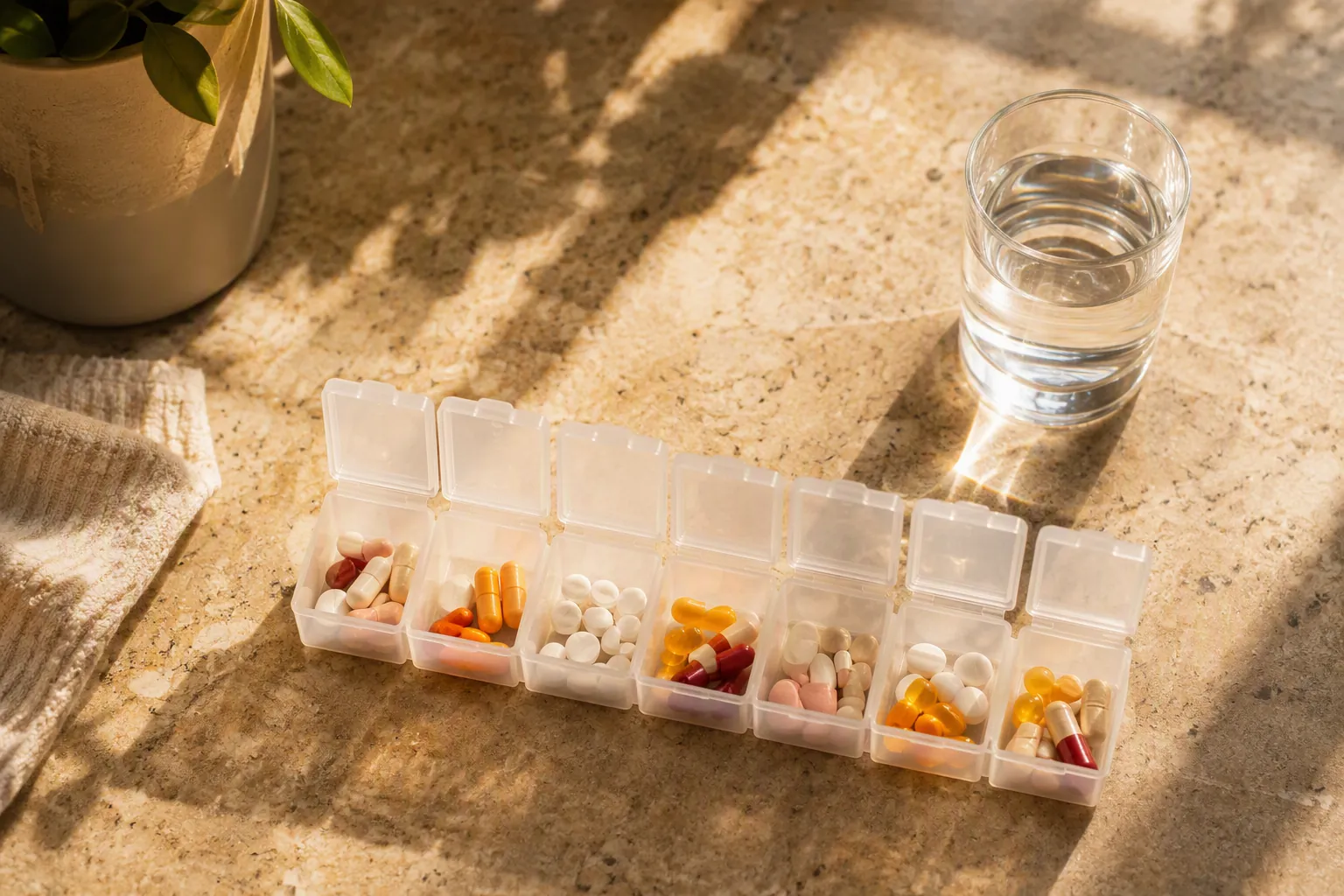
For many older adults, the first heat-stroke prevention tool is not the thermometer. It is the medication list.
That sounds less dramatic than a heat alert, but it is often where the practical risk is hiding. CDC clinician guidance links several common medication groups to dehydration, volume depletion, lower blood pressure, reduced cardiac output, reduced sweating, and an increased risk of fainting and falls during hot weather; it also advises clinicians to make medication plans before heat arrives, not after a patient is already sick.[1]
Heat stroke symptoms in seniors still matter. Confusion, fainting, very high body temperature, hot skin, vomiting, or a sudden change in alertness should be treated as urgent, and you should not wait at home trying to prove whether it is heat exhaustion or heat stroke. For symptom recognition and emergency distinctions, use Heat Exhaustion or Heat Stroke in Older Adults?. This article stays with the quieter prevention question: why a parent who seems fine at breakfast may be dizzy, dehydrated, confused, or fall-prone by late afternoon.
Why older bodies overheat differently
CDC’s older-adult heat guidance does not describe age as a vague weakness. It names two concrete reasons people age 65 and older are at higher risk: they do not adjust as well as younger people to sudden temperature changes, and they are more likely to take medicines that affect temperature control or sweating.[2]
The practical physiology is straightforward: older adults may sweat less, notice thirst only after dehydration has started, and have a less responsive nervous system for heat regulation. Those changes help explain why a person can seem stable in the morning and then become weak, dizzy, confused, or fall-prone later the same day.
That distinction changes the job for a caregiver. If the body may not signal overheating clearly, and the prescription list may be quietly changing sweating, blood volume, or blood pressure, “drink more water” is too blunt. The plan has to account for the specific person, not just the forecast.
The stakes are not theoretical. In CDC’s analysis of U.S. heat-related deaths from 2004 through 2018, people age 65 and older accounted for about 39% to 40% of heat-related deaths and had the highest age-specific death rate, 0.7 per 100,000 population.[3]
That statistic should not be turned into panic or a prediction for one household. It should be turned into a planning prompt: which medicines are in the organizer, which room can actually stay cool, what fluid instructions apply to this person, and who gets called before the forecast turns severe?
The medication mechanisms that belong in a heat plan

A medication does not have to be “dangerous” to matter in a heat wave. The same drug that is useful in February can create a narrower safety margin in August if it changes sweating, circulation, fluid balance, electrolytes, alertness, or blood pressure. The point is not to stop medicines on your own. The point is to ask the prescribing clinician or pharmacist the heat-specific questions before the first alert.
| Medication group | Heat-related mechanism to ask about | Why it changes the home plan |
|---|---|---|
| Diuretics, often called “water pills” | Volume depletion, dehydration, electrolyte imbalance, and lower blood pressure are concerns in CDC clinician guidance.[1] | Hydration advice may need to be individualized. Dizziness, weakness, or standing lightheadedness may become fall risks, not just discomfort. |
| Beta blockers | Reduced cardiovascular response and reduced cardiac output can make it harder for the body to compensate during heat stress.[1] | A parent may not look dramatically ill at first but may have less reserve when standing, walking, or climbing stairs in a warm home. |
| Anticholinergic medicines | Reduced sweating can interfere with heat release.[1] | A fan may feel pleasant while the body still fails to cool effectively, especially if the room itself is hot. |
| Some antidepressants and other nervous-system medicines | CDC groups several medications by effects on thermoregulation, sweating, fluid balance, cognition, and blood pressure.[1] | Confusion, sedation, or delayed response can make it harder for the person to notice heat illness early or act on a plan. |
| ACE inhibitors or ARBs, especially with a diuretic | CDC notes that combining an ACE inhibitor or ARB with a diuretic may significantly increase risk of harm from heat exposure.[1] | This combination deserves a pre-summer review because the risk is not obvious from the pill organizer alone. |
Diuretics: the water pill is not a small detail
A diuretic may be prescribed for an important reason, including blood pressure, heart failure, swelling, or another condition. During heat, though, its usual effect can intersect with sweating and low intake: less circulating fluid, more risk of dehydration, electrolyte shifts, and lower blood pressure. CDC’s clinician table specifically connects diuretics with volume depletion, dehydration, electrolyte imbalance, hypotension, fainting, and falls in heat.[1]
For a caregiver, the practical question is not “Should Mom skip the water pill?” It is: “Who prescribed it, what should we watch for during hot weather, and are there heat-day instructions for fluids, blood pressure readings, weights, dizziness, or lab monitoring?” Those answers need to come from the clinician or pharmacist who knows the person’s conditions.
Beta blockers: less cardiovascular reserve can look quiet
The body cools itself partly by moving warm blood toward the skin and adjusting heart rate and circulation. CDC guidance identifies beta blockers as medications that can reduce cardiovascular response and cardiac output during heat exposure.[1]
That can make an ordinary activity—standing up after lunch, carrying laundry, walking to the mailbox—more consequential on a hot day. The fall may be the visible event, but the chain may have started with heat stress, lower blood pressure, reduced reserve, and a medication effect. For a fuller explanation of that chain, see Why Extreme Heat Raises Fall Risk in Older Adults.
Anticholinergics: reduced sweating can defeat “just use a fan”
Sweating is not a comfort feature; it is a cooling mechanism. CDC guidance identifies anticholinergic medications as a concern because they can reduce sweating and interfere with thermoregulation.[1]
This is where generic advice can mislead. A fan may make someone feel less miserable, but if the room is hot and the person is not sweating effectively, airflow alone may not solve the cooling problem. CDC advises older adults not to rely on an electric fan as the primary cooling device during extreme heat.[2] For the room-by-room work of lowering heat exposure at home, use Room-by-Room Extreme Heat Safety Tips for Older Adults.
Blood pressure medicines: combinations matter
Heat planning gets more important when medicines overlap. CDC specifically warns that an ACE inhibitor or an angiotensin receptor blocker, often called an ARB, combined with a diuretic may significantly increase risk of harm from heat exposure.[1]
That is the kind of interaction a family may miss if each prescription is viewed separately. The cardiologist prescribed one medication, the primary-care clinician renewed another, and the pill organizer makes them look equally routine. A heat review should look at the whole list, including over-the-counter sleep aids, allergy medicines, bladder medicines, pain medicines, supplements, and any recent dose changes.
What to ask before summer, not during the emergency
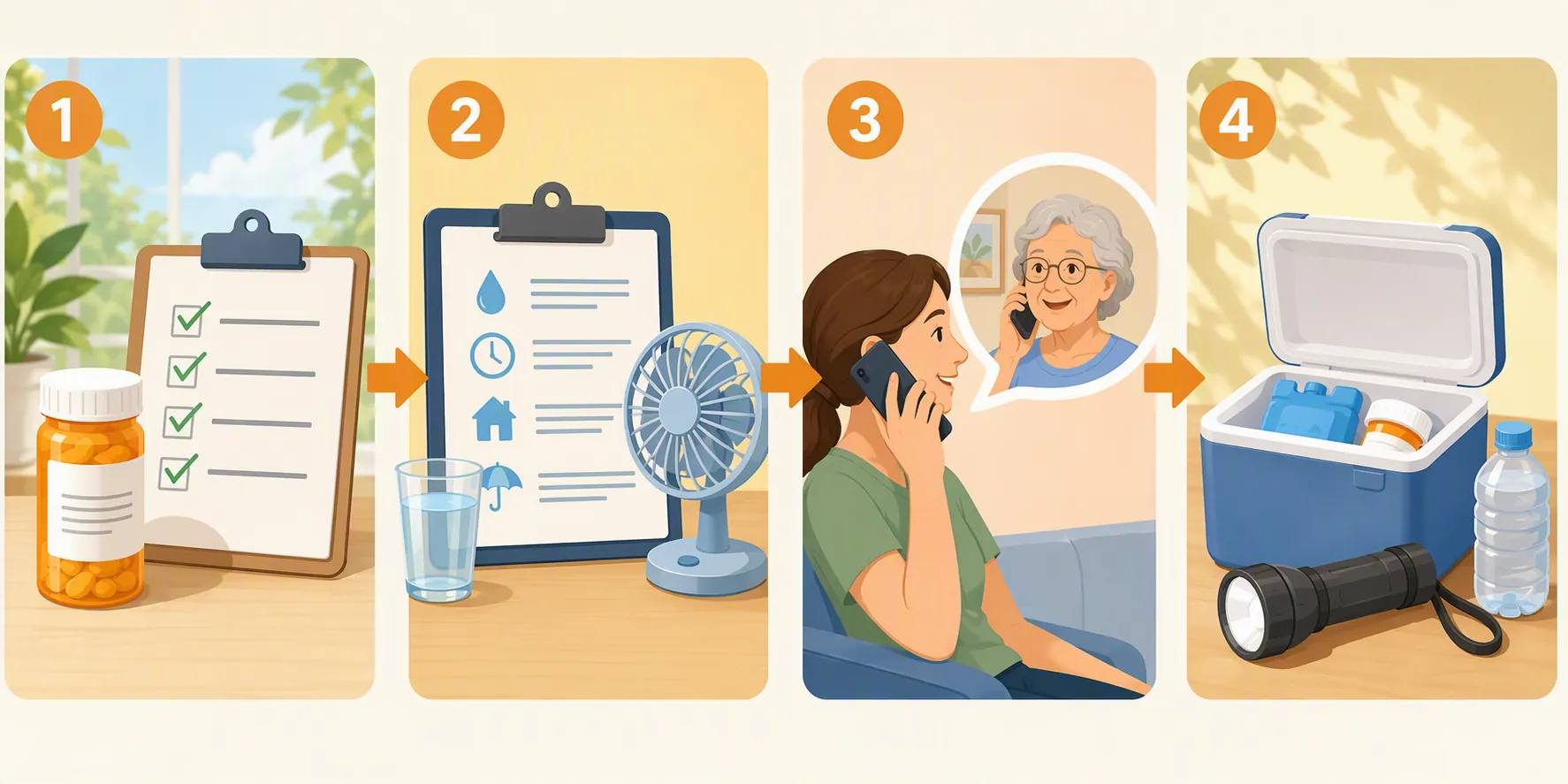
A useful heat plan is not a long binder. It is a short set of decisions made while everyone is calm enough to think clearly.
- Bring one current medication list to the prescribing clinician or pharmacist. Include prescription drugs, over-the-counter medicines, supplements, patches, eye drops, inhalers, and “only as needed” medicines.
- Ask which medicines could affect sweating, thirst, hydration, electrolytes, blood pressure, alertness, or fall risk during heat.
- Ask whether any heat-day instructions apply. Do not create your own stop-start rules for blood pressure medicines, diuretics, diabetes medicines, psychiatric medicines, or heart medicines.
- Write down individualized fluid guidance, especially if the person has heart failure, kidney disease, liver disease, low sodium, a fluid restriction, or a history of dehydration.
- Write down who to call first for non-emergency medication questions and when to use 911 for severe symptoms.
The most useful clinician question is usually specific: “When the forecast is dangerously hot, what changes should we make to monitoring, fluids, cooling, activity, or call thresholds because of this medication list?” That is different from asking whether the medicine is “safe.” It asks how to use it safely in a predictable seasonal stressor.
The written cooling and hydration plan
The plan should fit on one page and be visible: refrigerator, medication cabinet, shared caregiving app, or the inside of a kitchen cabinet. It should answer the questions that become hard to solve at 4 p.m. in a hot apartment.
| Plan item | What to write down |
|---|---|
| Cooling location | Which room stays coolest, where the person can go if the home is too hot, and who can drive or arrange transportation. |
| Hydration instructions | How much fluid is appropriate for this person, what drinks are allowed or discouraged, and what to do if appetite or intake drops. |
| Medication notes | Heat-specific instructions from the clinician or pharmacist, including what symptoms or readings should trigger a call. |
| Check-ins | Who calls or visits, when they do it, and what they ask beyond “Are you okay?” |
| Escalation | When to call the clinician, when to call urgent care, and when to call 911. |
| Power and medication storage | What needs refrigeration, what equipment needs electricity, and where backups are kept. |
Hydration is the part most families oversimplify. If someone is on a diuretic, has kidney disease, has heart failure, has a fluid restriction, or has been told to watch sodium, the answer cannot be copied from a generic heat article. For a more detailed way to think about thirst cues, fluid restriction, and dehydration monitoring, see Why Dehydration Is the Real Cyclospora Risk for Older Adults. The infection context is different; the caregiver mechanics of noticing dehydration before it becomes obvious are relevant.
Check-ins should also be more concrete than “Are you drinking water?” A better call sounds like: “What room are you in? Is the air conditioner on? What have you had to drink since breakfast? Any dizziness when standing? Any confusion, headache, vomiting, weakness, or trouble walking? Did you take your usual medicines?” For full heat-alert timing, including action levels and twice-daily check-ins, use How to Build a Heat Wave Safety Plan for Elderly Parents.
Medication storage is part of prevention
Heat can affect medications themselves, not only the person taking them. CDC clinician guidance notes that insulin can lose effectiveness if exposed to extreme temperatures, inhalers can burst, and people who rely on refrigerated medicines or electric medical devices need a plan for power outages.[1]
That belongs in the same heat plan as cooling and hydration. If a parent uses insulin, temperature-sensitive medicines, oxygen equipment, a powered mobility device, a CPAP machine, or an electric recliner they need to stand safely, the plan should name the backup power source, transportation option, pharmacy contact, and place to go if the home loses electricity. For the power-loss version of that plan, use Your 72-Hour Power Outage Safety Checklist for Seniors.
Do not build the plan around a magic number
Caregivers often want a single cutoff: a body temperature, an indoor temperature, a heat-index number, or a fan rule. The problem is that public-health and medical sources do not always phrase those thresholds the same way. Some sources use different core-temperature cutoffs for heat stroke, and fan guidance also varies by authority and context. CDC’s practical warning for older adults is simpler: do not rely on an electric fan as the primary cooling device during extreme heat.[2]
A home plan should therefore use sourced thresholds where they exist—local heat alerts, clinician instructions, emergency symptoms, and cooling-center guidance—rather than family guesses. If an older adult is confused, fainting, unable to keep fluids down, very weak, or suddenly not acting like themselves in heat, the safer decision is to treat it as urgent and call 911.
This is informational prevention guidance, not a medication order. The safest heat plan for seniors starts before summer: the medication list reviewed by a clinician or pharmacist, cooling options written down, hydration instructions individualized, power-loss backups named, and emergency thresholds sourced instead of guessed.
References
Related reading
Noticed something outdated or inaccurate on this page? Flag a correction. We review every report against CDC, NIA, and AARP HomeFit guidance before updating a page.
Part of the Fall Prevention section.