
STEADI: Intervene
Prevent Heatstroke and Falls in Seniors During a Heatwave
Heat raises fall risk in older adults through dehydration, fatigue, blood-pressure drops, and heat-sensitive medications — so one pre-heatwave checklist can prevent both heatstroke and falls. This plan-ahead guide gives caregivers the home, medication, and hydration steps to prepare before hot weather arrives.
Heatstroke prevention is fall prevention for older adults. Before a heatwave, the practical question is not only whether an older parent can avoid overheating, but whether heat will make them dizzy, slower to react, newly confused, or more likely to stand up into a blood-pressure drop on the way to the bathroom.
The stakes are not theoretical. CDC summarizes a JAMA Internal Medicine analysis showing that heat-related deaths in the United States rose 117% from 1999 to 2023, and adults 65 and older accounted for 39% of those deaths.[1] A Medicare-based study reported by Harvard T.H. Chan School of Public Health estimated that heatwaves were associated with about 9 additional deaths per 10,000 older adults each year, or roughly 17,600 additional deaths from 2000 through 2018.[2]
Those numbers matter because they should change what happens in the home before the forecast turns dangerous. A working air conditioner, a medication plan, a glass of water within reach, and a clear path from bed to bathroom are not separate safety projects during extreme heat. They are one plan.
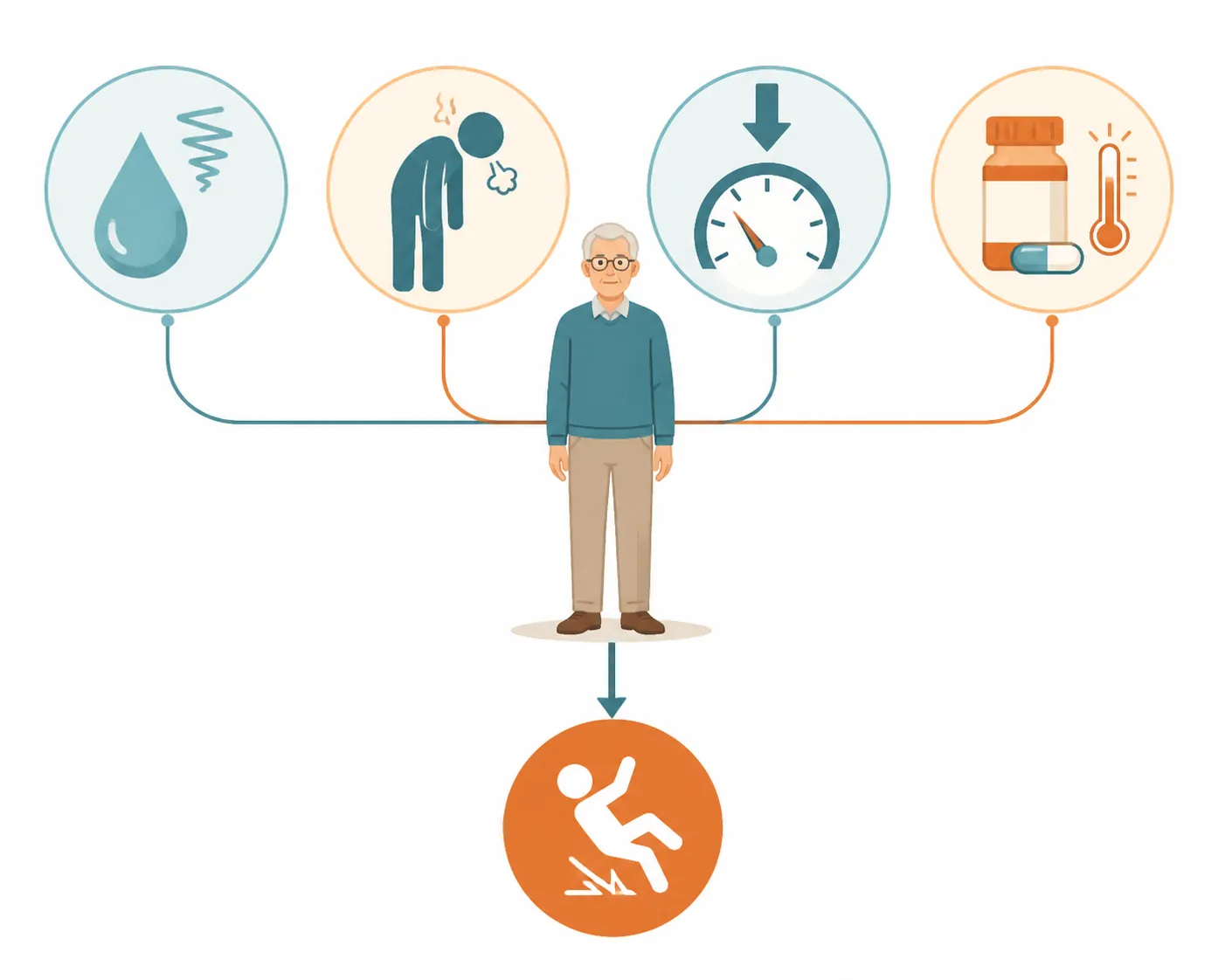
Why heat makes falls more likely
The heat-to-fall link is best treated as an evidence-supported chain of hazards, not as proof that every heatwave directly causes every fall. The useful part for caregivers is that the chain has visible weak points.
| Heat pathway | How it can show up at home | What to check before the heatwave |
|---|---|---|
| Dehydration | Lightheadedness, dry mouth, headache, confusion, darker urine, less frequent urination | Set a drinking plan, keep fluids where the person actually sits, and ask a clinician for individualized limits if they take diuretics or have fluid restrictions |
| Fatigue and slower reaction time | More time getting out of a chair, shuffling, missed grab bar, late reach for a walker | Move tasks to cooler hours, reduce unnecessary trips across the home, and put essentials within easy reach |
| Heat-related blood-pressure drops when standing | Dizziness after rising from bed, toilet, recliner, or dining chair | Add a pause routine: sit, stand, wait, then walk; make sure night lights and handholds are in place |
| Heat-sensitive medications | Reduced thirst, reduced sweating, dehydration, low blood pressure, sedation, confusion, or kidney strain | Review the medication list with a clinician or pharmacist before hot weather; do not stop medicines abruptly |
Dehydration deserves special attention because it is common enough to hide in plain sight. In a cohort of 30,634 adults 65 and older, dehydration was present in 37.9% and was associated with falls, with an odds ratio of 1.13.[3] That is a modest association, but in a real apartment it can be the difference between standing steadily and grabbing for the counter.
Heat also changes circulation. CDC clinician guidance notes that some medications can contribute to volume depletion, electrolyte imbalance, reduced sweating, low blood pressure, and an increased risk of fainting and falls in hot weather.[4] Falls-prevention guidance from Injury Matters similarly points to dehydration, fatigue, vasodilation, and medication effects as summer heat hazards for older adults.[5]
For a deeper look at the dehydration-medication-humidity chain, see Why Extreme Heat Raises Fall Risk in Older Adults. This guide stays with the before-the-heatwave checklist: what to test, move, ask, and schedule.
Build one pre-heatwave checklist, not two
A caregiver can lose time if heatstroke prevention and fall prevention are handled as separate lists. The same home walk-through should answer five questions.
- Will the home stay cool enough, and will the cooling actually be used?
- What happens if the air conditioner fails or the power goes out?
- Which medications could make heat, dehydration, dizziness, or confusion more dangerous?
- How will hydration happen for this specific person, not for an average healthy adult?
- Are the walking routes safe for someone who may be tired, lightheaded, or getting up at night?
If the forecast involves a named or prolonged heat dome, use this plan alongside Heat Dome Fall Prevention for Elderly Parents or the more time-boxed 72-hour heat dome checklist. For many families, the biggest gains still come from the basics below.
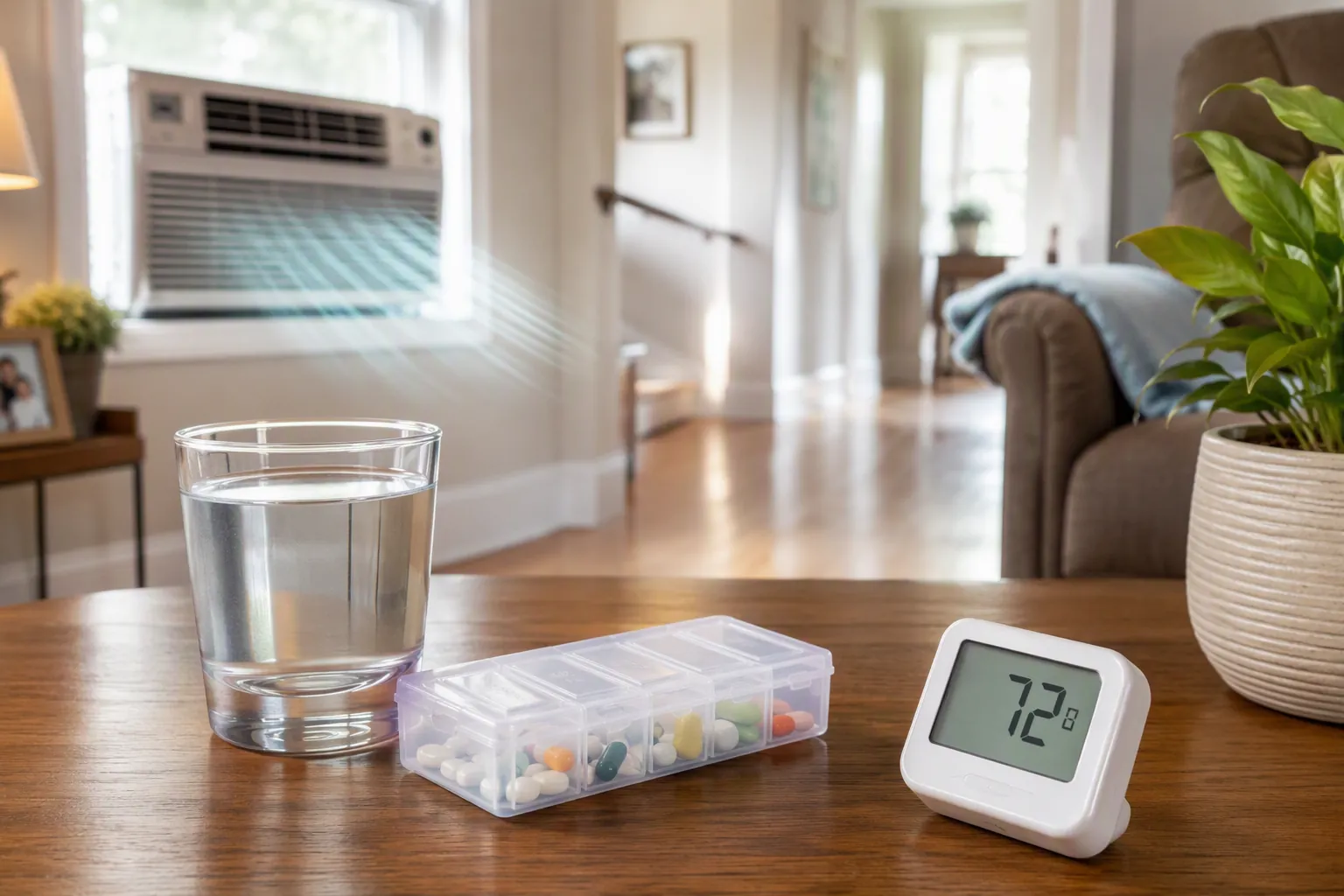
Confirm the cooling will work when it matters
Air conditioning is the strongest protective tool in the home, but only if it cools the rooms the older adult actually uses. An Ontario nursing home study found that on extreme-heat days, nursing homes without air conditioning had higher mortality odds, with an odds ratio of 1.11 and 95% confidence interval of 1.06 to 1.16, compared with 1.03 in homes with air conditioning. The same study notes that more than 35 million U.S. households lack air conditioning.[8]
The more painful failure is the home that technically has AC but does not get protected by it. In a Phoenix review of indoor heat deaths in 2019, 91% of victims had air conditioning that was off, broken, or set too low to protect them.[9] That finding turns “Does Mom have AC?” into a more useful set of questions.
- Turn the unit on before the heatwave and confirm that the room temperature actually drops.
- Check the room where the person sleeps, the chair where they spend the afternoon, and the route to the bathroom, not only the hallway thermostat.
- Ask whether they avoid using AC because of cost, noise, drafts, or a belief that they “do not need it.” Solve that barrier before the hottest day.
- Replace or clean filters if the unit requires it, and make sure cords do not cross walking paths.
- Choose one cool room as the daytime refuge and move water, phone charger, medications, glasses, walker, and a lamp within reach.
- Write down the backup destination: a relative’s home, cooling center, library, senior center, or other air-conditioned place they can realistically reach.
Fans need more caution than they usually get. CDC advises not relying on a fan as the main cooling source when it is very hot.[1] WHO says fans can help only below 40°C, or 104°F.[10] NHS guidance gives a lower threshold, saying fans can help when temperatures are below 35°C, or 95°F.[11] Those thresholds are not identical, so the safe planning point is simple: a fan may move air, but it is not the backup plan for an older adult sitting in dangerous indoor heat.
If the concern is a blackout during a heatwave, pair this checklist with How to Fall-Proof a Senior's Home Before a Power Outage. For broader severe-weather planning, use the Severe Weather Prep Checklist to Prevent Senior Falls. Heat is often treated as a comfort issue until the cooling fails; then it becomes a fall, medication, and emergency-access problem at the same time.
If AC cost or access is the barrier
For low-income older adults, the Low Income Home Energy Assistance Program may help with cooling costs, utility bills, or air conditioning. AGS Health in Aging lists LIHEAP at 1-866-674-6327.[12] This is worth checking before the heatwave, not after an unpaid bill or broken unit has already changed the plan.
Review medications before hot weather, not during the crisis
The medication review is one of the highest-value caregiver tasks because heat risk can be hidden in an ordinary pill organizer. CDC lists several medication groups that can affect fluid balance, sweating, blood pressure, cognition, or heat response, including diuretics, beta blockers, ACE inhibitors and ARBs, calcium channel blockers, antipsychotics, SSRIs and SNRIs, anticholinergics, antihistamines, opiates, benzodiazepines, and anticonvulsants.[4] AARP also warns that multiple medication types can impair heat tolerance, including heart medications, antidepressants, central nervous system stimulants, and dopaminergics.[6]
The point is not to make a caregiver suspicious of every prescription. The point is to bring the full list to a clinician or pharmacist before the heatwave and ask specific questions: Does this medicine increase dehydration risk? Does it lower blood pressure? Can it reduce sweating or thirst? Could it worsen confusion? Should timing, monitoring, or fluid guidance change during hot weather?
Rush geriatrician Juan Cobo, MD, gives a memorable stacking example: a diuretic, a beta blocker, and an NSAID on a hot day can contribute to fluid and electrolyte depletion, with confusion, dizziness, dehydration, and kidney damage as possible consequences.[7] That is exactly the kind of combination a family can miss if they only look for “heat medicines” instead of reviewing the whole medication picture, including over-the-counter pain relievers.
Do not stop medications abruptly, and do not change dose or timing without clinical guidance. CDC and AARP both frame medication adjustment as something to discuss with a clinician, not something to improvise during a hot afternoon.[4][6]
Check medication storage, too
A pill organizer on a sunny kitchen counter is not a neutral detail during a heatwave. CDC warns that heat can degrade insulin, cause inhalers to burst, and make EpiPens malfunction.[4] Move medicines out of hot rooms, direct sun, parked cars, and bags left near windows. If any medication has specific temperature instructions, follow the label or ask the pharmacist how to protect it during high indoor temperatures or a power outage.
Make hydration specific enough to happen
“Drink more water” fails when the older adult does not feel thirsty, dislikes frequent bathroom trips, forgets the glass in another room, or has been told to limit fluids. WHO gives general hot-weather targets of about 1 cup of water per hour and 2 to 3 liters per day for generally healthy adults.[10] That is not a universal target for every older adult.
If the person has heart failure, kidney disease, a prescribed fluid restriction, or takes water pills, ask the clinician what amount and timing are appropriate during a heatwave. CDC and Rush both flag the importance of medication and fluid-balance guidance in hot weather, especially for older adults and people taking drugs that affect hydration or blood pressure.[4][7]
- Put a filled water bottle or cup at the chair, bedside, and table where the person spends time.
- Pair drinking with existing habits: morning pills, breakfast, lunch, afternoon TV, dinner, and evening medications.
- Use foods with fluid, such as fruit or soup, if that fits the person’s diet and medical plan.
- Watch for new dizziness, headache, unusual sleepiness, confusion, very dark urine, or fewer bathroom trips.
- Do not encourage large sudden fluid loads if the person has a fluid restriction or has been told to monitor weight or swelling.
Hydration planning should also respect fall risk. If drinking more means more trips to the bathroom, then the route has to be safer: lights on, rug edges secured, walker reachable, toilet path clear, and a chair or stable surface available if the person needs to pause.
Fall-proof the hot-weather routes
Heatwave fall-proofing should focus on the paths that will be used when the person is most vulnerable: after standing up from sleep, after sitting in a warm room, after taking medications, and during extra bathroom trips.
- Clear the route from bed to bathroom, bathroom to cool room, and cool room to kitchen.
- Remove loose cords from fans, AC units, phone chargers, and extension cords crossing walking paths.
- Place night lights where they illuminate the floor, not only the wall.
- Keep the walker, cane, glasses, hearing aids, phone, and water within reach of the main chair and bedside.
- Set a standing routine: sit at the edge of the bed, place both feet, stand, wait, then walk.
- Move heavy chores, laundry, trash, and outdoor errands out of the hottest hours or delegate them during the heatwave.
The standing pause may sound small, but it directly addresses the blood-pressure drop problem. It also gives the person a moment to notice dizziness before they are halfway across the room.
Schedule check-ins through the days after the peak
CDC advises checking on older adults at least twice daily during hot weather.[1] For fall prevention, those check-ins should not be limited to “Are you okay?” Ask questions that test whether the plan is working.
- Is the AC on, and what does the room thermometer say?
- When did you last drink something?
- Have you felt dizzy, faint, unusually tired, or confused today?
- Did you take all medications as prescribed, and did you take any over-the-counter pain relievers?
- Have you gone to the bathroom less than usual, or is urine darker than usual?
- Are the lights, walker, phone, and water still within reach?
Keep the check-ins going after the worst forecast day. In the Ontario nursing home study, the effects of extreme heat on residents lasted up to 3 days.[8] A cooler-looking day on the weather app does not always mean an older adult’s body, medications, apartment, and sleep have recovered.
Know when prevention has ended
This is a plan-ahead guide. If symptoms are already present, the job changes from prevention to urgent response.
Mayo Clinic describes heat exhaustion symptoms that can include heavy sweating, cool moist skin, faintness, dizziness, fatigue, weak rapid pulse, low blood pressure when standing, muscle cramps, nausea, and headache. It also advises calling 911 or the local emergency number if the person’s condition worsens, especially with confusion, agitation, loss of consciousness, inability to drink, or a core body temperature of 104°F or higher.[13]
Use a companion emergency-recognition guide for the act-now decision tree. Before that point, the measurable plan is straightforward: cooling verified, medication questions asked, hydration individualized, walking routes cleared, backup cooling arranged, and check-ins scheduled through the days after the heat peaks.
References
- Heat and Older Adults (Aged 65+) — CDC
- Heat waves and annual death rates in older adults in the United States — Harvard T.H. Chan School of Public Health
- Mayo Clinic Proceedings (PMC) — PMC
- Heat and Medications – Guidance for Clinicians — CDC
- Beat the Heat This Summer — Injury Matters
- Medications That Can Impair Your Response to Heat — AARP
- Older Adults Face Extra Hazards in the Heat — Rush University System for Health
- JAMA Internal Medicine (PMC) — PMC — 2025
- The Effects of Heat on Older Adults — Harvard Medicine Magazine
- Climate change and heat and health — WHO
- Heatwave: how to cope in hot weather — NHS
- Tip Sheet: Hot Weather Safety Tips for Older Adults — AGS Health in Aging
- First aid: Heat exhaustion — Mayo Clinic
Related reading
Noticed something outdated or inaccurate on this page? Flag a correction. We review every report against CDC, NIA, and AARP HomeFit guidance before updating a page.
Part of the Fall Prevention section.