
STEADI: Intervene
How to Prevent Heat Stroke and Falls in Older Adults
Extreme heat in older adults first appears as the same warning signs as fall risk — dizziness, weakness, unsteadiness, and confusion — so one prevention routine protects against both. The routine combines hydration, a cooled home, safe activity timing, and medication awareness with a twice-daily caregiver check-in, plus clear rules for when heat stroke is a 911 emergency.
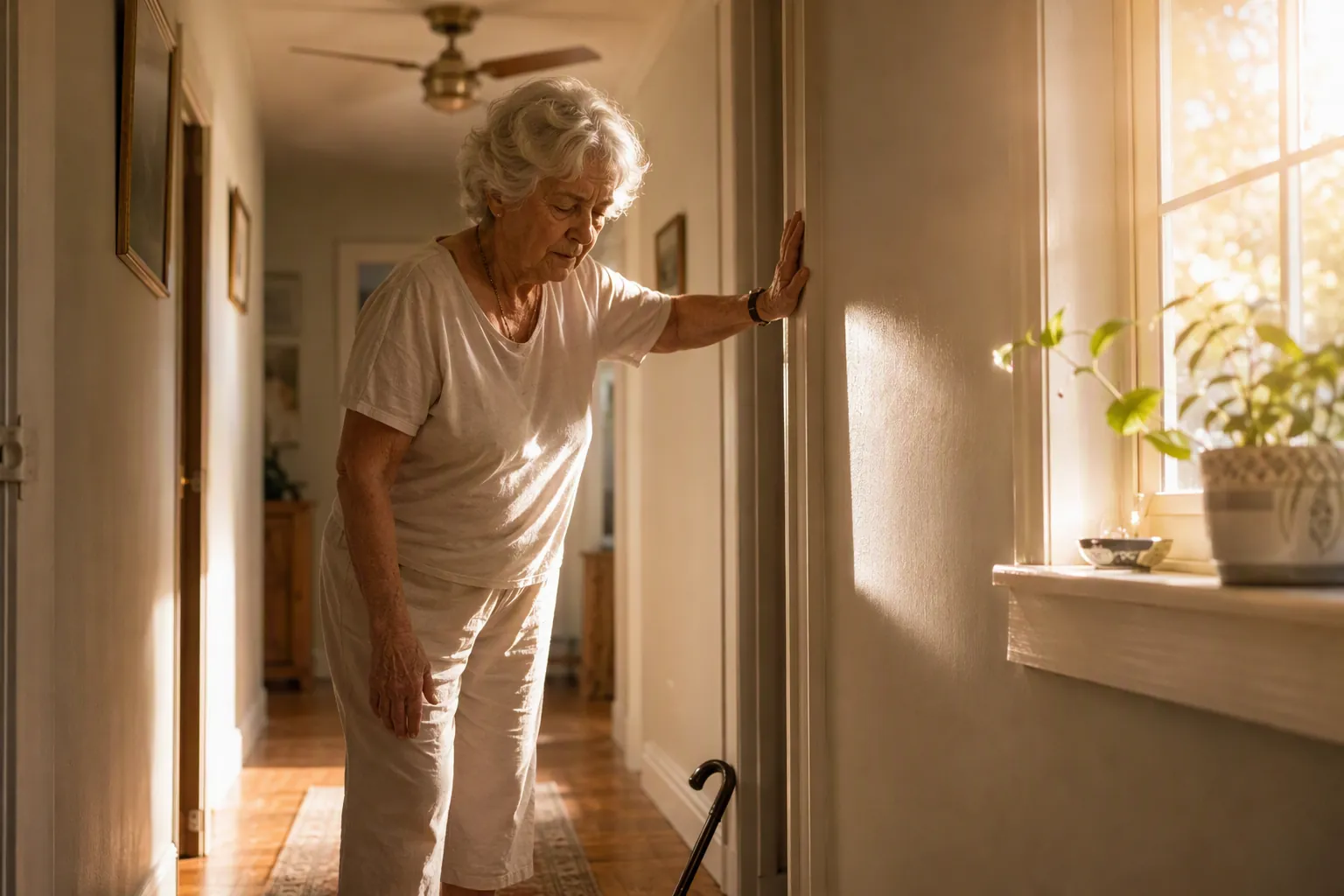
On a very hot day, the first warning may not look like a heat emergency. It may look like an older parent standing up from a chair and grabbing the wall, walking more slowly to the bathroom, answering a simple question with unusual confusion, or saying “I’m fine” while looking weak and unsteady. For adults 65 and older, preventing heat stroke in extreme heat belongs in the same mental file as fall prevention, because the early clues often overlap: dizziness, weakness, light-headedness, unsteadiness, and changes in thinking.
That overlap matters because a caregiver can miss the danger by sorting symptoms into neat categories. “Heat problem” sounds like water, shade, and air conditioning. “Fall problem” sounds like shoes, walkers, rugs, and balance. At home, the body does not divide itself that cleanly. Heat can lower blood pressure, make standing harder, reduce walking endurance, and cloud judgment. Those are exactly the conditions that make a hallway, bathroom, porch step, or parking lot more dangerous.
This article is for home-safety education and planning. It is not a substitute for medical care, and it should not be used to diagnose symptoms or change treatment. If symptoms are severe, sudden, or frightening, treat that as a medical situation rather than a home checklist.
The fall risk can start with a blood-pressure drop
The most useful evidence here is not a dramatic heat-wave story. It is a small, concrete pilot study that watched what happened to older women’s bodies in heat. In a study of 26 community-dwelling older women with a median age of 75.5, exposure to 30°C, compared with 20°C, was associated with lower systolic blood pressure after 60 minutes: about 143.5 mmHg down to about 133.5 mmHg. When participants stood, systolic pressure dropped by 17.4 mmHg at 30°C, and their six-minute walk distance fell by 4.9%. The authors connected that pattern to dizziness, fainting, and falls [1].
That is the bridge caregivers need. Heat does not have to announce itself as heat stroke to become dangerous. A parent who becomes light-headed on standing may still be talking, still refusing help, and still trying to walk to the kitchen. The problem is that the next few steps now require more blood-pressure stability, more balance, and more judgment than the body may be able to provide.
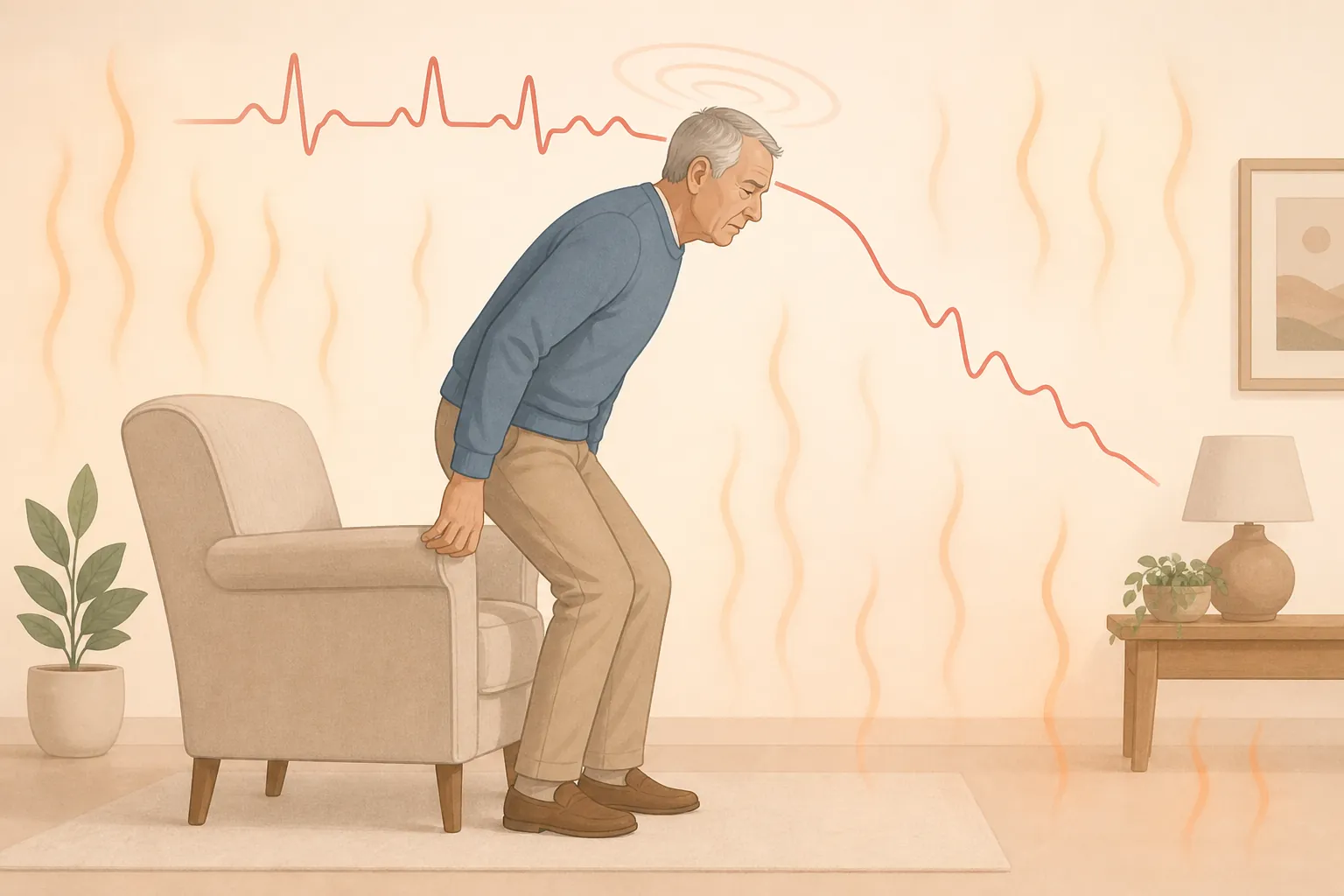
Medications can intensify that risk. CDC clinical guidance identifies diuretics, anticholinergics, and some psychotropics among the medication classes that can increase heat-related risk. The mechanisms CDC lists are not abstract: volume depletion, hypotension, reduced cardiac output, fainting, sedation, cognitive impairment, and increased risk of falls. CDC also gives the rule that matters most at home: do not stop any medication abruptly or change a medication plan without a clinician’s direction [2].
That means the caregiver’s job is not to play pharmacist during a heat wave. It is to notice which medications deserve a clinician conversation, watch for dizziness or confusion when heat is present, and ask ahead of time what the plan should be on very hot days.
Use the twice-daily check-in as the heat-day routine
CDC advises checking on older adults at least twice a day during hot weather and asking four practical questions: Are they drinking enough water? Do they have access to air conditioning? Do they know how to keep cool? Are they showing signs of heat stress? [3]
Those questions work better as a repeated routine than as a friendly “How are you feeling?” call. Many older adults will underreport symptoms, minimize weakness, or not notice thirst early enough. A useful check-in asks for observable facts.
| CDC check-in question | What the caregiver should make concrete |
|---|---|
| Are they drinking enough water? | Ask what they have actually had since waking or since lunch. Look for a glass, bottle, pitcher, or other cue that makes drinking visible. |
| Do they have access to air conditioning? | Confirm that the room they are using is actually cool, not just that the home technically has an air conditioner. |
| Do they know how to keep cool? | Review where they will sit, what errands will wait, what clothing they will wear, and who they will call if they feel weak or dizzy. |
| Are they showing signs of heat stress? | Listen and look for dizziness, weakness, headache, nausea, confusion, unusual sleepiness, unsteadiness, or trouble walking. |
For an older adult living alone or resisting check-ins, the routine may need to be less conversational and more structured. A morning and evening phone call can use the same four questions every time. A neighbor, building staff member, or nearby relative may be able to verify the room is cool if the older adult cannot or will not describe it clearly. The point is not surveillance. It is to catch the moment when heat strain first becomes a standing, walking, or thinking problem.
Start with the room, because independence depends on a cool place to recover
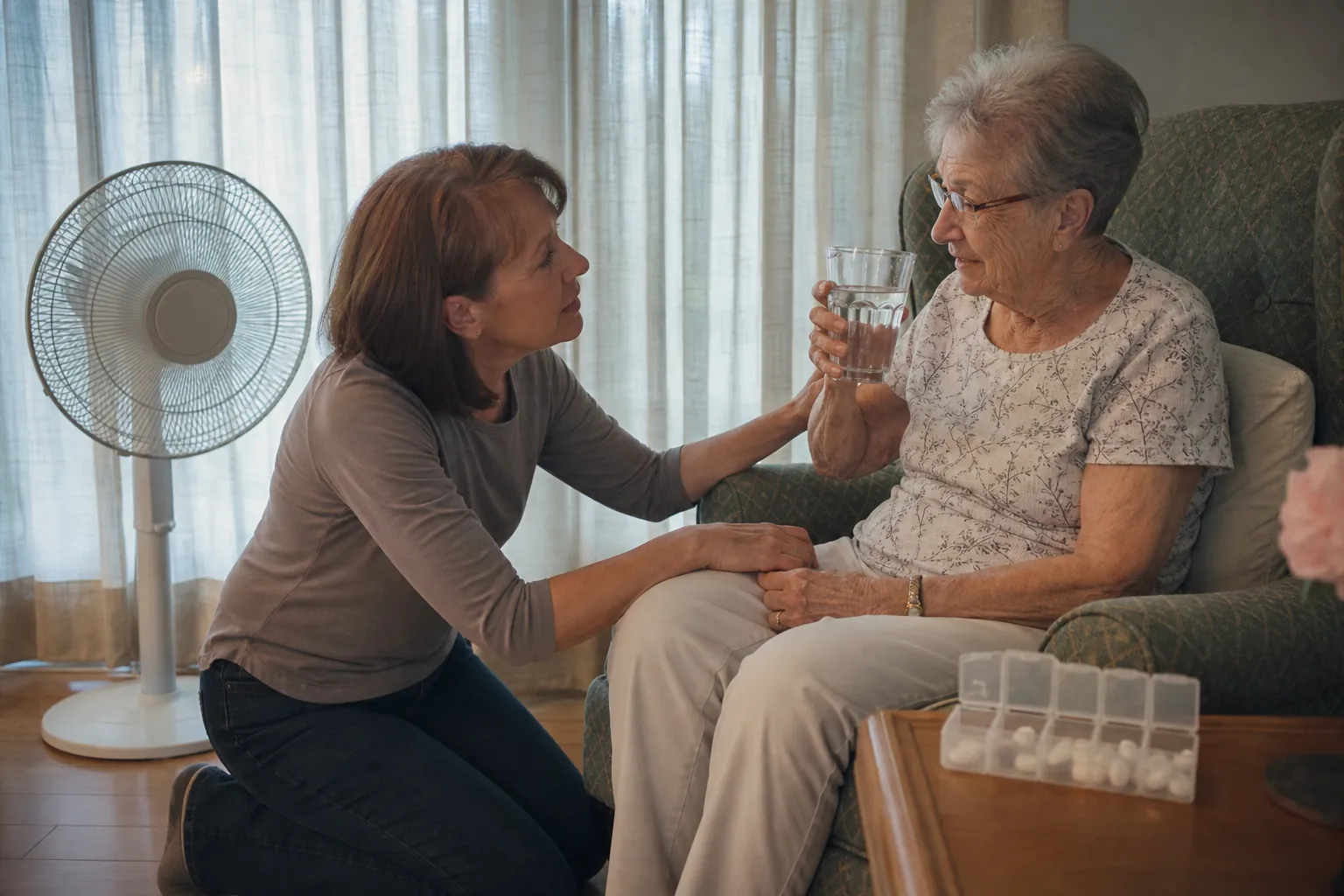
A cool home is not a comfort detail during extreme heat. It is the place where an older adult’s blood pressure, walking, and thinking have a better chance to recover. Harvard Medicine Magazine describes why older bodies are at higher risk in heat: they tend to hold more heat, sweat less effectively, and feel less thirst when dehydrated [4]. Those changes make it risky to rely on the older adult to notice the problem early and ask for help.
Indoor heat is especially unforgiving because it can be invisible to family members who are checking from elsewhere. Harvard Medicine Magazine reported that in Maricopa County in 2019, 91% of indoor heat deaths occurred where air conditioning was off, not cooling adequately, or broken [4]. AARP has also described the 2021 Portland heat wave as a warning about older-adult vulnerability when homes are not adequately cooled [5].
For today’s check-in, the caregiver needs a specific answer: where is the older adult spending the hottest part of the day, and is that space actually cool? A thermostat reading helps, but so does listening for the air conditioner, asking whether curtains are closed on sun-facing windows, and making sure the older adult is not sitting in a hot bedroom out of habit while the cooler room is somewhere else.
- Move the day’s main sitting area to the coolest usable room, even if it is not the usual favorite chair.
- Close curtains or blinds before the room heats up, not after the older adult already feels weak.
- Keep water within arm’s reach in that same cool area so drinking does not require extra trips.
- Make the route to the bathroom clear, lit, and free of loose rugs or clutter, because heat-related urgency and unsteadiness are a bad combination.
- If the home cannot be cooled, plan where they will go before symptoms appear: a relative’s home, a cooling center, a library, or another air-conditioned place they can realistically reach.
Hydration is checked by what happened, not by whether they feel thirsty
“Drink more water” is too vague to protect anyone who already feels a little foggy or weak. On heat days, hydration has to become visible. Ask what they drank with breakfast, what is beside the chair now, and what they will drink with medication or meals. If a clinician has given fluid limits because of heart, kidney, or other medical conditions, those limits matter; the heat-day plan should be discussed with that clinician rather than improvised.
The fall-prevention reason is straightforward. Dehydration can worsen light-headedness, concentration, and energy. Injury Matters, an Australian falls-prevention organization, frames heat as a falls issue through hydration and cognition, energy levels, balance and blood pressure, and medication effects [6]. That framing is useful at home because it keeps the caregiver focused on the things that change whether an older adult can stand, walk, and make safe decisions.
- Put water where the older adult already sits, not across the room.
- Pair drinking with existing routines: waking up, meals, medication times if appropriate, and the evening check-in.
- Watch for dry mouth, unusual tiredness, dizziness on standing, less urination than usual, or new confusion, while remembering that symptoms can have causes other than heat.
- If the older adult has been told to restrict fluids, ask the clinician in advance what to do during extreme heat.
Change the day’s movement, not just the day’s drinks
Heat-day fall prevention also means changing when and how the older adult moves. The errand that is ordinary in April may be unsafe in an August afternoon. A short walk to the mailbox may be the first time the parent discovers that standing up makes them light-headed. A parking lot, curb, porch step, or grocery aisle gives that dizziness consequences.
The safer plan is usually less dramatic than the risk. Move errands, outdoor chores, appointments that can be rescheduled, and longer walks away from the hottest part of the day. If they must go out, the plan should include transportation, shade, water, a place to sit, and a clear decision point for turning back. “I’ll be quick” is not a heat plan.
Inside the home, treat standing up as a transition that deserves attention. Sit at the edge of the chair or bed first. Stand slowly. Pause before walking. Use the cane, walker, rail, or counter if it is normally part of the fall-prevention setup. Wear stable shoes or nonslip slippers rather than loose sandals or socks on smooth floors. None of this is glamorous. It is how a caregiver lowers the chance that a heat-related blood-pressure dip becomes a broken hip.
Medication awareness belongs in the plan before the heat wave
The medication question is not, “Which pills should we stop because it is hot?” The answer to that is: none, unless the prescribing clinician has given a plan. The useful question is, “Which medications make heat, dehydration, dizziness, sedation, or confusion more likely, and what does the clinician want us to watch for?” CDC specifically warns against abrupt medication changes and recommends clinician involvement when heat may interact with medications [2].
A caregiver can prepare for that conversation by bringing a current medication list and describing real heat-day observations: light-headedness after standing, near-falls, unusual sleepiness, confusion, reduced walking, poor intake, or a room that could not be kept cool. That is more helpful than saying, “She seemed off.” It also gives the clinician something to weigh against the medical reason each drug was prescribed.
- Ask whether any medication increases dehydration, low blood pressure, sedation, or confusion risk during heat.
- Ask what symptoms should trigger a call to the office, urgent care, or 911.
- Ask whether fluid advice changes during extreme heat if the older adult has heart, kidney, blood-pressure, or other chronic conditions.
- Keep the medication list in the same place as emergency contacts so a helper can find it quickly.
If medications have already been part of a fall concern, connect this heat-day plan with a broader medication fall-risk review. Heat does not create a separate medication category so much as it exposes the fall risks already sitting in the routine.
A practical heat-day routine for the caregiver
The routine works best when it is repeated morning and evening, with extra checks during the hottest part of the day or after any outdoor trip. It should take in the room, the body, the medication context, and the walking environment.
| Time | What to check | Why it matters for falls and heat illness |
|---|---|---|
| Morning | Cooling plan for the day, water within reach, errands moved earlier or canceled, stable footwear, medication list visible | The day is safest when the older adult does not have to solve these problems after becoming weak or confused. |
| Midday or hottest period | Actual room temperature or cooling comfort, water intake, dizziness on standing, unusual sleepiness, confusion, walking changes | This is when heat strain may first show up as unsteadiness, slower walking, or poor judgment. |
| Evening | What they drank, whether the home cooled down, whether they nearly fell, whether any symptoms appeared after activity | Evening details help decide whether tomorrow’s plan needs more support or a clinician call. |
If a check-in reveals a near-fall, a new fall, or a sudden change in walking, do not file it away as “just the heat.” Use the site’s post-fall decision tree if a fall has already happened, and review the home assessment checklist before the next heat wave. A hot day often reveals weak points that were already there: a long walk to the bathroom, a favorite chair that is hard to rise from, a dark hallway, or a habit of going outside alone at the worst hour.
When prevention stops and emergency response starts
A checklist is for prevention and early correction. It is not for suspected heat stroke. Mayo Clinic describes heatstroke as a condition involving a dangerously high body temperature, typically 104°F or higher, along with altered mental state or behavior; it is a medical emergency [7].
Call 911 if an older adult has confusion, agitation, slurred speech, loss of consciousness, collapse, seizure, severe weakness, or other severe symptoms in the setting of heat. Do the same if they fall and cannot get up safely, have head injury concerns, chest pain, trouble breathing, one-sided weakness, or any symptom that makes you think emergency care is needed. This is the point where the caregiver leaves prevention mode.
While waiting for help, move the person away from heat if it can be done safely, loosen excess clothing, and follow dispatcher instructions. Do not make them walk to prove they are okay. Do not delay the call to keep checking boxes. For broader escalation rules, use the site’s 911 guidance for older-adult emergencies.
Most hot-day risk is managed by a repeated, boring routine: cool room, water within reach, safer timing, slow transitions, medication awareness, and twice-daily check-ins. Confusion, collapse, severe symptoms, or heat-stroke signs are different. They are not a tougher version of the routine. They are the handoff to emergency care.
References
- Effects of a Brief Heat Exposure on Blood Pressure and Physical Performance in Older Women, International Journal of Environmental Research and Public Health.
- Heat and Medications – Guidance for Clinicians, CDC.
- Heat and Older Adults (Aged 65+), CDC.
- The Effects of Heat on Older Adults, Harvard Medicine Magazine.
- Extreme Heat Is Especially Dangerous for Older Adults, AARP.
- Beat the Heat this Summer!, Injury Matters.
- Heatstroke, Mayo Clinic.
Related reading
Noticed something outdated or inaccurate on this page? Flag a correction. We review every report against CDC, NIA, and AARP HomeFit guidance before updating a page.
Part of the Fall Prevention section.