
STEADI: Intervene
How Older Hikers Can Prevent Hypothermia and Falls
For older hikers, a cold trail creates a two-way hazard: hypothermia can weaken balance and coordination enough to cause a fall, while a fall on cold, wet ground accelerates heat loss. This guide explains the early warning signs and the prevention steps that address hypothermia and falls together.
The cold-weather mistake that worries me most is not the dramatic one. It is the hiker who was moving well an hour ago and now needs two hands to work a zipper, plants a trekking pole a beat late, or starts scuffing a boot on packed snow. For older hikers, hypothermia prevention tips have to start there, because cooling can show itself first as clumsiness, poor coordination, and stumbling. Once that hiker falls and stays on cold or wet ground, the fall is no longer only an injury problem. It has become a heat-loss problem too.
That two-way hazard is easy to miss if a group is waiting for a clean, textbook sign of hypothermia. REI’s cold-weather hiking guidance, reviewed by NOLS Wilderness Medicine WEMTs, describes mild hypothermia as including minor clumsiness such as trouble with zippers, while moderate hypothermia may include more obvious coordination problems such as stumbling and falling.[1] Princeton Outdoor Action teaches the old trail shorthand of the “-umbles”—stumbles, mumbles, fumbles, and grumbles—as warning signs of impaired coordination and judgment in the cold.[2]
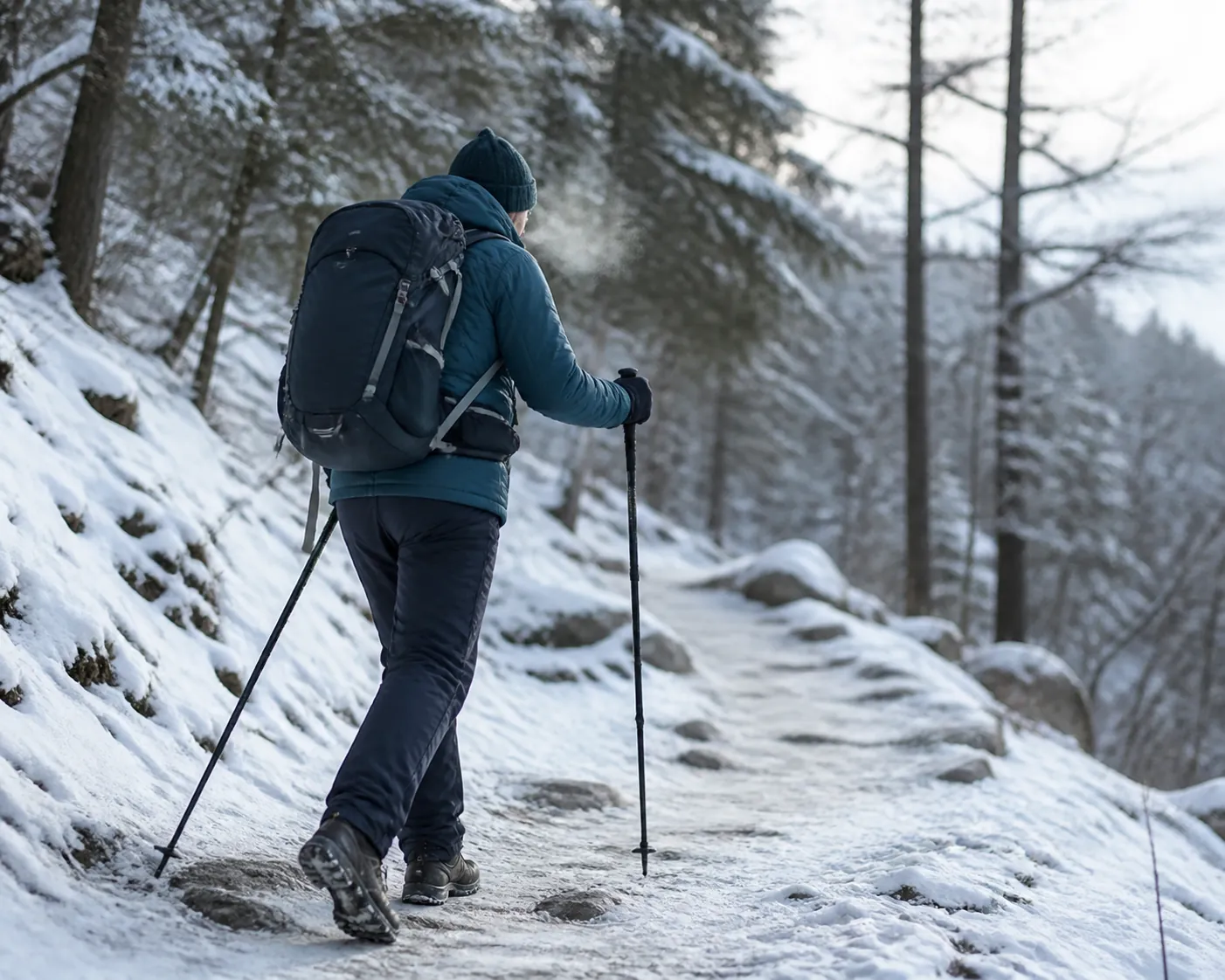
Older hikers need an even lower threshold for concern because shivering may not announce the danger. The American Geriatrics Society’s HealthInAging winter-safety guidance says older adults may shiver less, or not at all, even when body temperature drops.[3] UCLA Health also notes that older adults are more susceptible to hypothermia because age-related changes such as thinner subcutaneous fat and less efficient circulation make it harder to conserve heat.[4] So the safest trail rule is not “wait until the person is shaking.” Watch how the person is moving.
Read the trail signs before they become a fall
Cold-weather hiking partners should treat small movement changes as safety information, not as embarrassment. A hiker who suddenly cannot open a snack wrapper, clip a buckle, use a phone, tighten a glove, or run a zipper may be showing the “fumbles” part of cooling. It matters because those same hands may soon be needed to steady a pole, adjust traction, or catch a slip.
Gait changes deserve the same respect. A person who begins taking shorter, flatter steps may be adapting to ice; that can be sensible. But repeated toe catches, late pole plants, drifting off the firmer part of the trail, or needing a hand for ground they handled easily earlier are different. Those are changes in coordination and balance, and in the cold they belong in the same mental file as numb fingers and wet clothing.
Speech and mood count too. The “mumbles” and “grumbles” are not a diagnosis, but they are useful trail language because they turn vague unease into something observable. Slurred or unusually quiet speech, slow answers, poor decisions about route or pace, and a sudden irritable refusal to add a layer can all be part of a pattern. One sign by itself may have another explanation. A cluster of signs in cold, wet, or windy conditions should change the plan.
This is where families often talk past each other. The older hiker hears, “You are not capable.” The adult child sees a parent stumble and imagines the worst. A better standard is more practical: if hand function, gait, speech, or judgment has changed in the cold, the group acts before anyone has to prove they are in trouble.
| What you see | Why it matters on a cold trail | What to do next |
|---|---|---|
| Trouble with zippers, buckles, gloves, snacks, or phone use | Fine-motor clumsiness can appear with mild hypothermia | Stop out of wind, add insulation, check wet clothing, and reassess the route |
| Repeated stumbles, late pole plants, or new unsteadiness | Coordination problems can signal worsening cooling and can also cause a fall | Turn back or shorten the hike before balance deteriorates further |
| Mumbling, slow answers, unusual irritability, or poor route decisions | The “-umbles” are a field warning that coordination and judgment may be impaired | Do not argue on the exposed trail; move to shelter and warm the person |
| No shivering despite cold exposure | Older adults may shiver less or not at all | Do not wait for shivering before taking warming steps |
Prevent hypothermia and falls as the same problem
A winter packing list is only useful if every item has a job. For an older hiker, the important jobs are simple: stay warm, stay dry, stay upright, notice early impairment, and reduce heat loss if someone goes down.
Choose footing gear for the surface you will actually meet
On packed snow and ice, ordinary boot tread may not be enough. The American Hiking Society recommends traction devices for better footing on packed snow and ice, and trekking poles for added points of ground contact and improved balance.[5] That does not make a slick trail safe, and it does not turn a tired hiker into a steady one. It does give the hiker more chances to stay upright before a slip becomes a fall.
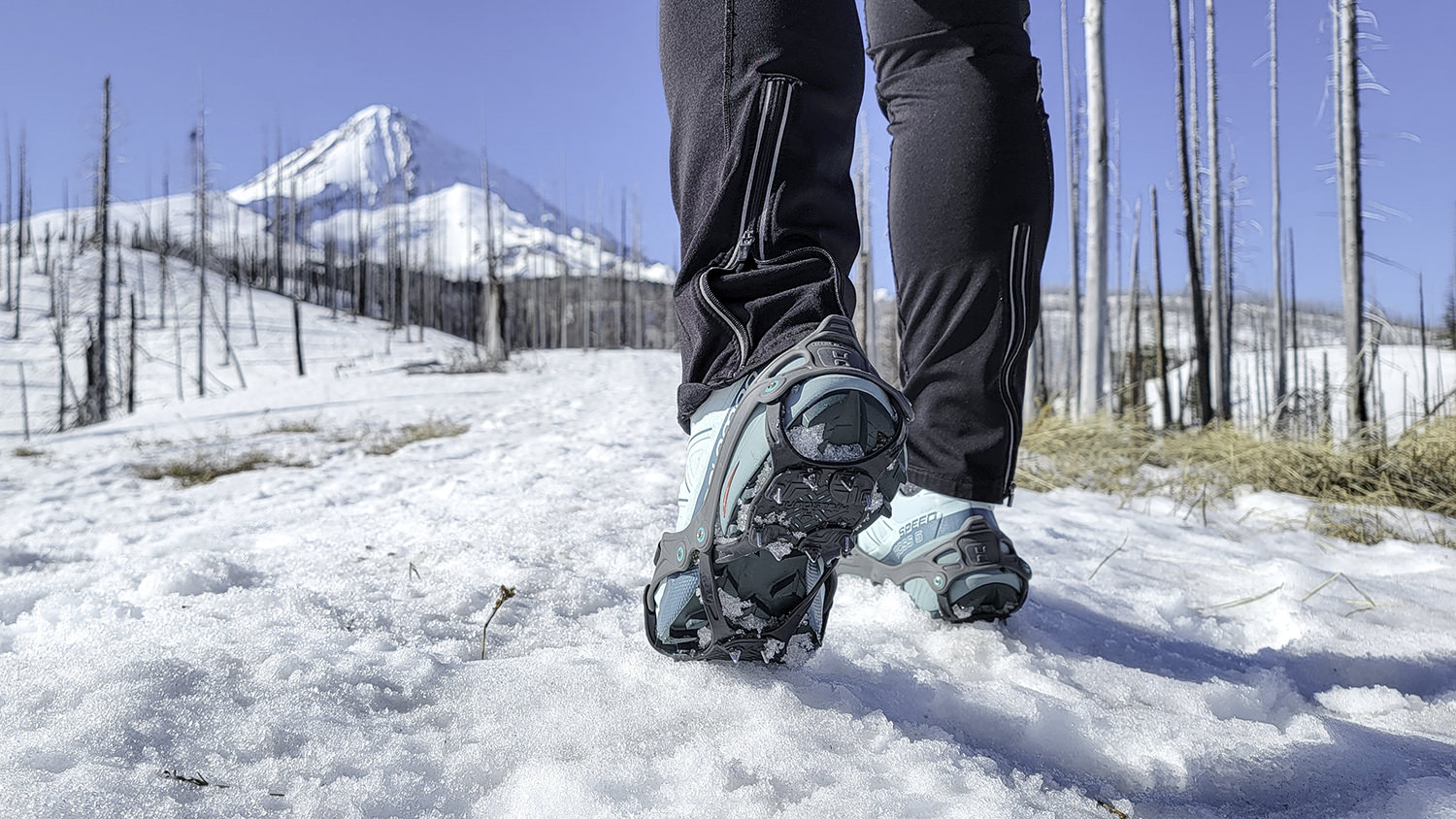
Fit matters as much as the device. Boots that are too loose invite sliding inside the boot; boots that are too tight can make feet colder and less responsive. Poles need to be adjusted before the difficult section, not after the trail turns icy. Traction devices should be put on before the hiker has already started shortening steps and grabbing branches.
This is the outdoor version of a familiar fall-prevention pattern: weather changes the walking surface, and the body has less margin for recovery. CareWise Guide’s broader discussion of weather-linked fall risk covers the same logic around ice, darkness, and disrupted routines. The trail adds exposure, distance, and fewer easy places to sit and warm up.
Dress to keep moving, not to stand around sweating
Layering is not just a comfort habit. It is how an older hiker avoids two bad choices: overheating during the climb and then chilling quickly during a rest, or starting cold and losing hand function before the turn-around point. A practical cold-hike system has a moisture-managing layer next to the skin, insulation that can be added or removed, and weather protection against wind or wet snow. The exact brands do not matter. Staying dry does.
Stops should be short enough that the hiker does not cool into stiffness. Put on a layer before resting, not after teeth start chattering. Keep gloves accessible; do not bury the warmer pair at the bottom of the pack. Carry something warm to drink if the route and conditions make that realistic. The CDC says warm drinks can help, but alcohol should not be used in a hypothermia situation.[6]
Set the turn-back rule while everyone is still competent
The worst time to debate the plan is after someone is cold, annoyed, and unsteady. Before the hike, agree on observable reasons to turn back: repeated stumbles, trouble using hands, wet base layers, worsening wind, a pace that leaves someone chilled during every stop, or any change in speech or judgment. This protects independence better than pretending there will be a perfect moment when everyone agrees the hike has become unsafe.
For an older adult hiking with family, the agreement should be mutual. The older hiker can name the signs they want others to watch for. The adult child can say plainly what would make them insist on stopping. Nobody needs to win the argument about toughness. The trail gets a vote, and the cold gets a vote.
After a fall, warmth becomes urgent
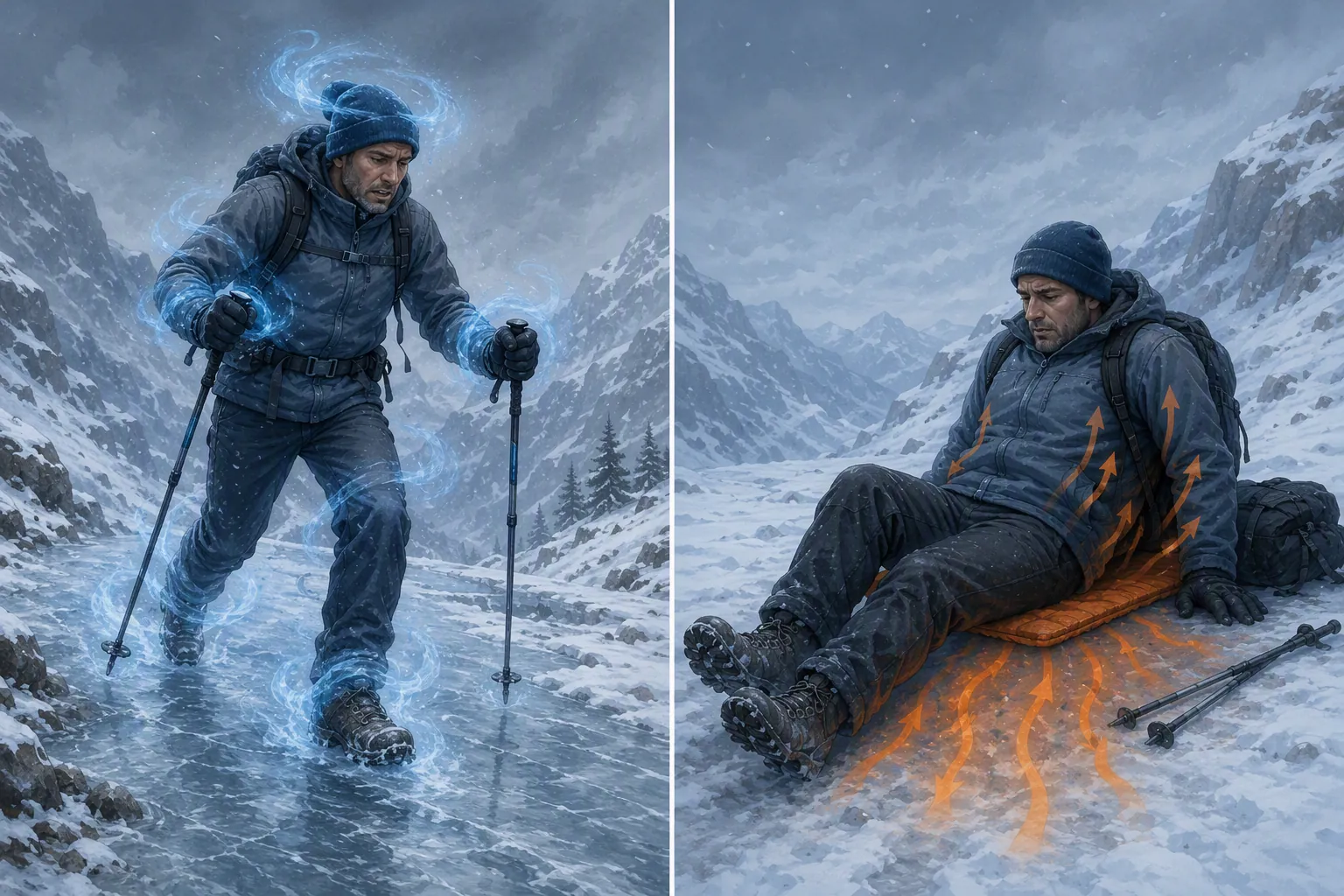
A fall on a warm, dry path is one problem. A fall onto snow, ice, frozen mud, or wet leaves is another. Princeton Outdoor Action notes that water conducts heat away from the body roughly 25 times faster than air.[2] Wet clothing, cold ground, wind, and the inability to get up quickly can turn minutes on the ground into real exposure.
The first priority, after checking for obvious injury and immediate danger, is to get the person insulated from below. That may mean a sit pad, foam pad, pack, extra jacket, emergency blanket used with insulation beneath it, or anything dry that separates the body from cold ground. A shiny emergency blanket under a person on snow is better than nothing, but it is not magic; trapped air and dry insulation matter.
If the person can move safely, help them to a sheltered spot rather than leaving them sprawled where they fell. Replace or cover wet layers if you can do so without creating more exposure. Add insulation around the torso. Protect the head and neck. Offer warm, nonalcoholic drinks if the person is alert and able to swallow safely. Do not use alcohol as a warming strategy; the CDC specifically warns against it in hypothermia prevention and response guidance.[6]
The CDC’s first-aid guidance for hypothermia emphasizes warming the center of the body—the chest, neck, head, and groin—and says a body temperature below 95°F requires immediate medical attention.[6] On a trail, most people will not have a reliable core-temperature reading. That makes the visible signs more important: confusion, worsening coordination, slurred speech, unusual drowsiness, a fall followed by cold exposure, or an older adult who is cold but not shivering should lower the threshold for calling for help.
This is not a wilderness-medicine course. It is a conservative field rule: if hypothermia is suspected, stop treating the fall as a simple stumble. Get the person off the cold surface, insulate from below, warm the core, avoid alcohol, and seek medical help.
Why injury and exposure overlap in older adults
The strongest reason to plan this way is not a dramatic statistic; it is the ordinary sequence. Cooling makes hands clumsy and steps unreliable. A stumble becomes a fall. The fall leaves someone on cold or wet ground. The ground steals heat while the person is injured, embarrassed, slow to rise, or waiting for help.
Emergency-department research supports the idea that trauma and hypothermia can overlap in older patients, though the evidence is not hiking-specific. A systematic review in European Geriatric Medicine reported that trauma was an underlying factor in up to 14% of hypothermic older adults presenting to emergency departments, and it also found that mortality increased with age among hypothermic older patients.[7] That figure should not be read as a trail-fall rate. It is still a useful reminder that in older adults, injury and cold exposure are not neatly separate problems.
The same planning habit used for other weather risks applies here. In heat, families are often told to check in before dehydration or medication problems become obvious; CareWise Guide’s record-heat safety guide uses that kind of advance structure. Cold hikes need their own version: agree on the route, the turn-back signs, the traction choice, the dry-layer plan, and the after-fall plan before anyone is tired or chilled.
A practical cold-hike plan for older hikers
Before leaving, match the hike to the hiker’s present condition, not last year’s best day. Cold tolerance, balance, foot sensation, medications, sleep, and recent illness can all change what is reasonable. If there is any medical uncertainty—especially heart disease, circulation problems, diabetes, neurologic disease, or medications that affect alertness or temperature regulation—the safer move is to ask a clinician before choosing cold, remote, or icy routes.
- Pick a route with known footing, shorter bailout options, and places to stop out of wind.
- Wear boots that fit securely with the socks being used that day.
- Carry traction devices when packed snow or ice is possible, and put them on before the slippery section.
- Use trekking poles when balance, grade, snow cover, or fatigue makes extra ground contact useful.
- Layer clothing so insulation can be added during stops and removed before sweating heavily.
- Keep gloves, hat, snacks, and a warm drink easy to reach, not buried under gear.
- Carry a way to insulate someone from the ground after a fall: a sit pad, foam pad, spare dry layer, or similar barrier.
- Agree that repeated stumbles, hand clumsiness, speech changes, confusion, wet clothing, or unusual irritability end the outward part of the hike.
For older hikers, a cold-weather safety plan is not complete unless it protects balance before a fall and protects body heat immediately after one.
References
- Cold-Weather Hiking Tips, REI Expert Advice
- Hypothermia & Cold Weather Injuries, Princeton Outdoor Action
- Tip Sheet: Winter Safety for Older Adults, HealthInAging.org
- Older adults more susceptible to hypothermia, UCLA Health
- Cold Weather Hiking, American Hiking Society
- Preventing Hypothermia, CDC
- Incidences of underlying causes of hypothermia in older patients in the emergency department: a systematic review, European Geriatric Medicine
Related reading
Noticed something outdated or inaccurate on this page? Flag a correction. We review every report against CDC, NIA, and AARP HomeFit guidance before updating a page.
Part of the Fall Prevention section.