
STEADI: screen
Heat Stroke Warning Signs in Elderly Parents
Heat stroke in a parent 65+ often looks different from the textbook version — reduced thirst, little or no sweating, and confusion that's easy to dismiss as an off day. This elder-specific warning-sign checklist shows when to call 911, what to do while EMS is on the way, and how to prevent heat stroke all season.
If an older parent is acting “off” during hot weather — answering strangely, dozing in a warm room, not feeling thirsty, not sweating much, or waving you away — treat that as a safety decision, not a debate. Call 911 right away for new confusion or disorientation, fainting, seizure, loss of consciousness, or a very high body temperature. CDC NIOSH describes heat stroke as a medical emergency with confusion, altered mental status, slurred speech, seizures, and loss of consciousness among its warning signs.[1] Mayo Clinic and Cleveland Clinic commonly describe heat stroke as involving a core body temperature of 104°F or higher, while the National Weather Service lists body temperature above 103°F as an emergency sign.[2][3][4]
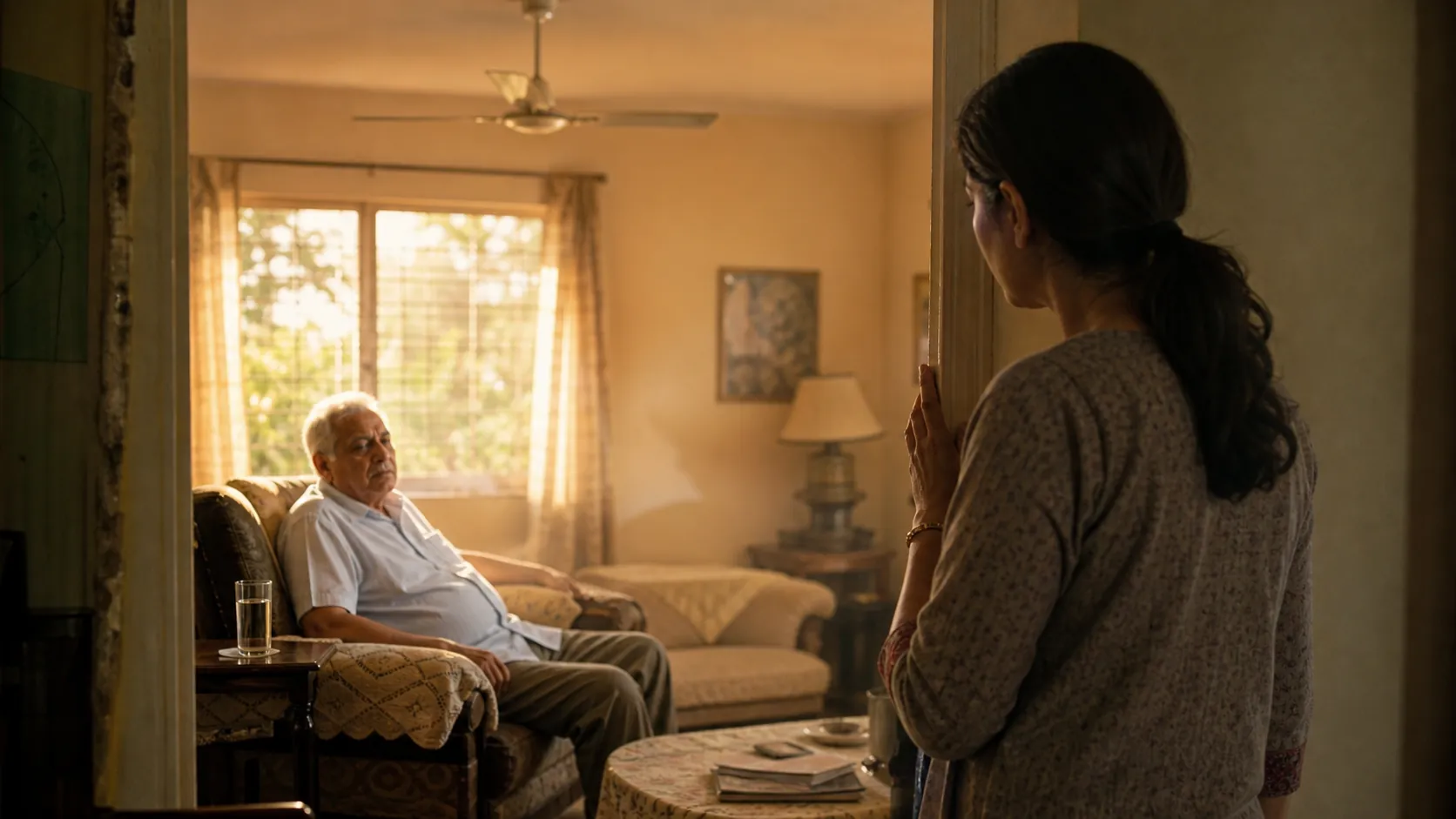
The uncomfortable part is that heat stroke in elderly parents does not always announce itself like a textbook emergency. A parent may not say, “I’m overheated.” They may say they are fine, refuse water, or sound irritated and vague. In adults 65 and older, that quiet gap matters: a CDC MMWR analysis found that adults 65+ accounted for about 40% of U.S. heat-related deaths from 2004–2018, had the highest heat-related death rate of any age group at 0.7 per 100,000, and that heat caused an average of 702 deaths per year during that period.[5]
This guide is educational and not a substitute for medical care. If you are unsure whether your parent is having heat stroke, use the safer rule: call 911 and start cooling while help is on the way.
The 911 rule for heat stroke warning signs in elderly parents
During hot weather, call 911 now if your parent has any of these signs:
- New confusion, disorientation, odd answers, slurred speech, or behavior that is clearly not normal for them.
- Fainting, collapse, seizure, or loss of consciousness.
- A body temperature around the emergency thresholds used by major sources — for example, 104°F or higher in Mayo Clinic and Cleveland Clinic guidance, or above 103°F in National Weather Service guidance.[2][3][4]
- Hot skin, very flushed skin, rapid strong pulse, rapid shallow breathing, severe headache, nausea, or vomiting with any mental-status change.[1][2][4]
- They cannot cooperate with cooling, cannot sit or stand safely, or cannot reliably drink and respond.
Do not wait for a perfect thermometer reading if their thinking or behavior has changed. A thermometer helps, but it should not outrank what you are seeing. CDC NIOSH notes that body temperature in heat stroke can rise to 106°F or higher within 10 to 15 minutes.[1]
What heat stroke can look like in an older parent
The signs below are not a scoring system. One severe sign is enough to act. The point is to catch the version that gets missed: the parent who is sitting still, saying little, and insisting nothing is wrong.
1. They are not thirsty, or they refuse fluids
A parent who does not feel thirsty can still be in danger. California Department of Public Health guidance for seniors notes that older adults may be less likely to feel thirsty and should not wait until they are thirsty to drink in hot weather.[6] That is why “I’m not thirsty” is not reassuring when the room is warm and your parent is acting unlike themselves.
This is also where generic advice falls short. “Drink more water” assumes the person recognizes thirst, can decide to drink, and is thinking clearly. In possible heat stroke, those assumptions may already be gone.
2. They are sweating very little — or not at all
Hot, dry skin is the classic warning sign, but sweating is not a simple yes-or-no test. CDC NIOSH lists hot, dry skin or profuse sweating as possible heat stroke signs, and Mayo Clinic notes that skin may feel hot and dry in heatstroke caused by hot weather, while heatstroke from strenuous exercise may involve dry or slightly moist skin.[1][2] Jefferson Health’s older-adult heatstroke guidance also highlights little or no perspiration as a concerning sign in older adults.[7]
So do not rule out heat stroke because your parent is sweating, and do not dismiss it because they are not sweating. Look at the whole picture: heat exposure, mental status, skin, breathing, pulse, and whether they can respond normally.
3. They seem confused, unusually quiet, irritable, or unable to concentrate
This is the sign families most often try to explain away. Poor sleep, stubbornness, age, a bad mood, or “Mom gets like this sometimes” can all sound plausible in the moment. But confusion and altered mental status are central heat stroke warnings in CDC NIOSH, Mayo Clinic, Cleveland Clinic, and National Weather Service materials.[1][2][3][4]
For an older parent, the change may be subtle at first: they cannot follow the conversation, give answers that do not match the question, forget where they are in the day, stare at the phone instead of responding, or suddenly become combative about a simple cooling step. Jefferson Health also flags behavior change and inability to concentrate as concerning older-adult signs.[7]
4. They faint, nearly faint, stumble, or cannot stay upright
Fainting during heat is not something to watch casually in a parent 65+. National Weather Service heat illness guidance lists dizziness and fainting in heat exhaustion and loss of consciousness in heat stroke; CDC NIOSH also lists loss of consciousness among heat stroke symptoms.[1][4] If fainting is paired with confusion, very hot skin, vomiting, seizure, or inability to recover quickly, call 911.
Heat can also start a broader safety cascade: weakness, dizziness, dehydration, and poor sleep can raise fall risk even when the event stops short of heat stroke. If you want that broader prevention angle after the immediate emergency question is settled, see why extreme heat raises fall risk in older adults.
5. The classic physical signs appear
The more familiar heat stroke signs still matter. Watch for very hot skin, flushed skin, rapid strong pulse, rapid shallow breathing, throbbing headache, nausea or vomiting, and worsening weakness. CDC NIOSH and Mayo Clinic both include several of these physical signs in heat stroke symptom lists, and the National Weather Service includes rapid strong pulse and possible unconsciousness in its heat stroke warning signs.[1][2][4]
The mistake is waiting for every sign to appear. A parent can be in a heat emergency before the picture looks complete.
Heat exhaustion or heat stroke?
Heat exhaustion can include heavy sweating, weakness, dizziness, headache, nausea, and fainting. It is serious because it can progress to heat stroke. The practical dividing line for a family caregiver is mental status: once your parent is confused, disoriented, unable to respond normally, seizing, or unconscious, treat it as heat stroke and call 911.[10][11]
| What you see | What to do |
|---|---|
| Tired, sweaty, dizzy, nauseated, but alert and answering normally | Move them to a cooler place, cool them down, give small sips if they are fully alert, and monitor closely. |
| Confused, disoriented, fainted, seizing, unconscious, or not responding normally | Call 911. Start cooling while EMS is on the way. |
| Very high temperature near emergency thresholds | Call 911, especially if there is any behavior or consciousness change. |
If you are trying to choose between “cool and monitor” and “call 911,” new confusion should move the decision to 911.
Do not get stuck on one temperature number
Temperature thresholds are useful, but major sources do not phrase them identically. That is not a reason to wait; it is a reason to treat the number as one piece of evidence.
| Source | How it describes heat stroke temperature |
|---|---|
| Mayo Clinic and Cleveland Clinic | Commonly describe heat stroke as a core body temperature of 104°F or higher.[2][3] |
| American Geriatrics Society / HealthInAging | Uses 104°F or higher in its hot-weather safety tip sheet for older adults.[8] |
| National Weather Service | Lists body temperature above 103°F among heat stroke signs.[4] |
| Harvard Health | Describes heat stroke as involving body temperature of 105°F or higher.[9] |
| CDC NIOSH | Notes body temperature can rise to 106°F or higher within 10 to 15 minutes.[1] |
For a caregiver on the phone or standing in the doorway, the safest reading is this: a high temperature strengthens the case for emergency care, but severe neurological signs do not need a thermometer’s permission.
What to do while EMS is on the way
After calling 911, start cooling immediately. Red Cross heat stroke first-aid guidance says to move the person to a cooler place, remove excess clothing, and cool rapidly using methods such as cold water or ice packs; Cleveland Clinic also warns not to give fever-reducing medication for heat stroke.[12][3]
- Move your parent out of direct heat. Get them into air conditioning if possible, or at least shade.
- Remove extra clothing, shoes, blankets, or anything trapping heat.
- Cool the body with water: spray, sponge, or wet the skin if you can do so safely.
- Place cold packs or ice packs at the neck, armpits, and groin — areas where large blood vessels are close to the skin.
- Fan only if it helps cooling and does not delay water or ice-pack cooling.
- Do not give fluids if your parent is confused, drowsy, vomiting, having a seizure, or not fully able to swallow and follow directions.
- Do not give aspirin, acetaminophen, ibuprofen, or other fever reducers to treat heat stroke unless emergency clinicians direct you to.
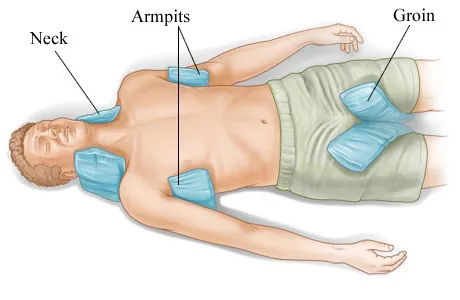
The fluid point is worth slowing down for. If your parent is fully alert and heat exhaustion seems more likely, small sips may be appropriate. But if they are confused or not reliably awake, forcing fluids can create a choking risk and wastes time that should be spent cooling and waiting for EMS.
A prevention routine for the rest of the heat wave
Prevention is not a lecture about willpower. Older adults may not adjust as well to sudden temperature changes, and CDC’s older-adult heat guidance tells caregivers to check on older adults twice a day during hot weather and ask whether they are drinking enough water, have access to air conditioning, know how to keep cool, and show signs of heat stress.[13]
- Check twice daily during extreme heat — once is often not enough if the home warms up in the afternoon.
- Ask a concrete question: “How many glasses have you had today?” works better than “Are you drinking enough?”
- Confirm where they will cool off, not just whether they “have AC.” Make sure the unit works, the room is actually cool, and they are willing to use it.
- Listen for thinking changes on the phone: delayed answers, wrong details, unusual irritation, or trouble following simple plans.
- Have a neighbor, building staff member, or nearby relative check in if your parent lives alone and stops answering normally.
Fans need caution. CDC notes that electric fans may provide comfort, but when temperatures are high they may not prevent heat-related illness; CDPH and National Weather Service materials similarly warn that fans alone may not prevent heat illness and can worsen risk in very hot conditions.[14][6][4] If the indoor space is hot, the plan should be air conditioning, a cooling center, a cooler home, or emergency help — not simply pointing a fan at a parent who is already becoming confused.
If your parent lives alone during heat waves, passive monitoring may help you notice that something is off — for example, no usual movement in the morning or no kitchen activity — but it does not replace a call or in-person check when heat is dangerous. For that narrower home-safety angle, see passive home monitoring sensors for aging parents.
The usable rule is simple enough to remember under stress: in hot weather, a parent 65+ who is newly confused, fainting, seizing, unconscious, or dangerously overheated needs 911, active cooling, and no waiting around to see if they “perk up.”
References
- Heat-related Illnesses — CDC NIOSH.
- Heatstroke — Mayo Clinic.
- Heat Stroke — Cleveland Clinic.
- Heat Illness — NOAA / National Weather Service.
- Heat-Related Deaths — United States, 2004–2018 — CDC MMWR.
- Seniors and Heat-Related Illness — California Department of Public Health.
- How to Recognize the Signs of Heatstroke in Older Adults — Jefferson Health.
- Tip Sheet: Hot Weather Safety Tips for Older Adults — HealthInAging.org / American Geriatrics Society.
- Heat Stroke (Hyperthermia) — Harvard Health.
- Heat Exhaustion vs. Heat Stroke — Cleveland Clinic.
- Heat exhaustion or heat stroke? Know the signs of heat illness — NOAA.
- Heat Stroke — American Red Cross.
- Heat and Older Adults (Aged 65+) — CDC.
- About Heat and Your Health — CDC.
Related reading
Noticed something outdated or inaccurate on this page? Flag a correction. We review every report against CDC, NIA, and AARP HomeFit guidance before updating a page.
Part of the Fall Prevention section.