
STEADI: Intervene
Rainy Weather Safety Checklist for Elderly Parents
Use this zone-by-zone checklist to prepare an aging parent's home for rainy weather — from wet outdoor walkways and entryway mats to footwear, indoor warmth, and power-outage prep. Each item explains the fall or chill risk it targets, grounded in CDC falls data, AGS cold-weather guidance, and Ready.gov recommendations.
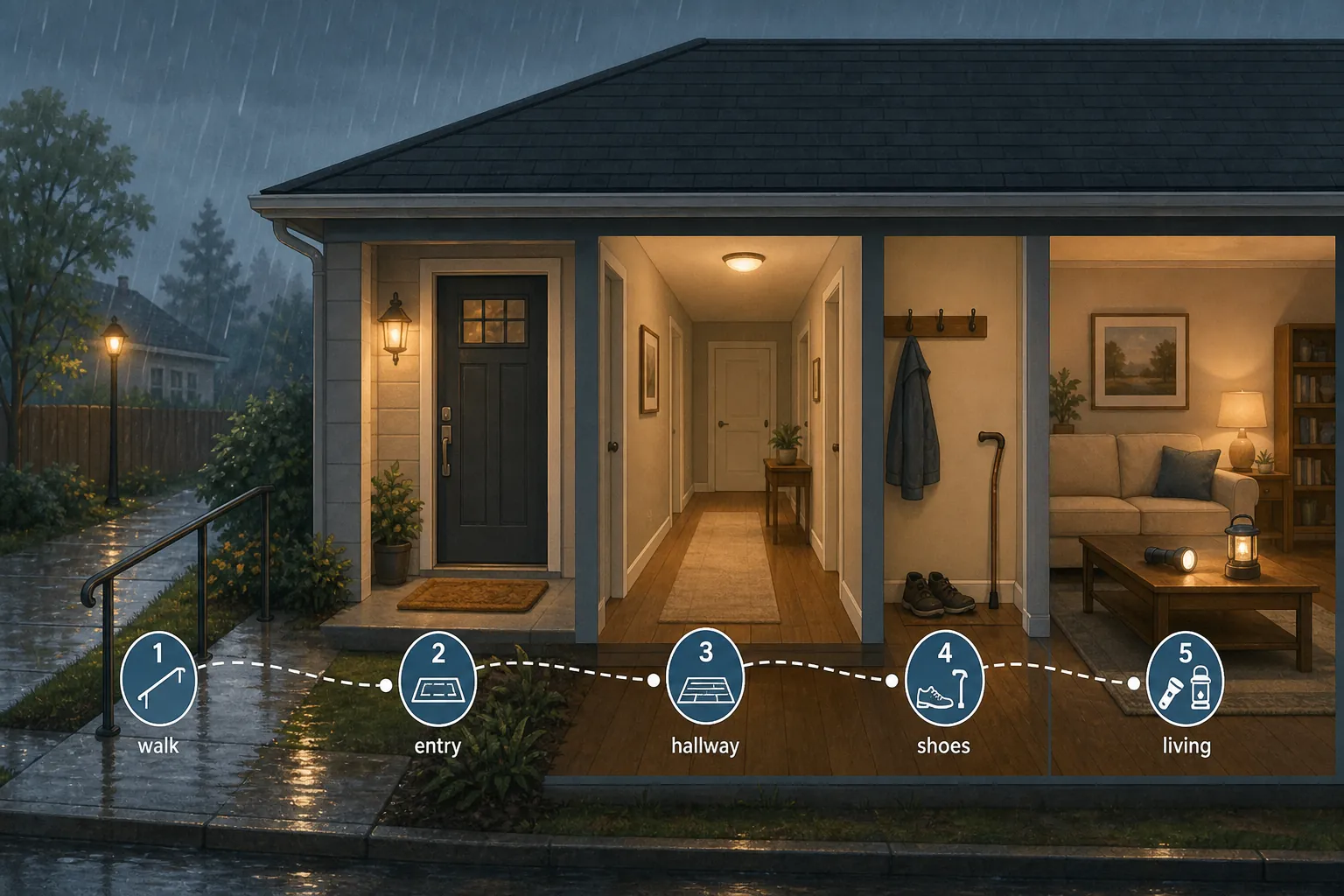
A rainy weather safety checklist for elderly parents should start before the front door, because that is where the day first changes underfoot. The safer inspection is not a room-by-room inventory. It is the route your parent actually takes: front walk, steps or ramp, threshold, entry mat, hallway, bathroom or kitchen, shoes, cane or walker, thermostat, and the place where a flashlight will be found if the power fails.
The stakes are real without needing to exaggerate what rain alone does. More than one in four older adults falls each year, and falling once doubles the chance of falling again, according to CDC falls data.[1] Outdoor-fall research also gives a useful warning: in one study of adults 45 and older, about 73% of outdoor falls were precipitated by environmental factors such as uneven or wet surfaces, and walking was the most common activity at the time.[2] That does not mean 73% of rainy-day walks end in a fall. It means wet, uneven walking surfaces deserve attention before the next storm.
Follow the rainy-day route, not the contractor’s room list
Walk the route at the time your parent is most likely to use it: when the porch is dim, the pavement is wet, and the entry rug has already taken one round of shoes. If your parent uses a cane, walker, umbrella, tote bag, or mail key, carry it during the inspection. A hazard that looks minor when both hands are free can become the exact spot where balance, traction, and visibility all disappear at once.
| Zone | What to look for | Why it matters on a rainy day | Change before the next rain |
|---|---|---|---|
| Outdoor approach | Puddles, leaves, algae, uneven edges, loose handrails, weak lighting | The first wet surface may be crossed while carrying mail, groceries, or an umbrella | Clear the path, improve drainage where possible, check rails, and make the walkway visible |
| Threshold and entryway | Curling mats, slick tile, water tracked past the door, shoes removed in the walking path | The fall risk moves indoors on wet soles | Use flat, stable mats, create a place to sit, and keep the first steps dry |
| Indoor route | Wet footprints, throw rugs, dim hallway, cool rooms, damp outerwear left on | Rain can create both slip risk and chill risk inside the home | Dry the route, remove trip points, improve night lighting, and keep warm dry clothing nearby |
| Footwear and mobility gear | Smooth shoe soles, worn cane tips, walker feet, rail location, where gear is parked | Traction depends on the whole contact chain: floor, shoe, cane or walker, and hand support | Replace worn tips, choose grippy footwear, and store mobility gear where it is used |
| Storm-day power plan | Flashlights, device charging, medical-device backup, refrigerated medicines, generator location | Heavy rain can add darkness, cold indoor air, and disrupted routines | Put light and medical plans in place before the outage |
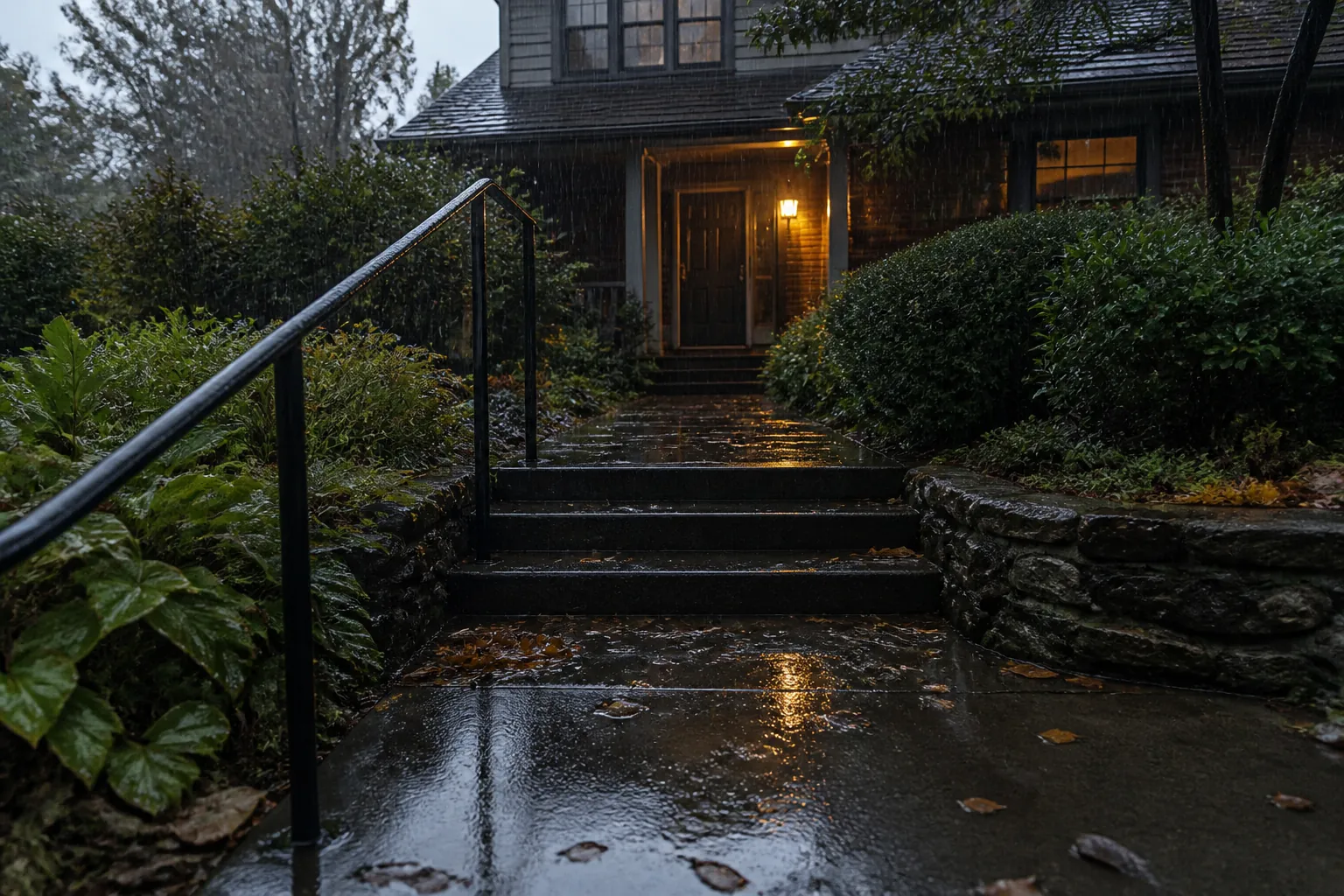
Outdoor approach: the slick patch matters more than the planter
Begin at the first surface your parent steps onto after leaving a car, sidewalk, mailbox, or driveway. Look for the place where water gathers, not just the place that looks untidy. A shallow puddle at the bottom of a step, leaves plastered to concrete, a mossy edge beside a ramp, or a downspout that drains across the walking line can all change a familiar route.
- Walk the path slowly in both directions. Check for low spots where water pools, raised edges, cracked concrete, loose gravel, and wet leaves. Clear debris before rain, and after rain if the surface collects leaves or seed pods.
- Stand where your parent would stand to unlock the door. If water drips from the roofline, downspout, or awning onto that spot, the hazard is not just the walkway; it is the pause point where one hand may be busy with keys.
- Check handrails with weight, not just with your eyes. A rail that wiggles, ends too soon, or sits out of reach at the wettest step may not be useful at the moment it is needed.
- Look at the porch light from the walkway, not from inside the house. Rainy afternoons can make a front step feel like evening, especially if shrubs, storm doors, or overhangs block light.
Wet-weather safety guidance from the University of Washington’s Environmental Health & Safety program emphasizes using handrails, wearing slip-resistant footwear, and wiping feet on entry mats during wet conditions.[3] Those are simple actions, but they only work if the home route lets them happen. A parent cannot use a handrail that starts after the first slick step, and a mat cannot help if it slides when a wet shoe hits it.
If the outdoor approach has more than one problem, fix the hazard that affects the most unavoidable step first. A decorative planter can wait. A loose rail at the only stair, a puddle in front of the threshold, or a dark path from the driveway cannot.
For larger home changes, such as adding railings, changing exterior lighting, or deciding which entry improvement comes first, a separate aging-in-place modification priority plan can help sort urgent safety work from nice-to-have upgrades.
Entryway: stop the rain from traveling inside
The threshold is a small area with a long list of jobs. It has to hold a mat, a wet umbrella, shoes, possibly a walker or cane, a place to set mail, and sometimes a place to sit. On a dry day, clutter here may be annoying. On a rainy day, it can decide whether water stays at the door or gets carried across the first ten indoor steps.
- Press down on every corner of the outdoor and indoor mats. If a corner curls, a rubber backing has lost grip, or the mat bunches under a shoe, remove or replace it before rain returns.
- Check whether the mat is large enough for both feet to land fully. A tiny mat encourages one wet foot on the mat and one wet foot on tile, wood, or vinyl.
- Create a dry landing place for an umbrella, raincoat, grocery bag, or purse. If your parent has to reach across the walking path to hang a wet coat, drips and twisting happen in the same moment.
- Add a stable place to sit if shoes are changed at the door. The chair should not slide, tip, or require a long reach to the shoe area.
- Keep the cane, walker, or rollator from being parked behind the door swing. A mobility aid that must be retrieved after stepping onto a wet floor is already one step too late.
The entryway check is also where politeness can hide a hazard. A parent may not want shoes by the door, a towel near the threshold, or a chair in the entry because it looks informal. The safer question is whether the first dry step is available every time. If the answer is no, the layout is asking wet soles to solve the problem by luck.
If the entryway connects directly to a hallway, kitchen, or bathroom, continue the inspection without resetting the scene. Keep the same wet shoes on and look for the line of travel. A glossy floor that seems fine when clean may show its problem only after the second or third step.
Indoor floors and rainy-day warmth belong in the same inspection
Once rain has entered on shoes, wheels, cane tips, clothing, or bags, the inside route needs its own pass. Follow the path from the door to the bathroom, kitchen, bedroom, favorite chair, and thermostat. Look for throw rugs near the door, bath mats that shift, pet bowls on the route, extension cords, and dim corners where a wet footprint would be hard to see.
A room-by-room aging-in-place checklist is useful for the full home, but a rainy-day pass should stay narrower: where does water go, where does light fail, and where would your parent reach for support?
Rain also brings a chill problem that is easier to miss than a puddle. The American Geriatrics Society’s Health in Aging winter safety guidance says to keep indoor temperature at 65°F or warmer, change out of damp clothing because wet clothing chills faster, and not rely on shivering as a warning sign in older adults.[4] Treat that 65°F point as AGS guidance, not as a personalized medical prescription, and use it to ask a practical home question: can your parent stay warm and dry after coming inside?
- Check the thermostat setting and whether your parent can read and adjust it in dim light.
- Put dry socks, a warm layer, and a towel where they can be reached without crossing the house in wet clothing.
- Make sure wet coats, hats, and gloves have a drying place that does not drip onto the walking route.
- Ask whether your parent tends to “warm up later” after errands. That delay is exactly when damp clothing can keep drawing heat away.
CDC hypothermia guidance makes the rain connection explicit: hypothermia can occur even above 40°F if a person becomes chilled by rain, and older adults are among the groups most at risk.[5] That is why the checklist should not stop at traction. A rainy front walk and a cold living room can be part of the same safety problem.
For a deeper temperature plan across seasons, use a thermostat guide for seniors. For this rainy-day pass, the immediate correction is simpler: dry clothes accessible, heat usable, and no expectation that an older adult will always feel or report cold in time.
Footwear, cane tips, and hand support: inspect the contact points
Rain turns small wear into visible risk. The cane tip that was merely old on Monday may slide on a wet step on Thursday. The shoe that works indoors may skid on damp concrete. The walker that is parked across the room may not help during the first wet step inside.

The AGS Health in Aging tip sheet specifically says to replace a cane’s rubber tip before it wears smooth.[4] That advice is easy to postpone because a worn tip still looks like part of the cane. Turn the cane upside down and look at the contact surface. If the tread is flat, uneven, cracked, or polished from use, it belongs on the short list before the next rainy day.
- Check shoe soles for tread, flexibility, and slick wear patterns. Rubber-soled footwear is one of the fall-prevention measures NCOA highlights for slick winter surfaces.[6]
- Check whether outdoor shoes are also the shoes used on indoor tile or wood. If wet outdoor soles become indoor soles, the entryway drying system has to work every time.
- Inspect cane tips, walker feet, and rollator wheels for wear and water-trapping debris.
- Confirm that the handrail, cane, walker, and shoe all meet the same surface. A rail on the right side does less if your parent carries groceries in the right hand and the cane is in the left.
- Watch one real transition if your parent agrees: car to walkway, walkway to step, step to threshold, threshold to mat. Do not correct gait or diagnose balance. Just name the surface, lighting, and gear problems you can actually change.
Mobility aids deserve this separate pass because they change both risk and routine. National Safety Council Injury Facts reports that older adults using canes or walkers are 11 times more likely to report a fall in the last three months and six times more likely to limit walking outside because of fear of falling.[7] Those figures do not mean the device caused the fall. They do mean a rainy-day plan should pay close attention to the places where mobility gear meets wet ground, mats, thresholds, and handrails.
If the mobility setup needs more than replacing a worn tip or moving a walker to the correct side of the door, a broader home mobility adaptation plan can help separate simple household changes from equipment questions that should be handled with a clinician or trained professional.
Storm-day power plan: darkness and disrupted routines change the house
An ordinary rainy day does not require the same plan as a major severe storm, but heavy rain can still bring a brief outage, a dark hallway, a silent heater, a dead phone, or a refrigerator concern. This is where the rain checklist connects to emergency planning without turning into a full storm timeline.
Ready.gov’s power-outage guidance calls for flashlights for every household member, planning for power-dependent medical devices and refrigerated medicines, and placing generators outdoors at least 20 feet away from windows.[8] Put those items into the route inspection. The flashlight should be reachable from the bed and the favorite chair, not stored in a basement cabinet. The medical-device plan should be written down where the person using it and the caregiver can find it. The generator rule is not flexible because an open window, porch, garage, or covered entry is still too close for safe indoor air.
- Place flashlights where the next step happens: bedside, entryway, bathroom route, and main sitting area.
- Check batteries or charging status before the rainy season, then again after any outage.
- Write down what happens if a power-dependent medical device stops working, including who is called and where backup supplies are kept.
- List refrigerated medicines that need temperature protection and who decides what to do after an extended outage.
- If a generator is part of the household plan, mark the outdoor location in advance so no one improvises near a door, window, garage, or porch.
For broader severe-weather preparation, keep this checklist beside a severe storm fall-risk plan for older adults. If outage planning is the main concern, use a dedicated power-outage safety checklist for seniors rather than trying to solve backup power, medications, communications, and heat in one rainy afternoon.
Finish with the corrections that change the next rainy day
At the end of the route, sort the findings by immediacy. The best rainy-day checklist is short enough to act on, but specific enough that no one has to guess what “be careful” meant.
| Fix first | Examples | Reason |
|---|---|---|
| Wet surface plus no support | Loose handrail, puddle at the step, slick threshold, walker parked away from the door | A slip is more dangerous when there is nothing stable to hold |
| Water moving indoors | Sliding mat, curled rug, wet shoe path across tile, no place to set umbrella or bags | The outdoor hazard has become an indoor hazard |
| Worn contact points | Smooth cane tip, slick shoe sole, worn walker feet | Traction depends on the small surfaces touching the ground |
| Cold and damp routine | Wet clothing left on, thermostat hard to use, dry socks or layers stored too far away | Rain chill can continue after the person is indoors |
| Power-dependent safety gaps | No reachable flashlight, no written device plan, no medicine refrigeration plan | A brief outage can turn a familiar route dark and disrupt care routines |
End the inspection by writing the next physical action, not the general worry. “Replace the cane tip.” “Move the mat.” “Put a chair by the door.” “Add a flashlight at the bedside.” “Move dry socks to the entry cabinet.” These are the corrections a caregiver can see later and know were done.
The boundary is just as important. This checklist does not diagnose balance problems, prescribe equipment, or decide whether a parent is safe to live alone. It names rain-related hazards that can be corrected around the home and routine. If a parent becomes very cold, confused, unusually drowsy, or is suspected of hypothermia, treat it as urgent. CDC guidance says a body temperature below 95°F requires immediate medical attention.[5]
References
- Facts About Falls, CDC
- Outdoor Falls Among Middle-Aged and Older Adults: A Neglected Public Health Problem, American Journal of Public Health
- Prevent Slips, Trips and Falls in Wet Weather, University of Washington Environmental Health & Safety
- Tip Sheet: Winter Safety for Older Adults, HealthInAging.org
- Preventing Hypothermia, CDC
- Winterize to Prevent Falls, National Council on Aging
- Older Adult Falls Data Details, National Safety Council Injury Facts
- Power Outages, Ready.gov
Related reading
Noticed something outdated or inaccurate on this page? Flag a correction. We review every report against CDC, NIA, and AARP HomeFit guidance before updating a page.
Part of the Fall Prevention section.