
STEADI: intervene
How Heatwaves Increase Fall Risk for Seniors Living Alone
Learn why heatwaves silently raise fall risk for seniors living alone through dehydration-triggered dizziness and orthostatic hypotension, and get practical tips that serve both heat safety and fall prevention.
A heatwave changes the risk inside an older adult’s apartment before anyone faints, collapses, or calls it an emergency. The first danger may be much smaller: standing up from a chair, walking to the bathroom, or reaching for the kitchen counter while dehydrated and light-headed. The CDC warns that older adults are at higher risk during extreme heat, and more than 700 people die from extreme heat in the United States each year.[1] For a senior living alone, that same heat risk can also become a fall risk.
The strongest practical clue comes from a large cohort study of 30,634 community-dwelling older adults. In that study, 37.9% were dehydrated, and dehydrated older adults had 13% higher odds of falling than those who were not dehydrated.[2] That does not prove that one glass of water prevents one fall. The study was observational and based in the Midwest. But it does put evidence behind something caregivers often notice too late: heat can quietly set up the exact conditions that make an ordinary trip across the room unsafe.
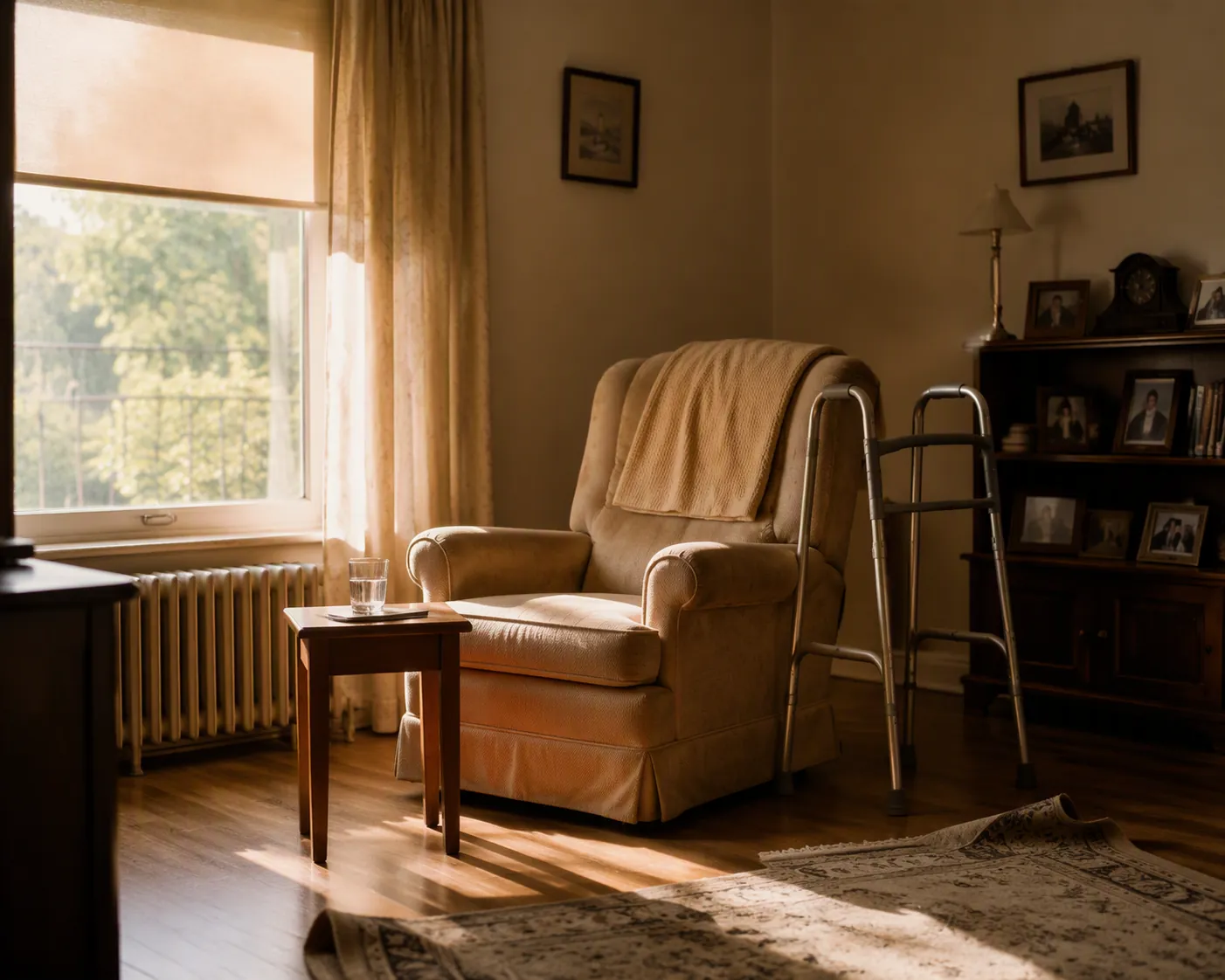
The Fall Risk Starts Before Anyone Feels Thirsty
The usual heatwave safety advice for older adults living alone often begins and ends with “drink more water.” That advice is not wrong. It is just too vague for the way aging bodies and real apartments work.
Older adults may not feel thirsty early enough to protect themselves. Hamrick and colleagues point to age-related changes in thirst sensation, including hypothalamic changes described in prior research, as one reason dehydration is so common in later life.[2] So when a parent says, “I had some water,” that may not tell you whether they are safely hydrated. It may only tell you they are not currently asking for a drink.
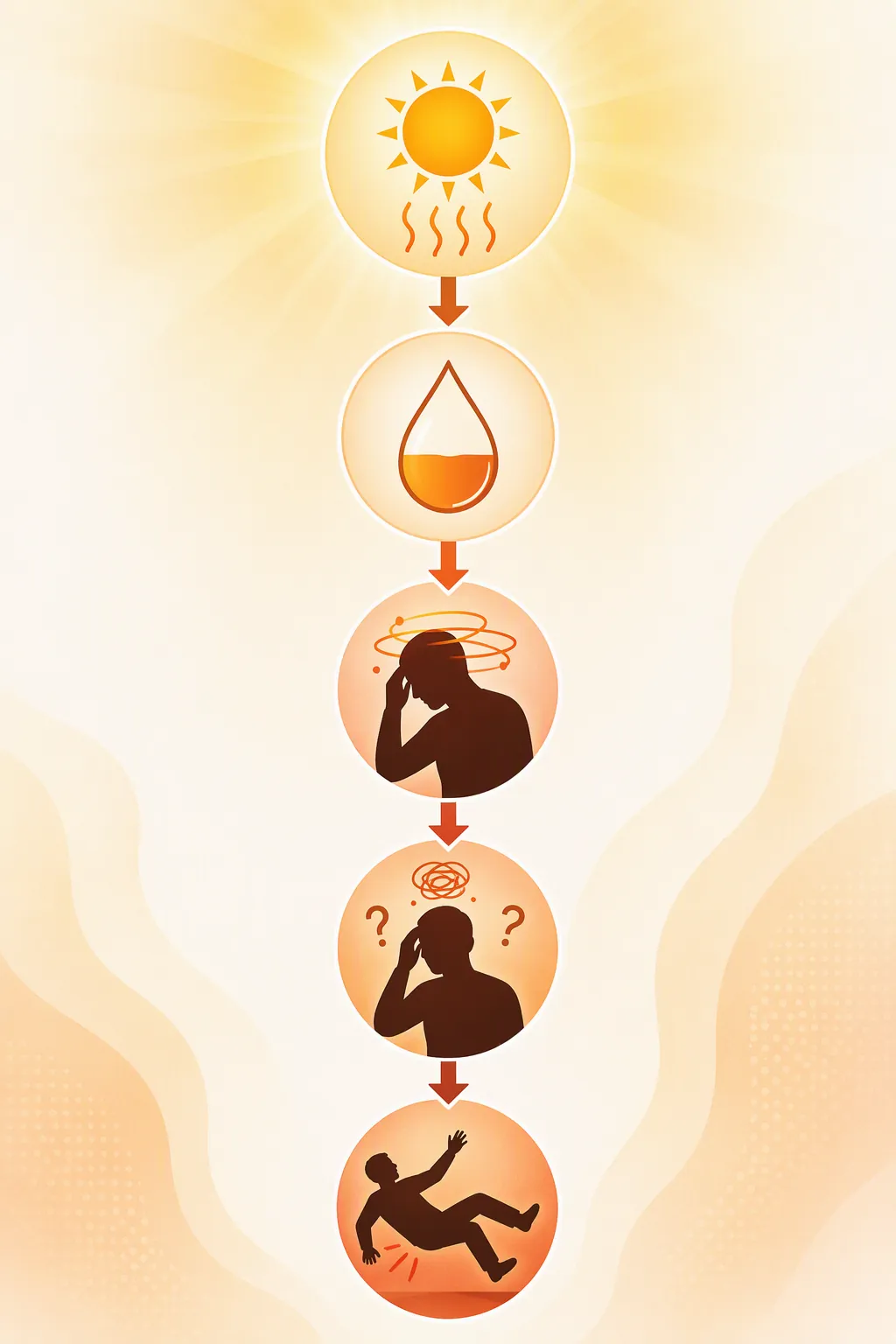
During heat, the body tries to cool itself. Blood vessels widen near the skin, sweating increases, and fluid is lost. If fluid is not replaced, blood volume can drop. Then, when an older adult stands up, blood pressure may fall instead of adjusting quickly. That is orthostatic hypotension in plain terms: the body does not keep enough pressure moving blood to the brain during the position change. The person may feel dizzy, weak, foggy, or suddenly unsure of their balance.
Those few seconds matter. A senior does not have to be severely ill for a fall to happen. They may stand too fast after watching television, turn toward the hallway, and realize too late that their legs feel unreliable. Heat fatigue can slow reaction time. Mild confusion can make someone forget the walker, misjudge the distance to the bathroom, or decide not to turn on a light. None of this looks dramatic on a phone call.
Why Living Alone Raises the Stakes
Living alone does not cause dehydration, dizziness, or falls. It changes how long those problems can go unnoticed. A spouse might see that someone is unusually quiet, unsteady, or not eating. A person alone can lose half a day to heat fatigue and still sound “fine” during a short call.
The broader heat data explains why this deserves urgency, even if the fall pathway is the focus here. An article in The Conversation notes that people aged 65 and older accounted for 69% of heat-related deaths in Australian data, a pattern consistent with the wider recognition that older adults are disproportionately vulnerable during heat events.[3] WHO has also reported that heat-related mortality among people older than 65 increased by about 85% between 2000–2004 and 2017–2021.[4]
Still, the caregiver’s immediate problem is not a global mortality trend. It is whether the apartment is cool enough, whether the water is being drunk on a schedule, whether medications are making heat harder to tolerate, and whether someone will notice dizziness before a fall.
Medications Can Make Heat and Falls Interlock
A pill organizer can look orderly and still hide heat-related risk. Some medications affect fluid balance, sweating, blood pressure, alertness, or heat tolerance. The CDC’s clinical guidance on heat and medications warns that certain drugs can increase risk during hot weather, including by affecting hydration, kidney function, sweating, electrolyte balance, or blood pressure regulation.[5] AARP also cautions that common medication classes can contribute to heat intolerance, including diuretics, antidepressants, and blood pressure medications.[6]
The Hamrick study gives this concern a fall-prevention edge. Loop diuretics were associated with 26% higher odds of falls or death, and antidepressants were associated with 58% higher fall risk in the study population.[2] Those findings do not mean a caregiver should stop or adjust prescriptions. They do mean a heatwave is the wrong time to assume the medication list is irrelevant to balance.
The practical move is simple: before or early in a heatwave, ask a clinician or pharmacist whether any current medications increase dehydration, dizziness, sedation, blood pressure drops, or heat intolerance. The question should be specific. “Is anything here risky in extreme heat or likely to make standing dizziness worse?” is more useful than “Are these medicines okay?”
A Heatwave Fall-Prevention Plan That Can Survive Tuesday
The plan does not need to be elaborate. It needs to remove guesswork from the hours when heat, dehydration, and isolation overlap.
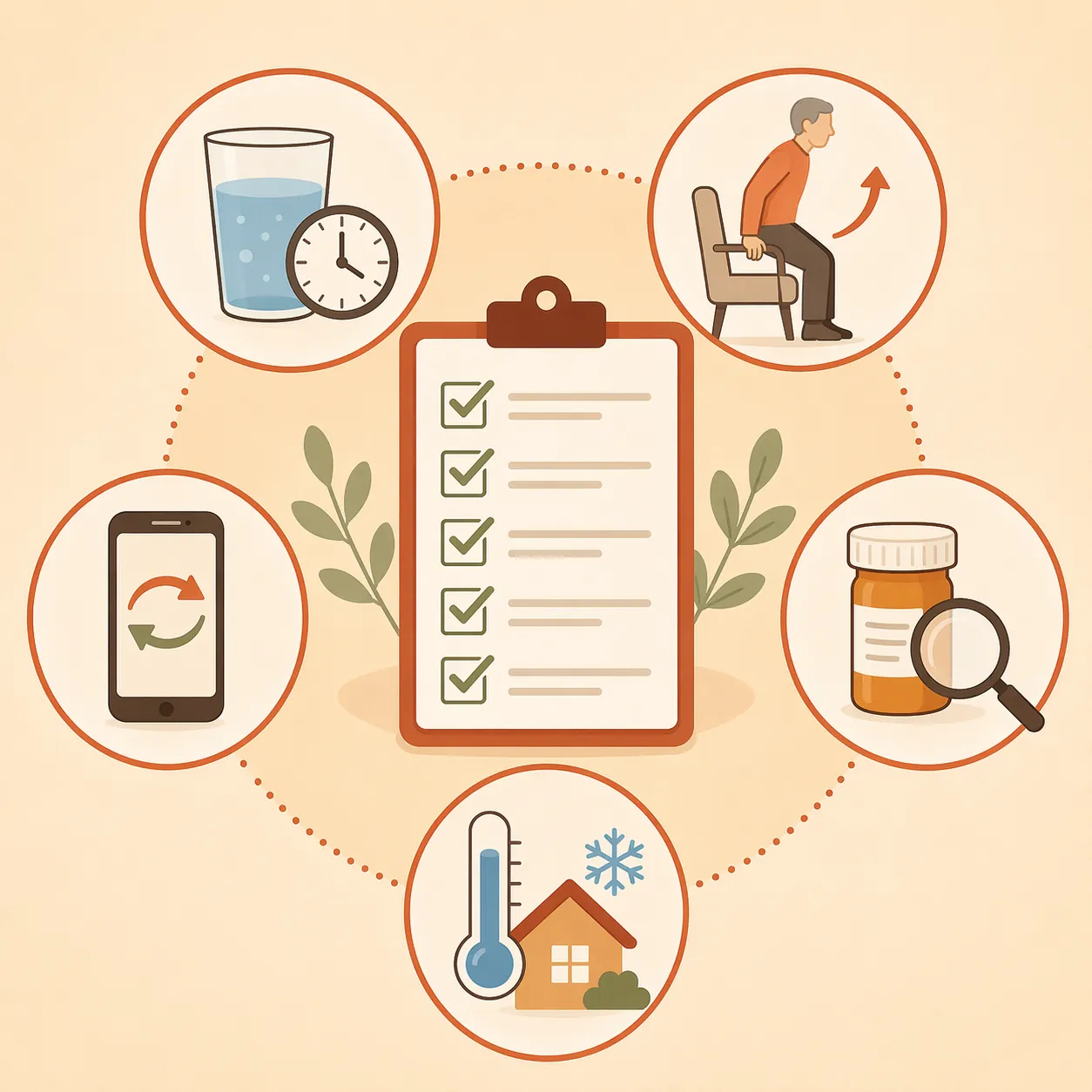
| Risk During Heat | Fall-Prevention Action |
|---|---|
| Reduced thirst cues | Use scheduled fluids instead of waiting for thirst |
| Blood pressure drop when standing | Build in slow position changes before walking |
| Heat fatigue or confusion | Use twice-daily check-ins with specific questions |
| Medication effects | Request a heat-focused medication review |
| Unreliable cooling | Confirm the apartment has a safe cooling option, not just a fan |
Schedule Fluids, Do Not Wait for Thirst
A hydration schedule works better than a general reminder because it creates something observable. For example, a caregiver and parent might agree that a glass of water, a nonalcoholic low-sugar drink, or another clinician-approved fluid is finished with breakfast, midmorning, lunch, midafternoon, dinner, and evening medication. That is a hypothetical schedule, not a medical prescription; people with heart failure, kidney disease, fluid restrictions, or other conditions need clinician guidance.
The caregiver’s job is not to police every sip. It is to replace “I’ll drink when I’m thirsty” with a plan that does not depend on thirst. If the older adult dislikes being managed, frame the schedule as a heatwave-only safety agreement: a temporary routine for dangerous days, with their consent, not a permanent loss of independence.
Make Standing Up a Deliberate Step
The riskiest moment may be the first minute after standing. Ask the older adult to sit at the edge of the chair or bed first, place both feet on the floor, pause, stand while holding a stable surface, pause again, and only then start walking. If dizziness appears, the next action is to sit back down, not to “push through” to the bathroom or kitchen.
This is not about making someone move like a patient. It is about respecting the mechanics of heat and blood pressure. A walker parked across the room is not useful during the dizzy seconds after standing. A cane leaning in another room is not part of the plan. The mobility aid needs to be where the person stands up.
Use Twice-Daily Check-Ins With Better Questions
The CDC recommends checking on older adults at least twice a day during hot weather.[1] For fall prevention, those check-ins should not be casual temperature reports. “Are you okay?” is easy to answer with “yes,” especially for someone who does not want fuss.
Better questions are concrete:
- What have you had to drink since breakfast or since lunch?
- Did you feel dizzy, weak, or light-headed when you stood up today?
- Is the room you are sitting in actually cool?
- Have you used your walker or cane every time you got up?
- Have you urinated normally today, or is it much less than usual?
If the answer sounds vague, do not treat vagueness as reassurance. Heat confusion can be subtle. A second call, a neighbor check, a building staff visit, or a ride to a cooler location may be the safer move.
Check Cooling, Not Just Air Movement
A fan is not the same as cooling. The CDC advises against relying on fans as the primary cooling device when temperatures are in the 90s, because fans may not prevent heat-related illness at those levels.[1] WHO advises that fans should be used only when indoor temperatures are below 40°C, or 104°F.[4] Below those thresholds, a fan may help with comfort. Above them, it can move hot air across the body without solving the heat problem.
The home check should be blunt: Is there working air conditioning? Is there one room that stays cool? Can the older adult get to a cooling center, library, community room, relative’s home, or other air-conditioned place before the hottest part of the day? If transportation depends on someone else, that person needs to be named before the heat peaks.
Decide in Advance What Counts as Escalation
A plan should say what happens when something is off. Dizziness on standing, new confusion, unusual sleepiness, very little fluid intake, a hot apartment with no reliable cooling, or a missed check-in should trigger action. That action may be another call, a visit, a neighbor knocking, contacting the building manager, arranging transportation to a cooler place, or seeking medical help if symptoms suggest illness or injury.
This is where siblings and friends need assignments, not good intentions. One person handles the morning check. One handles the evening check. One knows the medication list. One has the landlord or building number. If everyone assumes the regular phone call is enough, the riskiest details stay invisible.
What to Look For During the Call or Visit
A caregiver does not need to diagnose heat illness to notice fall danger. The useful signs are the ones that change what happens next.
- The person sounds newly confused, unusually tired, or slower than normal.
- They report dizziness, weakness, or light-headedness after standing.
- They cannot clearly say what they drank during the day.
- The apartment is hot, and the only cooling is a fan during very high temperatures.
- They are avoiding walking because they feel weak, or they are walking without the mobility aid they normally use.
- They missed a scheduled check-in and cannot be reached.
Any one of these can be a reason to tighten the plan for the rest of the heatwave. More than one should lower the threshold for an in-person check or medical advice.
The Practical Takeaway
For an older adult living alone, heatwave safety is not separate from fall prevention. Scheduled fluids, slow standing, medication review, reliable cooling, and twice-daily check-ins all aim at the same vulnerable moment: when a dehydrated, overheated person gets up and no one is there to see the warning signs.
Checking those details is not overreacting. It is the part of heatwave planning that vague advice leaves out.
References
- Heat and Older Adults Aged 65+, CDC, https://www.cdc.gov/heat-health/risk-factors/heat-and-older-adults-aged-65.html
- Association of Dehydration and Falls, Mayo Clinic Proceedings, 2020, https://pmc.ncbi.nlm.nih.gov/articles/PMC7283563/
- 5 reasons to check on your elderly neighbour during a heatwave, The Conversation, https://theconversation.com/5-reasons-to-check-on-your-elderly-neighbour-during-a-heatwave-196218
- Climate change: Heat and health, WHO, https://www.who.int/news-room/fact-sheets/detail/climate-change-heat-and-health
- Heat and Medications – Guidance for Clinicians, CDC, https://www.cdc.gov/heat-health/hcp/clinical-guidance/heat-and-medications-guidance-for-clinicians.html
- Medications and Heat Intolerance, AARP, https://www.aarp.org/health/conditions-treatments/medications-heat-intolerance/
Related reading
Noticed something outdated or inaccurate on this page? Flag a correction. We review every report against CDC, NIA, and AARP HomeFit guidance before updating a page.
Part of the Fall Prevention section.