
STEADI: intervene
Heatwave Safety Checklist for Seniors Living Alone
Because no one else is in the house to notice early heat illness, a senior living alone needs a heatwave plan built around scheduled check-ins, self-monitoring cues, and a pre-arranged cooling spot. This checklist gives caregivers the before, during, and after steps, including the temperature and hydration numbers that matter and the point at which heat illness becomes an emergency.
A useful heatwave safety checklist for seniors living alone starts with the fact that no one else is in the room. There may be no spouse to notice a confused answer, no roommate to see an unsteady walk to the bathroom, no second set of eyes to catch that the living room has become hotter than expected. Heat safety changes when the first sign of trouble has to be noticed by the person already affected by it.
That matters for fall prevention as much as for weather safety. Heat can leave an older adult dizzy, weak, dehydrated, or slow to react. Some medications can make heat harder to tolerate or make dehydration and fainting more likely. A senior who might safely cross the kitchen on an ordinary morning can become a fall risk after several hot hours, especially if no one checks in until evening.
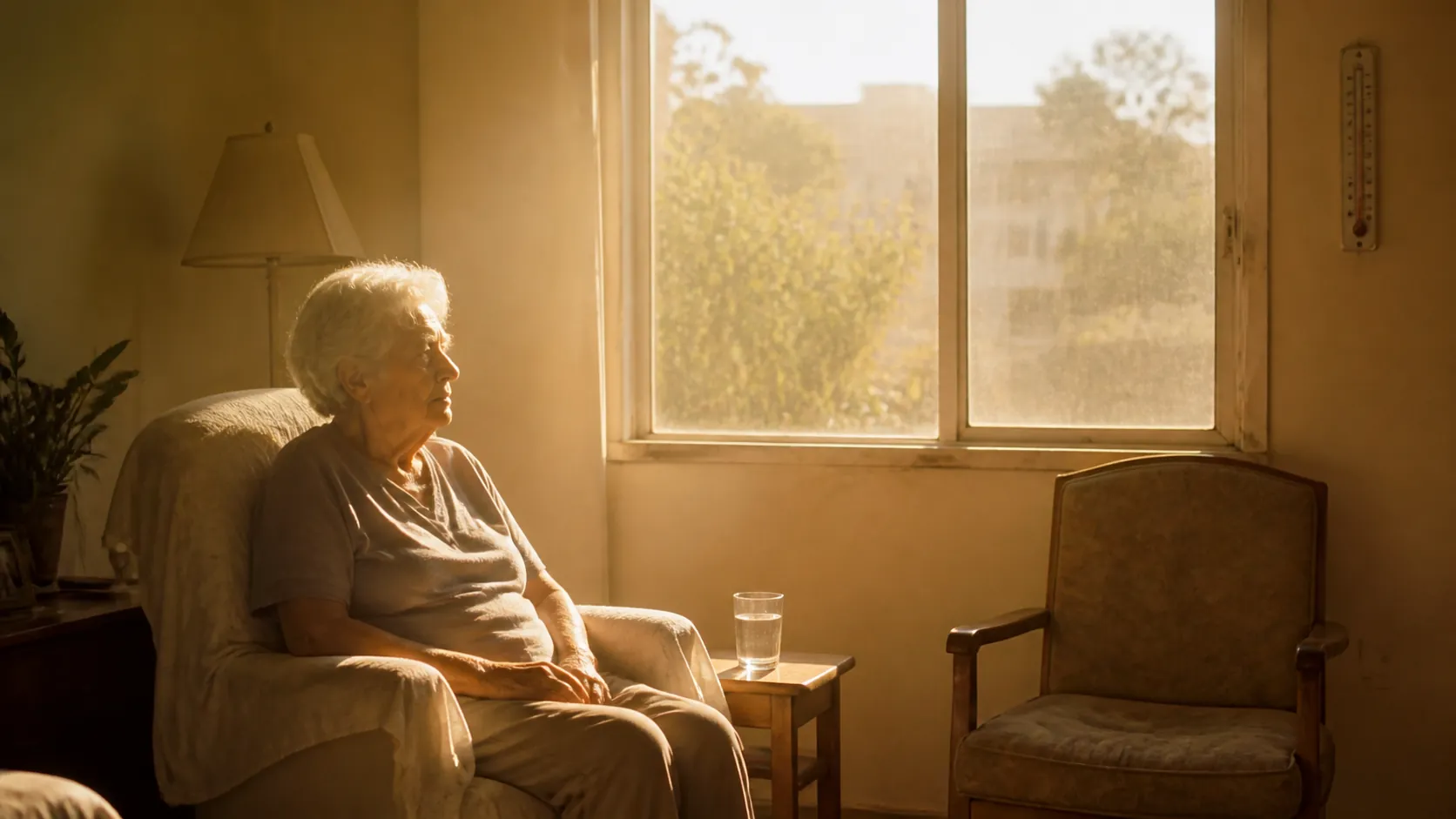
The preparedness gap is not just theoretical. In a study of seniors and extreme heat, 56.3% of seniors living alone said they felt unprepared or only somewhat prepared, compared with 32.5% of those living with a partner.[1] That difference is the reason the plan below does not treat “stay cool” as enough. It builds a substitute observer system: scheduled human contact, visible self-check cues, and a cooling place chosen before judgment is impaired.
The heatwave plan at a glance
| When | What has to be decided | Why it matters when someone lives alone |
|---|---|---|
| Before the heatwave | Check the indoor temperature plan, choose a cooling location, arrange transportation, schedule check-ins, prepare water and medication review questions. | The safest decisions are made before the home is hot and before symptoms affect judgment. |
| During the heatwave | Use twice-daily check-ins, monitor indoor temperature, drink a visible daily water target, watch for dizziness or confusion, and leave for the cooling location when the home plan is not working. | This is where the missing observer has to be replaced with a routine that someone else can verify. |
| Emergency branch | Treat a body temperature around 104°F, confusion, fainting, or worsening symptoms as an emergency rather than a home-management problem. | A senior living alone should not be left to “wait and see” once warning signs are serious. |
| After the heatwave | Rest, restock, review missed check-ins, and adjust the next plan. | A plan that almost failed once should not be reused unchanged. |
Before the heatwave: set up the observer system
The preparation stage should not depend on a senior remembering a long list during the hottest part of the day. Put the important decisions where they can be seen: on the refrigerator, next to the phone, or taped near the thermostat. The written plan should name the person who checks in, the time they call, the place to cool down, and the point at which staying home is no longer the plan.
Confirm the indoor temperature plan
Start with the actual room where the senior spends the afternoon, not the weather forecast. Place an easy-to-read thermometer in that room. If there is air conditioning, confirm that it works before the heatwave arrives, that the senior knows how to set it, and that no one has quietly turned it off to save money. If the home has only fans, the plan needs a lower threshold for leaving, because fans do not cool the body safely in very hot indoor conditions and can give a false sense of control.[2]
The adult child or caregiver should ask for one specific action: “Read me the indoor thermometer at 10 a.m. and 6 p.m.” A vague “Are you keeping cool?” is too easy to answer politely. A number changes the conversation.
Choose the cooling location before it is needed
A cooling location is not “somewhere with air conditioning.” It is a named place: a library, mall, senior center, community cooling center, church hall, or relative’s home. Write down the address, hours, phone number if available, and how the senior will get there.
- If the senior drives, decide whether they should drive during the heat of the day or go earlier.
- If they do not drive, name the ride source: neighbor, family member, paratransit, rideshare, taxi, community shuttle, or emergency contact.
- If mobility is limited, confirm whether the cooling location has accessible entry, seating, restrooms, and a safe path from drop-off to door.
- If pets are the reason the senior resists leaving, decide in advance who can check the pet or where the pet can go.
The cooling-location decision should not wait until the senior is already dizzy. Heat makes delays easier to justify: one more hour, one more glass of water, one more fan. The plan needs a written trigger for leaving.
Schedule check-ins and decide who escalates
During extreme heat, the check-in schedule should be at least twice daily, with one call before the hottest part of the day and one later in the afternoon or early evening.[2] For someone at higher risk, a third brief text or call may be reasonable, but the basic rule is that the call times are fixed enough that a missed call means something.
A missed check-in should have a next step, not a round of hopeful waiting. The person responsible for escalation should know whether to call again, text, contact a neighbor, request a wellness check, or go to the home. If several adult children share responsibility, write down who owns each time slot.
| Check-in item | Ask for this, not a general reassurance |
|---|---|
| Indoor temperature | “What does the thermometer say in the room you are sitting in?” |
| Hydration | “How much of today’s water bottle or pitcher is gone?” |
| Balance | “Any dizziness when you stand up or walk to the bathroom?” |
| Thinking | “Tell me what you plan to do for the next two hours.” |
| Cooling plan | “At what number or symptom are you leaving for the cooling location?” |
Make hydration measurable
“Drink more water” is hard to verify from a distance. A practical target is roughly three-quarters of a gallon of water over the day unless a clinician has given fluid restrictions or different instructions.[2] For many households, the simplest method is to fill one clearly marked pitcher or several bottles in the morning and use that as the day’s visible supply.
This is also the right time to ask about medical limits. Some people with heart, kidney, or other conditions may have been told to restrict fluids. Some medications can affect hydration, sweating, blood pressure, or heat tolerance. The checklist should include a note to ask the clinician or pharmacist what to do during extreme heat, especially if the senior takes diuretics, blood pressure medicines, sedatives, or medications that have previously caused lightheadedness.
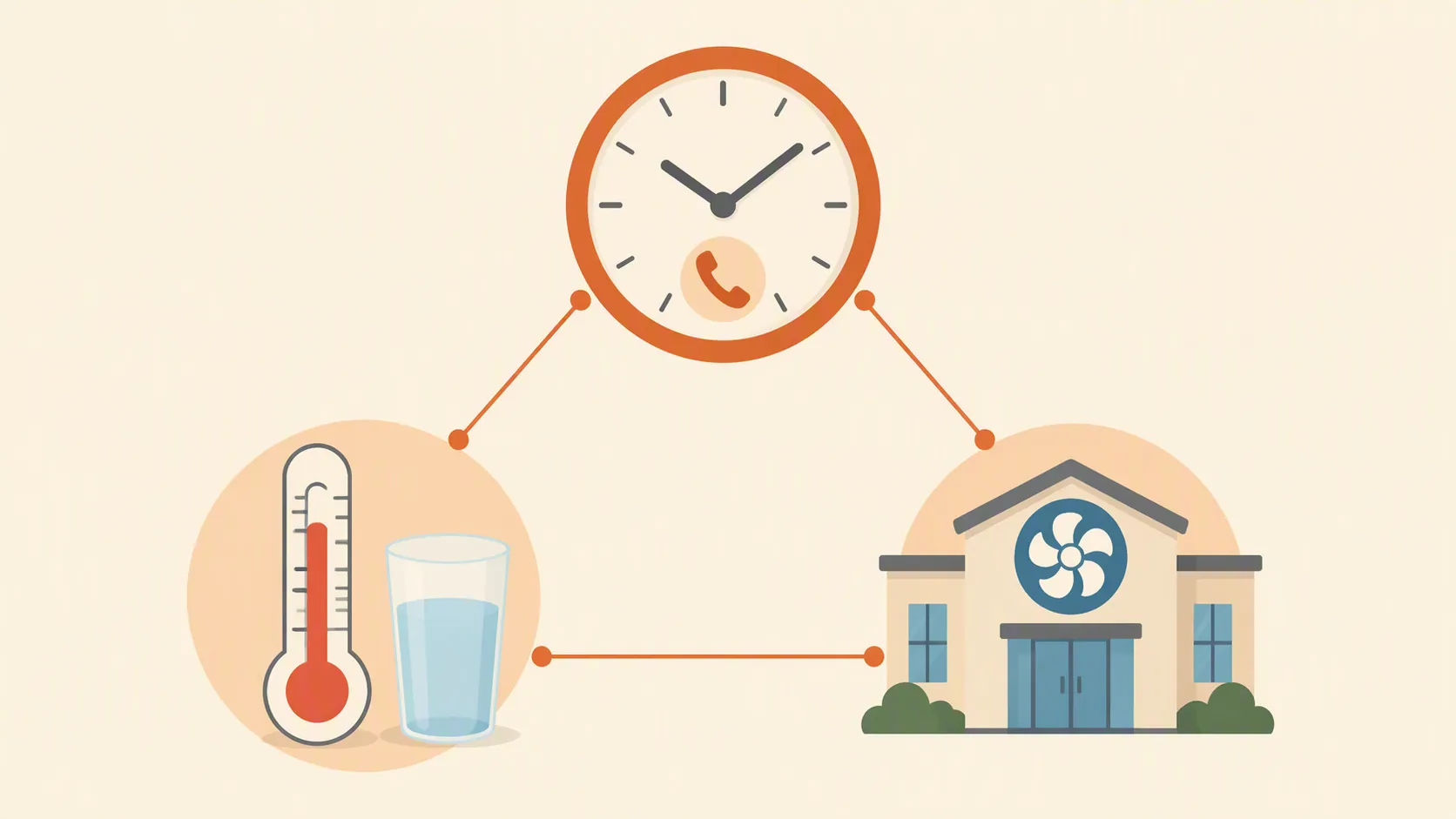
During the heatwave: replace the missing second set of eyes
The heatwave routine should be boring, visible, and repeatable. That is the point. A senior living alone should not have to decide from scratch every afternoon whether they are safe. The decision should come from the thermometer, the hydration setup, the check-in questions, and the pre-arranged cooling trigger.
Use check-ins as a safety inspection, not a social call
A friendly call is useful, but during a heatwave it needs structure. The caller should listen for changes: slower answers, unusual irritability, confusion about the day’s plan, or a voice that sounds weak. The senior may not label those changes as heat illness. The caller is there to catch what the senior may normalize.
- Ask for the indoor thermometer reading.
- Ask what they have eaten or drunk since the last call.
- Ask whether they felt dizzy, faint, unusually weak, nauseated, or confused.
- Ask whether they have urinated recently and whether the urine looked darker than usual.
- Confirm the next cooling step: stay in the cooled room, take a cool shower, move to the cooling location, or call for help.
If the senior does not answer, follow the escalation plan. Do not leave repeated voicemails over several hot hours while assuming everything is fine.
Keep the home cooler without adding fall risks
Heat advice can accidentally make the home less safe. Extension cords across walkways, towels on the floor after cool showers, and rushed trips to adjust windows or blinds can all create fall hazards. The cooling setup should be arranged before the worst heat arrives.
- Close blinds or curtains before direct sun heats the room.
- Keep the main sitting area on the coolest level of the home if stairs are not required.
- Use nightlights if the senior may move around after dark to reach water, the bathroom, or the phone.
- Place the phone, water, medications, glasses, and thermometer within easy reach of the main chair.
- Keep fan cords and air-conditioner cords out of walking paths.
Fans deserve special attention. They may help with comfort when used with other cooling measures, but they are not a reliable safety plan in very hot indoor air. If the indoor space is hot and the senior is already feeling unwell, moving to air conditioning matters more than aiming another fan at the chair.[2]
Watch the heat-to-falls bridge
For a senior living alone, dizziness is not a minor symptom. It changes the safety of every ordinary movement: standing from a recliner, stepping into the shower, walking to the kitchen, turning quickly when the phone rings. The check-in caller should treat new dizziness, weakness, or near-fainting as a reason to stop the normal routine and move to a safer cooling step.
A simple rule helps: if standing makes the senior lightheaded, they should sit or lie down, cool the body, drink water if allowed, and call the designated contact. If symptoms do not improve quickly or the person seems confused, faint, or unable to move safely, the plan should move to urgent help.
Use the water target without ignoring medical limits
The visible water setup does two jobs. It reminds the senior to drink before thirst becomes the only cue, and it lets a caregiver ask a factual question. “How much is left in the pitcher?” is more useful than “Are you drinking enough?”
Urine color is another cue, though not a diagnosis. Darker-than-usual urine, little urination, dry mouth, headache, or dizziness should tighten the plan: drink if medically allowed, cool down, reduce activity, and check in sooner. If fluid restriction is part of the senior’s care plan, the heatwave checklist should show the clinician-approved limit instead of the general target.
Decide when staying home ends
The cooling location is part of the active plan, not a last resort. Use it when the indoor temperature plan is not working, when the senior cannot get comfortable, when symptoms appear, or when the caregiver cannot reliably confirm the senior’s condition.
A caregiver helping from a distance should be direct about transportation. “Do you want to go?” may invite delay. “I’m calling the neighbor now,” “Your ride is coming at 2,” or “Please take your cooling bag and wait by the inside door” gives the plan a next action.
- Cooling bag: water, medications, medication list, phone charger, ID, glasses, hearing aids or batteries, snack if appropriate, and a light layer for an air-conditioned room.
- Home exit: clear path to the door, shoes with backs or secure straps, mobility aid within reach, and no loose rugs near the route.
- Contact plan: call or text when leaving, when arriving, and when returning home.
The emergency branch: when heat illness is no longer a home problem
Some symptoms should end the checklist and start emergency action. A body temperature around 104°F or higher is an emergency threshold. Confusion, fainting, loss of consciousness, worsening weakness, hot skin, or symptoms that do not improve with cooling should be treated as urgent.[3]
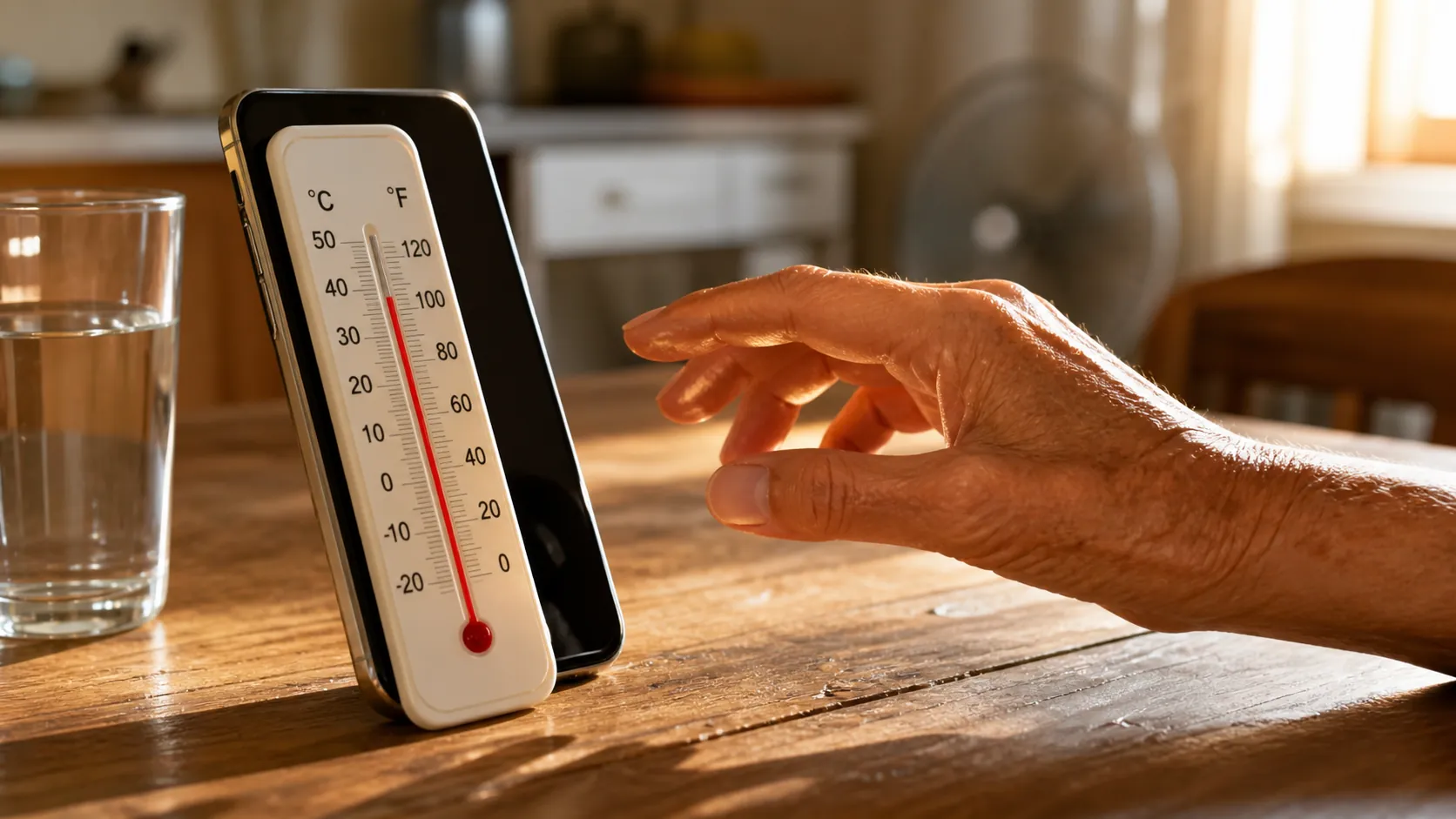
For a senior living alone, the emergency instruction has to be written plainly: call 911, then start cooling while waiting if it can be done safely. Move to a cooler place, loosen extra clothing, use cool cloths, or sit near air conditioning. Do not drive while confused, faint, severely weak, or lightheaded.
The caregiver’s role is to remove negotiation from this step. If the senior sounds confused, cannot answer basic questions, has fainted, or is too weak to move safely, call emergency services or request immediate local help. A person affected by heat may not be the best judge of how serious the situation has become.
| If this happens | Do this |
|---|---|
| No answer at scheduled check-in | Follow the written escalation plan immediately: call again, text, contact neighbor, go to the home, or request a wellness check. |
| New dizziness, weakness, nausea, headache, or dark urine | Cool down, drink water if medically allowed, reduce movement, and check in again soon. |
| Indoor cooling is not working or the senior cannot get comfortable | Move to the pre-arranged cooling location using the planned transportation. |
| Confusion, fainting, loss of consciousness, severe weakness, or body temperature around 104°F or higher | Call 911. Begin safe cooling while waiting for help. |
After the heatwave: fix the weak points before the next one
The day after a heatwave is not the time for a victory lap. Heat can leave an older adult tired, off schedule, or less steady than usual. Keep the next day simple: rest, normal meals if tolerated, hydration within medical limits, and no unnecessary errands during hot hours.
Then review the plan while the details are still fresh. Did the senior answer both check-ins? Was the indoor thermometer easy to read? Did anyone know when to escalate? Was the water target visible enough? Did transportation to the cooling location work? Did pride, pet care, cost concerns, or confusion delay leaving?
- Restock water, shelf-stable foods, cooling cloths, batteries, and any heatwave supplies that were used.
- Recharge phones, medical alert devices, fans, backup batteries, and hearing-aid supplies.
- Update the check-in list if one caller was unavailable or one time slot was missed.
- Change the cooling trigger if the senior waited too long to leave.
- Ask a clinician or pharmacist about any symptoms that appeared during the heat, especially fainting, near-fainting, confusion, or medication concerns.
For a senior living alone, heatwave safety is not a pile of seasonal tips. It is a way to replace the person who would otherwise notice trouble early: the scheduled caller, the thermometer reading, the visible water supply, the symptom cues, and the cooling destination chosen before the house becomes unsafe.
References
- Reducing the risks of extreme heat for seniors, Health Promotion and Chronic Disease Prevention in Canada, 2020.
- Heat and Older Adults, Centers for Disease Control and Prevention.
- Warning Signs and Symptoms of Heat-Related Illness, Centers for Disease Control and Prevention.
Related reading
Noticed something outdated or inaccurate on this page? Flag a correction. We review every report against CDC, NIA, and AARP HomeFit guidance before updating a page.
Part of the Fall Prevention section.