
STEADI: intervene
Protect an Older Adult from Falls After a Tornado
After a tornado, the home is filled with new fall hazards for an older adult. This guide walks caregivers through a systematic room-by-room safety check before the senior re-enters, covering debris, damaged supports, lighting, and when to relocate.
Before your parent gets out of the car
If you are trying to help an older adult after tornado damage, the first answer is not “start cleaning.” It is: keep the older adult out of damaged areas until someone else has checked the route they would actually walk. That means driveway, steps, threshold, hallway, bathroom, bedroom, and the way back out.
Start with the hazards that make the whole property off-limits. CDC post-tornado guidance tells people to watch for downed power lines, gas leaks, and unstable structures after a tornado; those come before any fall-prevention checklist because they decide whether anyone should approach or enter at all [1]. NIOSH also names falls as a tornado cleanup and response hazard, alongside dangers such as electrocution, chemical hazards, and falling objects [2].
The public sources cited here do not directly measure senior fall injury rates in tornado-damaged homes. The safer conclusion is narrower and still important: tornado damage creates the same conditions that standard fall-prevention guidance tries to remove—poor lighting, wet or uneven surfaces, obstacles, and failed supports—while adding debris, broken glass, exposed nails, and structural uncertainty.
Do the life-safety screen first
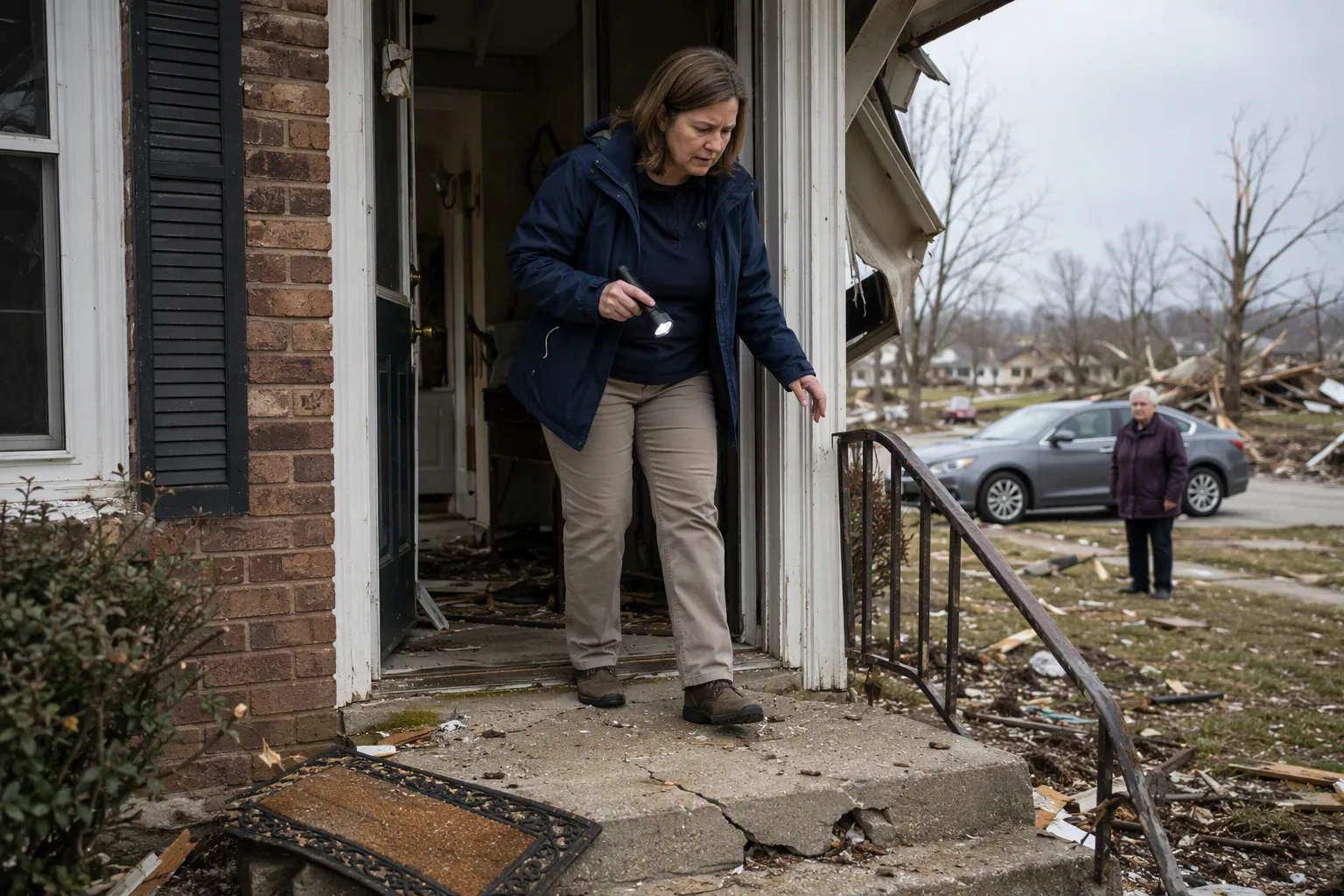
Before looking for loose rugs or wet tile, stand back and look at the property as a whole. If any of the following are present, the walking-route inspection stops and the older adult stays away from the home:
- Downed or low-hanging power lines, including lines touching fences, trees, vehicles, puddles, or debris.
- Smell of gas, hissing sounds, damaged gas appliances, or any reason to suspect a leak.
- A roof that appears to sag, a wall that leans, a porch that has shifted, or any room that looks visibly unstable.
- New foundation cracks, separated exterior steps, or a door frame that has shifted enough to jam or twist.
- Large hanging limbs, loose roofing material, dangling gutters, or other overhead debris along the route.
CDC warns people not to enter damaged buildings until authorities say they are safe, and AIHA’s tornado recovery hazard guidance also points to structural hazards such as unstable buildings and damaged materials after tornadoes [1][3]. A caregiver with a flashlight is not a structural engineer. If the building itself looks questionable, the decision is not “walk carefully.” The decision is “do not bring the older adult in.”
Walk the route in the order the older adult would encounter it
CDC STEADI’s caregiver resources include a home-safety approach built around removing hazards, improving lighting, and adding or checking supports [4]. That logic is useful after a tornado, but the house can no longer be treated as intact. A grab bar, stair rail, non-slip mat, walker, or familiar chair only counts as support after it has been inspected again.
The sweep should follow the older adult’s body through the home, not the caregiver’s curiosity. Do not start in the room with the most visible damage if your parent first has to cross a wet threshold, step over a broken planter, and reach for a loose rail.
Driveway, walkway, porch, and threshold
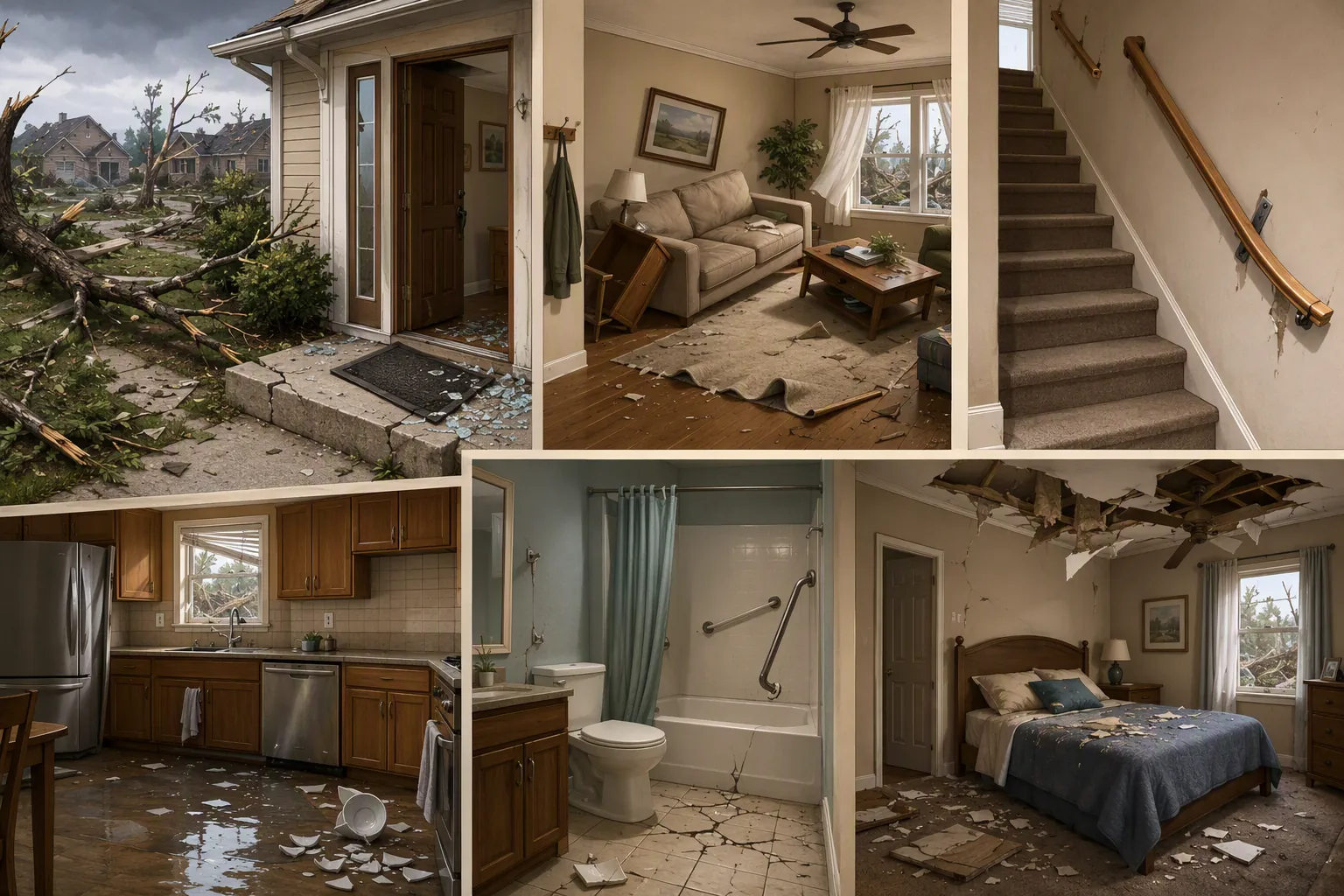
Check where the older adult would place each foot from the car to the door. Look for cracked concrete, shifted pavers, mud, wet leaves, loose gravel, shingles, nails, glass, branches, and small debris that can roll under a shoe or walker tip. A displaced doormat is not harmless if it bunches at the threshold or hides broken glass.
Test porch boards and steps with your own weight before anyone relies on them. If a rail wiggles, pulls away from the wall, or is attached to a damaged post, do not count it as a handhold. If the older adult normally needs that rail to enter, the entrance is not passable until another safe entrance is found or the support is repaired.
Entryway and living areas
Inside the door, pause. Tornado-damaged entryways often collect the hazards people underestimate: wet flooring from wind-driven rain, broken glass from sidelights or windows, splintered trim, loose weatherstripping, tipped lamps, and shoes or bags dropped during evacuation. Clear only what you can remove without disturbing unstable materials.
In the living room, compare the room with the way your parent normally moves through it. A couch pushed six inches into a walkway may be enough to block a walker. A coffee table that shifted toward the recliner can force a sideways step. Ripped carpet, lifted flooring, loose cords, broken picture-frame glass, exposed nails, and ceiling debris all matter because the older adult will be moving through a familiar room with unfamiliar foot placement.
Stairs and changes in level
Stairs deserve a stricter standard than flat rooms. Clear debris from each tread only if the stair structure looks sound. Then check whether every tread is dry, visible, and free of broken material. Look for loosened nosing, torn carpet, mud, branches, insulation, glass, and roofing grit. A small object on a stair is not small to a person who cannot recover quickly from a misstep.
Do not trust a handrail because it was sturdy yesterday. Pull gently along the length of the rail, check brackets, and look at the wall or post it is attached to. If the rail moves, the wall is damaged, or the stairway is dark, block the stairs. If the bedroom or only bathroom is upstairs and there is no safe stair route, the older adult should not be asked to “just hold on tight.”
Kitchen
The kitchen can look manageable from the doorway and still be a bad place for an older adult to cross. Check for water on smooth flooring, broken dishes, food containers, cabinet contents spilled into the walkway, displaced appliances, loose toe-kicks, and cords from refrigerators, microwaves, or temporary equipment. If the refrigerator or stove has shifted, do not ask a senior to squeeze past it.
If you need to retrieve medication, glasses, a hearing aid, or documents, have one steady person go in after the route is checked. The older adult does not need to stand in the kitchen while people decide what to save.
Bathroom
Bathrooms become dangerous quickly after roof damage, window breakage, or plumbing disruption. Check for water on tile, cracked floor tiles, broken mirror glass, loose rugs, damaged toilet seats, displaced shower chairs, and wet towels in the walking path. A non-slip mat that has curled, shifted, or trapped debris is no longer a safety feature.
Grab bars need the same suspicion as stair rails. Hold the bar and test for movement before anyone uses it. Look at the wall around it for cracks, loosened anchors, water-softened material, or pulled caulk. If the older adult cannot toilet or transfer safely without that bar, the bathroom is not usable until the support is repaired or another accessible bathroom is available.
Bedroom and overnight path
Do not judge the bedroom only by the bed. Check the route from the door to the bed, from the bed to the bathroom, and from the bed to the exit. Look for fallen ceiling material, wet carpet, broken window glass, damaged blinds, shifted nightstands, cords, toppled lamps, loose slippers, and bedding dragged onto the floor.
If the older adult might wake during the night, the standard is higher. A path that is barely passable with a caregiver holding a flashlight at 4 p.m. is not a safe overnight route for someone who may be tired, urgent, dizzy, or disoriented.
Exit paths
Before allowing even limited entry, make sure the older adult can leave without crossing a newly blocked route. Tornado damage can make exits unreliable: broken doors, jammed frames, fallen branches, glass near thresholds, wet steps, and debris piles can turn a short visit into a trap if weather changes, power fails again, or a room becomes unstable.
Create temporary lighting for feet, hands, and exits
After a tornado, lighting is not just about seeing the damage. It is about seeing foot placement, handholds, thresholds, and the way out. If the power is off or unreliable, use flashlights, battery-operated lanterns, and glow sticks to mark the route rather than relying on one person’s phone light. Senior disaster-preparedness materials from the California Department of Aging and Keystone Health both emphasize battery lighting and flashlights as emergency supplies for older adults [5][6].
Place light low enough to show the floor and high enough to show handrails and door frames. Put one light at the entry, one at any change in level, one at the bathroom path if it will be used, and one at the exit. If a room cannot be lit well enough to see small debris, wet spots, and uneven surfaces, do not use the room.
Inspect mobility aids before they touch the damaged route
A walker, cane, wheelchair, rollator, or transport chair can bring debris into the house or lose traction after water exposure. Ready.gov’s fall-prevention guidance tells people to inspect and clean walkers, canes, and wheelchairs after debris or water exposure, and to dry wheels and tips before entering [7].
Check cane tips for embedded glass, mud, or splits. Check walker legs and wheels for nails, insulation, wet leaves, carpet fibers, or grit. Check wheelchair tires, brakes, footrests, and hand rims. If the device wobbles, slides, sticks, or tracks water onto the floor, it is not ready to support an older adult through a damaged home.
Decide: fix now, block off, or relocate
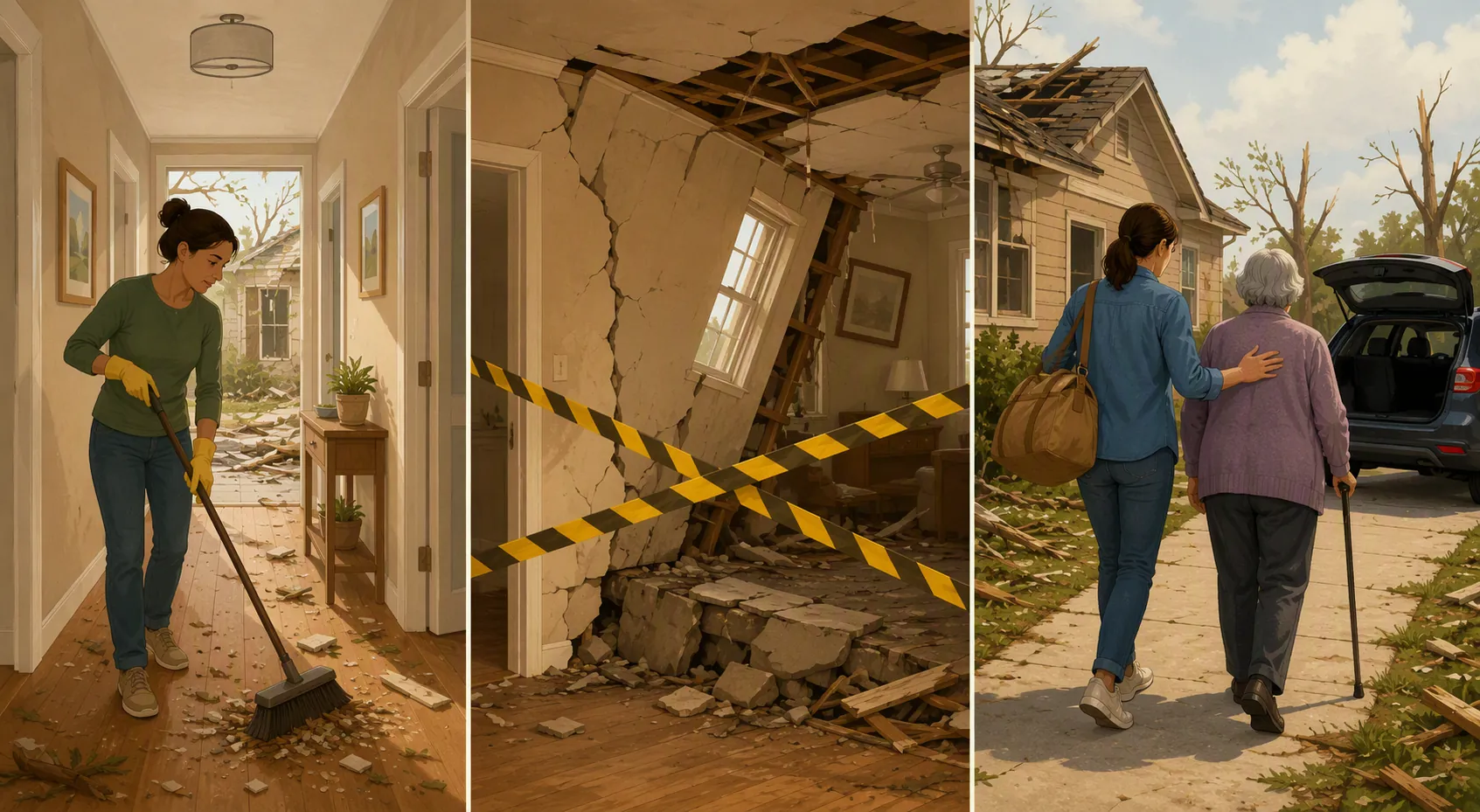
The inspection is not finished when the caregiver has a list of problems. It is finished when each part of the route has been sorted into one of three decisions: fix it now, block it off, or keep the older adult somewhere else.
| Decision | What belongs here | What to do |
|---|---|---|
| Fix now | Small debris on an otherwise stable path, a displaced rug that can be removed, a small wet area that can be dried, furniture that can be moved without strain, a loose cord that can be rerouted | Clear, dry, move, relight, and recheck the route before the older adult walks it |
| Block off | Broken glass you cannot fully remove, a wet bathroom, a dark stairway, a loose handrail, a room with ceiling debris, a kitchen with shifted appliances, a bedroom with broken window glass | Close the door, tape or mark the boundary, tell everyone the area is not in use, and choose another route or another room |
| Relocate | Downed lines, suspected gas leak, sagging roof, leaning wall, foundation crack, unstable porch or stairs, missing critical support, no dry and lit bathroom route, no safe exit path | Keep the older adult out of the home until emergency responders, utilities, inspectors, contractors, or other appropriate professionals have addressed the hazard |
The middle category is where families argue. One person sees a bedroom that is mostly fine. Another sees the bathroom path, the missing hallway light, the loose rug, and the broken glass under the dresser. The person walking the route carries the consequence, so that person’s standard has to be allowed to be stricter.
Limited supervised access can make sense only when the route is dry, lit, clear, supported, and structurally credible. That may mean one caregiver retrieves medication while the older adult waits outside. It may mean the older adult enters only the front room and leaves again. It may mean no entry at all.
After the immediate go/no-go decision
Once the older adult is safely away from the damaged route, recovery planning can start. NCOA describes disaster assistance programs that may help older adults after a disaster, including resources connected to home repair and recovery needs [8]. Repairs that restore safe movement—handrails, grab bars, ramps, lighting, dry flooring, and accessible pathways—belong high on the list because they determine whether the person can use the home, not just whether the home can be cleaned.
For planning before the next severe-weather event, preparation belongs in a different conversation, such as severe-thunderstorm safety for seniors. This moment is narrower. If the walking route cannot be made dry, lit, clear, supported, and structurally credible today, the older adult should not re-enter that space today.
This guidance is educational and does not replace medical advice, emergency instructions, legal guidance, insurance direction, or structural assessment by qualified professionals.
References
- Safety Guidelines: After a Tornado — CDC
- Tornado Cleanup and Response — NIOSH/CDC
- Tornado Recovery: Hazards — AIHA
- Patient & Caregiver Resources — STEADI/CDC
- Disaster Preparedness Tip Sheets for Seniors — California Department of Aging
- Emergency Preparedness for Seniors — Keystone Health
- Preventing Falls at Home — Ready.gov
- Programs Available for Older Adults After a Disaster — NCOA
Related reading
Noticed something outdated or inaccurate on this page? Flag a correction. We review every report against CDC, NIA, and AARP HomeFit guidance before updating a page.
Part of the Fall Prevention section.