
STEADI: intervene
Tornado Safety Tips for Older Adults to Prevent Falls
Learn how to fall-proof your tornado shelter route with a pre-season checklist designed for older adults and their caregivers, reducing the risk of falls when a warning sounds.
The most useful tornado safety tips for older adults start before the siren, with a plain question: from the chair, bed, bathroom, or kitchen table, can this person reach the chosen shelter without falling?
That sounds smaller than the usual tornado advice, but it is the part that decides whether the advice works. A warning does not arrive in a tidy house at 2 p.m. with every light on. It may arrive after bedtime, when bifocals are on the nightstand, the walker is across the room, a pet is underfoot, and the basement stairs are darker than anyone remembered.
Older adults deserve this extra attention. In the CDC review of deaths from the 2011 Southeast tornado outbreak, about one-third of the people who died were adults 65 and older; that outbreak is not a current-year measure of all tornado risk, but it is a hard reminder that age changes what “get to shelter” requires.[1] The fall side of the problem is just as ordinary and just as serious: the CDC reports that more than 1 in 4 older adults falls each year.[2]
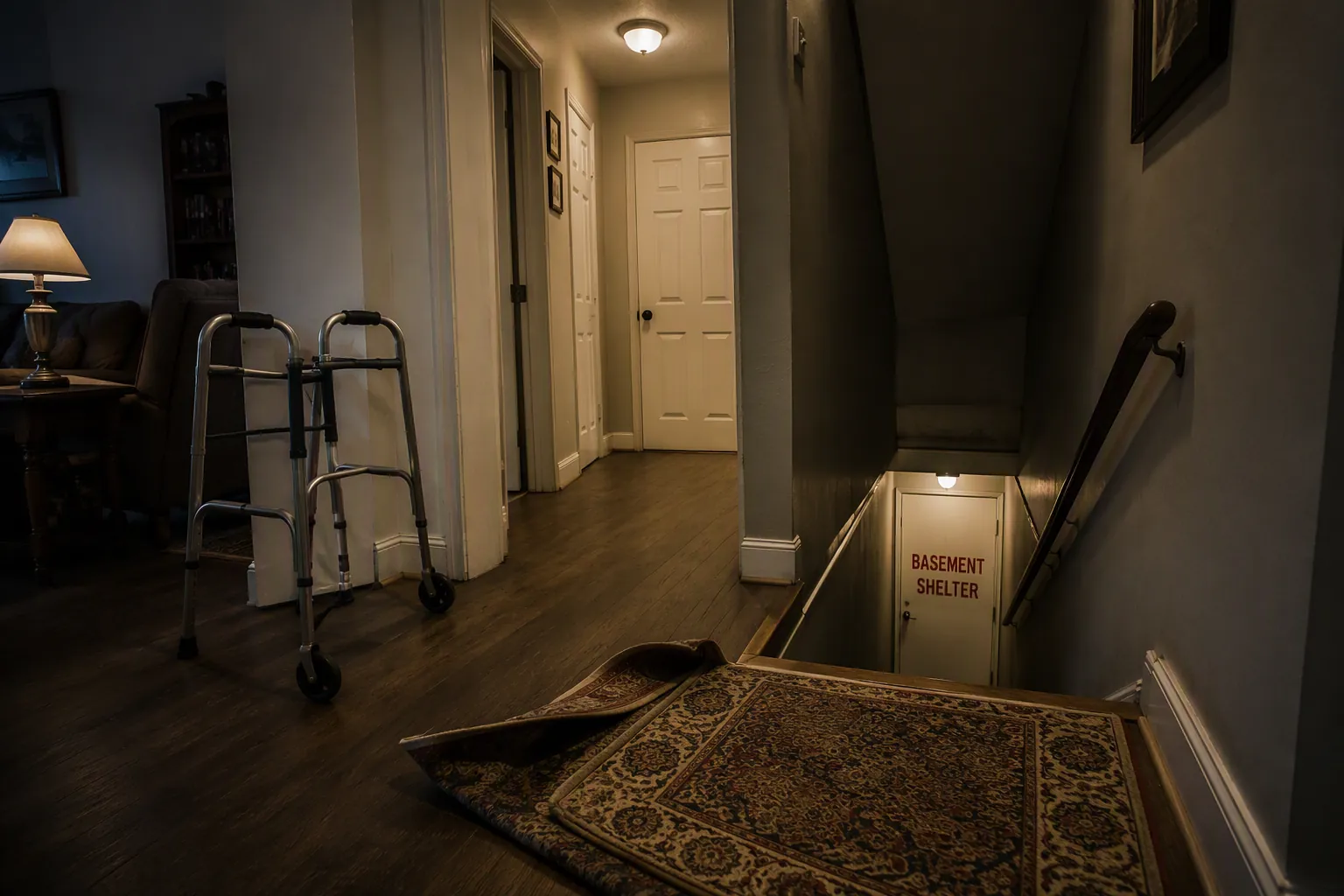
Those two facts belong in the same conversation. Tornado preparedness says to move to the safest available place. Fall prevention asks whether the path to that place is lit, clear, stable, and familiar. For an older adult with stiff knees, low vision, hearing loss, neuropathy, a cane, or a walker, the route is not a detail. It is the plan.
Start With the Shelter, Then Test the Route
Official guidance still matters. FEMA’s Ready.gov guidance for older adults emphasizes planning ahead, staying informed, gathering supplies, and building a support network.[3] The CDC’s tornado safety guidance says that during a tornado, people should move to a basement or an inside room without windows on the lowest floor, protect the head and neck, and avoid windows.[4] The American Red Cross also advises identifying safe rooms, practicing the plan, and keeping emergency supplies ready.[5]
Once that shelter location is chosen, stop talking in generalities. Walk the exact route from every room where the older adult actually spends time. Do it in daylight first, with the usual mobility aid, the usual shoes, and the usual furniture in place. If the person uses a walker at night, do not test the route with a cane at noon and call it done.
| Starting Place | What to Check Before Storm Season |
|---|---|
| Bedroom | Glasses, shoes, flashlight, phone, and mobility aid can be reached from bed without standing first. |
| Bathroom | The path from toilet or shower area to the hall is dry, uncluttered, and wide enough for the walker or cane. |
| Kitchen | Mats, pet bowls, cords, and narrow turns do not block the route to the shelter. |
| Living room | The route from the main chair is clear, and the mobility aid is parked on the side the person naturally stands from. |
| Hallway and stairs | Lighting, handrails, thresholds, rugs, and stored boxes are checked as if the power is out. |
| Shelter space | There is a place to sit, a light, head protection, supplies, and enough room to turn around safely. |
This is also where caregiver tone matters. An adult child can say, “I want to time how long it takes me to get there too,” rather than, “You need help.” The route will reveal enough on its own. If a rug edge catches a shoe in daylight, it will not become safer when the weather radio is sounding.
Walk It Room by Room, Not From Memory
Begin in the bedroom because many tornado warnings happen when people are tired, undressed, or half-awake. Sit on the edge of the bed and look at what must happen first. Are glasses within reach? Is the flashlight reachable without crossing the room? Are sturdy shoes on the same side of the bed as the walker? Is there a clear path around the bed, or does a laundry basket turn the first step into a shuffle?
Then go to the bathroom. Bathrooms are already high-risk spaces because of water, tile, small turning spaces, and transfers. For the shelter route, check whether a bathmat slides, whether the door swing blocks the walker, and whether the person can leave the room quickly without grabbing a towel bar that was never meant to hold body weight.
Move next to the kitchen. Look low. Pet bowls, anti-fatigue mats, a trash can pulled into the walkway, and an extension cord to a countertop appliance can all become foot traps. A tornado plan that sends someone through the kitchen should not depend on perfect housekeeping at the exact wrong moment.
In the living room, start from the actual chair. Not the prettiest chair, not the one guests use—the chair where the person watches television, naps, reads mail, or keeps the remote. Is the walker parked where it can be reached before standing? Is there a side table blocking the first turn? Does the oxygen tubing, charging cord, or throw blanket cross the path? If the person normally needs both hands to push up, the first few feet of the route should not require carrying supplies.
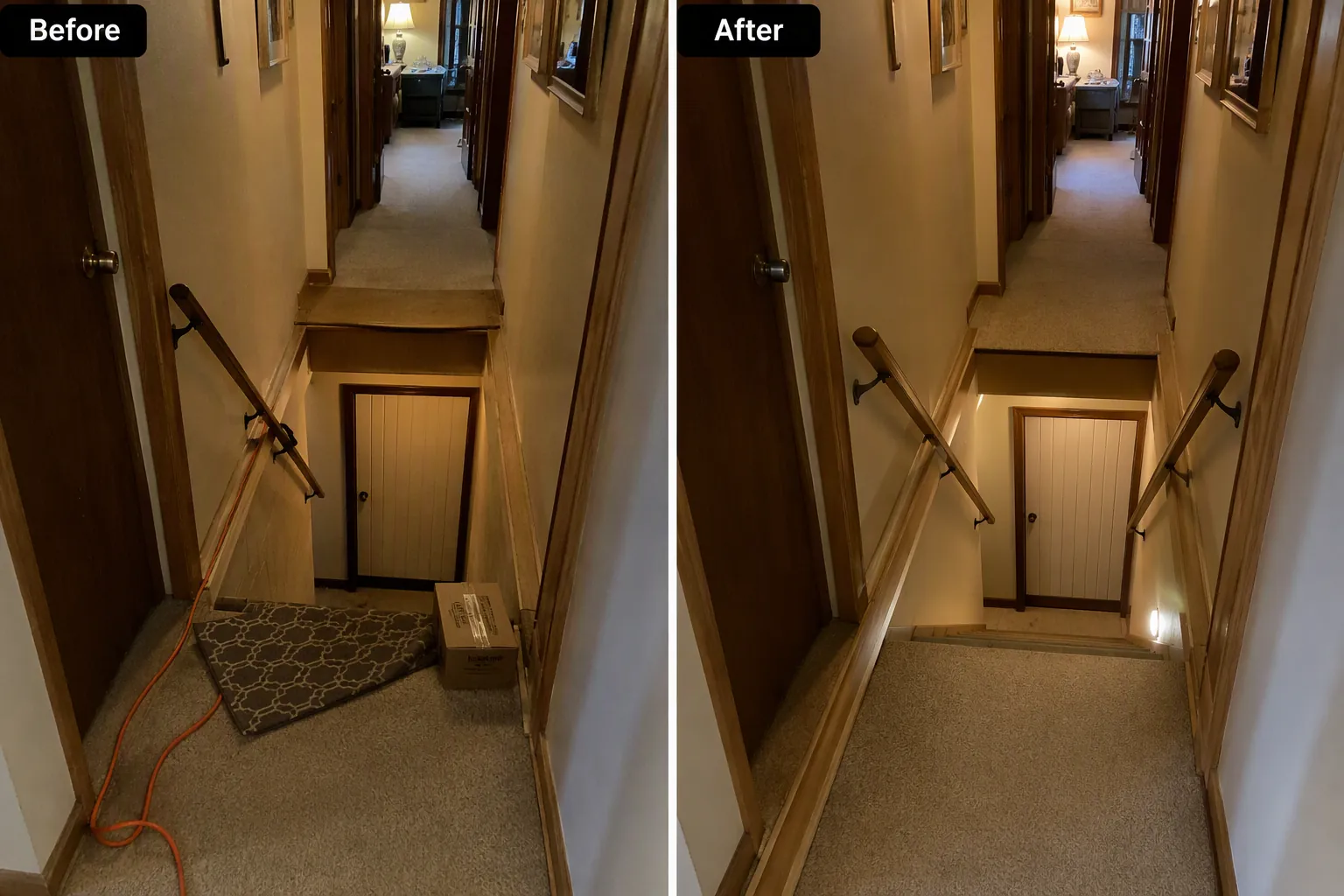
Finally, walk the hall, stairs, and shelter entry slowly enough to notice thresholds. A half-inch lip between flooring types, a curled rug corner, or one dark landing can be the place the plan fails. Older adults with vision, hearing, or mobility limitations face added injury risks during disasters, according to the American Association for Geriatric Psychiatry’s disaster preparedness guidance.[6] United Spinal Association also notes that people with disabilities are 2 to 4 times more likely to be injured in disasters.[7] Those are not reasons to panic. They are reasons to remove the predictable hazards before the sky turns green.
Fix the Hazards That Steal Time
The best pre-season fixes are usually not dramatic. They are the kind that make the route boring.
- Clear a walker-width path from the bed, bathroom, kitchen, and main chair to the shelter route.
- Remove loose throw rugs from the route, or secure only the rugs that truly need to stay.
- Route extension cords along walls instead of across walking paths.
- Add battery-powered nightlights or motion-sensor lights at the bed, hall turns, stair landings, and shelter entrance.
- Keep flashlights where the person starts, not only inside the shelter.
- Install or repair sturdy handrails where stairs are part of the route.
- Reduce thresholds where possible, especially where flooring changes near the shelter path.
Lighting deserves its own attention because it changes everything else. A person who walks safely through a hallway in daylight may slow down, reach for furniture, or misjudge the last stair in dim light. Put one flashlight within arm’s reach of the bed and another near the main chair. Add a light at the stair landing. If the power fails, the route should not depend on a phone flashlight that may be in another room or at 12 percent battery.
Stairs need a stricter standard than flat halls. If the shelter route includes basement stairs, check both sides of the stairwell. One rail may be enough for a young visitor carrying laundry; it may not be enough for someone descending under warning conditions. Loose boxes, shoes, paint cans, and stored holiday bins do not belong on shelter stairs. They are not storage during storm season. They are obstacles.
Do not wait until a warning to decide whether the walker fits through a turn. Measure by use, not by tape alone. Can the older adult turn without lifting the walker? Can the cane tip land flat at the threshold? Can a caregiver assist without squeezing sideways? A route that barely works on a calm afternoon will feel much smaller under pressure.
Different Shelter Types Create Different Fall Risks
This is not a ranking of shelters. Basement, ground-floor interior room, and above-ground safe room routes each have their own fall problems. The right shelter choice depends on the home, local guidance, construction, mobility, and available time. Once a safe location is chosen, the fall-prevention work gets specific.
Basement Route
A basement may offer strong protection, but the stairs are the price of admission. Check the stairway in the dark, with the person’s usual footwear and mobility aid. Add lighting at the top and bottom. Make sure handrails are secure, continuous, and easy to grasp. Keep the door area clear so the person is not trying to open a heavy door while balancing on a landing.
At the bottom, the shelter corner should not require stepping over stored items. If the basement floor gets damp, use a stable non-slip surface in the shelter area. A chair matters here. Sitting on a cold floor may be impossible for someone with knee, hip, or back pain, and getting back up after the warning can become its own emergency.
Ground-Floor Windowless Room
A bathroom, closet, or interior hallway on the lowest floor may avoid stairs, but tight spaces create other risks. Remove baskets, hampers, scales, and stored cleaning supplies from the floor. If the room is a bathroom, make sure bathmats do not slide and that any grab bar used for balance is properly installed. A towel rack is not a grab bar.
If the safest interior room is small, practice entering it with the walker or cane. Some people will need to park the walker just outside and pivot to a chair. That should be practiced calmly, not invented while the warning is active.
Above-Ground Safe Room
An above-ground safe room may reduce stair concerns, but the door threshold, door weight, latch, and interior floor space still need testing. If the entry has a lip, check whether the walker catches. If the door is heavy, make sure the older adult can open and close it without losing balance. If supplies are stored inside, keep them off the walking surface.
Some states and local governments offer storm shelter assistance or rebate programs, and availability changes by location and funding cycle. Treat those programs as something to check with local emergency management, not as something to count on for the current storm season.
Make the Shelter Space Usable After Arrival
Getting to the shelter is only half the route problem. The older adult also has to remain there safely until the warning passes. A clear floor, stable chair, and reachable supplies are not comforts. They prevent rushed bending, awkward transfers, and unnecessary trips back upstairs.
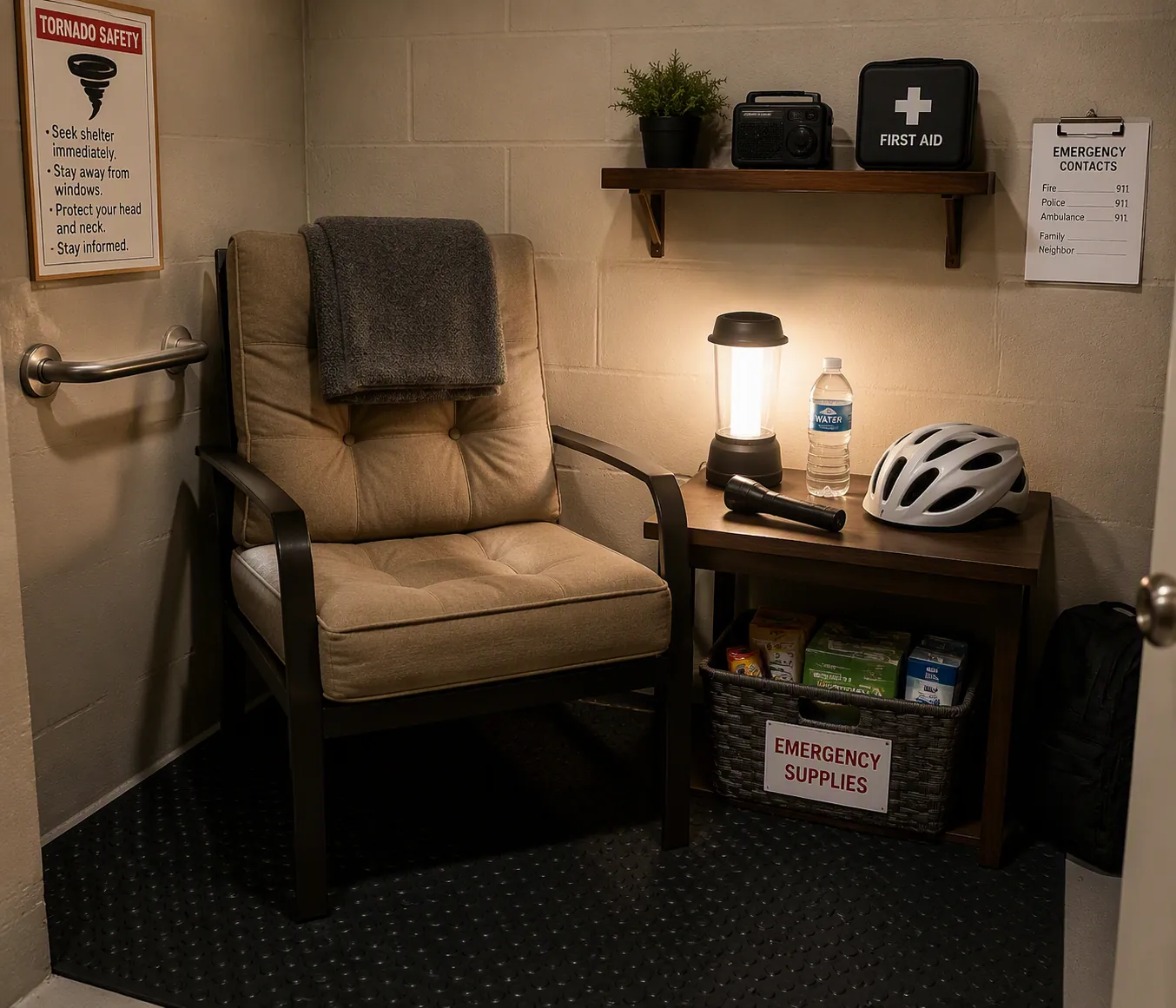
- Place a sturdy chair where the person can sit without backing up blindly.
- Keep an LED lantern or flashlight within reach of the chair.
- Use non-slip footing where the floor is smooth, damp, or unfinished.
- Add a properly installed grab bar if the person needs a handhold for sitting, standing, or steadying.
- Store a helmet or other head protection where it can be reached quickly.
- Keep water, a charged phone or backup power, and basic supplies in one open basket or bin.
The CDC specifically advises protecting the head and neck during a tornado.[4] A bicycle helmet in the shelter area is a simple way to make that advice easier to follow. It should not be buried in a storage tote under winter coats.
Medication planning belongs here, but it should not take over the whole tornado plan. The Red Cross advises keeping a 2-week supply of medications and medical supplies when possible.[5] For people whose prescriptions, oxygen, insulin, mobility equipment, or hearing-aid batteries are essential to daily function, the shelter kit should also include a current medication list and key medical contacts.
Set the Check-In Plan Before Anyone Is Scared
Preparedness for older adults is not only about objects in a bin. Ready.gov emphasizes support networks for older adults, and Keystone Health’s emergency preparedness guidance similarly separates safety, self-sufficiency, and support systems as related parts of readiness.[3][8] For tornado warnings, the support piece needs names, timing, and backup.
- Choose at least two people who may call or text when a tornado watch or warning is issued.
- Decide whether the older adult wants a reminder at tornado watch stage, warning stage, or both.
- Write down who has a key or access code if physical help is needed.
- Place emergency contacts in the shelter kit and near the main phone.
- Agree on a post-warning check-in so nobody assumes silence means everything is fine.
The wording matters. “Call me when you get to the shelter” is clearer than “Be careful.” “I’ll call when the watch is issued so you can move your walker and shoes into place” is more useful than a last-minute flurry of worried texts. The goal is not to take over the home. It is to remove decisions that get harder under sirens.
Practice Once, Then Fix What the Practice Shows
A practice walk does not need to be theatrical. No siren sounds, no stopwatch pressure, no pretending the house is in danger. Start from the bed, the bathroom, the kitchen, and the main chair. Move to the shelter at a normal safe pace. Notice what the person reaches for, where the feet slow down, where the walker bumps, and where the light is not enough.
Then change the house, not the person’s dignity. Move the cord. Take up the rug. Put the flashlight where the hand already goes. Clear the stair landing. Add the motion light. Tighten the rail. Put the helmet on the chair instead of in a box. If a contractor or clinician is needed for a grab bar, railing, ramp, or mobility question, get that help before storm season rather than improvising.
The safest shelter is only protective if the older adult can reach it without getting hurt on the way. Treat tornado safety and fall prevention as one route problem: clear it, light it, stabilize it, stock it, and practice it while the weather is quiet.
References
- Tornado-Related Fatalities — Five States, Southeastern United States, April 25–28, 2011, CDC MMWR, July 20, 2012
- Facts About Falls, CDC
- Older Adults, Ready.gov
- Stay Safe During a Tornado, CDC
- Tornado Safety, American Red Cross
- Older Adults and Disaster Preparedness and Response, American Association for Geriatric Psychiatry
- Tornado Preparedness for the Disability Community, United Spinal Association
- Emergency Preparedness for Seniors, Keystone Health
Related reading
Noticed something outdated or inaccurate on this page? Flag a correction. We review every report against CDC, NIA, and AARP HomeFit guidance before updating a page.
Part of the Fall Prevention section.