
STEADI: intervene
Protect Your Elderly Parent from Falls After a Hurricane
Learn why the days after a hurricane are the most dangerous for your aging parent's fall risk and discover specific steps to prevent falls when power outages, wet floors, debris, and disrupted care routines compound every CDC-identified risk factor at once.
The wind has stopped, the worst rain has moved on, and someone finally says the house made it through. That is usually the moment an elderly parent tries to get up.
The hallway is darker than it should be. A towel is bunched near the back door. The bathroom floor is damp because the vent is off and everyone has been tracking water inside. The walker is not where it normally waits beside the chair; it was moved to make room for a cooler, a bucket, or a stack of storm supplies. Nobody means to create a fall hazard. The house just stops behaving like the house your parent knows.
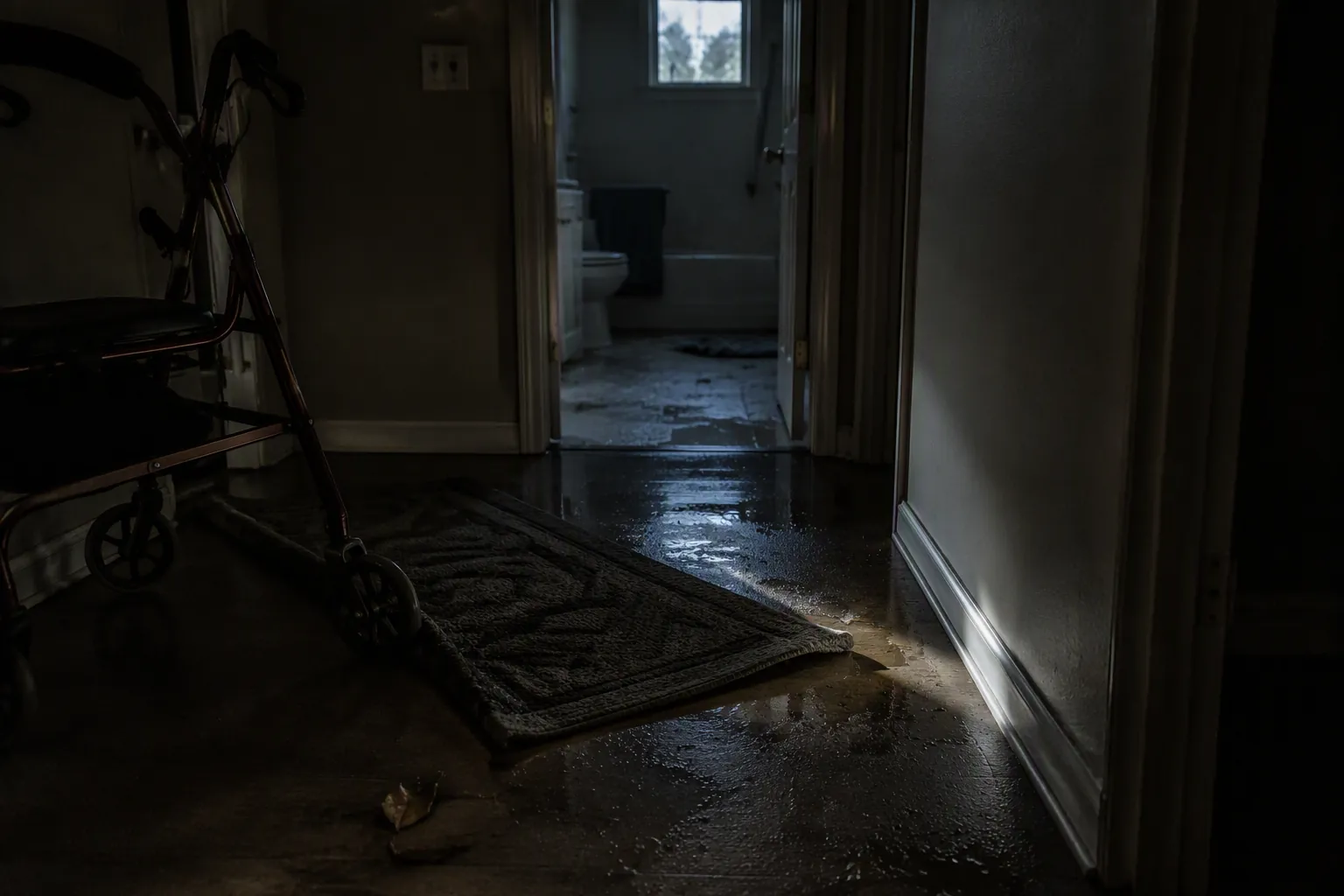
That is why hurricane preparedness for elderly parents cannot end when landfall ends. In a study of injury-related emergency department visits after Hurricane Maria at a hospital in southern Puerto Rico, falls, slips, and trips accounted for 47% of all injury-related visits; among injured patients age 60 and older, 55% were fall victims, the highest proportion of any age group in the study.[1] The 47% number is not an elderly-only statistic, but the age breakdown makes the warning hard to ignore: recovery is not a neutral waiting period for older adults.
Before any storm, older adults already carry a real baseline fall risk. The CDC reports that about 1 in 4 older adults falls each year.[2] After a hurricane, the usual risks do not pause. They multiply. Poor lighting, wet floors, fatigue, medication disruption, blocked pathways, uncharged mobility devices, and delayed help all arrive at once.
The First Question Is Not Whether the House Is Standing
A house can be structurally intact and still be unsafe for an older person to cross. The practical question in the first hours after a hurricane is narrower: can your parent move from the bed to the bathroom, from the favorite chair to the kitchen, and from the front door to the car without stepping over, around, through, or into something?
General emergency guidance from Ready.gov and the American Red Cross rightly emphasizes planning, supplies, communication, evacuation decisions, and support networks for older adults.[3][4] Those pieces matter. But once the storm has passed, the fall-prevention layer has to become much more concrete. A working flashlight in a drawer does not help if your father will not use it on the way to the bathroom. Bottled water in the pantry does not help if your mother has to cross a slick tile floor to reach it.
For the first 72 hours, treat movement as the emergency task. Not the only task, but the one that determines whether everything else stays manageable.
A 72-Hour Fall Watch After the Hurricane
The first three days after landfall are often when families are tired, power is uncertain, cleanup starts, routines are broken, and outside help may be slow. This is not a formal medical protocol. It is a practical way to apply ordinary fall-risk thinking to a damaged, half-functioning house.
| What Changes After the Storm | Why It Raises Fall Risk | What to Do First |
|---|---|---|
| Power is out or unreliable | Rooms, hallways, steps, and bathrooms lose visual cues | Put battery lights on actual walking routes, not just in storage areas |
| Floors are wet or gritty | Shoes, socks, walkers, and canes lose traction | Dry one narrow, dependable route before widening cleanup |
| Debris and supplies crowd normal paths | The parent has to step sideways, reach, or lift a device | Clear the route your parent uses most, even if the rest of the room stays messy |
| Medication timing is disrupted | Dizziness, weakness, confusion, or urgency can increase unsafe movement | Confirm what was taken, what was missed, and who needs to be called |
| Powered mobility or medical devices lose charge | A safe transfer or trip may become unsafe without the usual device | Prioritize charging, backup batteries, and no-walk decisions |
The order matters. Do not start by cleaning the whole house. Start by making one or two routes safe enough to use repeatedly.
First: control the bed-to-bathroom route
This is the route that makes families underestimate danger because it is familiar. Your parent has walked it thousands of times. After a hurricane, familiarity can work against them: they may move by memory even when a basket, towel, extension cord, or damp patch has changed the floor.
- Place a flashlight, lantern, or battery motion light so the floor is visible before your parent stands up.
- Remove loose rugs, curled bath mats, wet towels, and anything that shifts under a cane or walker.
- Dry the bathroom threshold and the area beside the toilet first, not after the rest of the cleanup.
- Put the walker, cane, glasses, and shoes exactly where your parent expects them before bedtime.
- If the toilet route is unsafe, set a safer temporary toileting plan rather than hoping they will call for help every time.
The last point is the uncomfortable one. Many older parents would rather risk a short walk than ask an adult child for help at 2 a.m. Plan for dignity, not obedience. If help is needed, make the help easy to accept: a bell, phone, chair placement, clear lighting, and calm language beat repeated warnings.
Then: make one chair-to-kitchen path boring
After a storm, the kitchen often becomes the family’s supply room. Coolers, cases of water, trash bags, pet food, damp shoes, and phone chargers collect in the same place. That may be logical for the household and still dangerous for the person using a walker.
Pick the chair your parent actually uses, not the one you wish they would use, and walk from that chair to the sink, refrigerator, medication area, and nearest safe sitting place. If a walker cannot roll straight through without angling around objects, the path is not clear. If a cane tip lands on a cord, rug edge, or damp floor, the path is not clear. If your parent has to carry a cup in one hand while managing a device with the other, the task needs to be changed.
Move supplies out of that one route even if it makes another room look less organized. A post-hurricane house does not have to be tidy. It has to stop surprising the person with the least margin for recovery.
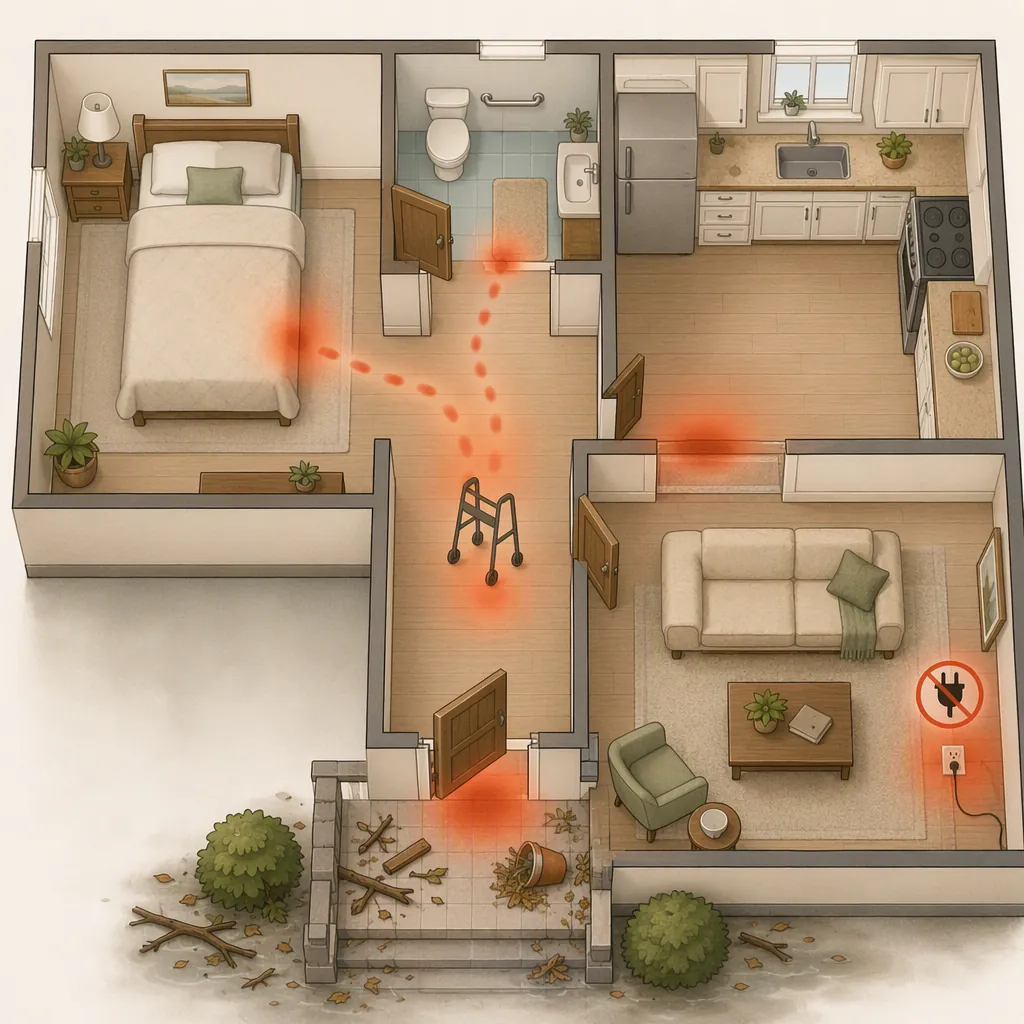
Do Not Let the Porch Become the Test
The front door to driveway route is where good judgment often collapses under practical pressure. Someone needs to check the car. A neighbor calls from outside. A branch is blocking the walkway. Your parent wants to see the damage for themselves.
Porches and driveways after a hurricane ask older adults to solve too many problems at once: uneven boards, slick steps, missing handrail visibility, small branches underfoot, puddles hiding edges, wind-blown mats, loose screens, and low light. A cane can slip on wet concrete. A walker wheel can catch on a threshold or debris. A wheelchair can lose stability where water has softened ground near the edge of pavement.
- Open the door and inspect the threshold before your parent approaches it.
- Remove doormats until the area is dry and flat.
- Clear a route wide enough for the actual device: walker, wheelchair, cane plus caregiver, or rollator.
- Treat outdoor steps as off-limits until lighting, handholds, and traction are restored.
- If your parent insists on going outside, make it a supervised trip with a clear destination, not a slow tour of damage.
This is not overprotective. It is recognizing that the porch has temporarily become unfamiliar terrain.
Medication Disruption Is a Fall Hazard, Too
Wet floors are easy to see. Missed pills are quieter. So are doubled doses, skipped meals, dehydration, poor sleep, anxiety, and the dizziness that can follow a broken routine. If your parent manages medication independently on a normal day, do not assume the system survived the hurricane unchanged.
Check the medication setup without turning it into an interrogation. Look at the pill organizer, bottles, written schedule, and the place where medication is normally taken. Ask what was taken today and yesterday. If doses were missed, doubled, vomited, or mixed up, call the clinician, pharmacist, nurse line, or care team for instructions rather than improvising.
Also look at how medication changes movement. A diuretic may send someone urgently toward the bathroom. A pain medicine may make them drowsy. A blood pressure medication taken after poor sleep and little food may leave them lightheaded. The point is not to diagnose. The point is to stop treating falls as a flooring problem only.
Mobility Devices Need Their Own Power Plan
Ready.gov advises older adults to plan for medical and assistive needs during emergencies, including supplies, support contacts, and power-dependent equipment.[3] The fall-prevention version of that advice is more specific: if a device helps your parent move safely on an ordinary day, losing that device after a hurricane changes whether they should walk at all.
A powered wheelchair, scooter, lift chair, adjustable bed, stair lift, oxygen equipment, hearing aids, phone, medical alert device, or rechargeable flashlight can all affect safe movement. Some are obviously mobility devices. Others become mobility devices because they let your parent call, see, hear, transfer, or rest without taking extra risky steps.
- Confirm which devices are charged now, not which ones were charged before the storm.
- Move chargers and backup batteries above any damp floor area.
- Use the remaining charge for essential transfers and routes, not convenience trips.
- If a stair lift, lift chair, or powered bed is unavailable, change the room plan instead of asking your parent to compensate.
- If the safe device is down and no substitute is safe, decide that your parent does not walk unassisted until conditions change.
That decision can feel dramatic in the moment. It is less dramatic than an emergency department visit when roads are blocked and services are stretched.
Walk the House by Routes, Not by Rooms
Room-by-room checks are useful, but older adults fall while moving between tasks. After a hurricane, follow the paths your parent actually uses. Bring the walker, cane, wheelchair, rollator, or transfer aid with you. If you only inspect with your own body, you will miss what the device catches.
Bed to bathroom
- Can your parent see the floor before standing?
- Is there a dry, flat place for both feet beside the bed?
- Is the mobility aid within reach without leaning?
- Does the bathroom door open fully, or is something stored behind it?
- Are grab bars, toilet supports, or stable surfaces usable in the dark?
Chair to kitchen
- Is the route wide enough for the mobility aid without turning sideways?
- Are cords, coolers, water cases, pet bowls, and trash bags outside the path?
- Can your parent sit before handling food, water, or medication?
- Is the floor dry where they stand longest?
- Can they reach what they need without carrying objects while walking?
Front door to car
- Is the threshold flat, dry, and free of mats?
- Are steps visible and supported by a usable handhold?
- Has debris been cleared from the exact tire, walker, cane, or foot path?
- Is there enough light for the return trip, not just the trip out?
- Is the trip necessary now, or can someone else bring information, supplies, or help inside?
Medication and charging area
- Are medication, water, glasses, and lighting in the same reachable area?
- Is there a chair nearby so medication is not handled while standing?
- Are device cords routed away from walking paths?
- Are backup batteries, power banks, and chargers dry and findable?
- Does someone know what must be charged first if power comes back briefly?
When Your Parent Says They Are Fine
Many older adults are trying to protect their independence in the middle of a situation that already feels humiliating. They may minimize dizziness, hurry to prove they can still manage, or refuse help because every offer sounds like a loss of control.
Arguing about whether they are “allowed” to walk usually makes the house tenser. It works better to make the environment do more of the persuading. Put the light where it needs to be. Move the walker back to its normal parking spot. Clear the path before announcing rules. Offer choices that are both safe: “Do you want to sit in the kitchen while I make coffee, or should I bring it here?”
Fear of falling can also change behavior after a storm. A parent who had a close call may stop moving, skip bathroom trips until urgent, avoid drinking enough, or refuse to sleep in a safer temporary room. That fear deserves attention, but it does not mean the answer is to push them back into normal routines too quickly. Rebuild movement in small, safe routes first.
What to Skip Until the Routes Are Safe
After a hurricane, families can spend precious energy on visible recovery tasks that do not reduce the immediate chance of a fall. Some cleanup can wait. Some pride can wait. Some normal household standards definitely can wait.
- Do not ask your parent to help sort debris if the walking route is not stable.
- Do not store supplies in hallways because they are “only temporary.”
- Do not leave wet towels, fans, buckets, or cords near a bathroom path overnight.
- Do not let a quick porch check become an unsupervised inspection of damage.
- Do not assume a parent who uses a walker indoors can handle wet outdoor surfaces with the same device.
The broader hurricane kit still matters: water, food, documents, contacts, evacuation planning, and medical information belong in the plan.[3][4] But once the storm has passed, supplies should support safe movement rather than block it.
The Moment to Get More Help
There are times when clearing a path is not enough. Get medical or emergency guidance if your parent fell, hit their head, has new confusion, new weakness, chest pain, severe dizziness, trouble breathing, signs of dehydration, or cannot transfer safely. Also ask for help if the home cannot be made navigable with the people and equipment available.
Older adults may face harder evacuation and transportation decisions during disasters, especially when health needs, mobility limits, and caregiving support are involved.[5] That reality should lower the threshold for arranging help early, not raise the expectation that a parent should make do in unsafe conditions.
A safe recovery plan may mean staying in one cleared part of the home, sleeping in a different room, delaying outdoor cleanup, accepting a neighbor’s help, calling a clinician, or relocating temporarily. The right choice depends on the house, the parent, and the help available. The wrong choice is pretending the old routine still fits the damaged environment.
Restore Movement Before Routine
The storm being over does not mean your elderly parent is safe. It means the danger has changed shape. It is now in the dark hallway, the damp bathroom threshold, the porch step, the misplaced cane, the uncharged device, the missed medication, and the tired decision to “just walk over there for a second.”
Fall prevention after a hurricane is not a separate senior-care chore. It is the missing layer in ordinary hurricane preparedness: before the household returns to normal, restore the routes your parent needs to move without guessing, reaching, stepping around, or proving anything.
References
- Injury-Related Emergency Department Visits After Hurricane Maria in a Southern Puerto Rico Hospital, PMC
- Facts About Falls, Centers for Disease Control and Prevention
- Older Adults, Ready.gov
- Older Adults Emergency Preparedness, American Red Cross
- Why evacuating older adults during disasters is so difficult, PBS NewsHour
Related reading
Noticed something outdated or inaccurate on this page? Flag a correction. We review every report against CDC, NIA, and AARP HomeFit guidance before updating a page.
Part of the Fall Prevention section.