
STEADI: intervene
Helping Elderly Parents Avoid Falls After a Tornado
This room-by-room checklist helps adult children prevent falls when cleaning up a parent's tornado-damaged home, covering debris hazards, temporary lighting, and when to call a professional. Based on CDC and NWS data showing that 50% of tornado injuries occur during cleanup.
The first fall hazard may be right at the doorway: wet leaves on the porch, a strip of splintered siding across the threshold, insulation underfoot, and a parent trying to get a walker through a house that no longer behaves like home. That is why helping elderly parents after tornado damage has to start before anyone begins “cleaning up.” The National Weather Service says 50% of tornado-related injuries happen during rescue and cleanup, and nearly one-third of post-tornado injuries come from stepping on nails.[1]
For an older adult, that cleanup phase piles risk on top of risk. At baseline, more than 1 in 4 older adults falls each year.[2] After a tornado, the same parent may be walking through poor lighting, wet flooring, displaced furniture, loose rugs, broken glass, nail boards, mud, fatigue, and unfamiliar room layouts all at once. Tornado damage does not create one new fall hazard. It turns nearly every known fall trigger on at the same time.
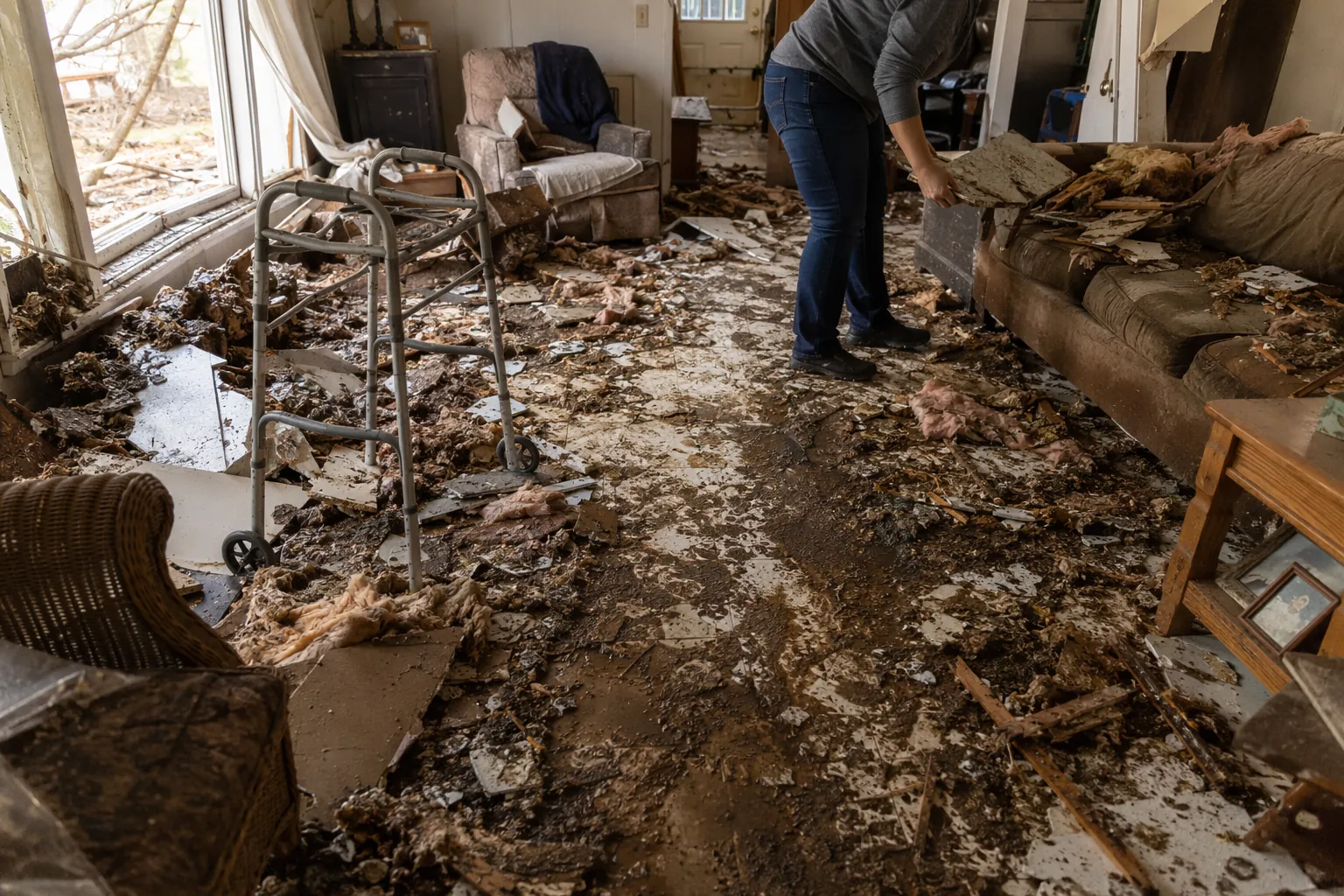
Stop Before Entering: Conditions That End the Family Cleanup Plan
A room-by-room checklist only helps if the home is safe enough to enter. If any of these conditions are present, keep your parent out and call emergency services, the utility company, your insurer, or a qualified contractor before trying to clear paths inside:
- Downed wires, sagging service lines, sparks, or standing water near electrical outlets, appliances, extension cords, or breaker panels.
- A gas smell, hissing sound, damaged gas appliance, or concern that a gas line has shifted.
- Major roof damage, bowed walls, leaning chimneys, cracked foundations, or ceilings that are sagging under wet insulation or debris.
- Broken stairs, loose railings, collapsed porch boards, or any step that moves when pressed.
- Flooded rooms, sewage contamination, or wet flooring where you cannot see what is underneath.
- Cleanup tasks involving chainsaws, generators, heavy tree limbs, unstable roof sections, or large debris piles.
This is not overcautious. Official tornado cleanup guidance treats generators, chainsaws, lifting injuries, tetanus concerns, and carbon monoxide poisoning as serious post-storm hazards.[3] Those risks also change fall prevention decisions: a parent should not be stepping around a generator cord in a dark hallway, and an exhausted adult child should not be lifting heavy debris while also spotting a parent with poor balance.
If power is out, handle darkness as a fall hazard, not an inconvenience. Set up battery lanterns or flashlights before cleanup stretches into dusk. For a deeper room-by-room approach to outage conditions, see the power outage fall prevention checklist for seniors.
The First 10 Minutes: Make One Safe Route, Not a Clean House
The first goal is not to restore the house. It is to create one route your parent can use without stepping over, around, or through debris. That route should connect the entrance, a seated resting place, the bathroom or temporary toileting option, drinking water, medications, and a sleeping area if your parent is staying on-site.
Start with a quick pass while your parent stays outside, in the car, with a neighbor, or in one cleared chair away from the work area. Do not ask them to “just hold this” or “step over here for a second” while boards, glass, and wet drywall are still underfoot. That is how cleanup turns into a rescue.
| First-pass priority | What to do before your parent walks through |
|---|---|
| Footing | Remove boards with nails, glass, metal trim, wet insulation, and loose roofing grit from the walking route instead of stepping around them. |
| Width | Clear a path wide enough for the actual mobility aid your parent uses, including room to turn. |
| Lighting | Place battery lights at the entrance, hallway turns, bathroom, bedroom, and any step or threshold. |
| Edges | Mark or block broken thresholds, lifted flooring, uneven porch boards, and missing trim. |
| Resting | Set one stable chair in a cleared area so your parent is not standing while decisions are being made. |
Water damage adds pressure. The CDC advises drying wet or water-damaged items and areas within 24 to 48 hours when possible to help prevent mold growth.[5] That window matters, but it is not permission to rush an older adult across wet tile or a debris-covered hallway. Treat it as a reason to divide work: one person clears and dries the safe route, another handles calls, photos, supplies, and contractor coordination.
Entry and Exterior Path
The path from car to door often gets underestimated because everyone is looking at the roof or the broken windows. For a parent using a cane, walker, rollator, or unsteady gait, the driveway and porch may be the first serious fall zone.
- Clear the route from the parking spot to the door before your parent gets out of the car.
- Remove loose branches, siding strips, shingles, glass, nails, and metal flashing from the walking line.
- Check porch boards, handrails, ramps, and steps with your own weight before your parent uses them.
- Block muddy shortcuts across the yard; mud on cane tips and shoes will follow your parent indoors.
- Use a stable chair outside or just inside the door if your parent needs to sit while you inspect the next zone.
If the safest entrance is not the usual entrance, say so clearly. After a tornado, habit is not reliable. A parent may automatically reach for the same porch rail they have used for years, even if that rail is now loose.
Main Walking Routes
Hallways and room-to-room paths carry the whole recovery. People move through them with trash bags, insurance papers, wet towels, medication bottles, chargers, and boxes of salvaged belongings. If those paths are sloppy, every trip becomes a balance test.
Walk the route at your parent’s speed. Look down where their feet, cane, walker legs, or rollator wheels will actually land. Tornado recovery hazards commonly include exposed nails, broken glass, sharp displaced objects, and wet or muddy flooring.[4] A board with one nail sticking up should be removed from the path, not mentally labeled “watch that.” No one remembers every “watch that” after six hours of cleanup.
- Pull furniture fully out of travel lanes rather than angling it halfway aside.
- Roll up loose rugs and mats if they are wet, curled, gritty, or bunched from shifting furniture.
- Tape down temporary cords only after confirming they are not near water and are needed for safe lighting or essential equipment.
- Put trash bags, bins, and salvage piles against a wall, not beside the path where a walker may clip them.
- Keep doors fully open or fully closed; half-open doors narrow the route and hide debris behind them.
Living Areas
The living room often becomes the command center: phone calls, insurance photos, family updates, chargers, water bottles, and a parent who wants to see what happened. That makes it useful, but also crowded.
Pick one chair that is stable, dry, and reachable by the cleared route. Do not use a low sofa buried behind boxes or a recliner that sits on damp carpet with cords across the front. If the ceiling is damaged, choose a place away from sagging drywall, broken windows, and shelves that may have shifted.
- Move small tables, ottomans, lamps, and tipped decor away from the route to the chair.
- Set a battery light within reach so your parent does not stand up to find a flashlight.
- Place medications, glasses, hearing aids, phone, water, and tissues on a stable surface that does not require bending.
- Keep active sorting piles out of the room if your parent is seated there; salvage work spreads quickly.
This is also the point to decide whether the home is only a daytime stop. If bathroom access, lighting, or sleeping arrangements cannot be made safe, your parent may need to stay elsewhere while cleanup continues.
Kitchen
Kitchens combine slick flooring, broken dishes, leaking appliances, cabinet contents on the floor, and people trying to make coffee because everyone is tired. Keep your parent out until you have checked the floor, counters, and appliance area.
- Sweep or lift broken glass and ceramic pieces instead of pushing them under cabinets where cane tips or shoes can find them later.
- Dry visible water and block off wet areas that may keep seeping from appliances, pipes, windows, or roof damage.
- Move pet bowls, coolers, food boxes, and trash bags away from the main walking line.
- Do not let your parent carry heavy water containers, coolers, or full trash bags across uneven flooring.
- If food, medication refrigeration, or appliance safety is uncertain, separate that problem from fall prevention and get appropriate guidance.
Kitchen cleanup can wait if the route to a safe bathroom and sleeping area is not ready. A parent does not need access to every cabinet in the first pass. They need not to fall while trying to rinse a cup in a room full of broken dishes.
Bathroom
The bathroom deserves more attention than almost any other room because it is where privacy, urgency, water, tile, and poor balance collide. A parent may insist they are fine. That does not make wet tile safer.
- Check the route to the bathroom first, including threshold strips, hallway debris, and door swing.
- Dry the floor completely or block bathroom use until it can be dried.
- Remove soaked rugs and bath mats; wet fabric can slide, bunch, or hide sharp debris.
- Put a battery light where it lights the toilet path and sink area without forcing your parent to reach in the dark.
- Confirm the toilet, grab bars, vanity, and towel bars have not loosened before your parent uses them for support.
- If the bathroom cannot be made safe quickly, arrange another toileting option rather than letting your parent improvise.
Do not treat a towel bar as a grab bar because it is the only thing nearby. After wind, water, and shifting walls, even familiar fixtures need a quick check. If your parent normally uses bathroom equipment, make sure it is still level, dry, and positioned where they can use it without twisting.
Stairs, Steps, and Thresholds
Stairs should not be part of the first route unless there is no alternative and they have been checked. A single loose tread, missing handrail, wet stair edge, or strip of siding across the step can turn a tired parent’s normal climb into a fall.
- Press each step before your parent uses it; do not rely on how it looked before the storm.
- Check both handrails, not just the one your parent usually grabs.
- Remove grit, leaves, insulation, and small debris from each tread rather than sweeping it to one side.
- Light the top, bottom, and any turn in the stairway.
- Block stair use if there is roof leakage, broken glass, missing trim, or any movement in the structure.
Thresholds need the same respect. Tornado damage can lift flooring, warp doors, loosen transition strips, and leave splinters exactly where a walker wheel or cane tip catches. If a threshold cannot be made smooth, mark it brightly and help your parent avoid that route until it is repaired.
Bedroom or Temporary Sleeping Area
A parent who stays overnight in a damaged home needs a short, boring nighttime route: bed, light, bathroom, water, phone. Anything more complicated becomes dangerous at 2 a.m.
- Choose a sleeping area on the same level as the bathroom if possible.
- Clear both sides of the bed if your parent may get up from either side.
- Place a battery light, phone, glasses, mobility aid, and medications within reach.
- Remove boxes, laundry baskets, shoes, and salvage piles from the bed-to-bathroom route.
- Avoid air mattresses or low temporary beds if your parent has trouble standing from low surfaces.
If the usual bedroom is under a damaged ceiling, near broken windows, or upstairs beyond unsafe steps, set up a temporary sleeping spot elsewhere. Familiar is not the same as safe after a tornado.
Mobility Aids Need Their Own Inspection
Most tornado cleanup advice says to wear sturdy shoes and avoid sharp objects. That is useful, but it misses the walker wheel that jams on roofing grit, the cane tip that lands in mud, and the rollator brake that stops gripping because the tire is wet. For an older adult, the mobility aid is part of the walking surface.
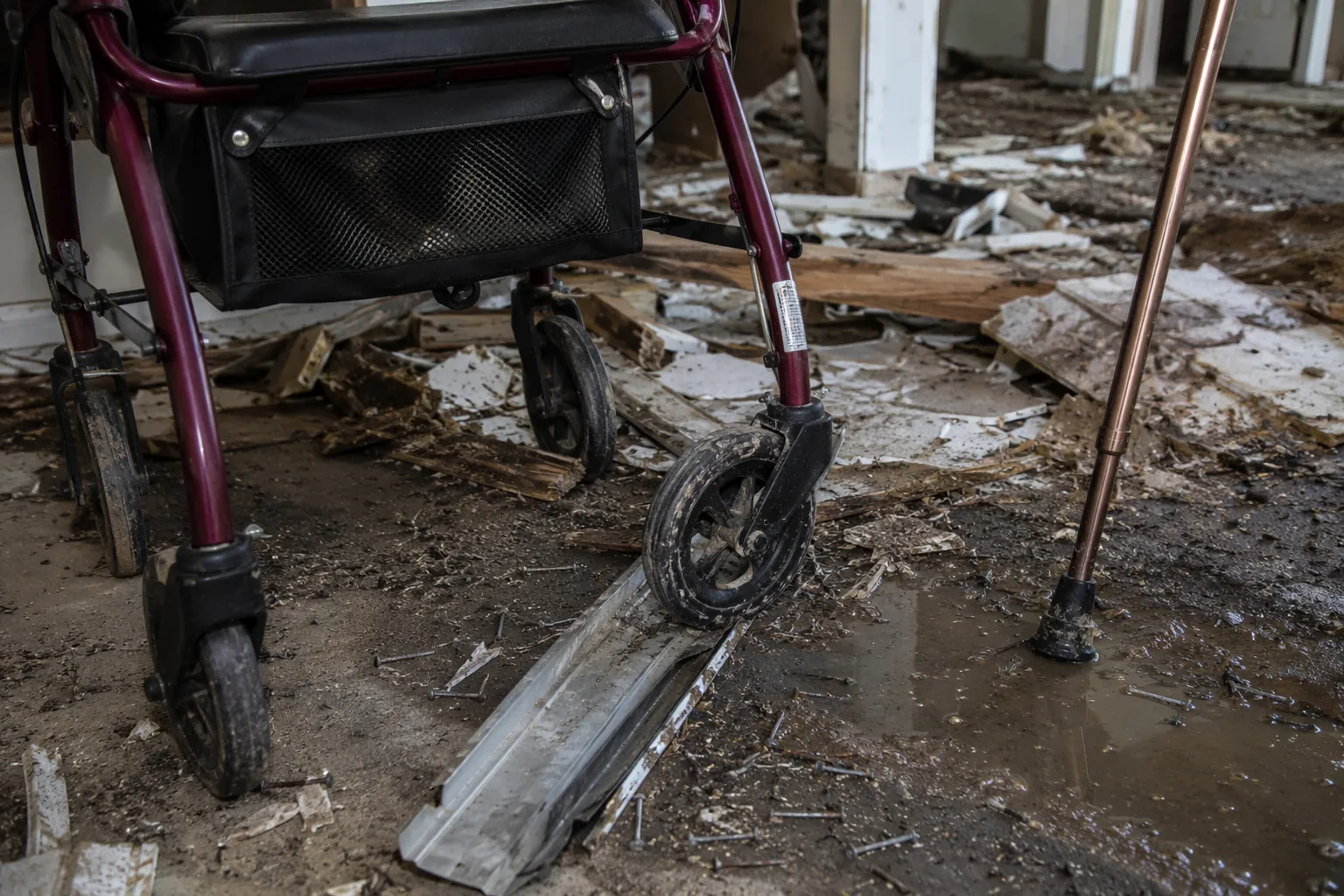
- Walker: Check all legs or wheels for mud, glass, grit, bent frames, loose rubber tips, and wobble before your parent uses it inside.
- Rollator: Test the brakes on dry flooring, then inspect the wheels for debris that could stop them suddenly.
- Cane: Wipe the rubber tip, replace it if it is split or loose, and keep it out of puddles and mud.
- Wheelchair: Clear extra turning space; debris at floor level can trap small front casters.
- Grabber tools: Use them for light items only; they are not a reason for your parent to reach over broken glass or unstable flooring.
Do not lift a walker over debris while your parent is leaning on it. Clear the debris or choose another route. If a walker-width path cannot be made, the room is not ready for your parent yet.
Pacing the Work Without Letting the House Run the Day
The first 72 hours can turn one adult child into the safety spotter, debris clearer, driver, medication tracker, insurance photographer, and reluctant project manager. The temptation is to let a parent “help a little” because there is too much to do and they want to feel useful. Give them jobs that do not put them in unstable footing.
- Safer parent tasks: make phone calls from a cleared chair, identify important documents, list medications, point out where supplies are usually kept, or choose items to prioritize.
- Unsafe parent tasks: carrying debris, sorting in wet rooms, stepping into closets with unknown floor hazards, holding ladders, walking through active cleanup zones, or navigating dark halls.
- Two-person tasks: moving furniture, carrying water-damaged items, shifting appliances, or clearing bulky debris from a path.
- Professional tasks: structural repair, electrical hazards, gas concerns, major roof work, large limb removal, generator setup questions, and chainsaw work.
NIOSH cleanup guidance includes lifting limits and warns against overexertion during tornado response.[3] Use that as permission to stop turning every heavy object into a family test. If moving something requires straining, twisting, or walking backward through debris, it belongs on the two-person or professional list.
Nail wounds and cuts also deserve attention. Because official cleanup guidance raises tetanus shot verification as part of tornado response, ask your parent’s doctor or another qualified medical professional whether their tetanus protection is current, especially if they had a puncture wound or dirty cut.[3]
What Can Wait Until the Safe Route Is Ready
Preparedness decisions, shelter upgrades, benefits paperwork, contractor bids, and long-term rebuilding all matter. They just should not interrupt the first job: keeping your parent upright and out of active debris zones.
Once the immediate fall route is under control, you can move to larger recovery questions. For assistance programs and documentation, use how to get tornado damage assistance for an older adult. For future planning, compare shelter options in which tornado shelter type works best for an elderly parent, or use a room-by-room severe storm safety checklist for seniors before the next storm season.
A First-72-Hours Fall Prevention Path
By the end of the first pass, you want a smaller house inside the damaged one: one safe entrance, one clear walking route, one stable sitting area, one usable bathroom plan, one sleeping setup if needed, and one checked mobility aid. Everything outside that route can be handled later, by more people, or by professionals.
- Keep your parent out until structural, utility, gas, roof, water, and electrical hazards are ruled out.
- Clear the exterior path and threshold before your parent leaves the car or safe waiting place.
- Create one walker-width route through the home before sorting belongings.
- Remove nail boards, glass, sharp metal, wet insulation, mud, and loose rugs from that route.
- Add temporary lighting before daylight fades, especially at steps, turns, bathrooms, and the bed path.
- Dry or block wet flooring instead of asking your parent to cross it carefully.
- Inspect walkers, canes, rollators, wheelchair casters, rubber tips, and brakes before use.
- Assign your parent seated tasks and keep them out of active debris zones.
- Use two-person help or professionals for heavy, unstable, electrical, gas, roof, generator, or chainsaw-related work.
When a tornado-damaged home is organized around the safe route first, cleanup decisions get clearer. The nail board does not stay because everyone knows to avoid it. The bathroom floor does not stay wet because someone is only going in for a minute. The walker does not get dragged across grit because the room is almost clear. Fall prevention becomes the way the cleanup is run.
References
- After the Storm, National Weather Service.
- Facts About Falls, Centers for Disease Control and Prevention.
- Tornado Cleanup and Response, NIOSH.
- Tornado Recovery Hazards, AIHA.
- Safety Guidelines After a Tornado, Centers for Disease Control and Prevention.
Related reading
Noticed something outdated or inaccurate on this page? Flag a correction. We review every report against CDC, NIA, and AARP HomeFit guidance before updating a page.
Part of the Fall Prevention section.