
Room checklist
Funding Sources for Home Modifications: A Complete Guide to VA, Medicaid, Grants, and More
This guide helps family caregivers navigate the fragmented landscape of home modification funding. It organizes all major options — federal VA and USDA programs, Medicaid HCBS waivers, state-level assistance, nonprofit grants, and low-interest financing — by eligibility, provides a clear decision tree to find the right starting point, and includes actionable steps for applying.
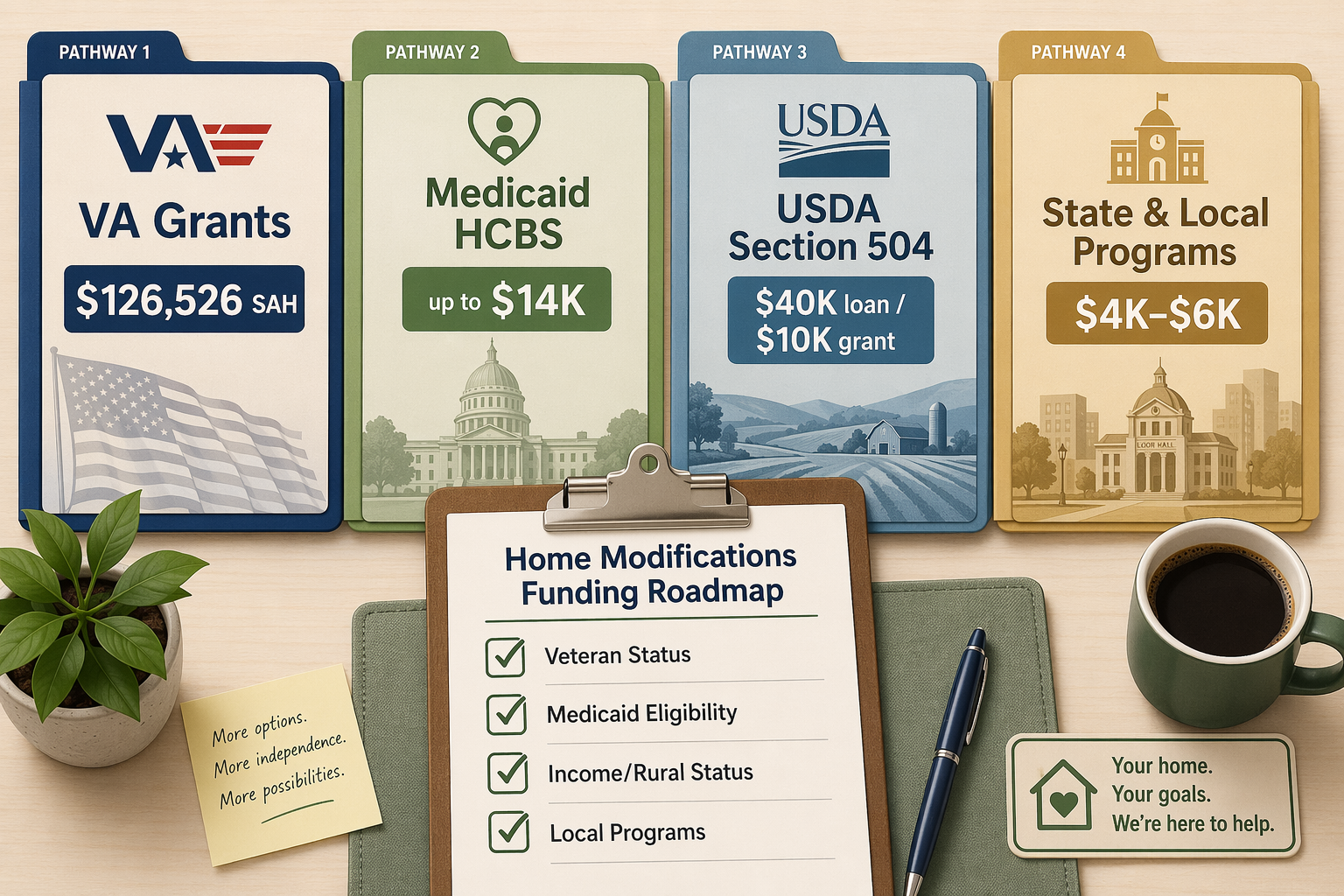
The Home Modification Funding Landscape: Why It Feels Overwhelming (and How This Guide Helps)
If you have started researching how to pay for a stair lift, a roll-in shower, or widened doorways for a parent, you have likely encountered a dizzying array of acronyms — SAH, SHA, HISA, HCBS, OAHMP — and a patchwork of programs with different eligibility rules, income limits, and application processes. This fragmentation is the single biggest barrier families face when trying to make a home safe for aging in place.
The good news is that most families can combine two or three funding sources to cover a significant portion — sometimes all — of their modification costs. The key is knowing which programs to pursue first based on your specific situation: veteran status, Medicaid eligibility, income, age, and where you live.
This guide organizes every major funding option — federal VA and USDA programs, Medicaid Home and Community-Based Services (HCBS) waivers, state-level assistance, nonprofit grants, and low-interest financing — into a single reference. It does not cover how to install a grab bar or choose a contractor; those are separate decisions you make after you know what funding is available. Instead, it gives you a decision tree to find your starting path, a detailed breakdown of each program, and the exact documents and questions you need to move forward.
Quick Decision Tree: Where to Start Based on Your Situation
Before diving into the details of each program, use this decision framework to identify your most promising starting point. The order matters: federal programs (VA, USDA) tend to offer the largest amounts, followed by state Medicaid waivers, then state and local programs, and finally nonprofits and financing.
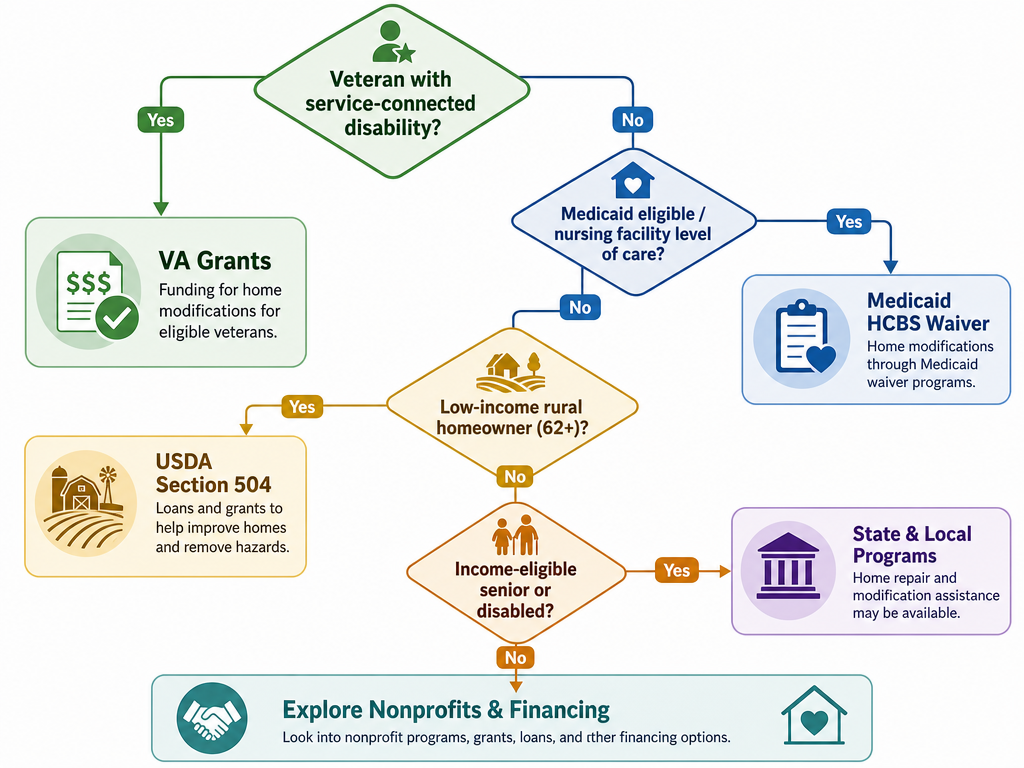
- Is the person a veteran with a service-connected disability? Start with VA Specially Adapted Housing (SAH) or Special Home Adaptation (SHA) grants — these are the most generous single source, with amounts up to $126,526 for SAH in FY 2026.
- Is the person eligible for Medicaid and requires a nursing facility level of care? Contact your state Medicaid agency to ask about HCBS waiver coverage for Environmental Accessibility Adaptations. Be prepared for waiting lists.
- Is the person a very-low-income homeowner age 62+ living in a rural area? Check USDA Section 504 grants (up to $10,000) and loans (up to $40,000 at 1% interest). This program is often overlooked.
- Does the person meet income limits for state or local programs? Contact your local Area Agency on Aging and check your state's profile on the National Directory of Home Modification Resources.
- None of the above? Explore nonprofit programs like Rebuilding Together, low-interest financing through FHA Title I loans or state assistive technology loan programs, and consider stacking multiple smaller sources.
Federal Programs: The Most Generous Sources of Funding
Federal programs offer the largest individual funding amounts, but they also have the most specific eligibility requirements. If the person you care for qualifies for even one of these programs, it should be your first call.
VA Specially Adapted Housing (SAH) and Special Home Adaptation (SHA) Grants
The VA offers two primary grant programs for veterans with qualifying service-connected disabilities to adapt their homes. For fiscal year 2026 (October 1, 2025 through September 30, 2026), the SAH grant provides up to $126,526, and the SHA grant provides up to $25,350. These amounts are adjusted annually based on construction cost changes.
SAH grants are for veterans who have lost, or lost the use of, more than one limb, are blind in both eyes, or have certain severe burns. SHA grants are for veterans who have lost, or lost the use of, both hands, or have certain severe burns or respiratory injuries. Both grants can be used up to three times over a lifetime — a feature that allows veterans to adapt a new home if they move.
In 2024 alone, the VA issued 2,352 SAH grants totaling more than $147 million. Since the program began in 1948, it has awarded more than 53,500 grants totaling $2.2 billion. The program has also expanded eligibility to include degenerative conditions caused or worsened by service, such as Parkinson's disease and ALS.
VA Temporary Residence Adaptation (TRA) Grants
For veterans who are living temporarily in a family member's home, the TRA grant provides up to $50,961 for those who qualify for SAH, and up to $9,100 for those who qualify for SHA, in FY 2026. This is a useful option for veterans who are staying with adult children while their own home is being modified or while they decide on a long-term living arrangement.
VA Home Improvements and Structural Alterations (HISA) Grants
HISA grants are separate from SAH/SHA and cover medically necessary home improvements that enable access to the home and essential rooms. The lifetime benefit is $6,800 for veterans with service-connected disabilities or those rated 50% or more service-connected, and $2,000 for other disabilities.
Covered modifications include ramps for entrance and exit, roll-in showers, kitchen and bathroom accessibility improvements, and plumbing or electrical work needed for medical equipment. The program explicitly excludes spa or hot tub installations, exterior decking, portable ramps, porch lifts, and stair glides. To apply, you need a VA physician prescription (Form 10-0103), a color photograph of the area to be modified, and an itemized contractor estimate.
USDA Section 504 Home Repair Loans and Grants
The USDA Section 504 program is one of the most overlooked funding sources for home modifications. It serves very-low-income homeowners in rural areas. Loans of up to $40,000 are available at a fixed 1% interest rate for 20 years and can be used for repairs, structural improvements, and accessibility modifications. Grants of up to $10,000 (up to $15,000 in presidentially declared disaster areas) are available for homeowners age 62 and older who cannot afford a loan.
Loans and grants can be combined for a total of up to $50,000 (or $55,000 in disaster areas). Grants must be repaid if the property is sold within three years. The applicant must own and occupy the home, have very low income by county standards, and be unable to obtain affordable credit elsewhere. Applications are accepted year-round through local USDA Rural Development offices.
HUD Older Adults Home Modification Program (OAHMP) — Current Status
The HUD OAHMP program, created in 2021, provided grants to local organizations to help low-income seniors with home modifications. A HUD evaluation found positive associations with improved functional abilities and reduced emergency visits among participants, though the study could not establish causation. However, the program has faced significant delays due to federal environmental review requirements, and HUD did not request additional funding for FY 2026.
This means the program's future at the federal level is uncertain. The HUD evaluation itself suggested that state and local governments may be better positioned to run such programs without federal red tape. For now, families should not rely on OAHMP as a primary funding source but should monitor their state and local housing agencies for any reallocated or successor programs.
| Program | Maximum Amount (FY 2026) | Key Eligibility | Best For |
|---|---|---|---|
| VA SAH Grant | $126,526 | Veteran with qualifying service-connected disability (loss of limb use, blindness, severe burns) | Major structural modifications: home purchase, construction, or extensive adaptation |
| VA SHA Grant | $25,350 | Veteran with qualifying service-connected disability (loss of both hands, severe burns/respiratory) | Home adaptations for specific mobility or access needs |
| VA TRA Grant | $50,961 (SAH-qualified) / $9,100 (SHA-qualified) | Veteran living temporarily in a family member's home | Adapting a family member's home for temporary stays |
| VA HISA Grant | $6,800 (service-connected) / $2,000 (other) | Veteran with VA physician prescription for medically necessary improvements | Ramps, roll-in showers, bathroom/kitchen accessibility, medical equipment access |
| USDA Section 504 Loan | $40,000 at 1% interest | Very-low-income rural homeowner; any age | Repairs, structural improvements, accessibility modifications |
| USDA Section 504 Grant | $10,000 (up to $15,000 in disaster areas) | Very-low-income rural homeowner age 62+; cannot afford a loan | Health and safety hazard removal, accessibility modifications (wheelchair ramps, wiring) |
If you have already decided on a specific modification, such as a stair lift, you can find detailed cost information in our Stair Lift Cost and Funding Options guide. That guide covers modification-specific costs and funding pathways, while this article focuses on the broader funding landscape.
Medicaid Home and Community-Based Services (HCBS) Waivers: State-by-State Coverage
Medicaid HCBS waivers (authorized under Section 1915(c) of the Social Security Act) are the primary vehicle through which Medicaid pays for home modifications. These waivers allow states to use Medicaid funds to provide home and community-based services — including Environmental Accessibility Adaptations — to people who would otherwise require care in a nursing facility.
It is critical to understand that HCBS waivers are not entitlements. Unlike standard Medicaid, which guarantees coverage to all eligible individuals, waivers have enrollment caps and often have waiting lists that can stretch for months or years. To qualify, the individual must meet the state's nursing facility level of care criteria, even though they are receiving care at home.
Typical financial eligibility for HCBS waivers in 2024 required income of approximately $2,829 per month and assets of $2,000 or less, though home equity is excluded from the asset limit. These figures can vary by state and waiver type.
Covered modifications under HCBS waivers commonly include wheelchair ramps, stair lifts, walk-in tubs, roll-in showers, widened doorways, grab bars, lighting adaptations, accessible handles, and personal emergency response systems (PERS). Some states operate consumer-directed programs that give families more flexibility in how they use funds for modifications, even if the modification is not explicitly named in the waiver.
The process for obtaining Medicaid-covered modifications typically follows this sequence:
- Contact your state Medicaid agency and ask about HCBS waiver programs that cover home modifications.
- A Case Manager is assigned to assess eligibility and coordinate services.
- An Occupational Therapist (OT) conducts a home evaluation and makes specific modification recommendations.
- The OT's recommendations are used to solicit competitive bids from 2–3 contractors.
- The Case Manager submits the recommendation and bids for approval.
- A Prior Authorization Request (PAR) is issued, and work can begin.
The entire process typically takes 6 to 12 months, so it is important to start early. Some states have specific annual or lifetime limits for home modifications. For example, Virginia's CCC Plus waiver provides up to $5,000 per year per individual for home modifications. Other states may have limits of $10,000 for children (renewable every five years until age 18) and a $14,000 lifetime maximum for adults.
State and Local Programs: Examples of What Your State May Offer
Beyond federal programs and Medicaid, many states offer their own home modification assistance programs. These vary widely in scope, funding levels, and eligibility. Using Virginia as a detailed example, here is the range of programs a single state may offer:
| Program | Maximum Amount | Eligibility | What It Covers |
|---|---|---|---|
| Emergency Home and Accessibility Repair Program (EHARP) | $4,000 | Low-income Virginia homeowners | Emergency repairs and accessibility modifications (wheelchair ramps, grab bars) |
| Livable Home Tax Credit (LHTC) | $5,000 tax credit | Virginia homeowners and homebuyers | Accessible home purchase or retrofitting (widening doors, bathroom/kitchen changes) |
| CCC Plus Waiver (Medicaid) | $5,000/year per individual | Medicaid-eligible Virginians requiring nursing facility level of care | Home modifications as Environmental Accessibility Adaptations |
| Granting Freedom | Varies | Virginia veterans with service-connected disabilities | Home modifications for accessibility |
| Rental Unit Accessibility Modification Grant Program | $6,000 | Virginia renters with disabilities earning ≤80% of area median income | Accessibility modifications in rental units |
In addition to these programs, eight of Virginia's 25 Area Agencies on Aging provide residential repair and renovation services using Older Americans Act funds. This pattern — local Area Agencies on Aging offering home modification services — is common across the country.
To find what is available in your state, start with two resources: the National Directory of Home Modification Resources (homemods.org) and your local Area Agency on Aging. The National Directory provides state-by-state profiles of home modification programs, including funding sources, eligibility criteria, and contact information.
If your priority modifications are in the bedroom — such as a hospital bed, ceiling lift, or bed transfer aids — our Bedroom Modifications for Seniors guide covers room-specific safety and accessibility considerations that can help you communicate your needs to funding programs.
Nonprofit and Community Resources: Free or Low-Cost Help
When federal and state programs are not an option or do not cover the full cost, nonprofit organizations can fill critical gaps. These organizations typically provide no-cost or low-cost safety modifications for low-income seniors, veterans, and people with disabilities.
Rebuilding Together
Rebuilding Together is the largest national nonprofit focused on home safety and accessibility for low-income homeowners. Their local affiliates provide free installation of grab bars, small wheelchair ramps, lighting improvements, and other safety modifications. Services, eligibility criteria, and wait times vary significantly by affiliate. Some affiliates focus on specific populations (seniors, veterans) or specific modification types.
Habitat for Humanity Aging in Place Programs
Many local Habitat for Humanity affiliates offer Aging in Place programs that provide home modifications such as ramp construction, bathroom safety improvements, and doorway widening. These programs often use a mix of volunteer labor and donated materials to keep costs low or free for qualifying homeowners.
Service Organizations
Local chapters of service organizations like Lions Clubs and Elks occasionally fund or provide labor for home modification projects, particularly for vision-related modifications (Lions Clubs) or veteran-focused projects (Elks). These are highly variable by location and are best discovered by contacting your local chapter directly.
- To find a Rebuilding Together affiliate: visit rebuildingtogether.org and use the affiliate locator.
- To find a Habitat for Humanity Aging in Place program: contact your local Habitat affiliate and ask specifically about Aging in Place or home modification programs.
- To find service organizations: search for Lions Clubs, Elks, or Kiwanis chapters in your area and ask about community service projects related to home accessibility.
- To find your local Area Agency on Aging: use the Eldercare Locator (eldercare.acl.gov) or call 1-800-677-1116.
Low-Interest Financing Options: When Grants Aren't Available
For families who do not qualify for grants or need to supplement grant funding, several low-interest financing options exist. These are not free money, but they can make home modifications affordable when spread over time.
| Financing Option | Typical Amount | Typical Interest Rate | Best For |
|---|---|---|---|
| FHA Title I Property Improvement Loan | Up to $25,000 for a single-family home (up to $60,000 for multi-unit) | Market rate, but fixed | Homeowners who need a moderate amount for structural improvements |
| FHA 203(k) Rehabilitation Loan | Included in mortgage refinance | Market rate | Homeowners who are already refinancing and need substantial modifications |
| State Assistive Technology Loan Programs | Varies by state (typically $5,000–$30,000) | Below-market (often 0–5%) | People with disabilities who need assistive technology or accessibility modifications |
| Home Equity Loan or Line of Credit | Varies based on home equity | Market rate, potentially tax-deductible | Homeowners with sufficient equity who need a larger amount |
State assistive technology loan programs are particularly worth investigating. These programs, often administered by state vocational rehabilitation agencies or nonprofit organizations, offer below-market interest rates for assistive technology and home modifications. The National Assistive Technology Act Technical Assistance and Training (AT3) Center maintains a directory of state programs.
Financing can often be stacked with other funding sources. For example, a family might use a VA HISA grant to cover a portion of a ramp installation and then use a low-interest loan to cover the remaining cost. The key is to understand the total project cost first, then identify which portions can be covered by grants and which will require financing.
How to Stack Multiple Funding Sources: Real-World Examples
The most successful home modification funding strategies combine two or three sources. Stacking allows families to cover larger projects than any single program would support. Here are three common scenarios:
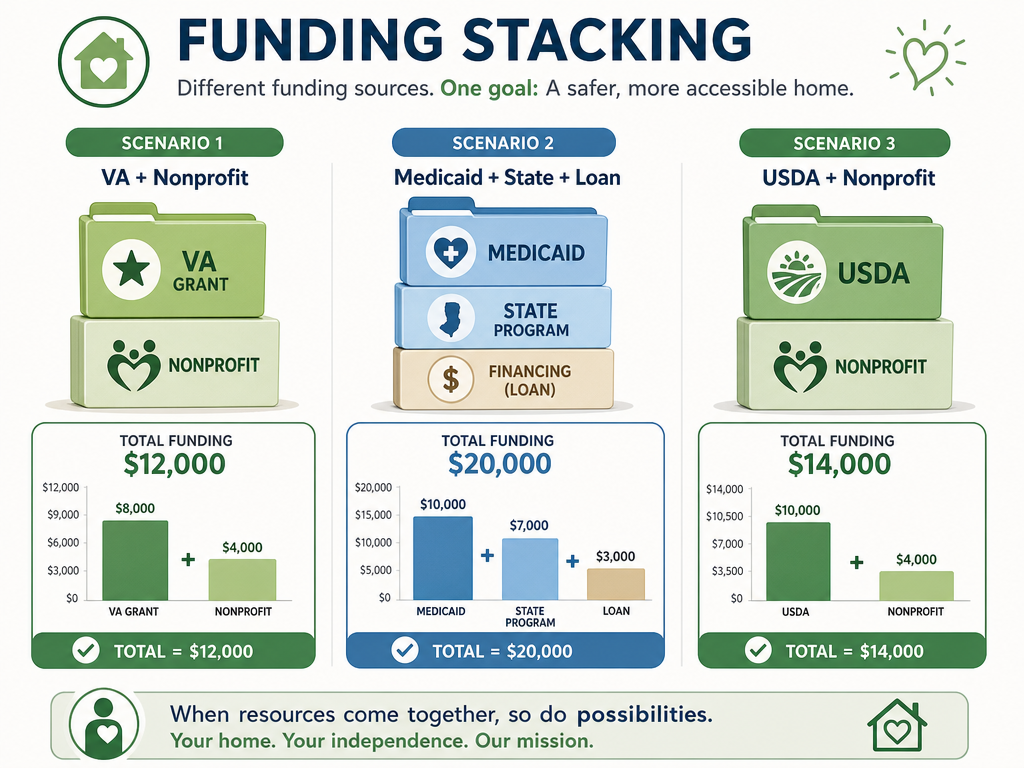
Scenario 1: Veteran + Nonprofit
A veteran with a service-connected disability qualifies for a VA HISA grant of $6,800 to install a roll-in shower and bathroom grab bars. The total project cost is $9,500. The family contacts their local Rebuilding Together affiliate, which agrees to provide volunteer labor for the grab bar installation and contributes $1,500 in donated materials. The remaining $1,200 is covered by the family through a low-interest state assistive technology loan.
Scenario 2: Medicaid + State Program + Loan
A Medicaid-eligible senior in Virginia qualifies for the CCC Plus waiver, which provides up to $5,000 per year for home modifications. The senior needs a stair lift ($4,500) and widened doorways ($3,000) — a total of $7,500. The CCC Plus waiver covers the stair lift. The senior then applies for the Virginia Livable Home Tax Credit, which provides a $5,000 tax credit for the doorway widening. The remaining $500 is covered by the family.
Scenario 3: USDA + Nonprofit
A very-low-income rural homeowner age 68 qualifies for a USDA Section 504 grant of $10,000 to install a wheelchair ramp and modify the bathroom for accessibility. The total project cost is $14,000. The family applies to their local Habitat for Humanity Aging in Place program, which provides volunteer labor and donated materials worth $4,000. The USDA grant covers the remaining $10,000 in materials and contractor costs.
If you are weighing different mobility solutions — such as a stair lift versus a home elevator — our Stair Lift vs. Home Elevator vs. Moving guide can help you compare costs and make an informed decision before you approach funding programs.
Documentation Checklist: What You Need for Every Application
One of the most effective ways to speed up the application process is to have all your documentation ready before you start. Most funding programs require a similar set of documents. Preparing these in advance means you can apply to multiple programs without scrambling for paperwork each time.
- Proof of veteran status: DD-214 (Certificate of Release or Discharge from Active Duty) or VA benefits letter.
- Income documentation: Most recent tax return, pay stubs (last 2–3 months), Social Security award letter, pension statements, or bank statements showing all income sources.
- Proof of homeownership: Deed, property tax statement, mortgage statement, or homeowner's insurance policy.
- Medical documentation: Physician's prescription or letter of medical necessity for the modification, or an Occupational Therapist evaluation with specific recommendations.
- Contractor estimates: Itemized written estimates from 2–3 licensed contractors (many programs require competitive bidding).
- Photographs: Clear, well-lit photos of the area to be modified, showing the current condition and the need for modification.
- Proof of age: Driver's license, birth certificate, or passport (especially for programs with age requirements like USDA Section 504 grants for age 62+).
- Proof of residency: Utility bill, lease agreement, or voter registration card showing current address.
Once you have funding approved, you will need to choose a contractor. Our CAPS Contractor vs. General Contractor guide explains the difference between a Certified Aging-in-Place Specialist (CAPS) and a general contractor, and helps you decide which type of professional is right for your project.
Your First Phone Call: A Script for Contacting Funding Programs
Making the first phone call to a funding program can be intimidating, especially when you are not sure what to ask. Use this script as a starting point. Adapt it based on the specific program you are calling (VA, Medicaid, USDA, state program, or nonprofit).
"Hello, my name is [your name]. I am calling because I am helping my [mother/father/spouse] [name], who is [age] years old, with home modifications to make our home safer and more accessible. We are interested in learning about [program name] and whether we might qualify."
- "What are the basic eligibility requirements for this program?"
- "What types of home modifications does this program cover?"
- "What is the maximum amount of funding available? Is it a one-time grant or can we reapply?"
- "What is the application process? How long does it typically take from application to approval to receiving funds?"
- "Are there any waiting lists? If so, how long is the current wait?"
- "Can this funding be combined with other programs or grants?"
- "What documents do I need to provide with the application?"
- "Do you have any preferred or approved contractors, or can we choose our own?"
- "Is there a deadline for applications, or can we apply at any time?"
Write down the answers and the name of the person you spoke with. Ask if they can send you a follow-up email with the application link and any relevant forms. If the first person you speak with cannot answer all your questions, ask to be transferred to the person who handles home modification funding specifically.
If you encounter resistance from the person you are caring for — especially around stair safety or accepting help — our guide on overcoming resistance to stair safety changes offers practical conversation strategies that can help you navigate these difficult discussions while you work through the funding process.
The home modification funding landscape is complex, but it is navigable. Start with the decision tree to identify your most promising path, gather your documentation, make your first phone call, and be prepared to combine sources. Most families who persist through the process find that more funding is available than they initially expected.
Related reading
Need a professional assessment?
Find a CAPS-credentialed professional or local aging services through our outbound resource list — we never name or rank individual contractors.
Find Local HelpNoticed something outdated or inaccurate on this page? Flag a correction. We review every report against CDC, NIA, and AARP HomeFit guidance before updating a page.