
How to Use the Air Quality Index for Senior Fall Prevention
New research links air pollution to increased fall risk in older adults. This guide explains how caregivers can use the daily Air Quality Index to protect their parent from an overlooked fall hazard.
Yes: the daily Air Quality Index belongs in a fall-prevention plan for an older parent who still walks outside. It should not replace the basics — medication review, vision checks, footwear, strength and balance work, grab bars, lighting, and the usual home scan — but it gives caregivers one more practical checkpoint before a walk that may be riskier than it looks.
The reason is not vague “bad air is bad” advice. A 2025 longitudinal study in Maturitas followed 9,869 community-dwelling adults aged 45 and older in the China Health and Retirement Longitudinal Study from 2011 to 2020. The researchers found that moderate-to-high PM2.5 exposure was associated with a 16% to 29% higher fall risk after adjustment, with stronger signals among adults over 60, women, and people with cognitive impairment.[1]
That finding is useful, but it should be used carefully. The cohort was Chinese, not U.S.-based. The study shows an association, not proof that air pollution directly caused the falls. And the pattern was not a neat straight line: moderate and high exposure levels were associated with elevated risk, while the effect diminished at the highest PM2.5 levels.[1] That nuance matters. It argues for adding AQI checks to a caregiver routine, not for treating the AQI number as a fall prediction tool.

The AQI Number That Should Change the Day
For caregiving purposes, the key threshold is not when the air looks terrible. It is when the AQI reaches Code Orange.
AirNow classifies adults 65 and older as a sensitive group, and says health effects can begin for sensitive groups when the AQI reaches 101, the start of Code Orange.[2] That is the point where an older adult’s usual outdoor walk deserves a second look, especially if they already have balance problems, shortness of breath, cognitive impairment, frailty, or a recent fall.
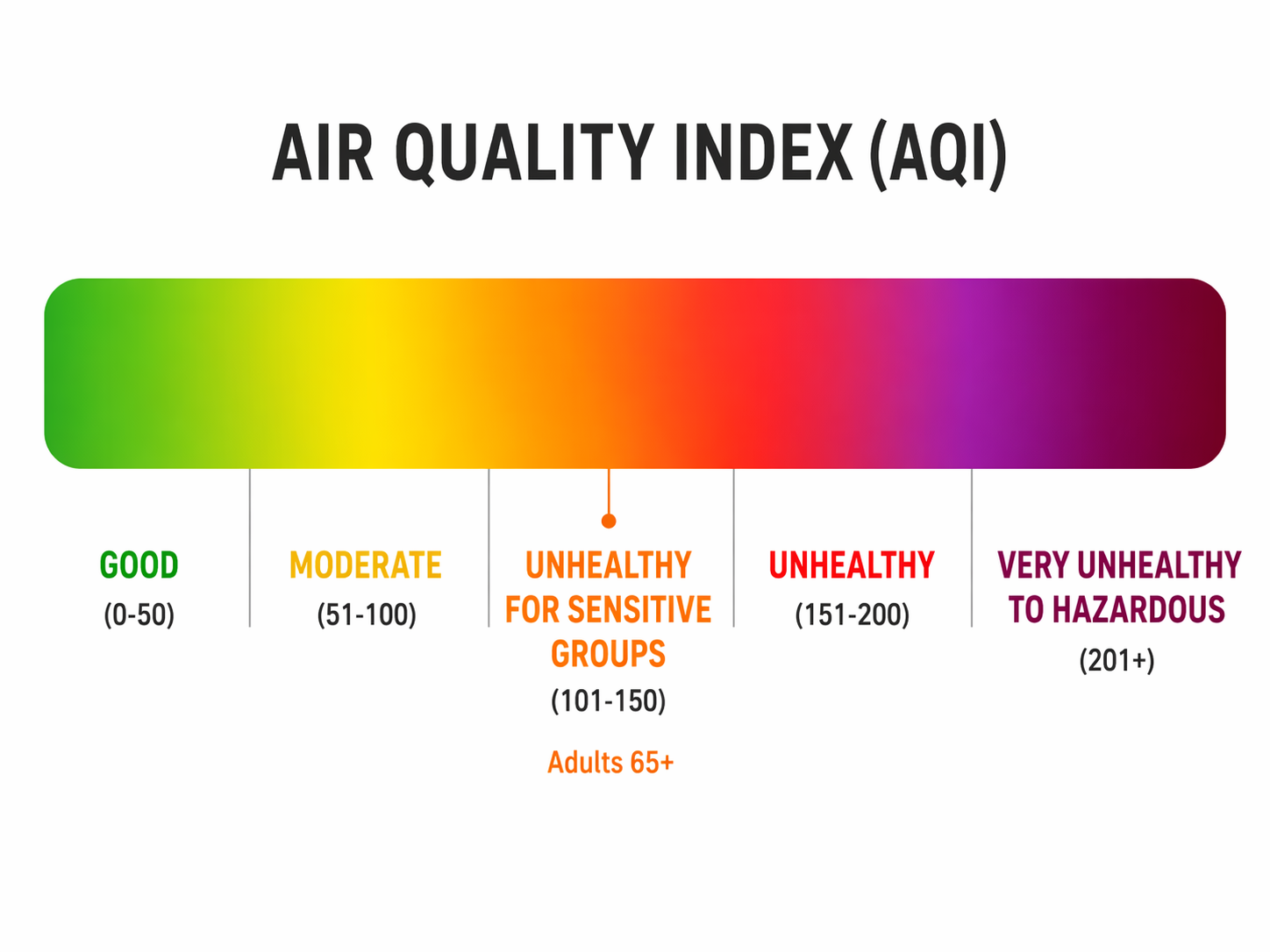
| AQI color | AQI value | Caregiver decision for an older adult |
|---|---|---|
| Green | 0–50 | Treat outdoor activity as normal, assuming the usual fall-prevention checks are also in place. |
| Yellow | 51–100 | Usually acceptable, but watch symptoms and use more caution for a parent with multiple health vulnerabilities. |
| Orange | 101–150 | Reduce prolonged outdoor exertion for older adults; consider shortening, rescheduling, or moving the walk indoors. |
| Red | 151–200 | Avoid making a vulnerable parent’s outdoor walk the default plan; choose a cleaner-air indoor option when possible. |
| Purple | 201–300 | Keep outdoor exposure brief and necessary; use an indoor fallback. |
| Maroon | 301+ | Treat outdoor activity as unsafe for routine exercise; stay indoors in the cleanest available air. |
For a parent who is steady, healthy, and walking briefly, a Yellow day may not change much. For a parent who has fallen twice this year, gets confused in unfamiliar settings, or tires after a few blocks, Orange is enough to change the plan. That does not mean panic. It means the walk is no longer an automatic yes.
Why Air Pollution Belongs in a Fall Conversation
Falls are usually discussed as mechanical events: a foot catches, a shoe slips, a chair rolls, a hallway is too dark. That remains true. But the person doing the walking is not separate from the air they breathed before and during the walk.
PM2.5 is fine particulate matter small enough to enter the bloodstream. Johns Hopkins Medicine describes air pollution exposure as a pathway that can trigger systemic inflammation and has been linked to both cognitive and physical decline.[4] That does not prove a direct PM2.5-to-fall chain in one individual parent. It does make the 2025 fall-risk association biologically plausible rather than random.
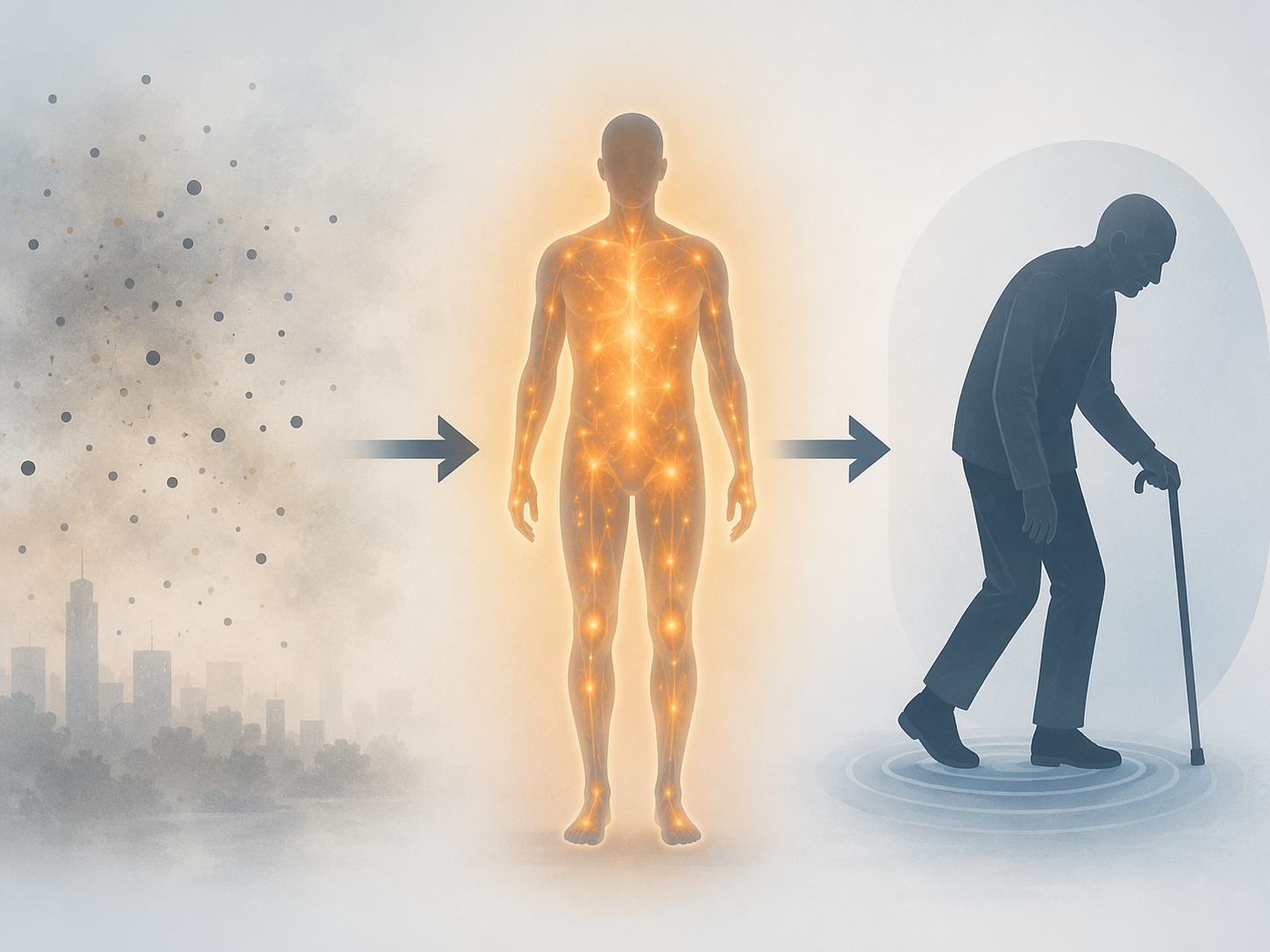
For caregivers, the practical point is simple: anything that can worsen fatigue, breathing comfort, attention, reaction time, or physical steadiness deserves a place in the pre-walk scan. Air quality is not as visible as a curled rug edge, but it can be checked faster than many things already on a fall-prevention list.
This is also not a fringe exposure. The American Lung Association’s 2025 “State of the Air” release reported that nearly half of people in the U.S. are exposed to dangerous levels of air pollution.[5] That broad backdrop does not tell you whether your parent will fall tomorrow. It does explain why an AQI habit is worth building before the next smoke event, ozone alert, or stagnant summer day.
Who Needs the Most Caution
The 2025 study’s subgroup findings are where many caregivers will recognize their own situation. The elevated fall-risk association was more evident among adults over 60, females, and people with cognitive impairment.[1]
That does not mean every woman over 60 should stay inside whenever the AQI changes color. It means the margin for “she’ll be fine” gets smaller when several risks stack together. A widowed mother with mild cognitive impairment who insists on a late-afternoon walk during Code Orange conditions is not facing the same risk picture as a healthy 66-year-old walking ten minutes on a Green morning.
Cognitive impairment deserves special attention because the fall-prevention problem is not only physical strength. It is also judgment, pacing, route choice, and whether a parent notices that they are more tired than usual. On a poor-air day, the safer choice may need to be made before they step outside.
Add AQI to the Routine You Already Use
The cleanest way to use this evidence is to attach AQI to the fall-prevention routine you already trust. Keep the established STEADI-style work as the base: review medications, remove trip hazards, improve lighting, address vision and footwear, and make the bathroom, stairs, bedroom, and entryway safer. If you need the room-by-room structure, use the CDC STEADI home fall prevention checklist as the foundation.
Then add one daily question before outdoor activity: “What is the AQI where my parent will actually walk?” Not across the state. Not where you live if your parent lives 40 minutes away. The relevant number is the local AQI for the place and time of the walk.
- Check the local AQI in the morning if your parent walks early, and again later if the walk often happens in the afternoon or evening.
- Treat Code Orange as the first serious decision point for adults 65 and older, especially if your parent has already fallen or has cognitive impairment.
- On Orange days, shorten the walk, choose a flatter and closer route, slow the pace, or move the walk to a cleaner-air time of day.
- On Red, Purple, or Maroon days, make indoor movement the default unless there is a specific reason outdoor exposure is necessary.
- After any poor-air walking day, pay attention to unusual fatigue, confusion, dizziness, breathlessness, or near-falls, and share concerning changes with the clinician.
The goal is not to take away walking. Walking is often part of maintaining strength, balance, mood, and independence. The goal is to stop treating all walking days as equal. A short indoor hallway routine, a senior-center indoor track, a supervised grocery-store loop during quiet hours, or simple seated and standing exercises may be a better fall-prevention choice on a high-pollution day than pushing through the usual route.
Use an Indoor Fallback Without Turning It Into a Shopping Project
High outdoor AQI days raise an indoor question, too: where will your parent spend the time they are not spending outside? Indoor air advice can quickly become a product pitch, so separate the basic caregiving move from the equipment discussion. First, identify the room where your parent can sit, move safely, breathe easier, and avoid unnecessary exposure from open windows or obvious indoor pollutant sources.
RenewAire, a commercial energy-recovery ventilation manufacturer, notes that seniors may spend up to 95% of their time indoors and that indoor pollutant levels can be 2 to 5 times higher than outdoors.[6] Because that source is commercial, it should not be treated as independent proof that a specific device is needed. It does, however, support a practical reminder: staying inside is not automatically the same as being in clean air.
If you decide to create a cleaner-air room, keep the fall-prevention lens on. The room should have clear walking paths, stable seating, good lighting, reachable water, a charged phone, and no cords stretched across the floor. If an air purifier or filtration product is part of the plan, evaluate it like any other safety-related purchase: fit, maintenance burden, noise, placement, and whether it creates a new trip hazard. A broader framework for comparing products is available in this guide to home safety products for seniors.
A Simple Pre-Walk AQI Habit
For most caregivers, the habit can stay small enough to survive a busy week.
- Check the local AQI before your parent’s usual outdoor walk.
- If it is Green or Yellow, proceed with the normal fall-prevention precautions.
- If it is Orange, adjust the walk for an older adult: shorter, easier, earlier or later, or indoors.
- If it is Red or worse, use the indoor fallback unless outdoor activity is necessary.
- Keep the home checklist, medication review, vision care, footwear, and strength work in place; AQI monitoring is an added checkpoint, not a substitute.
That is the useful place for the new research to land: beside the door, before the walk, alongside the same practical fall-prevention work caregivers were already doing.
References
- Exposure to ambient air pollution and falls risk in a community-dwelling adult population — Maturitas, 2025
- Older Adults and Air Quality — AirNow.gov
- AQI Basics — AirNow.gov
- Air Quality and Health — Johns Hopkins Medicine
- State of the Air 2025 — American Lung Association
- Why Indoor Air Quality Is Critical for Senior Health — RenewAire
Related reading
Noticed something outdated or inaccurate on this page? Flag a correction. We review every report against CDC, NIA, and AARP HomeFit guidance before updating a page.
Part of the Fall Prevention section.