
STEADI: intervene
Stay or Go? A Hurricane Decision Guide for Seniors in Texas
Deciding whether to evacuate or shelter in place during a hurricane is especially risky for older adults with limited mobility or medical needs. This guide provides a five-factor framework to help Texas families weigh fall risks and make a defensible choice.
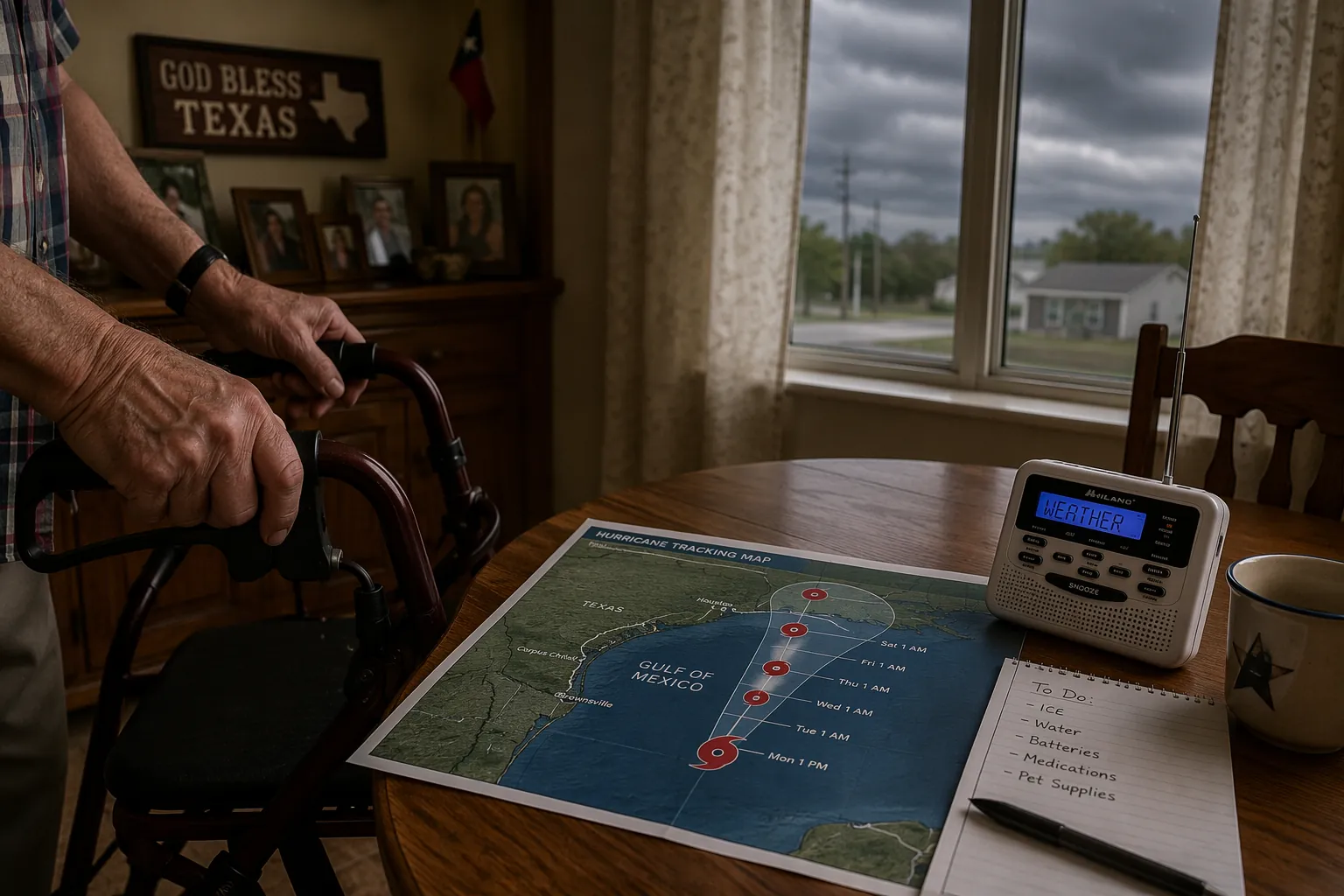
When a named storm starts moving toward the Gulf, hurricane preparedness for seniors in Texas has to get practical fast. The first question is not whether your parent is brave, stubborn, independent, or “used to storms.” The question is whether staying or leaving creates the smaller fall and medical risk for this particular older adult, in this particular evacuation zone, with this particular body.
Official evacuation orders come first. If local emergency management orders your parent’s zone to evacuate, do not use a family checklist to overrule that order. What a checklist can do is help you prepare before the order comes, so you are not trying to decide in a driveway with rain bands already coming through.
The hard part is that “go” is not automatically safe for a frail parent. Evacuation can mean a long wait in traffic, a shelter bathroom with grab bars in the wrong place, a cot too low to stand from, a dark motel room, a missed oxygen backup, or a rollator stuck in a crowded hallway. Staying can mean heat, darkness, wet floors, debris outside the door, and no one close enough to notice trouble.
That is why this guide uses five factors: evacuation zone, mobility level, powered medical equipment, support network, and fall hazards on both paths.
Why This Decision Is Different for Older Texans
Hurricane Beryl made the risk plain in the Houston area. At least 38 people died, and about three in four were seniors; about half of the deaths were attributed to hyperthermia after power loss, based on medical examiner information from five counties reported by Texas Standard.[1] That does not make every older adult unsafe at home. It does mean a “stay” plan is partly a heat and electricity plan, not just a food-and-flashlight plan.
Texas coastal evacuation maps also matter. The Houston-Galveston Area Council publishes evacuation ZIP zones labeled Coastal, A, B, and C, and TxDOT directs residents to hurricane evacuation and route information before storms threaten the coast.[2][3] A parent in a lower-lying coastal surge zone is not facing the same problem as a parent farther inland in a stronger home. The zone does not answer every question, but it sets the floor for the decision.
The family also has to count the things that do not show up on a storm map: whether Mom can rise from a low toilet without pulling on a towel bar, whether Dad can carry water across the kitchen without losing balance, whether a walker fits through the shelter aisle, whether someone can reset the CPAP battery at 2 a.m., and whether the person who says “I’ll be fine” can still make safe decisions when the lights go out.
The Five Factors to Check Before the Forecast Becomes a Scramble
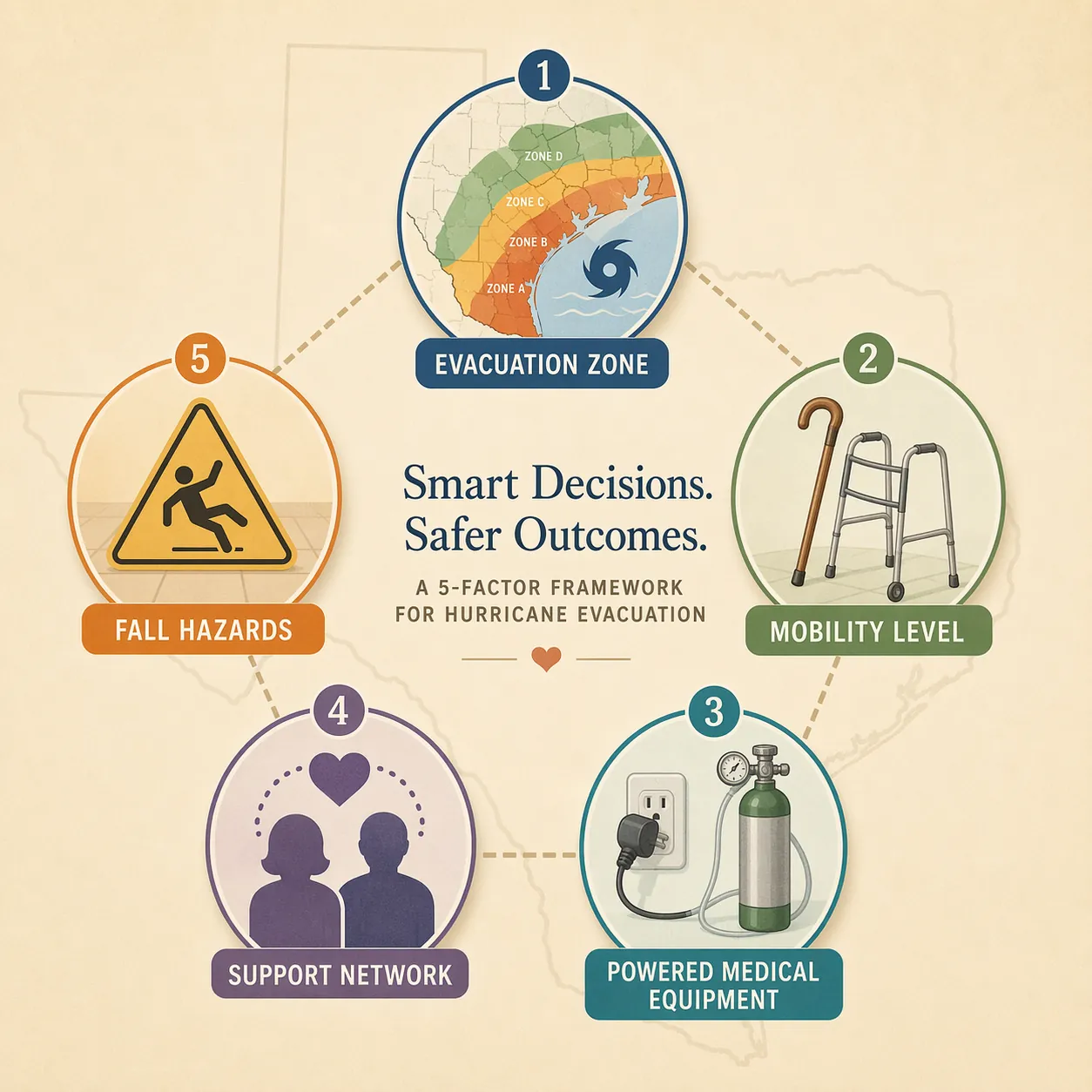
| Factor | What to Ask | Why It Changes the Stay-or-Go Judgment |
|---|---|---|
| Evacuation zone | Is the home in Coastal, A, B, or C, and has the county issued an order? | Storm surge and official orders can make staying indefensible, even if the home feels familiar. |
| Mobility level | Can the parent walk, transfer, toilet, bathe, and climb steps safely without power? | The safer location is not always the familiar one; it is the one where the parent can move without falling. |
| Powered medical equipment | Does the parent use oxygen, CPAP, dialysis-related equipment, refrigeration for medication, or powered mobility devices? | A power outage can turn a manageable condition into an urgent problem. |
| Support network | Who can physically get there before, during, and after the storm? | A plan that depends on help from someone two counties away is not the same as a plan with a neighbor next door. |
| Fall hazards on both paths | What hazards appear if the parent evacuates, and what hazards appear if the parent stays? | The right comparison is not home versus an ideal shelter; it is home during an outage versus the real evacuation destination. |
1. Start With the Evacuation Zone, Not Family Opinion
Before anyone argues, look up the address. Texas coastal areas use evacuation zones to help residents understand storm-surge risk and phased evacuation planning. In the Houston-Galveston region, the published zones are Coastal, A, B, and C.[2] TxDOT also points residents to hurricane evacuation information and route planning.[3]
If an official order applies, the family’s job changes from deciding whether to leave to deciding how to leave with the least fall and medical risk. That may mean leaving earlier than younger relatives would, because older adults often need more time for medication sorting, equipment charging, toileting before departure, and safe transfers in and out of the vehicle.
If there is no order yet, the zone still tells you how much margin you have. A parent in Coastal or A with limited mobility and oxygen dependence needs a more aggressive plan than a parent outside the highest-risk zones who has backup power, a nearby helper, and a home already arranged for safe movement.
2. Judge Mobility by Transfers, Not by Pride
“She gets around fine” is too vague for a hurricane decision. Break mobility into the tasks the storm will stress:
- Can the parent stand from a bed, recliner, toilet, and car seat without another person lifting?
- Can they walk with a cane, walker, or rollator across wet or uneven surfaces?
- Can they manage one or two steps if the usual entrance is blocked?
- Can they carry water, medications, a phone, or a flashlight while using their mobility aid?
- Can they toilet safely in an unfamiliar bathroom or in darkness?
A walker user may be safer leaving early with one strong helper and a known destination than staying alone in a dark house after power fails. A wheelchair user may be safer staying only if the home is outside the ordered evacuation area, the chair can be charged, the floor path is clear, the bathroom setup is stable, and help is close enough to arrive after the storm.
The dangerous middle is the parent who can manage a normal day but not a disrupted one. They can walk to the kitchen with lights on, but not through a hallway with extension cords and towels on the floor. They can get into a sedan once, but not repeatedly after sitting in traffic for hours. They can step over a threshold, but not while carrying a pet carrier or oxygen tubing.
For mobility, the stay-or-go question becomes: which location allows the parent to transfer, toilet, sleep, and walk with the fewest unassisted hazards?
3. Treat Powered Medical Equipment as a Deciding Factor
Powered equipment changes the whole calculation. In a 2020 University of Michigan survey reported by PBS NewsHour, only 25% of older adults who used essential medical equipment said they had an alternative power source. The same survey found that 24% of older adults said they could not afford to stay somewhere else for a week.[4]
Those numbers matter because they describe a real bind, not a lack of common sense. A parent may know they should leave but have no money for a week of motel rooms. Another may own an oxygen concentrator but not enough battery capacity to sleep safely through a long outage. Another may have a generator but no safe way to fuel, move, or operate it.
Make a written equipment list before the storm track tightens:
- Oxygen concentrator, portable oxygen, CPAP, BiPAP, nebulizer, suction device, hospital bed, lift chair, powered wheelchair, medication refrigerator, dialysis-related supplies, and hearing-aid chargers.
- Battery runtime for each device, not just whether a battery exists.
- Who can recharge, replace, lift, or troubleshoot the equipment.
- Whether the evacuation destination can support the equipment safely.
If the parent depends on powered medical equipment and has no reliable backup, leaving earlier usually becomes more defensible, especially in a high-risk zone. If staying is still being considered, build the plan around power first. The 72-hour power outage plan for medically dependent seniors is the more useful next document than a general hurricane supply list.
Call the clinician, home health agency, oxygen supplier, dialysis center, or durable medical equipment company before the storm is close. Ask what outage duration is medically acceptable, what battery setup is realistic, and whether evacuation to a medical shelter or other supported location should be considered. A family decision tool should not replace medical guidance for oxygen, dialysis, cardiac devices, or medication refrigeration.
4. Count the Support Network by Distance and Physical Ability
A support network is not a list of people who care. It is a list of people who can do specific tasks at specific times.
| Support Question | Stronger Stay Case | Stronger Evacuate Case |
|---|---|---|
| Who is within quick driving distance before landfall? | A nearby adult can move supplies, check rooms, and stay or return promptly. | The closest helper is far away or likely to be blocked by traffic or flooding. |
| Who can lift, steady, or transfer the parent? | A helper can safely assist without injuring the parent or themselves. | No one available can manage transfers, wheelchair loading, or oxygen transport. |
| Who can check after power fails? | A neighbor or family member has a key and a clear check-in schedule. | The parent lives alone and may not be reachable after outages. |
| Who understands medications and equipment? | Someone knows the equipment, dosing schedule, and backup plan. | Only the parent knows the routine, and memory, hearing, or stress may interfere. |
Texas residents with disabilities, access needs, or transportation needs can register with the State of Texas Emergency Assistance Registry, often called STEAR, but registration does not guarantee evacuation assistance. Treat it as one layer, not the whole plan.
If judgment or memory is uncertain, do not build the plan around promises made on a calm afternoon. A parent with cognitive decline may agree to use a flashlight, avoid the porch, keep the phone charged, and not walk outside, then forget each item under stress. For that situation, review a room-by-room approach for Alzheimer’s caregivers or the signs that it may be time to step in before leaving someone alone during a storm.
If cognitive decline is part of the decision, use A Room-by-Room Safety Checklist for Alzheimer’s Caregivers and Is It Time to Step In? 5 Signals of Declining Capacity.
5. Compare the Fall Hazards of Leaving Against the Fall Hazards of Staying
This is where many hurricane articles get too tidy. They describe evacuation as safety and staying as risk. For older adults with mobility limits, both paths can contain fall hazards. A FAMU-FSU engineering discussion of elderly hurricane sheltering noted that seniors with mobility limitations face heightened fall risk in crowded shelter environments, and that reluctance to evacuate during Hurricane Irma was linked to concerns such as dangerous environments, property loss, language and cultural barriers, and pets.[5]
Those concerns are not excuses. A pet can be the reason an older adult refuses a shelter. Property loss can feel like losing the only stable thing left. Money can decide whether a family has a ground-floor motel room or a shelter cot. Pride can keep a parent from admitting they cannot get up from a low toilet anymore. The plan has to work around those barriers, not lecture them away.
| If Evacuating | Fall or Medical Hazard to Check | Practical Fix Before You Leave |
|---|---|---|
| Vehicle loading | High step into truck or SUV; rushed transfers; wet driveway | Use the easiest vehicle, load early, keep walker last-in and first-out. |
| Traffic and delays | Urgent toileting, missed medication, stiffness after long sitting | Plan bathroom stops, medication timing, snacks, water, and absorbent supplies if needed. |
| Shelter or motel | Low bed, low toilet, poor lighting, crowded walkways | Call ahead if possible; request accessible room; bring night lights, raised toilet aid if portable, and mobility device. |
| Equipment | Oxygen, CPAP, chargers, extension cords creating trip hazards | Pack equipment with batteries and cord management; keep the medical list visible. |
| Pets | Leash pulling, carrier weight, refusal to leave without animal | Confirm pet-friendly destination before departure and assign one person to the pet. |
| If Sheltering in Place | Fall or Medical Hazard to Check | Practical Fix Before the Storm |
|---|---|---|
| Power outage | Dark halls, bathroom trips, dead lift chair, no cooling | Place lights at bed, bathroom, kitchen, and equipment paths; confirm backup power. |
| Heat | Hyperthermia risk when cooling fails | Identify a cooling destination and transport trigger before the house becomes dangerous. |
| Water and supplies | Carrying heavy jugs, bending to low shelves, cluttered floors | Set supplies at waist height in small containers the parent can lift. |
| Exterior hazards | Wet steps, debris, unstable porch, floodwater | Make a no-outside rule during and after the storm until a helper checks the path. |
| Communication | Dead phone, missed check-ins, hearing limitations | Use scheduled calls, backup charger, neighbor key access, and written instructions. |
If the family is leaning toward staying, move from general storm prep to room-level outage planning. The Power Outage Safety Checklist for Seniors Aging in Place and Room-by-Room Power Outage Safety for Seniors are better matched to the hazards that actually cause falls inside a dark home.
A Simple Scoring Framework for the Stay-or-Go Decision
Use this before panic sets in. It is not a medical directive, and it does not override evacuation orders. It gives the family a defensible way to compare bad options.
| Factor | 0 Points | 1 Point | 2 Points |
|---|---|---|---|
| Evacuation zone and order status | No order; outside highest-risk coastal or surge area | In a mapped zone but no order yet | Official order issued, or in a high-risk coastal/surge zone with worsening forecast |
| Mobility | Walks and transfers safely without help | Uses cane, walker, rollator, or needs help with some transfers | Wheelchair user, frequent falls, unsafe transfers, or cannot toilet safely alone |
| Powered medical equipment | No essential powered equipment | Uses powered equipment but has tested backup and help | Uses essential powered equipment with no reliable backup or uncertain runtime |
| Support network | Reliable helper nearby before and after storm | Some help available but timing uncertain | Lives alone with no nearby helper who can physically assist |
| Fall hazards if staying | Home is clear, one-level or accessible, stocked, and outage-ready | Some hazards can be fixed before landfall | Dark bathrooms, clutter, stairs, heat risk, debris, or supply-carrying hazards likely |
| Fall hazards if evacuating | Known accessible destination and transportation | Destination available but accessibility uncertain | No accessible destination, unsafe vehicle transfer, or shelter/motel hazards likely |
Add the first five categories to judge the pressure to leave. Then look separately at the evacuation-hazard score. A high pressure-to-leave score with a high evacuation-hazard score does not mean “stay.” It means the family needs a better evacuation method: earlier departure, accessible transportation, a medical shelter inquiry, a relative’s home, a first-floor motel room, or help from local emergency management.
- 0-3 points: Staying may be reasonable if there is no official order, the home is outside the highest-risk zone, and backup supplies are real.
- 4-6 points: Decide early. Fix the weak points immediately or arrange evacuation before routes and rooms tighten.
- 7-10 points: Evacuation planning deserves priority unless officials advise otherwise or medical guidance points to a supported stay location.
- Any official evacuation order: follow the order and focus on safe transport, equipment, medications, and fall prevention during the move.
The score should be written down with the reasons. A defensible decision sounds specific: “She is in Zone A, uses oxygen, has no tested backup power, lives alone, and cannot safely move through the house in a long outage.” Or: “He is outside the ordered area, has tested backup power, a one-level clear home, seven-day water access, and a neighbor with a key who can check him after the storm.”
Supplies Only Matter if the Parent Can Use Them Safely
The American Red Cross recommends that older adults prepare a 30-day supply of medication and seven days of water, which is more than the general three-day minimum many families keep in mind.[6] For a senior living alone, the question is not only whether the supplies are in the house. It is whether the parent can reach, lift, open, pour, and take them correctly during a power outage.
Put water in smaller containers if large jugs throw off balance. Store medication lists in the go-bag, on the refrigerator, and with the adult child who may have to speak for the parent. Keep a flashlight or lantern at the bed and bathroom, not in a garage cabinet. Charge hearing aids, phones, medical devices, and backup batteries before the storm becomes local news all day.
Once the stay-or-go direction is clear, use a path-specific checklist instead of trying to remember everything. For a full home-prep list, use the Hurricane Preparedness Checklist for Seniors Living Alone. For evacuation packing, use the Hurricane Go-Bag Checklist for an Elderly Parent Living Alone. For either path, a 72-hour senior power outage safety kit helps turn supplies into something the parent can actually use.
Do Not Use Old Storms as Simple Scare Stories
Past storms should sharpen planning, not flatten judgment. After Hurricane Harvey, a University of Michigan study released in January 2026 estimated 3,738 unadjusted excess deaths among older adults in the following year.[7] The word “unadjusted” matters. It should not be treated as a precise count of deaths caused directly by Harvey. It does support the narrower and more useful point: severe weather can affect vulnerable older adults well after the water drops and the headlines move on.
The same restraint applies during the 2026 season. A forecast can tell families to pay attention; it cannot tell one daughter in Galveston County whether her father can safely get from bed to bathroom without power. That decision still comes back to zone, mobility, equipment, support, and the real hazards of the place he will sleep.
The Defensible Next Action
If your parent is in a Texas evacuation zone, do these before the next advisory turns into a family argument: check the official zone and orders, score the five factors, call the clinician or equipment supplier for powered medical needs, confirm transportation and an accessible destination, and decide which checklist fits the chosen path.
If the choice is evacuation, make the trip safer before the storm makes it urgent. If the choice is sheltering in place and no official order says otherwise, make the house safer for darkness, heat, toileting, equipment, and post-storm debris. Either way, write down who is responsible for the next call, the next ride, the next battery check, and the next door knock.
References
- Hurricane Beryl’s elderly death toll shows need for more emergency preparedness, Texas Standard, link
- Hurricane Evacuation Planning, Houston-Galveston Area Council, link
- Hurricane Preparation, Texas Department of Transportation, link
- Why it can be more difficult to evacuate older adults in a disaster, PBS NewsHour, link
- Effective Sheltering: Saving Lives: How to Evacuate Elderly During Hurricanes, FAMU-FSU College of Engineering, link
- Older Adults, American Red Cross, link
- Severe weather is deadly for vulnerable older adults long after the storm ends, study finds, University of Michigan, January 2026, link
Related reading
Noticed something outdated or inaccurate on this page? Flag a correction. We review every report against CDC, NIA, and AARP HomeFit guidance before updating a page.
Part of the Fall Prevention section.