
STEADI: Intervene
How to Prevent Falls During Hurricane Surf Warnings
A targeted checklist for caregivers to prevent falls when hurricane surf warnings threaten, covering wet surfaces, power loss, debris, and evacuation risks specific to older adults.
When people search for how to keep elderly safe during hurricane surf warnings, they are usually not asking for beach footage. They are asking what to do before an older adult steps onto a wet porch, crosses a dark hallway, reaches for a walker parked on the wrong side of the door, or hurries toward a car because the evacuation decision came late.
One clarification matters first: “hurricane surf warning” is not usually one single National Weather Service product. In practice, families may be responding to High Surf Advisories, High Surf Warnings, rip current statements, coastal flood alerts, or storm surge watches and warnings. The names differ, but the fall hazards for an older adult often look similar: wave overwash, moving water, wet thresholds, debris, low light, power loss, and rushed movement.
The National Weather Service’s surf-zone guidance says to pay especially close attention to children and elderly people at the beach because “Even in shallow water, wave action can cause loss of footing.”[1] That warning belongs at the front door, too. Shallow water on a walkway, garage slab, ramp, or entry mat is not harmless when balance, vision, strength, medication side effects, or a mobility aid are already part of the day.
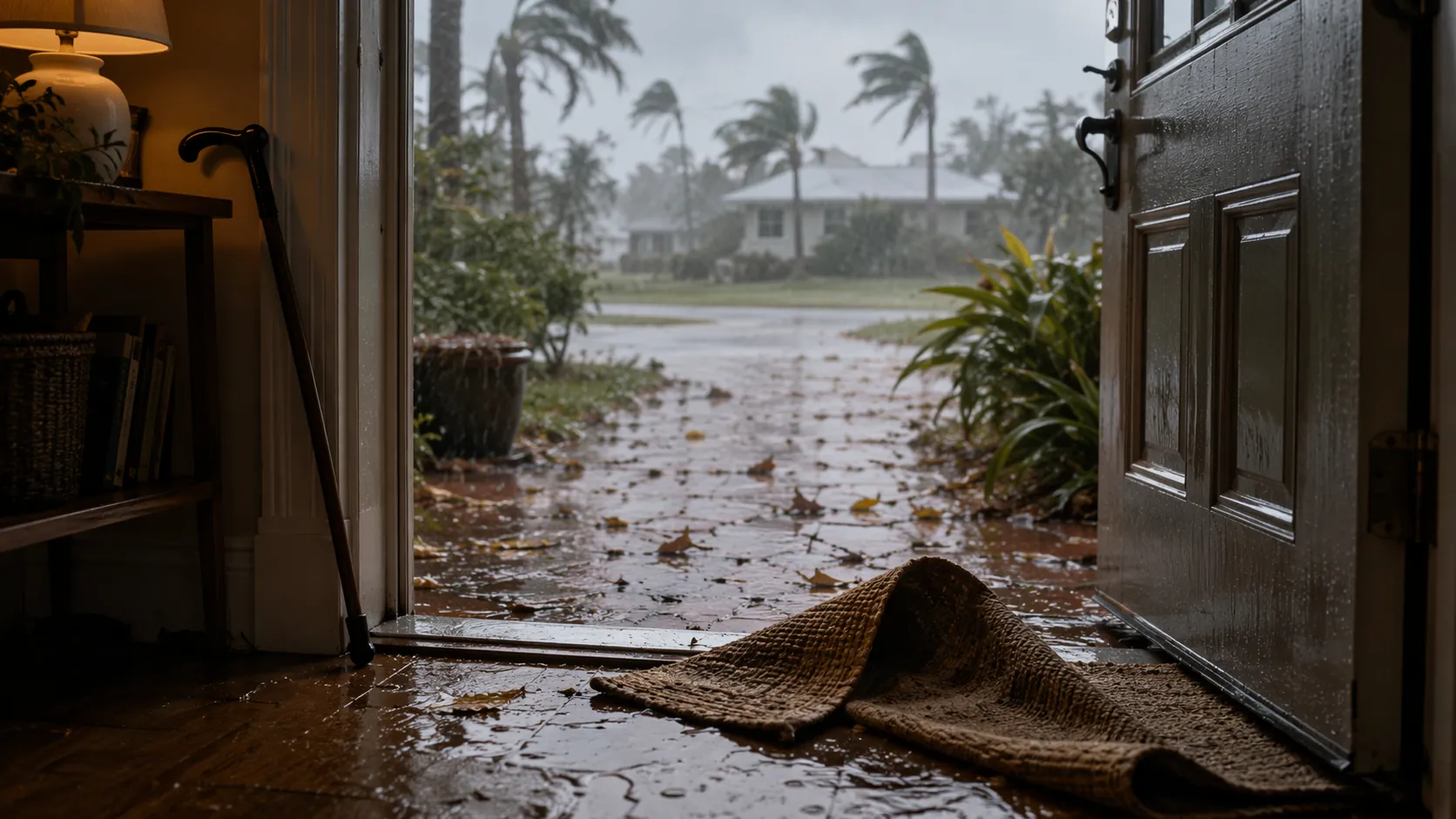
The Storm-Specific Fall Risks to Fix First
A general hurricane list may tell you to gather supplies and secure the home. That is necessary, but it does not say enough about the older adult’s actual path of movement. During surf-zone and storm-surge conditions, the dangerous route may be only ten feet long: bed to bathroom, recliner to kitchen, back door to trash bin, hallway to garage, porch to vehicle.
The California Department of Aging’s disaster-preparedness tip sheets give one plain rule worth treating seriously: “Do not walk through moving water. Six inches of moving water can make you fall.”[2] That is disaster guidance, not a clinical fall-risk measurement, but it is exactly the kind of threshold a family can remember when wind and water make a bad decision feel urgent.
Falls are not a side issue for older adults. The CDC reports that falls cause more than 38,000 deaths each year among adults age 65 and older.[3] A hurricane surf warning adds temporary hazards to people who may already be managing slower gait, weaker grip, poor night vision, joint pain, dizziness, or a walker that needs dry, level ground to work as intended.
| Storm condition | Fall hazard for an older adult | Immediate caregiver move |
|---|---|---|
| Wave overwash or shallow moving water | Loss of footing on steps, ramps, sidewalks, driveways, or beach access routes | Keep the person out of moving water; reroute or wait for official help |
| Rain pushed under doors | Wet thresholds, slick tile, soaked mats, hidden puddles | Dry and mark the crossing; remove loose mats |
| Wind-blown leaves, branches, trash bins, or outdoor furniture | Tripping obstacles in the route to a car, mailbox, generator, or neighbor | Clear the route before conditions worsen |
| Power loss | Low visibility, missed steps, misplaced walker or cane, bathroom trips in darkness | Stage flashlights, night lights, batteries, and mobility aids within reach |
| Evacuation under time pressure | Hurrying, carrying too much, stepping into puddles, unstable transfers into a vehicle | Move earlier when ordered; assign one person to the older adult’s footing and balance |
Before the Warning Worsens: Clear the Path the Person Actually Uses
Start with the path, not the pantry. Food, water, medications, and documents matter, but fall prevention begins with the places where feet, cane tips, walker wheels, and house shoes will meet wet surfaces. Walk the route slowly while there is still daylight: bed, bathroom, chair, kitchen, medication location, front door, back door, garage, vehicle, and any place the older adult insists on checking.
- Move trash bins, hoses, planters, loose chairs, doormats, and decorations away from doors, ramps, porch steps, and the route to the car.
- Remove or secure exterior mats before wind flips them or rain turns them into sliding surfaces.
- Sweep leaves, seed pods, sand, and small branches off steps and ramps while conditions are still safe.
- Check that handrails are reachable and not blocked by storm shutters, stacked supplies, or furniture moved indoors.
- Park the walker, cane, rollator, or wheelchair on the same side of the threshold as the older adult, not outside in rain or across a puddle.
Inside, remove the small obstacles that become serious in dim light. Tape down or remove area rugs. Pull electrical cords out of walking paths. Move shoe piles, pet bowls, laundry baskets, and storm supplies away from hallways and bathroom doors. If the older adult uses a walker, make sure the walking path is wide enough for the walker in its normal position, not angled sideways between boxes of bottled water.
Bathrooms deserve early attention because storm nights do not stop nighttime bathroom trips. Place a working flashlight within reach of the bed and another within reach of the toilet or bathroom entrance. If grab bars, a raised toilet seat, a shower chair, or non-slip mats are already part of the home setup, check that they are dry, stable, and not being used as storage hooks for towels, bags, or rain gear.
Stage Light Where a Hand Can Find It
A flashlight in a kitchen drawer is not useful if the power fails while someone is in bed. Put flashlights at the bed, main chair, bathroom, medication area, and exit route. Test them. Put extra batteries next to them, not in another room. Keystone Health’s fall-prevention storm tip is blunt and useful: keep flashlights easy to reach during power outages, and tape down or remove area rugs that could cause trips in low light.[4]
If the older adult resists “too much fuss,” keep the explanation practical: this is not about taking over the house. It is about making the next trip to the bathroom or doorway boring, visible, and dry.
Put Essentials Close Enough to Prevent Extra Trips
Many storm falls happen during unnecessary trips: one more look outside, one more search for the charger, one more walk to find the pills, one more shuffle to move something that should have been moved earlier. Put the essentials in the room where the older adult will spend most of the warning period.
- Daily medications, a written medication list, glasses, hearing aids, dentures, phone, charger, and backup battery
- Water, shelf-stable food, tissues, wipes, incontinence supplies, and a small trash bag
- Shoes with closed backs and non-slip soles, not loose slippers or wet sandals
- The mobility aid the person actually uses, positioned where they can reach it before standing
- A flashlight, batteries, and a whistle or phone for calling someone inside the home
NOAA explains that hurricane storm surge can bring waves that are larger and more powerful than normal, damage oceanfront structures, and push flooding inland.[5] For fall prevention, that means the home may change quickly. A dry entry at noon may be slick by late afternoon. A clear driveway may hold water, sand, branches, or broken pieces of outdoor furniture by evening.
Plan for Power Loss as a Mobility Problem
Power loss is not only a comfort problem. It changes balance, transfers, bathroom safety, medication timing, oxygen or equipment use, refrigeration, phone charging, and the ability to see water on the floor. The Red Cross advises older adults to plan for at least two weeks at home or evacuation and to plan for power loss.[6] That planning should include the practical details that keep someone from wandering through a dark house.
- Charge phones, backup batteries, hearing aids, medical devices, and mobility equipment batteries early.
- Place night lights or battery lights along the bed-to-bathroom route before the storm arrives.
- Keep a clear chair-to-bathroom route with no extension cords crossing it.
- Store medical equipment cords so they do not become trip lines during outages.
- If essential medical equipment needs electricity, confirm the backup plan before the warning becomes an emergency.
The Evacuate-or-Shelter Decision Is Also a Fall-Risk Decision
Leaving can reduce one danger and increase another. Staying can avoid a difficult transfer into a car, then become unsafe if flooding, power loss, medical equipment failure, or official evacuation orders change the situation. The right decision depends on official instructions, flood and surge risk, the older adult’s medical needs, available transportation, caregiver help, and, when possible, advice from the older adult’s doctor.
PBS News, reporting on University of Michigan disaster research by Sue Anne Bell, quoted Bell saying, “The risk of falling or injury while moving more than usual due to the storm preparations is a considerable challenge.” The same report said 24% of older adults would struggle to afford a week away from home, and only 25% of those with essential medical equipment had backup power.[7] Those numbers are a warning against easy advice. Evacuation is not just a map route; it is money, medication, equipment, transfers, bathrooms, fatigue, and unfamiliar floors.
If officials order evacuation, do not wait for the older adult to be tired, cold, anxious, or boxed in by water. Move while there is still light if possible. Assign one person to carry bags and another to stay with the older adult’s footing, walker, cane, oxygen tubing, or wheelchair. A person who is carrying a heavy bag is not fully available to prevent a fall.
| Decision point | Ask this before movement starts | Fall-prevention action |
|---|---|---|
| Official order | Are we under an evacuation order, shelter instruction, or local road closure? | Follow official instructions; do not improvise a route through water |
| Medical needs | Does the older adult need electricity, refrigerated medication, oxygen, dialysis access, or caregiver help? | Call the doctor, equipment provider, local emergency management, or care team early when possible |
| Timing | Can we move in daylight before wind, water, and fatigue worsen? | Leave earlier rather than rushing later |
| Route | Is the route to the vehicle dry, lit, and free of mats, hoses, leaves, and bins? | Clear it first; use another exit if the normal one is wet or blocked |
| Transfer | Who is helping with steps, walker placement, car entry, seat height, and bags? | Separate the helper role from the bag-carrying role |
During the Warning: Slow the Dangerous Moments Down
Once conditions are deteriorating, the best fall-prevention move is often to stop a trip before it starts. No trash bin, porch chair, plant, newspaper, or “quick look” outside is worth a wet step in gusting wind. The caregiver’s job is not to argue about the whole storm. It is to interrupt the next unsafe movement.
- Keep the older adult away from beaches, seawalls, flooded streets, piers, dunes, drainage areas, and wave-washed sidewalks.
- Do not let them walk through moving water; six inches can knock a person down under disaster-preparedness guidance.[2]
- Use closed-back, non-slip shoes for any necessary movement, even inside the house.
- Turn on staged lights before movement, not after the person is already standing in the dark.
- Dry thresholds immediately if water enters, and remove loose mats rather than stepping over or around them.
- Have the older adult stand only after the walker, cane, glasses, hearing aids, and light source are in place.
Wet thresholds are especially treacherous because they invite one hurried step: one foot inside, one foot outside, one hand on the door, wind pushing, mat sliding, walker not quite lined up. If someone must cross a doorway, pause first. Open the door fully. Check the floor. Move the mat. Place the walker or cane on the dry side. Let the person step with both hands available, not while holding a bag, flashlight, leash, or umbrella.
If water is coming under the door, do not send the older adult to manage towels or sandbags. That is a caregiver or emergency-response task. Put the person farther from the entry, keep their walking route dry, and preserve a lit path to the bathroom and exit.
If You Must Move to a Vehicle
Vehicle movement during a storm is where families often rush. Slow the sequence down before the older adult stands.
- Clear the route first, including mats, leaves, hoses, cords, branches, and loose storm supplies.
- Bring the vehicle as close as safely possible without blocking the walking path or forcing the person through water.
- Load bags before the older adult begins moving so no one is juggling luggage and balance at the same time.
- Use a flashlight even in daytime if the garage, porch, stairwell, or covered entry is dim.
- Have the person pause at each transition: chair to standing, doorway, step, ramp, curb, vehicle seat.
- Keep hands free for rails, walker grips, car frame support, or caregiver assistance.
The goal is not speed. The goal is a controlled transfer before the path changes again. If the route is already wet, dark, obstructed, or affected by moving water, stop and seek official help rather than asking the older adult to “just make it across.”
After the Surf Warning: Treat the House Like It Has Changed
The fall risk does not end when the worst wind passes or the alert expires. Water, sand, mud, broken branches, lifted mats, power loss, and displaced furniture can make a familiar home unfamiliar. Do the first inspection without the older adult walking behind you.
- Check every threshold, step, ramp, porch, hallway, bathroom, and garage path before the older adult uses it.
- Remove wet mats and rugs instead of leaving them to “dry in place.”
- Dry puddles and mark slick spots until they are fully safe.
- Clear branches, leaves, sand, glass, shingles, and small debris from walking routes.
- Confirm that walkers, canes, wheelchairs, grab bars, and handrails are dry, stable, and reachable.
- Keep flashlights in place until power is stable and nighttime routes are fully lit again.
Do not let the older adult inspect damage alone. Curiosity is understandable, especially for someone who owns the home and wants to know what happened. Give them information, photos, or a seated view if it is safe. Do not give them a wet porch, a loose handrail, and a half-lit path.
A Printable Routine for the Next Warning
Use this short routine each time surf, surge, or coastal flooding warnings enter the forecast. It is intentionally physical: floor, light, footwear, route, water, movement.
- Clear exterior routes before wind and rain increase: porch, ramp, steps, driveway, garage, and vehicle path.
- Remove or secure mats and rugs that can slide, curl, soak through, or disappear in low light.
- Stage flashlights, batteries, phone chargers, medications, glasses, hearing aids, shoes, and mobility aids within arm’s reach.
- Keep the older adult out of moving water, wave-washed areas, wet thresholds, and outdoor inspection trips.
- Decide shelter or evacuation using official instructions, medical needs, power needs, transportation, caregiver support, and medical advice when available.
- If evacuating, move early, light the route, load bags first, keep hands free, and pause at every transfer.
- After the warning, inspect and dry the route before the older adult walks through it.
The safest path during a hurricane surf warning is the one an older adult does not have to improvise in wet, dark, rushed conditions.
References
- Surf Zone Forecast, National Weather Service, https://www.weather.gov/box/surfzone
- Disaster Preparedness Tip Sheets, California Department of Aging, https://aging.ca.gov
- About Older Adult Fall Prevention, CDC, https://www.cdc.gov/falls/about/
- Fall Prevention During Storm Season, Keystone Health, https://keystone.health
- Understanding Hurricane Hazards, NOAA, https://www.noaa.gov
- Disaster Preparedness for Older Adults, American Red Cross, https://www.redcross.org
- Why it can be more difficult to evacuate older adults in a disaster, PBS News, https://www.pbs.org/newshour/health/why-it-can-be-more-difficult-to-evacuate-older-adults-in-a-disaster
Related reading
Noticed something outdated or inaccurate on this page? Flag a correction. We review every report against CDC, NIA, and AARP HomeFit guidance before updating a page.
Part of the Fall Prevention section.