
The Worst U.S. Cities for Air Quality and Senior Fall Risk
Identify the worst U.S. cities for air quality in 2026, learn why pollution is a direct fall-risk factor for seniors, and get a practical framework for evaluating your parent's living environment.
A parent can have the bathroom grab bars, the brighter hallway bulbs, the medical alert pendant, and the sensible shoes—and still be living in a place that quietly makes walking, breathing, medication timing, and recovery harder. That is the part of senior safety that does not show up during a room-by-room visit. The air outside the front door can become part of the fall-risk picture.
For families searching for the worst air quality cities for older parents, the point is not to shame a city or turn a ranking into an automatic moving order. It is to ask a more useful question: does this place make an older adult more likely to feel weak, dizzy, short of breath, cognitively slower, less steady, or less able to keep the daily routines that let them live alone?
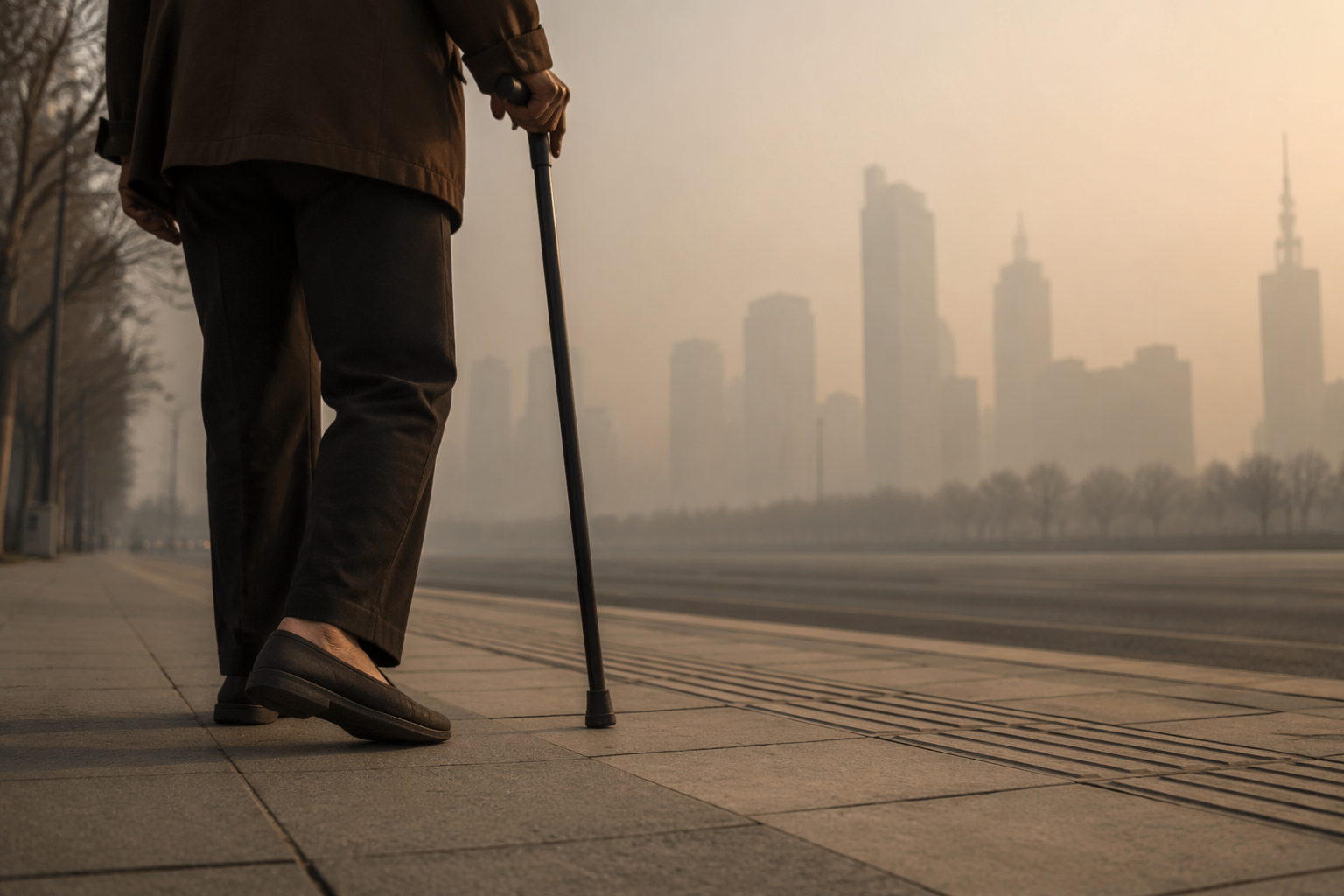
The 2026 Cities Caregivers Should Flag First
The American Lung Association’s 2026 State of the Air rankings give caregivers a practical starting point because they separate three different problems: ozone, short-term particle pollution, and year-round particle pollution. In 2026, Bakersfield-Delano, California ranked worst for year-round particle pollution, Los Angeles-Long Beach remained worst for ozone, and other places that deserve caregiver attention include Phoenix-Mesa, Fresno-Hanford-Corcoran, Visalia, Houston-Pasadena, Pittsburgh-Weirton-Steubenville, and parts of California’s Central Valley.[1]
The scale is not small. The ALA reported that more than 129 million people—44% of Americans—lived in counties with failing grades for at least one pollution measure, and 20 counties in seven states failed all three measures at the same time.[2] That turns air quality from a niche wildfire concern into a mainstream aging-in-place issue.
| City or region to flag | 2026 air quality concern | Why it matters for an older adult |
|---|---|---|
| Bakersfield-Delano, CA | Worst metro for year-round particle pollution; ranked worst for seven consecutive years | Long-term particle exposure belongs in the same review as stamina, heart disease, lung disease, and outdoor walking habits.[1] |
| Los Angeles-Long Beach, CA | Worst metro for ozone | Ozone can turn ordinary errands and walks into breathing-stress events for sensitive older adults.[1] |
| Phoenix-Mesa, AZ | Persistently concerning ozone and particle pollution profile | Heat, outdoor exposure, and poor air days can overlap with dehydration, medication vulnerability, and reduced walking tolerance.[1] |
| Fresno, Visalia, and the Central Valley, CA | Repeatedly prominent in particle and ozone pollution concerns | Valley geography and recurring pollution make daily monitoring more important than a one-time city label.[1] |
| Houston-Pasadena, TX and Pittsburgh-area metros | Listed among polluted metros in ALA rankings | These are reminders that senior air-quality risk is not limited to California or wildfire country.[1] |
A city ranking is a screening tool, not a verdict. A parent may have long-time doctors, friends, rent control, a church, a climate they tolerate, and a stubbornly important sense of belonging. Still, if that parent is already unsteady, frail, forgetful, short of breath, or recovering from a fall, a persistently failing air-quality location should move from “background fact” to “care-plan item.”
Why Dirty Air Belongs in a Fall-Risk Conversation
PM2.5 means fine particle pollution small enough to reach deep into the lungs and affect the cardiovascular system. Ozone is a reactive gas that irritates airways and can make breathing harder. Those definitions are enough; the caregiver question is what happens to a 78-year-old body that has to walk to the mailbox, manage blood pressure medication, climb one step into the garage, or recover from a dizzy spell on a bad-air day.
The most direct fall evidence is emerging, and it deserves careful wording. A 2025 Maturitas study of 9,869 community-dwelling adults aged 45 and older in China found that moderate-to-high PM2.5 exposure was associated with a 16% to 29% higher fall risk, with stronger effects among women, adults over 60, and people with cognitive impairment.[3] That does not prove the same exact percentage applies to older adults in Bakersfield, Phoenix, or Pittsburgh. It does make the old habit of separating “air quality” from “fall prevention” look too narrow.
Another 2025 study, also from China, followed 16,765 older adults and found that each 10 µg/m³ increase in nitrogen dioxide was associated with a 6.8% higher risk of hip fracture hospitalization.[4] Hip fracture is not the same outcome as a reported fall, but for families it is one of the losses everyone is trying to prevent: the ambulance ride, the hospital stay, the rehab bed, the sudden question of whether home is still possible.
The U.S.-specific evidence strengthens the independence concern, even though it does not measure the identical fall outcome. A 2024 Lancet Healthy Longevity study using Health and Retirement Study data followed 15,411 U.S. adults aged 65 and older for a mean of 7.9 years; 48% developed a new activity-of-daily-living disability, and long-term air pollution exposure was identified as a contributing risk factor.[5] ADL disability is the practical language of aging: bathing, dressing, transferring, toileting, eating, and getting across a room safely.
The biological pathways are plausible in ways caregivers can recognize. Particle pollution can stress the heart, contribute to blood-pressure swings, and worsen breathing symptoms; those changes can show up as lightheadedness, slower walking, less reserve on stairs, or a decision to skip activity altogether. Research also connects pollution with pathways involving bone loss, muscle loss, inflammation, and brain regions involved in reaction time and memory. None of that replaces the need to fix loose rugs. It widens the list of hazards.
The Older Adults Most Likely to Be Affected
Air pollution does not affect every older adult the same way. AirNow identifies older adults as a sensitive group because aging, heart disease, lung disease, and other chronic conditions can make pollution exposure more dangerous.[6] The American Lung Association also lists older adults among groups at higher risk from outdoor air pollution.[7]
For a family trying to decide how seriously to take a bad city ranking, the parent’s health profile matters more than the ranking alone.
- A fall in the past year, a near-fall, or a new fear of walking outside.
- COPD, asthma, heart failure, coronary disease, arrhythmia, or blood-pressure instability.
- Cognitive impairment, because slower judgment and reaction time can turn a small trip hazard into a real fall.
- Frailty, low muscle mass, osteoporosis, or a prior fracture.
- Medications that can compound dizziness, dehydration, blood-pressure drops, sedation, or breathing problems.
- Declining ADLs, especially bathing, transferring, dressing, and getting out for errands.
This is where a caregiver has to resist both overreaction and denial. A healthy, active 68-year-old in a high-ozone metro may need monitoring and behavior changes, not a moving truck. An 84-year-old with COPD, osteoporosis, a recent fall, and a third-floor apartment in a persistently failing county is a different conversation.
Use Rankings for Geography, AQI for Today
The ALA rankings answer one question: does this city or county have a recurring pollution burden? Daily AQI answers another: should Mom do the grocery trip today, or should someone move it, shorten it, or drive her door-to-door?
AirNow’s color-coded AQI system becomes especially useful because Code Orange, starting at 101, is “unhealthy for sensitive groups,” including older adults.[6] For a parent with fall risk, that should not only trigger a breathing plan. It should trigger a mobility plan.
- On Code Orange days, shift longer walks, errands, and outdoor chores to cleaner-air periods when possible.
- On worse days, reduce solo outdoor errands if the parent already has dizziness, shortness of breath, or balance problems.
- During wildfire smoke or very unhealthy events, use a more formal household protocol rather than improvising.
- If the parent uses oxygen, inhalers, diuretics, beta-blockers, sedatives, or blood-pressure medication, ask the clinician what symptoms should change the day’s activity plan.
For a daily operating guide, families can pair the local AQI with an AQI fall-prevention plan. For smoke, extreme pollution, or rapidly worsening days, a separate Code Purple air-quality protocol is worth having before the sky changes color.
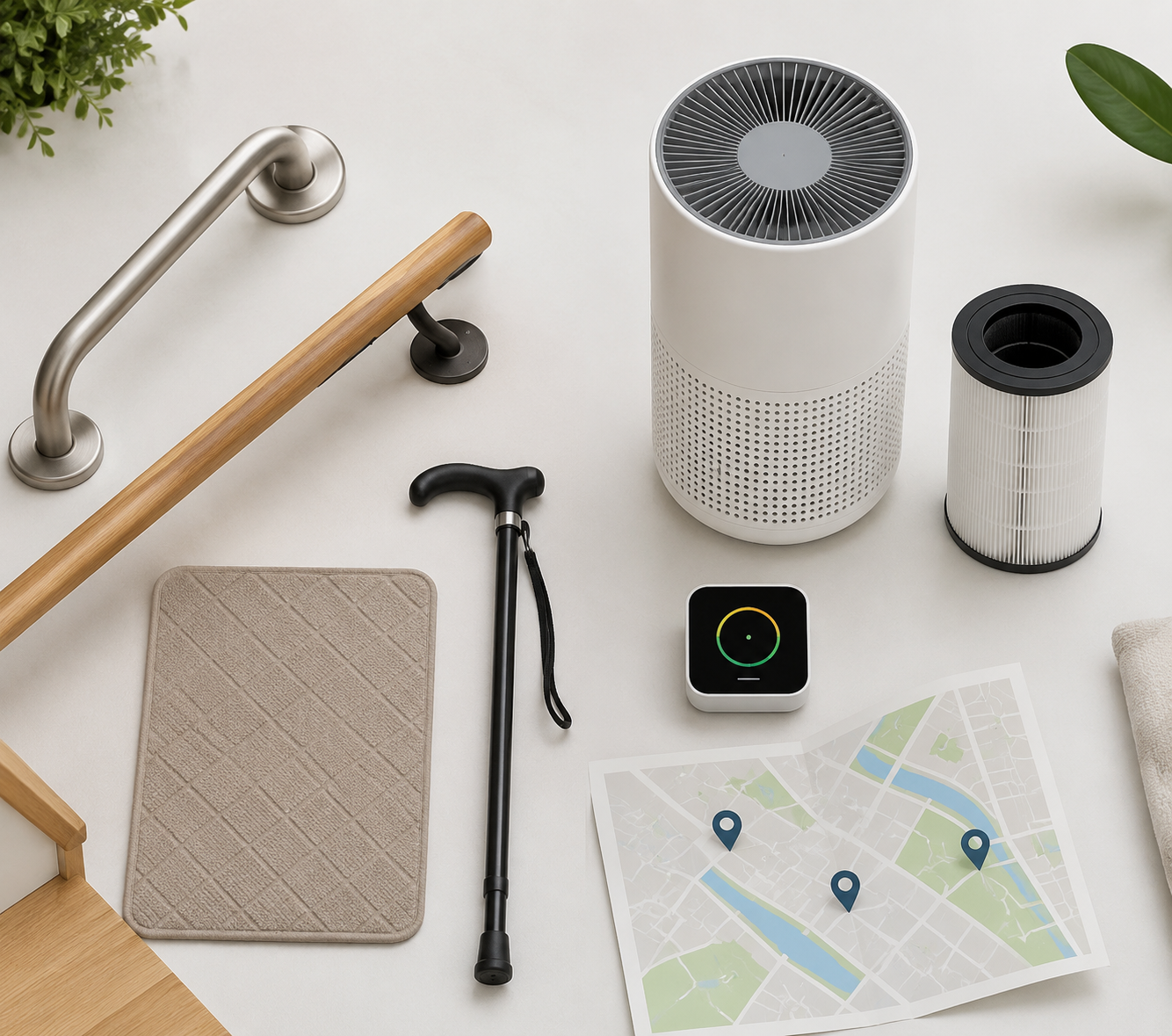
Add Air Quality to the Home Safety Audit
Aging-in-place planning already has a familiar checklist: bathroom grab bars, shower seating, stair handrails, non-slip flooring, night lighting, clear pathways, and medication review. Air quality belongs beside those items, not in a separate environmental folder no one opens.
The simplest way to combine the two is to review the parent’s home in layers.
| Layer | What to check | What changes if air quality is poor |
|---|---|---|
| City and county | ALA rankings for ozone, short-term particles, and year-round particles | A persistently failing location becomes a monitoring and care-planning trigger, especially with existing fall or chronic disease risk. |
| Daily conditions | AirNow AQI before walks, appointments, errands, and outdoor chores | Bad-air days may need shorter trips, transportation help, indoor exercise, or schedule changes. |
| Health status | Falls, dizziness, cognition, COPD, asthma, heart disease, osteoporosis, frailty, ADL decline | The more vulnerabilities present, the lower the threshold for changing routines or discussing housing. |
| Indoor air | Bedroom, main sitting area, HVAC filter, window habits, smoke entry points | Cleaner indoor recovery space matters if outdoor air regularly limits activity. |
| Physical home hazards | Bathroom, stairs, entryways, flooring, lighting, footwear, mobility aids | Air-quality planning does not excuse missing grab bars; it adds another preventable stressor to the same audit. |
| Medication plan | Drugs linked with dizziness, dehydration, sedation, blood-pressure drops, or breathing symptoms | Bad-air days may be when small medication side effects become mobility problems. |
A family doing a room-by-room home modification checklist can add one question to each room: where does this parent recover when the outdoor air is bad? The answer may be the bedroom, the living room, or a small den with the best filtration and fewest trip hazards. That recovery room should not be the cluttered room with a loose rug and a power cord crossing the walkway.
The same logic applies to physical upgrades. Evidence-based fall prevention still includes the basics—handrails, lighting, safer bathrooms, and fewer floor hazards—but those modifications work best when the parent is not repeatedly pushed into fatigue, breathlessness, or dizziness by the surrounding environment. Families comparing upgrades can use evidence-based home modifications that prevent falls as the physical-safety side of the same plan.
Practical Protections Before Relocation Enters the Room
Most families will not start with relocation, and they should not have to. The first question is whether the parent can reduce exposure enough to preserve safe routines.
- Put a HEPA purifier in the bedroom and the main daytime room, especially if outdoor air regularly limits activity.
- Use a MERV 13 or higher HVAC filter when the system can handle it, and set the system to recirculate during poor outdoor-air periods.
- Keep windows and doors closed during high-pollution or smoke events, and reduce indoor particle sources.
- Move outdoor walking, gardening, trash runs, and errands to cleaner-air times instead of asking a frail parent to “push through.”
- Keep rescue inhalers, oxygen instructions, hydration routines, and clinician-approved symptom plans current.
- Be cautious with N95 masks in older adults with preexisting lung disease; restricted airflow can be a problem, so the clinician’s advice matters.
The American Lung Association advises people to reduce exposure on unhealthy air days, check forecasts, avoid exercising near high-traffic areas, and take steps to keep indoor air cleaner.[8] The National Council on Aging also emphasizes checking local air quality, staying indoors when pollution is high, using air filtration when possible, and protecting people with chronic conditions.[9]
For a parent already at risk of falling, these protections should be written into the same household plan as “use the walker,” “turn on the hall light,” and “do not shower without the bench.” A useful hazardous-air fall precaution plan is specific about who checks the AQI, who changes the appointment, who brings groceries, and when the parent should call for help.
When Bad Air Should Affect the Housing Conversation
A move is a blunt instrument. It can separate an older adult from doctors, neighbors, faith communities, familiar streets, and the small routines that keep a week recognizable. A city’s bad ozone or particle ranking is not, by itself, a respectful reason to tell a parent to leave.
But air quality should affect the housing conversation when it repeatedly interferes with daily function. That may mean the parent stops walking outside, cancels appointments on bad-air days, has more breathlessness after errands, becomes less steady when dehydrated, or cannot keep up with the activities that protect strength and balance.
The threshold is lower when several risks stack together: a persistently failing city or county, prior falls, cardiovascular or lung disease, cognitive impairment, frailty, high-risk medications, osteoporosis, or new ADL limitations. In that situation, the housing question is no longer “Is this city dirty?” It is “Can this parent remain safe, mobile, and independent here with realistic support?”
Sometimes the answer will be yes, with filtration, AQI-based scheduling, transportation help, medication review, and stronger home modifications. Sometimes it will be yes for now, but only if the family stops pretending outdoor air is irrelevant. And sometimes, especially after a fall or a clear decline in ADLs, air quality may belong in the same family meeting as stairs, bathrooms, driving, and whether living alone is still working.
References
- Most Polluted Cities | State of the Air. American Lung Association.
- Most Polluted Places to Live | State of the Air. American Lung Association.
- Exposure to ambient air pollution and falls risk in a community-dwelling adult population. Maturitas, 2025.
- Air pollution and hip fracture risk in older people. BMC Geriatrics, 2025.
- Long-term air pollution exposure and incident physical disability in older US adults. The Lancet Healthy Longevity, 2024.
- Older Adults and Air Quality. AirNow.gov.
- Who is Most Affected by Outdoor Air Pollution?. American Lung Association.
- 10 Tips to Protect Yourself from Unhealthy Air. American Lung Association.
- Protecting Yourself from Poor Air Quality. National Council on Aging.
Related reading
Noticed something outdated or inaccurate on this page? Flag a correction. We review every report against CDC, NIA, and AARP HomeFit guidance before updating a page.
Part of the Fall Prevention section.