
A Hurricane Prep Guide for Seniors That Prevents Falls
This article provides a room-by-room checklist for adult children helping an aging parent prepare for hurricane season, with a focus on preventing falls during power outages, wet floors, and post-storm debris. It covers entryways, bedrooms, bathrooms, and kitchens with specific actions for seniors with mobility limitations.
Helping an elderly parent prepare for hurricane season starts in the hallway, not in the bottled-water aisle. If a parent uses a walker, has poor night vision, sleeps near oxygen tubing, relies on a power lift chair, or keeps insulin in the refrigerator, the storm plan has to answer a very plain question: can this person move safely through the home when the lights are out, the floor is damp, and nobody is standing beside them?
That is why hurricane preparation for seniors is also fall prevention. A flashlight in a drawer is useful only if it can be reached from the bed. A walker is useful only if it is parked where the first step lands. A stocked pantry is useful only if the water is not stored on the garage floor where someone has to bend, lift, and turn in the dark.
The danger often stretches past the storm itself. After Superstorm Sandy, Rutgers CEED reported a rise in falls and fractures among older adults in New Jersey, attributing the increase to extended power outages, dark conditions, and disrupted daily routines.[1] That is the part many checklists flatten into “after the storm, be careful.” In an older person’s home, “after” can mean a wet entry mat, a blocked porch step, a walker left on the wrong side of a door, and a bathroom trip attempted without working lights.
Older adults who use mobility aids already know this in their bodies. In a national study of adults ages 50 to 80, mobility-aid users had significantly lower confidence in handling power outages and severe weather, with adjusted odds ratios of 0.65 and 0.63 respectively.[2] The same study found that living alone was associated with lower odds of having an emergency kit, a seven-day food and water supply, and a discussed evacuation plan.[2] The study did not focus only on the oldest adults, so it may understate the gap for people in their 80s and 90s.
The stakes are not theoretical. AARP’s disaster resilience materials report that 71% of Louisiana hurricane deaths were people over 60; nearly half of Hurricane Katrina’s victims were 75 or older, although that age group was about 6% of the population; and of 87 Hurricane Ian fatalities with known ages, 61 were 60 or older.[3] Those numbers use different age cutoffs, so they should not be compared as if they are one tidy data set. They do point in the same direction: older adults bear a disproportionate share of hurricane harm.
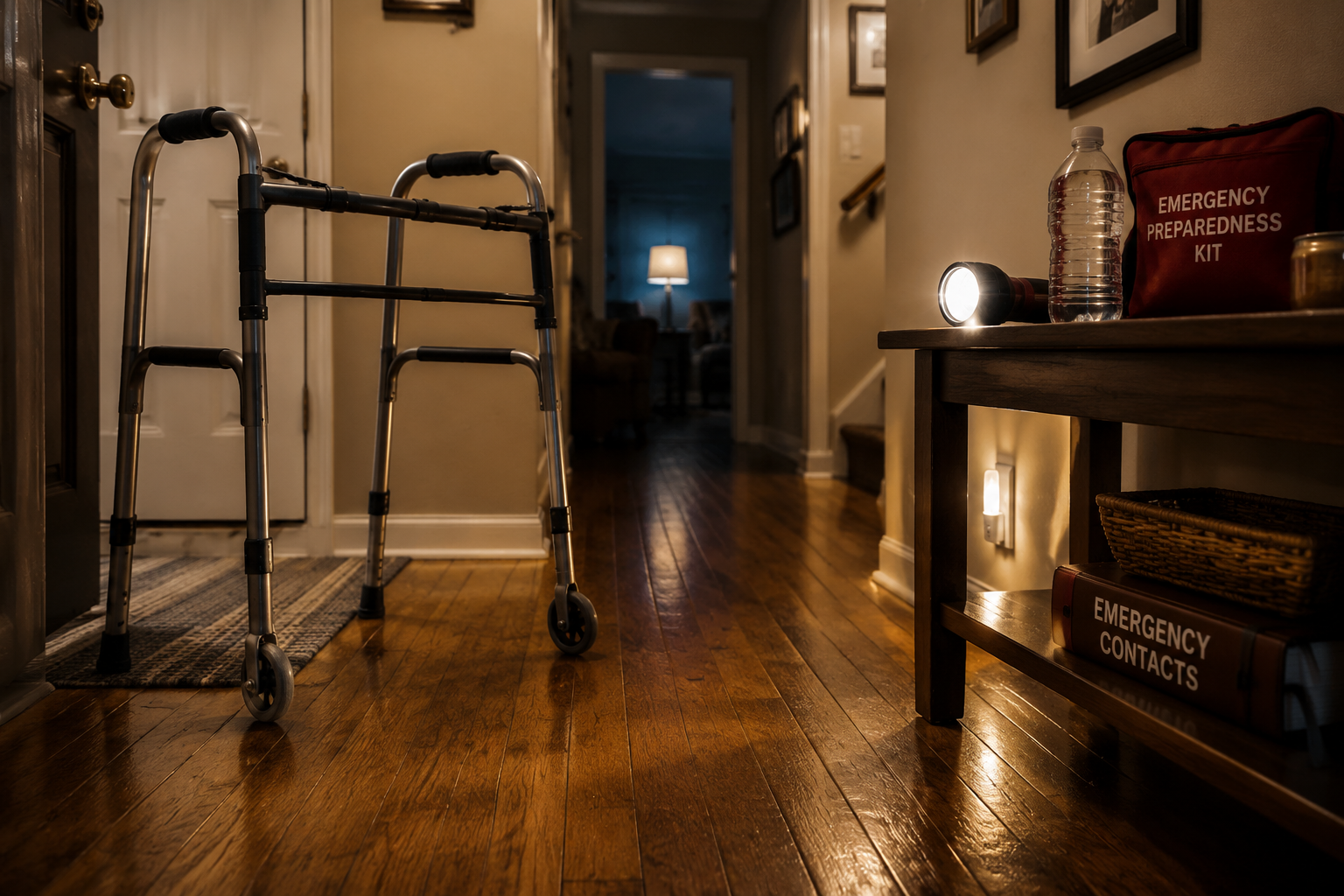
Start With The Route, Not The Supply List
Before buying one more battery pack, walk the home the way your parent will have to use it during an outage. Start at the bed. Go to the bathroom. Go to the kitchen. Go to the front door. Go to the place where medications, hearing-aid batteries, eyeglasses, oxygen supplies, chargers, and important papers live. Do it in daylight first, then imagine the same route with no overhead lights and a tired person moving slower than usual.
Ready.gov frames older-adult preparedness around assessing needs, creating a plan, and engaging a support network.[4] That is the right broad shape. Inside the home, the assessment needs to get uncomfortably specific: which hand reaches for the rail, which rug edge curls, which chair blocks the walker turn, which shelf requires bending, and which doorway becomes too narrow when a laundry basket is left there.
| Area | What To Check Before The Storm | Why It Matters During An Outage |
|---|---|---|
| Entry and walkway | Clear mats, hoses, planters, loose branches, and anything that can shift or get wet | The first post-storm trip outside may happen before anyone has cleaned the path |
| Bedroom to bathroom | Put the walker, flashlight, phone, and backup charger within reach from bed | Most overnight falls begin before the person is fully awake |
| Bathroom | Check grab bars, non-slip surfaces, towels, and dry replacement mats | Water plus darkness turns a familiar bathroom into a different room |
| Kitchen and medications | Place water, food, medication supplies, and cooling plans at usable height | Supplies do not help if retrieving them requires bending, climbing, or carrying too much |
| Post-storm re-check | Inspect floors, entryways, medication refrigeration, mobility aids, and downed-line risks | The home may be less safe after the storm than it was before it arrived |
Entryway And Walkway: Where Wet Surfaces Meet The Walker
The entry deserves more attention than it usually gets. It is where rain comes in, where leaves and grit collect, where a welcome mat becomes a skid pad, and where an older adult may be tempted to step outside “just to look.” If the parent uses a walker, the walkway is not just a path; it is part of the mobility system.
- Remove or secure welcome mats that can bunch, slide, or stay wet after wind-driven rain.
- Clear hoses, planters, extension cords, garden tools, loose pots, and decorative items from the walking route.
- Check that railings are tight enough to bear weight, not just present for appearance.
- Place a flashlight near the door at standing height, not in a low cabinet or crowded drawer.
- Decide where the walker, cane, or rollator belongs if the parent opens the door, sits near the entrance, or transfers to a car.
This is also the place to be honest about stairs. One or two exterior steps can become a serious barrier when the handrail is wet, the porch light is out, and someone is carrying a small bag or trying to hold a phone. If the entry is not safe in those conditions, plan for the parent not to use it alone until someone has checked it after the storm.
Bedroom To Bathroom: The Overnight Route Needs Its Own Plan
The bedroom is where good intentions fail quietly. A flashlight can be on the dresser and still be useless if the parent has to stand up to reach it. A phone can be charged and still be too far away after a fall. A walker can be “right there” and still be six feet from the bed, which might as well be across the room at 2 a.m. during a power outage.
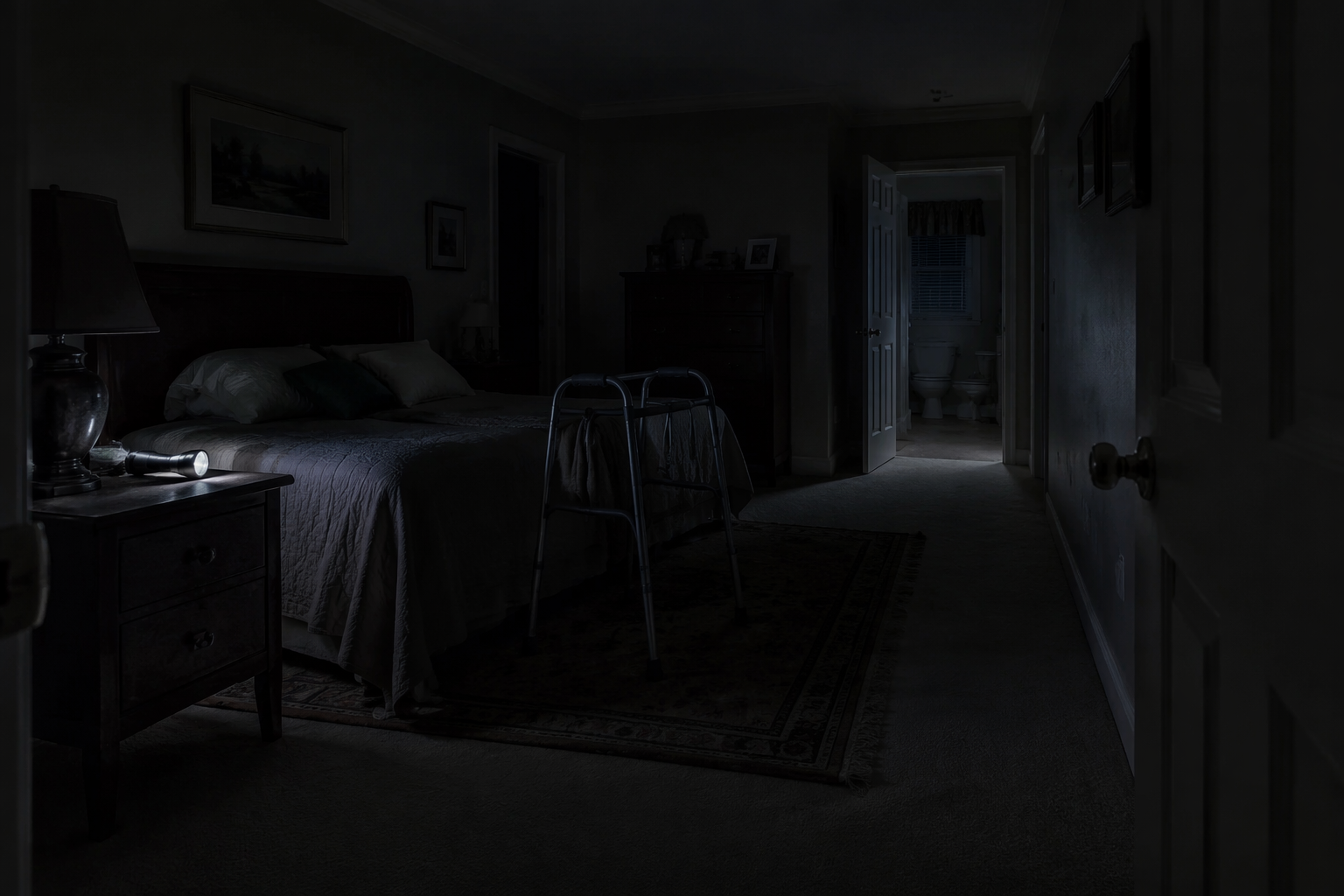
- Put a flashlight or lantern within reach from the sleeping position, on the side the parent actually uses to get out of bed.
- Keep the walker or cane at the same bedside position every night before and during storm season.
- Clear the full path from bed to bedroom door, including slippers, laundry baskets, oxygen tubing, pet beds, and small rugs.
- Use backup charging for the phone or medical alert device, and place it where it can be reached without standing.
- If oxygen tubing crosses the route, reconfigure it with the prescribing equipment provider or clinician rather than improvising a tight or unsafe setup.
Motion-sensor lights can help, but they should not be the only plan. Batteries die, sensors miss, and storm stress changes routines. The more reliable arrangement is a route that stays clear even when no light works perfectly.
Bathroom: Assume Water Will Be In The Wrong Place
Bathrooms are already unforgiving. During hurricane conditions, the risks stack up: dim light, damp floors, hurried toileting, changed bathing routines, and towels or mats moved from their usual spots. The goal is not to make the bathroom look neat. The goal is to make the next transfer predictable.
- Test grab bars by checking whether they are securely anchored, not suction-mounted or loose.
- Place non-slip mats where they are needed, and keep dry backups accessible if the first set gets wet.
- Remove throw rugs from the bathroom route, especially rugs without secure backing.
- Put a battery lantern where it lights the toilet and sink area without requiring the parent to carry it.
- Keep wipes, continence supplies, toilet paper, and a change of clothing at waist or chest height.
If the parent normally steadies themselves on a towel bar, glass shower door, sink edge, or rolling cart, treat that as a warning. Those are not substitutes for a properly installed grab bar. A hurricane will not make a weak support stronger; it will only make the floor less forgiving.
Kitchen And Medications: Put Essentials Where They Can Be Used
The kitchen plan should be simple enough to work when everyone is tired. Water should be reachable without bending into a low cabinet or lifting a heavy case from the floor. Food should not require a step stool, a sharp knife in poor light, or a long reach over a crowded counter.
- Pre-fill water containers and place them at a height the parent can reach while standing steadily or seated.
- Clear counters so a walker user has somewhere to set items down instead of carrying several things at once.
- Move shelf-stable food to easy-reach shelves before the storm, not after the power goes out.
- Keep a manual can opener where it can be found by touch or with a small flashlight.
- Avoid storing emergency supplies in the garage if reaching them requires stairs, wet concrete, or a heavy door.
Medication planning is essential, but it should stay inside the limits of the parent’s actual prescriptions. The Red Cross recommends that older adults prepare at least 30 days of medications and extra assistive items such as canes, eyeglasses, and hearing-aid batteries.[5] For insulin or other refrigerated medications, ask the pharmacist or prescribing clinician what temperature range is acceptable, how long the medication can be out of refrigeration, and when it must be discarded. Do not guess during an outage.
If the parent uses electrically powered medical equipment, the plan needs more than a charged phone. Ready.gov’s older-adult guidance emphasizes assessing needs and building support before an emergency.[4] In practical terms, that means knowing who can help if power fails, how long backup power realistically lasts, and when staying home stops being reasonable.
When Staying Home Is The Wrong Fall-Prevention Plan
Some homes cannot be made safe enough for a particular storm. The First Contact / 211 Tampa Bay Cares decision tree advises evacuation if an older adult is in a flood zone, lives in a mobile home, lives in a high-rise where elevator loss is a concern, uses electric medical devices, or lacks mobility assistance.[6] Those categories are not minor details. They describe situations where independence inside the home may collapse as soon as water rises, power fails, or elevators stop.
Local rules matter here. County shelter registration, special-needs transportation, pet policies, medical equipment requirements, and evacuation zones can change. Verify current procedures with the parent’s county emergency management office before storm season, not while a forecast cone is already on television.
This is one of the few conversations that may need to be firm. It is possible to respect a parent’s independence and still say that a mobile home, a fifth-floor apartment without reliable elevator access, or a home dependent on electric medical equipment is not a safe place to ride out certain storms.
Build The Support Network Before Anyone Needs To Prove They Need Help
A support network does not have to sound dramatic. It can be two neighbors, one adult child, one church friend, and one pharmacy contact. What matters is that the roles are clear before the outage: who checks the entryway, who calls if phones work, who has a key, who knows about the walker, who knows about refrigerated medication, and who understands that the parent may say “I’m fine” before the floor has actually been checked.
The Red Cross Scientific Advisory Council and the American Academy of Nursing identified social isolation, cognitive impairment, caregiver preparedness gaps, and psychological distress as key vulnerability factors for older adults in disasters.[7] Those are not abstract categories when the power is out. They show up as missed calls, forgotten instructions, a parent taking a risky shortcut, or a caregiver assuming someone else already checked in.
The Emergency Kit Still Matters, But It Has To Be Reachable
A kit that lives in a heavy plastic bin on a closet floor may satisfy a checklist and still fail the person who needs it. For a parent with limited mobility, divide supplies by use. Keep immediate items near the places where they will be needed, and store bulk supplies where a helper can retrieve them.
- Bedside: flashlight, phone, backup battery, glasses, hearing aids or batteries, and medical alert device.
- Bathroom route: nightlights, lantern, dry non-slip mat, wipes, and clear floor space.
- Kitchen: reachable water, shelf-stable food, medication list, manual can opener, and easy counter space.
- Entry: flashlight, shoes with backs and non-slip soles, mobility aid placement, and a dry towel for tracked-in water.
- Go-bag: medication list, copies of key documents, chargers, assistive-device supplies, and a written evacuation contact plan.
Shoes deserve a place on that list. Many older adults will pad around in slippers during an outage because that is what they do at home. If the floor may be wet or scattered with grit, slippers without backs can become another hazard. Put sturdy shoes where the parent can put them on without walking across the room first.
After The Storm, Do A Second Walk-Through Before Normal Routines Resume
The post-storm check is not a courtesy visit. It is a second fall-risk inspection. The house may look familiar to the parent and still function differently: no power, no elevator, wet thresholds, branches across the walkway, spoiled food, dim rooms, shifted furniture, and a walker parked wherever it was last used.
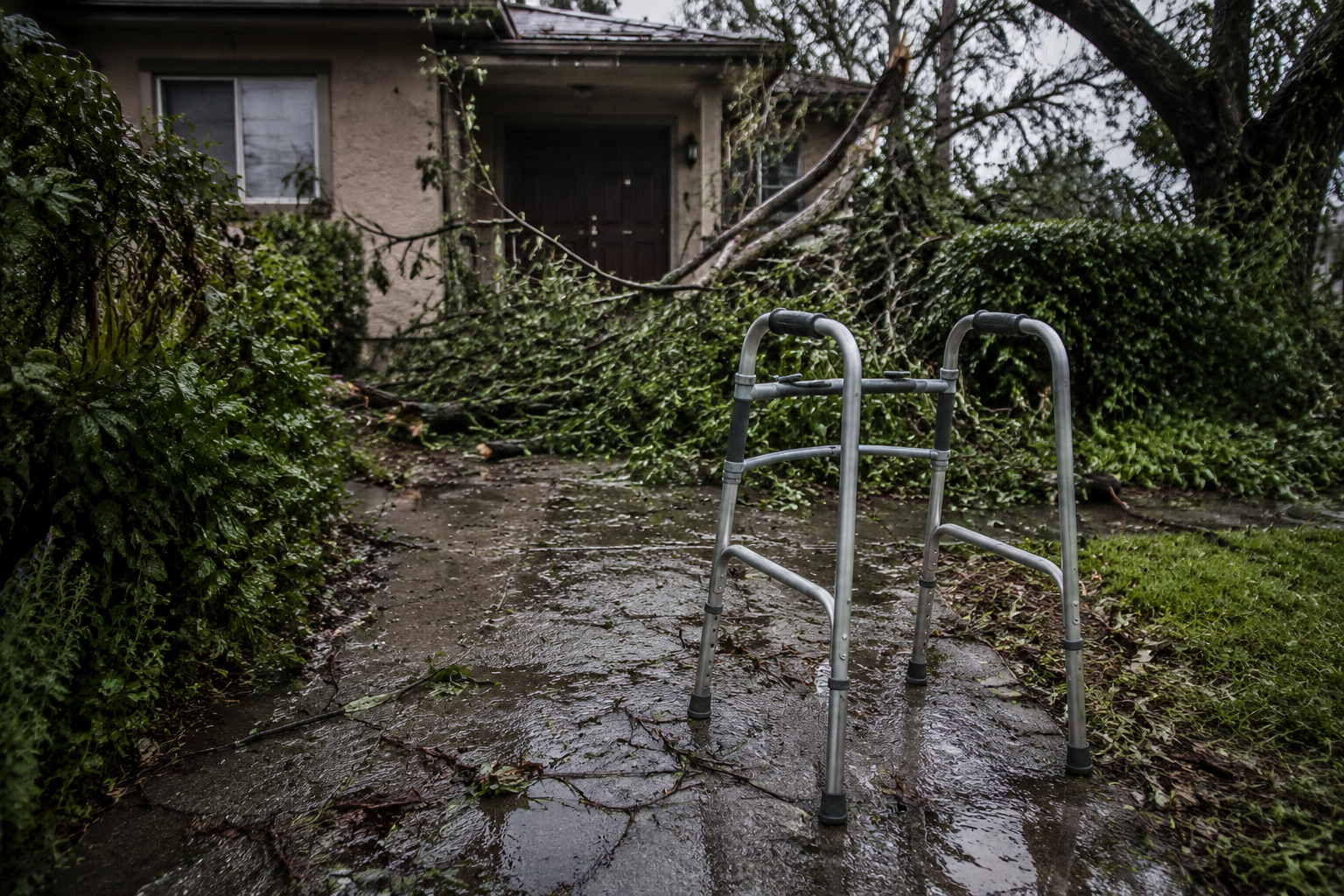
- Check the outside route first: driveway, porch, steps, ramp, railings, door threshold, and any standing water.
- Do not let the parent walk near downed power lines, flooded areas, or debris piles to inspect damage.
- Dry the entry floor and remove mats, towels, or shoes that create uneven footing.
- Return the walker, cane, glasses, phone, and flashlight to their assigned places.
- Check refrigerated medications and food safety before the parent resumes normal meals or dosing routines.
- Walk the bedroom-to-bathroom route again after dark or with lights off, because daylight can hide the problem.
This is also when fatigue matters. A parent who managed the storm may be sleeping poorly, skipping normal meals, worrying about damage, or trying to clean up too soon. The safer instruction is not “be careful.” It is “wait until the walkway is cleared,” “use this door, not that one,” “leave the branches,” and “call before you go outside.”
A Practical Two-Pass Checklist
If the home has many small hazards, do not try to solve all of them in one tense afternoon. Use two passes: one before hurricane season to set up the home, and one after any storm that affects power, water, access, or routines.
| Pass | Caregiver Action | Stop When |
|---|---|---|
| Before storm season | Walk each route with the parent, move supplies to reachable heights, clear floor hazards, check lighting, assign mobility-aid locations, and verify evacuation triggers | The parent can get from bed to bathroom, kitchen, and exit without stepping over, reaching low, or searching in the dark |
| When a storm is forecast | Charge devices, set out lights, place shoes and mobility aids, fill reachable water, confirm medications, and review who will call or come by | The home is ready for an outage without last-minute lifting, bending, or rearranging |
| After the storm | Inspect entryways, wet floors, debris, lighting, medication refrigeration, and walker placement before encouraging normal movement | The parent has a safe route through the home and knows which areas are still off-limits |
No checklist removes every risk, especially for an older adult who lives alone, has cognitive changes, or depends on electric medical equipment. But a better hurricane plan changes what gets noticed. It stops treating supplies as the whole job and starts treating movement as the test.
Before storm season, complete the room-by-room preparation with your parent while the lights are on and everyone is calm. After the storm, do a separate fall-risk re-check before encouraging them to resume normal movement through the home.
References
- Rise in Falls and Fractures Among Elderly After Superstorm Sandy, Rutgers CEED, 2013
- Predictors of Emergency Preparedness among Older Adults in the United States, PMC
- Disaster Resilience Tool Kit, AARP
- Older Adults, Ready.gov, updated 2026
- Older Adults Emergency Preparedness, American Red Cross
- Disaster Preparedness for Older Adults and Caregivers, First Contact / 211 Tampa Bay Cares
- New Research: Older Adults More Vulnerable After Disasters, American Red Cross, 2020
Related reading
Noticed something outdated or inaccurate on this page? Flag a correction. We review every report against CDC, NIA, and AARP HomeFit guidance before updating a page.
Part of the Fall Prevention section.