
STEADI: intervene
Hurricane Go-Bag Checklist for an Elderly Parent Living Alone
Standard emergency kits miss the items that prevent falls when a senior lives alone. This checklist organizes a go-bag around mobility, vision, hearing, and medication needs so your parent can stay safe before, during, and after the storm.
A standard hurricane kit can keep an older parent supplied and still leave them one bad step away from injury. The missing piece is usually not dramatic: eyeglasses left on the nightstand, a cane across the room, hearing-aid batteries in a drawer, a flashlight that ties up the hand they need for balance, or pill bottles packed so tightly they cannot open them.
That is why a hurricane preparedness checklist for elderly parents living alone has to be built differently. About 28% of older adults in the U.S. live alone, including 43% of women age 75 and older, so “someone will hand it to them” is not a reliable safety step [1]. If the bag is too heavy, too dark inside, too hard to search by touch, or missing the mobility and sensory items your parent actually uses, it is not ready.
Build the bag around the fall risk, not around the supply category
Most hurricane lists sort items by supply type: food, water, batteries, documents, medications. That works for inventory. It does not work well enough for a parent who may need to leave in rain, step over a threshold in the dark, hear an evacuation knock, or manage a walker while carrying a bag. AARP’s disaster resilience guidance notes that mobility difficulties are one reason older adults are disproportionately harmed in disasters [2].
Use a simple test for every item: what failure does this prevent, and can my parent use it alone? If the answer is vague, it probably belongs in a home stockpile, not in the go-bag. If the answer is “it keeps them from walking barefoot on wet tile” or “it lets them keep both hands on the railing,” it belongs near the top.
Hearing access deserves the same treatment as mobility access. NIH NIDCD data show that about 22% of adults ages 65 to 74 and 55% of adults 75 and older have disabling hearing loss, which changes what “alert” means in a storm [3]. A weather radio is useful, but it may not be enough if your parent cannot hear it, has removed hearing aids at night, or is sleeping through an evacuation notice.
Medication planning also needs more than a three-day mindset. The Red Cross recommends that older adults have a 30-day supply of medications for emergencies, while the American Association for Geriatric Psychiatry advises at least a two-week supply and warns that disrupted routines and unfamiliar surroundings can be especially disorienting for cognitively impaired older adults [4][5]. In practice, the bag should hold the amount your parent can safely carry and access, while the larger reserve is arranged before hurricane season with the prescriber and pharmacy.
Printable hurricane go-bag checklist for an elderly parent living alone
Print this as a two-part checklist: the left column is the grab-and-go bag by the door; the right column is the shelter-in-place stockpile that stays at home. Mixing the two is how bags become too heavy to lift.
| Fall-prevention need | Pack in the grab-and-go bag | Keep in the home stockpile | Why it matters |
|---|---|---|---|
| Mobility | Backup cane or folding cane if your parent uses one; walker label with name and phone number; spare rubber cane tips; small pouch for walker accessories; lightweight reacher only if your parent already uses one safely. | Primary walker or rollator kept clear of clutter; extra cane tips; pathway cleared from bedroom to exit; evacuation chair or transport plan if stairs are involved. | Prevents the rushed search for a cane or walker when evacuation is already underway. |
| Footwear | Closed-back, non-slip shoes that are already broken in; socks with grips only as a backup, not as the main evacuation footwear. | Non-slip shoes by the bed; water-resistant outdoor shoes near the safest exit; towel or mat for wet entry areas. | Wet tile, loose slippers, and barefoot walking are avoidable fall hazards. |
| Lighting | Headlamp with fresh batteries; small flashlight with wrist strap; extra batteries in a labeled pouch; glow tape or bright zipper pull on the bag. | Flashlight in every main room; motion-sensor nightlights; battery lanterns placed where they do not create trip hazards. | Hands-free light lets your parent hold a cane, walker, railing, or door frame instead of choosing between seeing and balancing. |
| Vision | Backup eyeglasses in a hard case; sunglasses if glare worsens balance; magnifier if your parent uses one; large-print medication and contact list. | High-contrast tape on step edges; clear route from bed to bathroom; familiar items left in consistent locations. | A storm can turn a familiar house into a low-visibility obstacle course. |
| Hearing and alerts | Hearing-aid case; extra hearing-aid batteries or charger; written card that says “I may not hear knocking or spoken instructions”; portable vibrating alert device if already used. | Strobe-light smoke and carbon-monoxide alarms; bed shaker or visual alert system if appropriate; alert settings tested before the season. | If your parent may not hear a siren, radio, phone, or knock, alerts need a visual or tactile backup [3]. |
| Medications | Current medications in original labeled containers when possible; printed medication list; dosing schedule in large print; easy-open pouch; rescue inhaler, glucose supplies, EpiPen, or other urgent-use medication if prescribed. | Two-week to 30-day medication reserve arranged with pharmacy and prescriber; backup copies of prescriptions; safe storage for temperature-sensitive medications [4][5]. | Medication interruption can worsen dizziness, weakness, confusion, pain, blood pressure instability, or other conditions that raise fall risk. |
| Medical devices and power | Power bank and charging cables; spare batteries for essential devices; written instructions for CPAP, oxygen, glucose meter, hearing aids, or mobility device charging; small extension cord if allowed by shelter rules. | Charged backup battery for CPAP, oxygen concentrator, or other prescribed device if used; power-outage plan registered with utility or local emergency management where available. | A dead device can turn a manageable evacuation into a medical and mobility emergency. |
| Documents | Waterproof folder with photo ID copy, Medicare or insurance cards, emergency contacts, medication list, allergies, diagnoses, physician contacts, pharmacy contact, advance directive or medical power of attorney copy if applicable. | Full document binder stored above flood-prone areas; digital copies shared with trusted family members. | Documents help responders, shelters, and hospitals act without making your parent repeat details under stress. |
| Communication | Charged phone; simple charger; power bank; written phone numbers in large print; whistle; small notepad and marker; NOAA weather radio only if your parent can operate and hear it. | Landline phone if available and functional during outages; backup charging station; contact schedule with family or neighbors. | A phone with no charge, no written numbers, or no accessible alerts is a weak link. |
| Food and water | Small water bottles your parent can open; ready-to-eat foods that do not require a can opener or strong grip; snacks compatible with diabetes, swallowing limits, or dental needs. | Larger water supply; shelf-stable food; manual can opener only if your parent can use it safely. | The useful food is the food they can actually open, chew, swallow, and carry. |
| Orientation and comfort | Light sweater; incontinence supplies if used; spare underwear; small comfort item; laminated card with home address and family contacts; recent photo of parent and caregiver. | Extra bedding, continence supplies, and hygiene supplies stored in accessible bins. | Comfort items are not indulgent when they reduce agitation, rushing, nighttime wandering, or disorientation. |
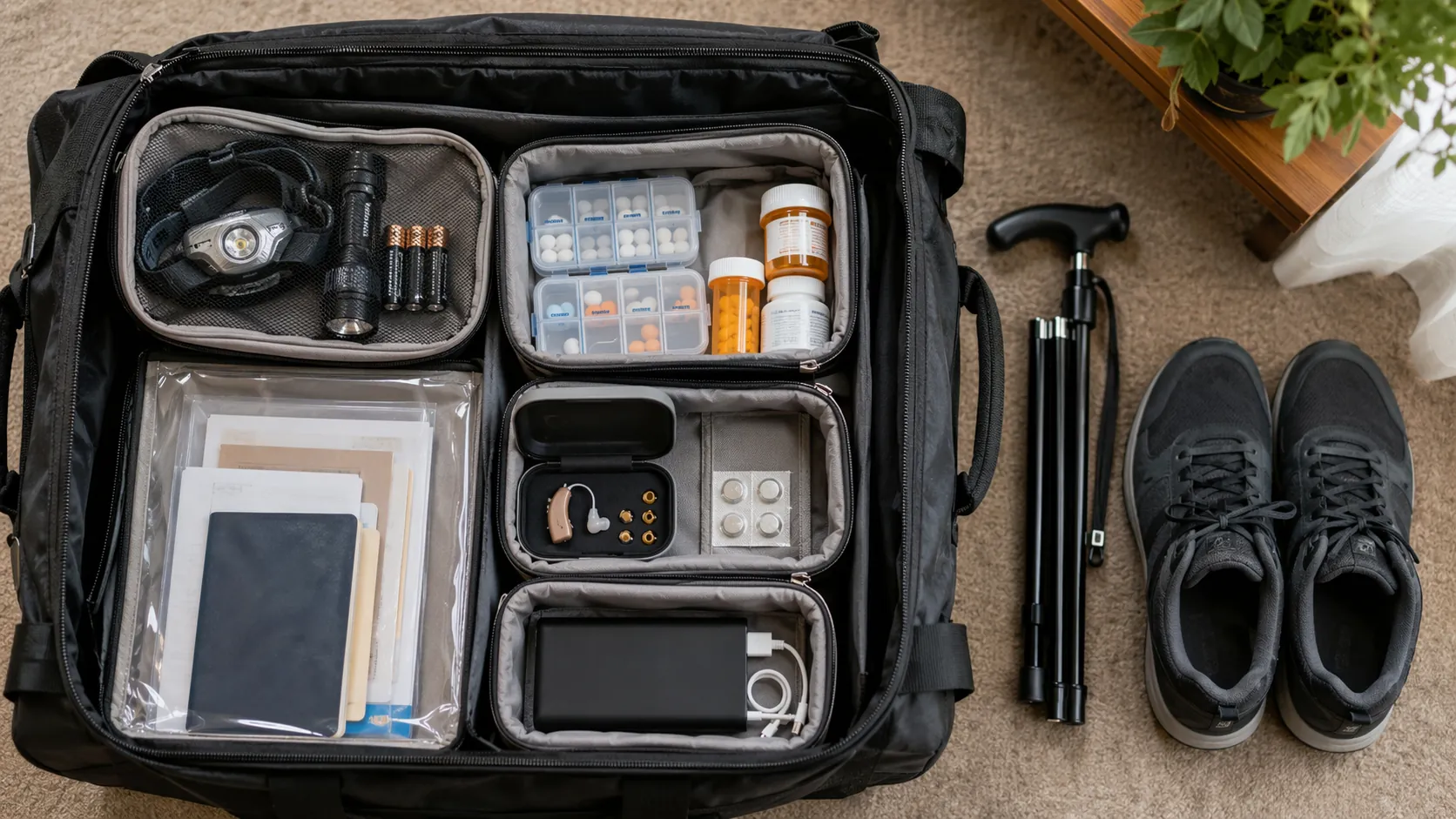
The four categories worth checking twice
Storm danger does not end when the wind drops. University of Michigan reporting on Hurricane Harvey found that older adults exposed to hurricane rainfall had a 3% higher mortality risk in the following year, and the increase was 5% for older adults with dementia [6]. The related JAMA Network Open research looked at post-storm mortality risk after major hurricanes; it does not prove that any single go-bag item prevents death, but it does widen the frame. The injury may happen during cleanup, in a dark hallway, at a shelter bathroom, or during a delayed medical routine [7].
Mobility and footwear
If your parent uses a cane, walker, rollator, orthotic brace, or shoe insert on ordinary days, it is not optional during a hurricane. Pack the backup pieces that are light enough to travel and stage the primary device where it cannot be blocked by boxes, patio furniture, or storm shutters.
Footwear should be chosen before the warning, not grabbed during it. Avoid the familiar trap of packing brand-new “safe” shoes that your parent has never worn. The best evacuation shoes are closed-back, non-slip, easy to put on, and already tested in the house. If your parent cannot bend easily, add a long-handled shoehorn to the home setup, not necessarily the go-bag, unless it is small and already part of their routine.
Lighting that leaves both hands available
A flashlight is useful until it steals the hand your parent needs for the railing. A headlamp earns its space because it points light where the face turns and leaves both hands free. Choose one with a simple switch, test whether your parent can put it on without help, and store it in the same pouch every time.
For the house, do not rely on one bright lantern in the kitchen. Place light where falls actually happen: the path from bed to bathroom, the hallway to the exit, the place where the walker is parked, and the area where medications are taken. Motion-sensor nightlights and battery lights belong in the home stockpile because they protect the route before the bag is even touched.
Vision and hearing access
Backup glasses are not a convenience item. They are the difference between seeing the threshold and guessing where it is. Put them in a hard case, label the case in large print, and keep it in the same pouch as the hearing-aid case if your parent uses both. If your parent needs readers for labels or medication instructions, pack those too; distance glasses alone may not solve the problem.
For hearing, think in layers. Pack batteries or a charger, but also include a written card that tells responders your parent may not hear spoken instructions. At home, visual and tactile alerts matter more than another device thrown into the bag. Strobe-light alarms, bed shakers, and phone alert settings should be tested before hurricane season, not discovered during a power outage.
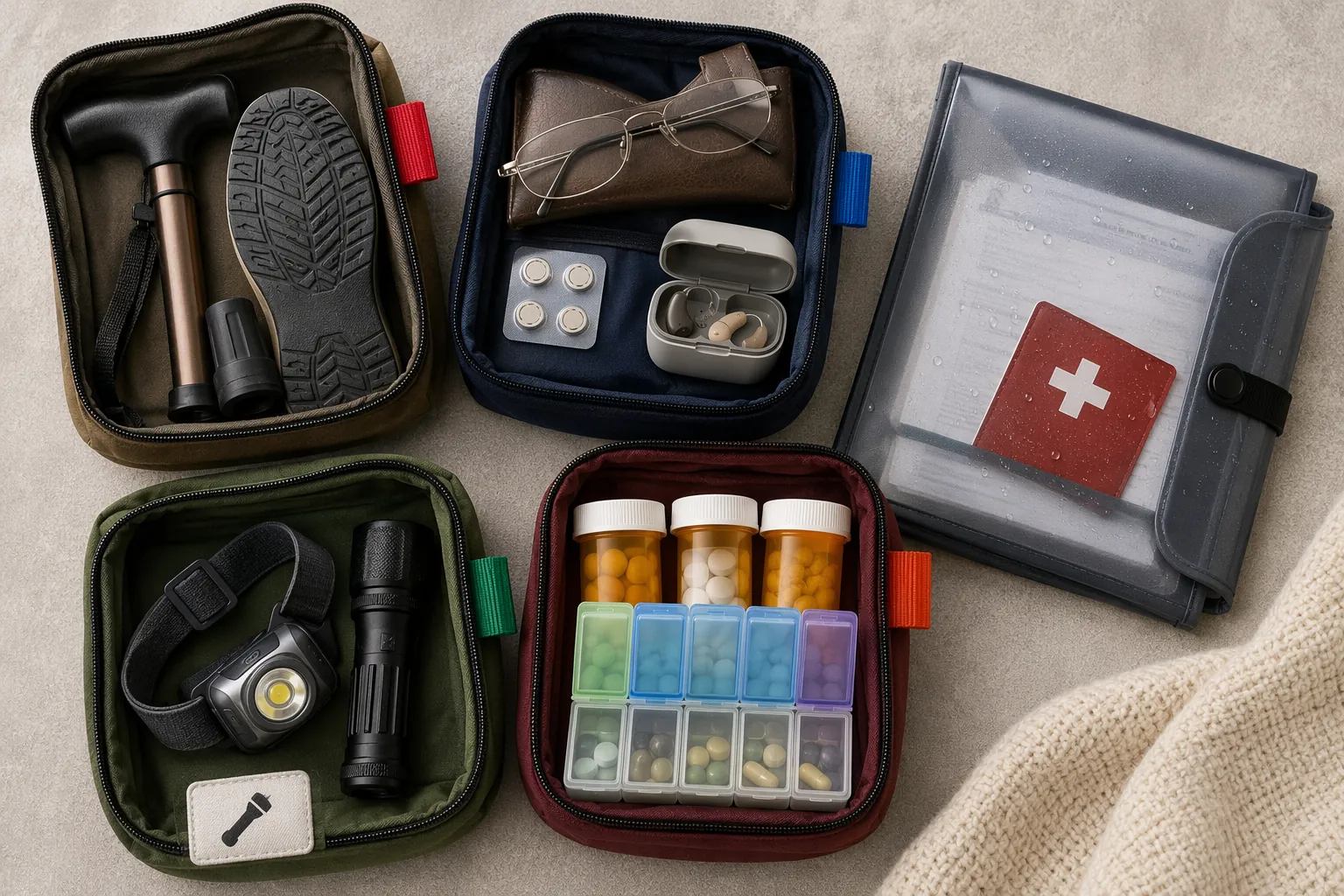
Medications and device power
Medication packing has two jobs: continuity and usability. Continuity means having enough medication available when pharmacies are closed, roads are blocked, or refills are delayed. Usability means your parent can identify, open, and take the medication correctly under stress.
Original labeled bottles are often safer than loose pills because they preserve the medication name, dose, prescriber, and pharmacy. If your parent normally uses a pill organizer, keep the organizer system familiar, but do not make the go-bag depend on a tiny unlabeled compartment that no responder can interpret. Add a large-print medication list with the time of day each medication is taken and a note about what must not be skipped.
For insulin, oxygen, CPAP, nebulizers, glucose monitors, powered mobility devices, or hearing-aid chargers, write down the power requirement in plain language. “Needs outlet overnight for CPAP” is more useful at a shelter than a family member trying to remember a model number over a bad phone connection. If backup batteries are part of the plan, charge and date-check them before the season.
Keep the go-bag light; build the home stockpile separately
A go-bag is for leaving. A shelter-in-place stockpile is for staying. When those lists collapse into one, the bag becomes too heavy, the important items sink to the bottom, and your parent may abandon it entirely.
| Decision | Put by the door | Store at home |
|---|---|---|
| Will your parent need it during evacuation or immediately at a shelter? | Pack it in the go-bag. | Keep only extras at home. |
| Is it bulky, heavy, or useful only if staying in place? | Do not overload the bag with it. | Store it in an accessible, labeled bin. |
| Does it prevent a fall on the path from bed to bathroom, bedroom to exit, or chair to medication area? | Pack the portable version if one exists. | Install or stage the larger version at home. |
| Does it require setup, testing, or wall power? | Pack written instructions and chargers. | Test the device and backup power before the storm. |
| Would your parent be unable to open, lift, read, or operate it alone? | Replace it or leave it out. | Find an accessible version before hurricane season. |
This boundary is especially important with power. A power bank belongs in the bag. A generator does not. Ready.gov warns that generators can produce carbon monoxide, and carbon monoxide exposure can cause dizziness and confusion [8]. In an older adult after a storm, those symptoms may be mistaken for fatigue, dehydration, or stress, while also increasing the chance of a fall. Generator placement, carbon-monoxide alarms, and ventilation are home safety planning, not go-bag packing.
Make the bag usable by touch
Organization is not cosmetic here. If the power is out and your parent is anxious, the inside of a dark duffel can become a junk drawer. Use separate pouches for mobility, lighting, medications, documents, hearing and vision, and chargers. Add large-print labels and tactile markers: a raised sticker, a rubber band, a textured zipper pull, or a strip of tape your parent can recognize by feel.
Keep the most urgent items closest to the opening: headlamp, glasses, hearing aids or batteries, medication list, phone charger, and shoes if they are not staged beside the bag. Do one practice run in daylight. Ask your parent to find the headlamp, put it on, locate the medication pouch, and lift the bag. If the practice run requires your coaching, the system is not finished.
Before hurricane season, remove the fall hazards the bag cannot fix
The bag is only one layer. It cannot fix a loose rug between the bedroom and bathroom, a grab bar that was never anchored properly, a hallway crowded with storage bins, or a step edge that disappears when the lights go out. Before the season, walk the route your parent would take at night: bed to bathroom, bed to phone, bed to exit, chair to medication area, kitchen to safest interior room.
If you need a structured way to decide what to fix first, use a room-by-room home modification prioritization guide before you start buying supplies. Bathroom safety usually deserves early attention because hurricanes create exactly the conditions bathrooms punish: darkness, wet floors, urgency, and disrupted routines.
For grab bars, non-slip flooring, handheld showerheads, raised toilet seats, and other fixes that may need installation, check realistic home modification costs for aging in place before storm season gets busy. If you are weighing whether one-time safety work is worth it, compare the investment with what aging-in-place modifications can cost and save when they prevent a serious fall.
Also decide what happens if a fall has already occurred. After a hurricane, roads, phone lines, and emergency response times may be disrupted. Your parent should have written instructions for who to call first, how to describe their location, where the spare key or lockbox is, and when not to try to get up alone.
A final parent-specific packing pass
After the general checklist is packed, customize it around your parent’s actual day. Watch for the places where they compensate without naming it: holding the wall on the way to the bathroom, turning on every light before walking, asking you to repeat phone instructions, carrying pills to a brighter room, or avoiding certain shoes because they feel unstable.
- If your parent steadies themselves on furniture, prioritize cane, walker, grab-bar, and clear-path planning.
- If they struggle in dim light, prioritize headlamp, nightlights, backup glasses, and high-contrast labels.
- If they miss calls or knocks, prioritize hearing-aid power, written communication cards, visual alerts, and neighbor check-ins.
- If medication timing is fragile, prioritize original bottles, large-print schedules, refill planning, and device power.
- If the bag is too heavy, remove home-stockpile items before removing mobility, lighting, medication, hearing, or vision supports.
The finished bag should be boringly obvious: light enough to lift, easy to search by touch, staged beside the shoes and mobility device, and packed around the failures most likely to cause a fall.
References
- Living Arrangements of Older Adults, U.S. Census Bureau, May 2024.
- Disaster Resilience Tool Kit, AARP, 2022.
- Quick Statistics About Hearing, NIH National Institute on Deafness and Other Communication Disorders.
- Older Adults, American Red Cross.
- Older Adults and Disaster Preparedness and Response, American Association for Geriatric Psychiatry.
- Severe weather is deadly for vulnerable older adults long after the storm ends, study finds, University of Michigan.
- Hurricane Exposure and Mortality Among Older Adults, JAMA Network Open.
- Older Adults, Ready.gov.
Related reading
Noticed something outdated or inaccurate on this page? Flag a correction. We review every report against CDC, NIA, and AARP HomeFit guidance before updating a page.
Part of the Fall Prevention section.