
Fall Prevention Handout for Seniors: A Caregiver's Action Guide
This printable handout gives adult children a practical, evidence-based action guide to help prevent falls in an aging parent — covering risk assessment, home safety checks, strength exercises, medication review, and how to respond after a fall.
A useful fall prevention handout for seniors has to do more than say “be careful.” It should give the adult child, spouse, neighbor, or friend a way to sit down with an older person and decide what happens next: what to ask, what to inspect, what to schedule, and what to bring to the doctor.
Print this as a working page, not as a lecture. The goal is to make the next conversation easier and the next walk through the house more specific.
| Caregiver action | What to do first | What to bring or record |
|---|---|---|
| Assess fall risk | Use the CDC Stay Independent questions and write down recent falls, near-falls, dizziness, balance changes, and fear of falling. | Completed assessment, fall notes, medication list, assistive devices used |
| Inspect the home room by room | Walk the normal path from bed to bathroom, kitchen to chair, and door to car. | Photos of hazards, list of quick fixes, list of repairs needing help |
| Build strength and balance | Ask whether the parent is already doing balance or leg-strength work, then choose a safe starting point. | Exercise program name, frequency, supervision needs |
| Review medications, vision, and hearing | Schedule a medication review and check whether vision and hearing changes are affecting movement. | Medication bottles or list, eye exam date, hearing concerns |
| Know what to do after a fall | Decide in advance who gets called, when urgent care is needed, and what should be reported afterward. | Emergency contacts, symptoms, time on floor, injury details |
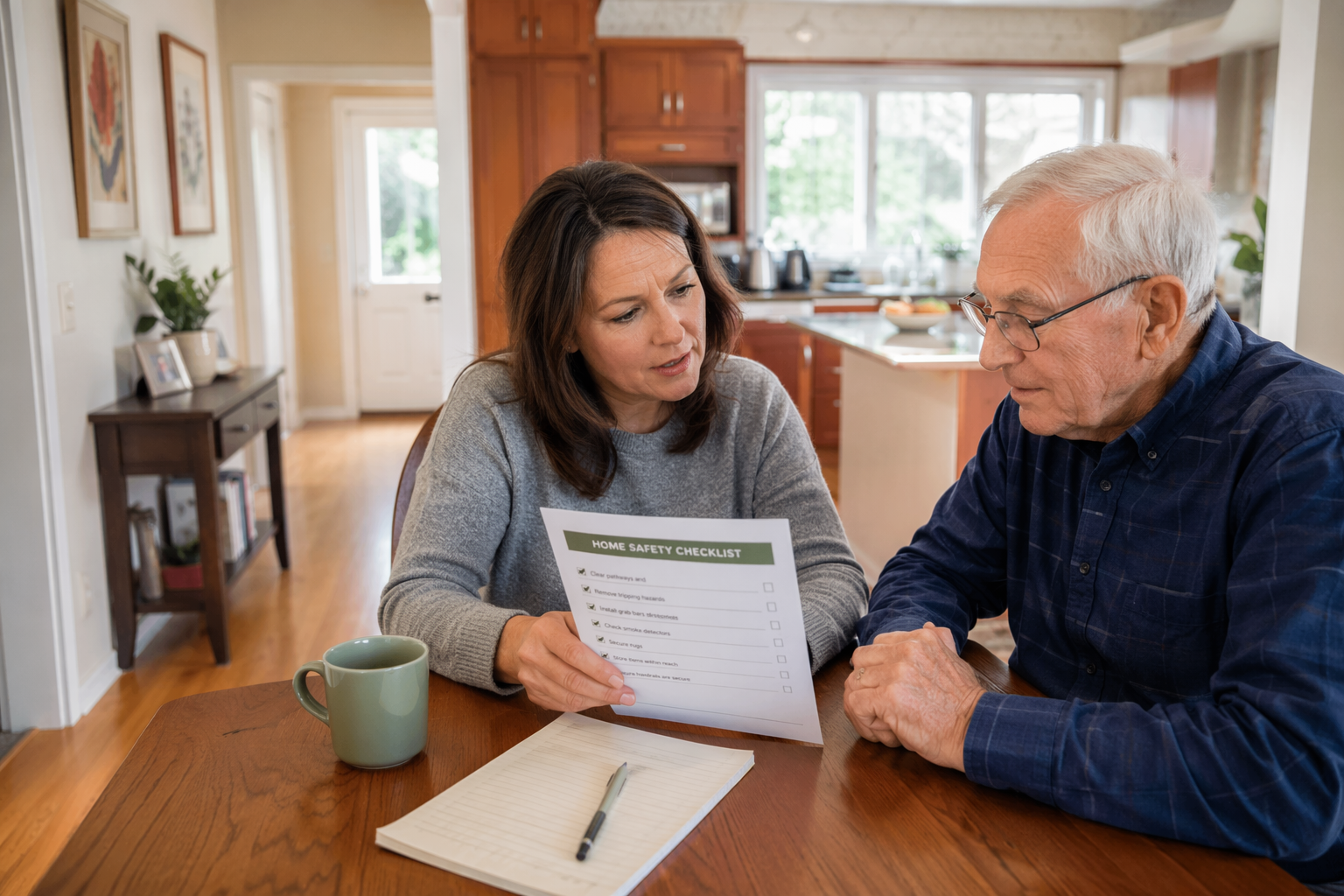
Start With Risk, Not Reassurance
The first question is not whether your parent “seems fine.” The first question is whether anything has changed: a fall, a near-fall, a new fear of walking outside, a hand suddenly reaching for furniture, a new medication, a quieter social life because stairs feel harder.
The CDC’s STEADI patient resources include two tools worth printing before you start: Stay Independent, a 12-question fall-risk self-assessment, and Check for Safety, a room-by-room home safety checklist.[1] The broader STEADI toolkit was designed to help primary care teams screen older adults for fall risk and connect that screening to assessment and intervention.[2]
I would not hand the form across the table and say, “Fill this out.” I would sit with the person and ask the questions out loud, because the answers often come with context. “I fell last month” may mean “I tripped over the dog bowl.” It may also mean “I got dizzy when I stood up,” or “I didn’t want to bother anyone, so I never mentioned it.” Those are different problems.
That last point matters. One in four older adults falls each year, falls are the leading cause of fatal and nonfatal injuries among older Americans, and fewer than half of older adults who fall tell their doctor.[3] That is not a reason to interrogate a parent. It is a reason to make the appointment easier: write down the fall, the date if known, what they were doing, whether they hit their head, whether dizziness or weakness came first, and whether they changed their routine afterward.
Falling once also doubles the risk of falling again, according to CDC STEADI patient materials.[1] A single fall deserves follow-up even when nothing was broken, because the next fall may happen after the same dizziness, the same loose rug, the same nighttime bathroom trip, or the same medication side effect.
Questions To Ask Without Taking Over
- Have you fallen in the past year, even if you were not hurt?
- Have you almost fallen or caught yourself on furniture, a wall, or another person?
- Do you feel unsteady when getting up from a chair, getting out of bed, turning, or stepping into the shower?
- Have you stopped doing anything because you are worried about falling?
- Do you feel dizzy, lightheaded, sleepy, or weak at certain times of day?
- Do you use a cane, walker, railing, furniture, or another person for balance?
If the answer to any of these is yes, the handout should become part of the medical visit. Bring the completed CDC assessment, the medication list, and a few notes from the house walk-through. A doctor can do more with “she gets dizzy after the morning pills and has started holding the wall between the bedroom and bathroom” than with “we’re worried about falls.”
Walk The House The Way Your Parent Actually Uses It
Do not begin with a whole-house renovation fantasy. Begin with the route your parent walks every day when tired, distracted, carrying laundry, using the bathroom at night, or answering the door. Falls often hide in ordinary paths.

The American Academy of Orthopaedic Surgeons states that 95% of hip fractures are caused by falls and that simple home changes can cut fall risk in half.[4] That is the kind of statistic that changes the chore list. A taped cord, a brighter bulb, a removed rug, or a properly installed grab bar is not cosmetic fussing. It is prevention.
Use the CDC Check for Safety checklist as the printed walk-through, then add your own notes in the margins.[1] The National Institute on Aging also organizes fall prevention by room, including floors, stairs, bathrooms, bedrooms, kitchens, and outdoor areas.[5] The categories matter because the fixes are different. A dim hallway needs lighting. A slippery shower needs traction and handholds. A front step with no railing may need a contractor.
The First Route: Bed To Bathroom
Start here because this route is often walked half-awake. Stand at the bed and look toward the bathroom. Is there a lamp within reach before getting up? Is the floor clear? Are slippers sturdy, or are they soft enough to twist? Is there a rug edge near the bed? Does the bathroom door swing easily? Is the toilet area lit without crossing a dark room?
Quick fixes belong on the handout with a checkbox: add a night-light, clear clothing from the floor, move a small table that narrows the path, place a phone within reach, remove loose rugs, and make sure glasses, cane, or walker are where the person can reach them before standing.
The Bathroom: Where Simple Advice Is Usually Too Vague
A bathroom inspection should be physical. Stand where your parent stands to get into the shower. Reach for the wall. If there is nothing solid to hold, write that down. Look at the bathmat, the shower floor, the toilet height, the lighting, and the towel bar. A towel bar is not a grab bar, even if someone has been using it as one.
This is where families should separate quick fixes from professional modifications. A non-slip mat, better lighting, and clearing clutter may be handled immediately. Grab bars, shower changes, stair railings, ramps, and doorway changes may need someone trained to match the modification to the person and the structure of the house. For that decision, use a comparison like CAPS, OT, or general contractor so the family does not hire the wrong help for the wrong problem.
Kitchen, Living Room, Entry, And Stairs
In the kitchen, look for reaching and carrying. Are everyday dishes stored high? Is the step stool wobbly? Does the person carry hot food while stepping around a rug? Could frequently used items move between shoulder and waist height?
In the living room, look for narrow paths and “temporary” obstacles that have become permanent: baskets, cords, ottomans, magazine stacks, pet items, footrests, and furniture that requires a sideways shuffle. A walking path should be wide enough for the mobility device the person actually uses, not the one everyone wishes they did not need.
At entries and stairs, look for weather, lighting, railings, and transitions. A threshold that is barely noticeable to a younger adult can be a real obstacle for someone with weak ankles, poor vision, neuropathy, or a walker. If your parent lives alone, add the communication layer too: how they would call for help from the porch, basement, garage, or yard. The home may look tidy and still be poorly prepared for aging in place; that broader mismatch is worth checking against an aging-in-place readiness guide.
For a parent living solo, the safety question is not only “can they avoid falling?” It is also “what happens if they do fall?” A phone left charging in another room, a locked door no one can open, or no regular check-in system can turn a fall into a longer crisis. Families can use an aging in place alone safety plan to connect fall prevention with response planning.
Build Strength Before The House Becomes The Only Safety Device
Home changes reduce hazards. They do not replace the body’s own ability to stand, turn, recover, and step. A parent who is getting weaker may need both: a safer bathroom and a plan to rebuild leg strength and balance.
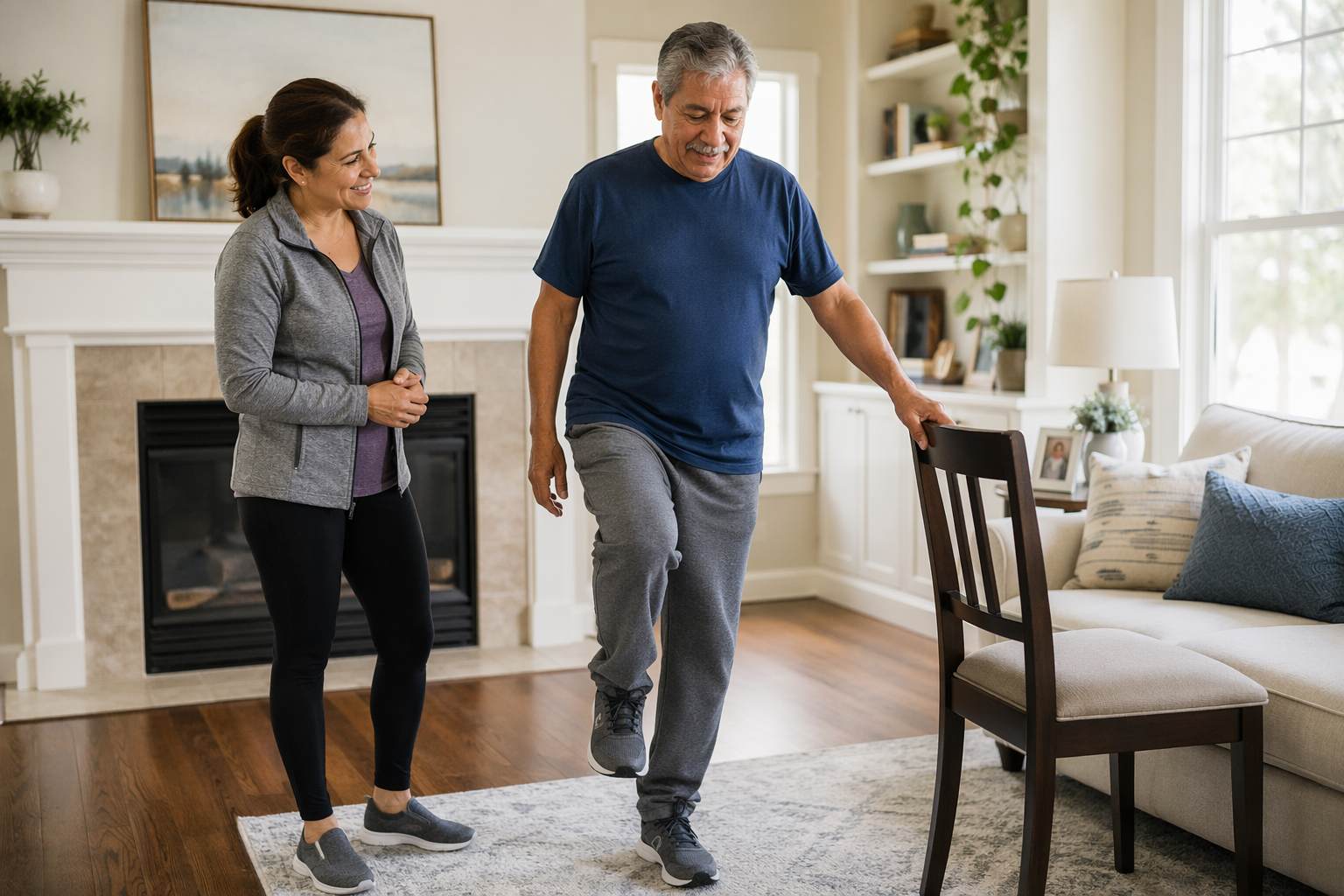
This does not mean inventing exercises from a video and hoping they fit. Ask the clinician whether your parent needs physical therapy, a supervised class, or a community program. NCOA identifies evidence-based fall prevention programs, including the Otago Exercise Program, which it says reduces falls by 35% to 40% for frail older adults, and Stepping On, which it says reduces fall risk by 31%.[7]
The caregiver job is usually not to become the trainer. It is to remove the friction: find the class, ask whether it is appropriate, arrange transportation, make space near a sturdy chair, and help the parent choose a time of day when they are not rushed or exhausted. For a parent whose mobility is already changing, connect the exercise plan to the home setup using a guide to maintaining mobility at home.
Bring The Medication List, Not A Guess
Medication review is one of the easiest fall-prevention steps to postpone because it feels medical, private, and complicated. It is also one of the easiest steps to prepare for. Put every prescription, over-the-counter medicine, supplement, and sleep aid on one list, with dose and timing if known. If the list is uncertain, bring the bottles.
Johns Hopkins Medicine notes that being on five or more medications significantly increases fall risk.[6] That does not mean the caregiver should decide what to stop. It means the prescribing clinician or pharmacist should be asked directly: which of these can cause dizziness, sleepiness, low blood pressure, confusion, or balance problems, and do any overlap?
Use ordinary language in the appointment. “She seems off after the morning pills.” “He is steadier before dinner than after.” “She got up at night after taking a sleep medicine.” Those observations are not diagnoses, but they are useful clues.
Schedule Vision And Hearing Checks As Part Of Fall Prevention
Vision belongs on the same page as rugs and railings. If a parent cannot see a curb edge, a stair nosing, a pet bowl, a dark hallway, or the difference between a glossy floor and a wet floor, the house is harder to navigate. Ask when the last eye exam happened and whether glasses are current, clean, and worn in the places where falls are most likely.
Hearing deserves attention too, especially if your parent misses environmental cues, startles easily, seems less aware of people approaching, or has stopped using hearing aids they already own. Some stronger hearing-loss statistics are not solid enough to repeat here as precise claims. The practical step is still reasonable: raise hearing changes with the clinician and make sure existing hearing aids are working, fitted, charged, and actually being used.
If A Fall Happens, Write Down More Than “They Fell”
A fall response plan should be written before anyone is on the floor. Decide who is called first, who has a key, which neighbor can check quickly, and when to call emergency services. If your parent lives alone, this plan should be visible and shared with the people who may actually be contacted.
After a fall, record what happened while details are fresh: time of day, room, footwear, lighting, activity, symptoms before the fall, injuries, whether the head was hit, how long the person was on the floor, and whether they could get up without help. Bring that record to the clinician. The point is not blame. The point is to find the next preventable link in the chain.
Use urgent care or emergency services when there is a possible head injury, severe pain, confusion, new weakness, chest pain, trouble breathing, suspected fracture, inability to get up, or any symptom that feels medically unsafe. A printable handout can organize the family response, but it should never replace medical evaluation after a concerning fall.
For the practical first hours after a fall, use the first 72 hours after a parent’s crisis. If this fall is the event that made you realize you are now the family systems person, the next document to print is the first 30 days as a caregiver.
The Printable Version
Use this one-page version as the working handout. Mark what is done, circle what needs an appointment, and add names and dates so the plan does not stay theoretical.
- Risk: Complete the CDC Stay Independent assessment. Write down all falls, near-falls, dizziness, balance changes, and fear of falling.
- Doctor visit: Bring the assessment, medication list, fall notes, and questions about dizziness, blood pressure, sleepiness, weakness, and mobility.
- Bedroom to bathroom: Add lighting, clear the path, remove loose rugs, place glasses and mobility aids within reach, and check footwear.
- Bathroom: Check shower entry, toilet area, flooring, lighting, towel bars, grab bars, mats, and whether professional installation is needed.
- Kitchen and living areas: Move frequently used items lower, remove cords and clutter, widen walking paths, and reduce reaching or carrying hazards.
- Stairs and entries: Check railings, lighting, thresholds, weather exposure, step edges, and whether repairs or modifications are needed.
- Strength and balance: Ask the clinician about physical therapy or an evidence-based fall prevention program. Set a realistic weekly routine.
- Medications: Review all prescriptions, over-the-counter medicines, supplements, and sleep aids with a clinician or pharmacist.
- Vision and hearing: Schedule needed checks. Make sure glasses and hearing aids are current, usable, and worn during daily routines.
- Fall response: List emergency contacts, key access, when to call 911, and what details to record after any fall.
The best version of this handout will have handwriting on it. A parent’s preference, a daughter’s note, a doctor’s instruction, a pharmacist’s warning, a contractor’s measurement, a class schedule. That is when it becomes useful: not as a substitute for care, but as the shared document that keeps everyone from assuming someone else handled the follow-through.
References
- STEADI Patient Resources, Centers for Disease Control and Prevention.
- The CDC's STEADI Initiative: Promoting Older Adult Health and Independence Through Fall Prevention, PMC.
- Get the Facts on Falls Prevention, National Council on Aging.
- Home Safety Checklist, AAOS OrthoInfo.
- Preventing Falls at Home: Room by Room, National Institute on Aging.
- Fall Prevention Exercises, Johns Hopkins Medicine.
- Evidence-Based Falls Prevention Programs, National Council on Aging.
Related reading
Noticed something outdated or inaccurate on this page? Flag a correction. We review every report against CDC, NIA, and AARP HomeFit guidance before updating a page.
Part of the Fall Prevention section.