
Hurricane Preparedness Tips for Seniors: Evacuate or Shelter in Place?
Deciding whether an aging parent should evacuate or shelter in place during a hurricane is not a simple yes-no question. This guide provides a structured decision framework tailored to seniors' medical, mobility, cognitive, and financial realities, plus preparation steps that must happen weeks before hurricane season.
The hard question is not whether hurricane evacuation orders matter. They do. The harder question for many families is whether an older parent can actually carry out the order safely, on time, with the equipment, medications, transportation, and supervision their health requires.
That distinction matters even in a season that looks quieter on paper. NOAA predicted a below-normal 2026 Atlantic hurricane season in May 2026, while still noting a 10% chance of above-normal activity; a lower seasonal forecast does not protect a particular coastal county, apartment building, or oxygen-dependent parent from one serious storm.[1]
So the useful question to ask before a storm is named is this: if an evacuation order comes, what are we actually doing? Not what sounds responsible in a calm phone call. Not what worked ten years ago. What can this parent do now, with their current mobility, cognition, housing, medical devices, income, and helpers?
Start With Orders, Then Test Whether the Plan Is Viable
Local emergency management instructions come first during an active storm. This guide is for the weeks before hurricane season and the quiet days before a storm becomes urgent. Its purpose is to expose the weak points in the family plan while there is still time to fix them.
For seniors, “evacuate or shelter in place” is not a clean yes-no choice. Evacuation can reduce exposure to storm surge, wind damage, flooding, and long outages. It can also create its own hazards: missed medications, transfer injuries, confusion in unfamiliar spaces, long waits without the right equipment, and exhaustion for someone who cannot sit in traffic for hours. Shelter in place may be reasonable for a well-supplied older adult in a safer structure with reliable help nearby. It is dangerous for someone who depends on powered medical equipment without backup power.
The family’s job is to decide which option can be made safe enough before the storm, not to defend a preference after conditions deteriorate.
A Senior Hurricane Decision Tree
Work through the decision in order. Do not start with “Mom refuses to leave” or “Dad always stays.” Start with the conditions that can kill or strand a person.
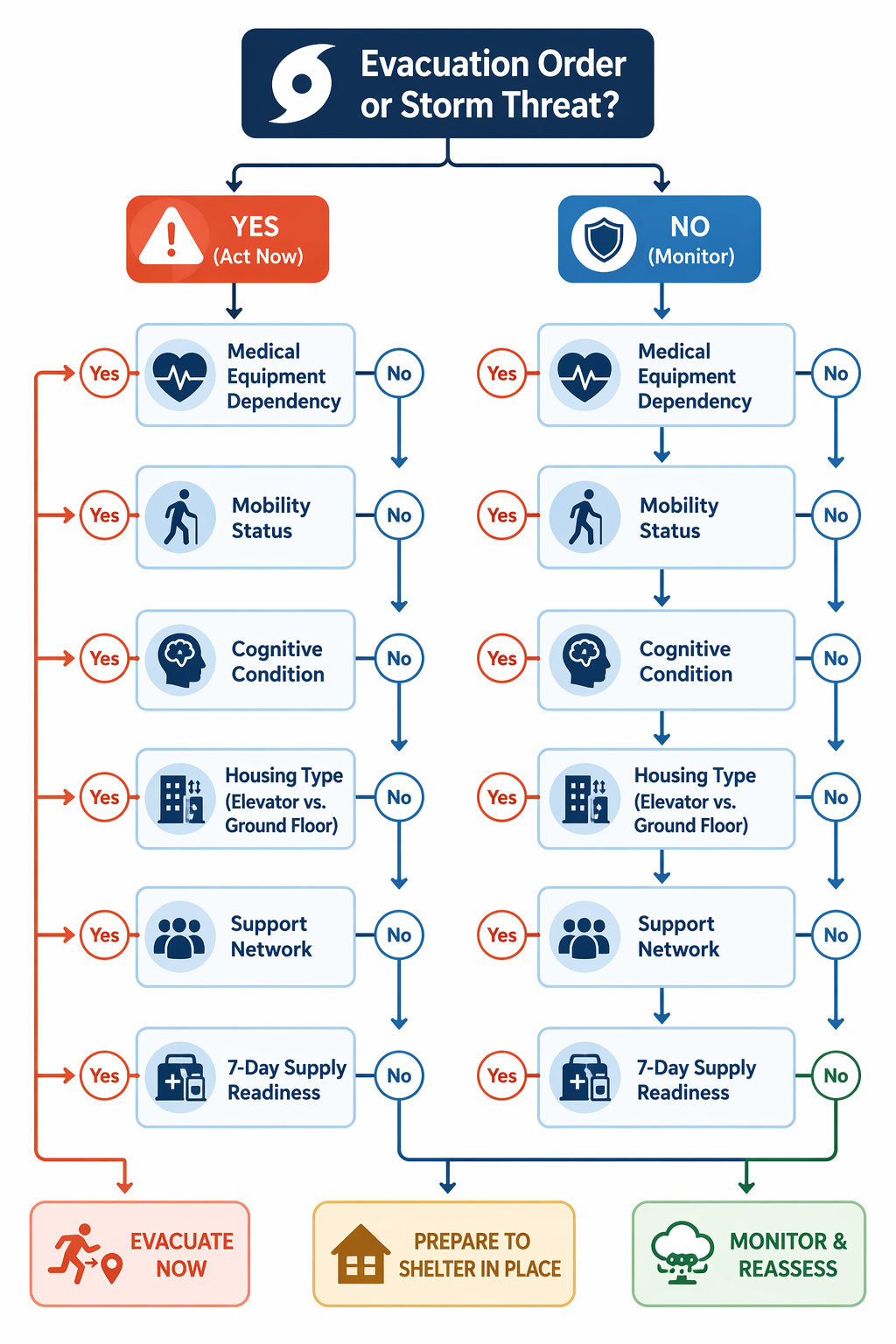
| Decision Point | If Yes | If No |
|---|---|---|
| Is the home in a mandatory evacuation zone or an area at risk of storm surge or flooding? | Plan to leave early, using the safest available destination: family home, hotel, general shelter, or special needs shelter. | Continue to housing, medical, mobility, cognition, support, and supplies checks. |
| Is the home a mobile home, unsafe structure, or building likely to lose critical access such as elevators? | Treat sheltering in place as unsafe unless local officials specifically identify the site as acceptable and support is arranged. | Continue to medical and mobility checks. |
| Does the parent rely on electricity for oxygen, CPAP, dialysis-related equipment, refrigeration, lift chairs, power wheelchairs, or communication? | Sheltering requires a tested backup power plan or a prearranged special needs shelter option. | Continue to medication, mobility, and support checks. |
| Can the parent transfer, walk, toilet, and tolerate travel safely with the available helper? | Evacuation may be possible if transportation, timing, destination, and medications are ready. | Arrange medical transport, special needs shelter support, or a staffed destination before storm season. |
| Does the parent have dementia, serious confusion, wandering risk, or poor judgment under stress? | Evacuation or sheltering requires continuous supervision, identification, medication control, and wandering precautions. | Continue to support-network check. |
| Is there a reliable local person who can physically check on the parent before, during, and after the storm? | Assign roles and check-in times in writing. | Do not assume phone calls are enough; build a remote monitoring and escalation plan. |
| Does the parent have at least seven days of realistic supplies and a way to manage heat, water, food, medications, toileting, and communication? | Sheltering may be considered if local officials allow it and the home remains safe. | Prepare to evacuate or arrange outside support before a storm is named. |
1. Evacuation Zone Comes Before Preference
If the home is in a mandatory evacuation zone, storm-surge area, low-lying flood area, or a location local officials identify as unsafe, the starting plan is to leave. A parent’s reluctance may explain why the plan will be hard; it does not erase the hazard.
What changes for older adults is the timing and destination. A frail parent who waits until highways are crowded may face hours without bathroom access, oxygen support, food, medication, or the ability to reposition. Nearly half of hurricane deaths are associated with delayed evacuation, according to FEMA data cited in guidance from the American Association for Geriatric Psychiatry; the same guidance also warns that forced relocation can carry serious health risks for frail older adults, including transfer trauma and medication disruption.[2]
That is the uncomfortable balance. Waiting can be deadly. Moving can be medically stressful. The answer is not to delay the decision; it is to prepare the move earlier and choose a destination that can support the parent’s actual condition.
2. Housing Can Make “Staying Home” Unrealistic
A one-story concrete-block home outside an evacuation zone is a different shelter-in-place situation from a mobile home, a flood-prone first-floor apartment, or a high-rise where elevator loss traps a parent above ground level. The caregiver has to think beyond whether the roof is likely to hold. Can the parent get out if emergency services advise leaving later? Can they reach the lobby if the elevator stops? Can they carry water, manage stairs, or tolerate heat if air conditioning fails?
For families already questioning whether the home setup is safe enough day to day, storm planning should not be treated as a separate issue. A home that barely works when the power is on and helpers arrive on schedule may fail quickly when roads close and routines break. A broader review of when senior home care is no longer enough can clarify whether sheltering in that environment is realistic.
3. Electric Medical Devices Are a Hard Stop Without Backup Power
This is one of the places where families often overestimate safety. If a parent uses oxygen equipment, CPAP, an electric wheelchair, a hospital bed, a lift chair, refrigerated medication, or communication technology they cannot do without, the plan cannot simply be “we’ll stay unless it gets bad.” Power loss may be the emergency.
In a National Poll on Healthy Aging study of adults ages 50 to 80, only 25% of seniors using electric medical devices reported having backup power plans.[3] The study did not include adults over 80, who are often more medically vulnerable, so that gap should not reassure families caring for the oldest parents.
For an electricity-dependent parent, sheltering in place requires a tested answer to each question: how long will the device run without grid power, who knows how to switch to the backup, where will batteries be charged, what happens if the outage lasts longer than expected, and which shelter or medical destination can accept the equipment? If those answers are not already written down, staying home is not a plan.
4. Mobility Decides the Transportation Plan
A parent who walks independently and can sit in a car for several hours needs a different evacuation plan from a parent who needs two-person transfers, a wheelchair-accessible vehicle, oxygen during transport, or help toileting. Families should be honest about the physical work involved. If one adult child cannot safely transfer the parent on an ordinary day, that child will not become stronger when rain bands arrive and everyone is tired.
The transportation plan should name the driver, vehicle, departure trigger, destination, backup driver, and backup destination. For wheelchair users or bedbound parents, it may need to include paratransit, medical transport, a facility evacuation plan, or a special needs shelter. These arrangements belong in preseason planning, not in the final grocery-store rush.
5. Dementia Changes Both Evacuation and Shelter Plans
Evacuating a parent with dementia may be necessary, but relocation is not automatically safer just because the building is safer. A shelter, hotel, or relative’s home can introduce unfamiliar doors, noise, disrupted sleep, crowding, and overstimulation. Those are not small inconveniences for someone who may already misread danger or become frightened when routines disappear.
The Alzheimer’s Association reports that 60% of people with dementia will wander, and that half of those not found within 24 hours suffer serious injury or death.[4] In hurricane planning, that statistic should change the supervision plan. It means no assumption that a confused parent will remain in a shelter cot, hotel room, or guest bedroom because everyone told them to stay there.
For families weighing identification devices, location technology, and consent concerns, a deeper GPS tracking framework for dementia wandering can help. For a parent whose dementia already requires around-the-clock oversight, the storm plan may also need to be part of a larger decision about 24-hour care at home versus memory care.
6. Living Alone Is a Planning Risk, Not a Personality Trait
Many older adults sound calm on the phone because they do not want to worry their children, do not know what help they need, or have survived storms before. Calm is not the same as ready.
The National Poll on Healthy Aging study found that older adults living alone were significantly less likely to have emergency supplies or evacuation conversations.[3] That finding matters for long-distance caregivers in particular. If nobody has physically checked the flashlight batteries, oxygen backup, medication supply, food, water, and transportation plan, then the plan may exist only as a family assumption.
Long-distance families need a named local helper, not just a promise to “call if anything happens.” The helper may be a neighbor, relative, building staff member, faith-community contact, paid caregiver, or care manager. Their job should be specific: check the apartment before storm season, confirm supplies, help with registration, report when power fails, or assist with evacuation. A remote monitoring plan for long-distance caregivers can support that arrangement, but it cannot replace a person who can act when roads and elevators are affected.
7. Money Affects the Decision More Than Families Like to Admit
Some seniors do not stay because they are stubborn. They stay because a week away means hotel costs, gas, pet boarding, replacement food, medical copays, lost caregiver hours, or expenses they cannot float until reimbursement arrives. PBS NewsHour reported that 24% of older adults cannot afford a week away from home.[5]
That financial constraint does not make an unsafe home safe. It does mean the family should solve the cost problem before the season: identify public shelters, special needs shelters, relatives within driving distance, pet-friendly options, transportation assistance, and who can pay for gas, lodging, medications, and food if evacuation becomes necessary.
The same PBS report also cites the widely repeated figure that 13 million Americans age 50 and older would need help evacuating.[5] That estimate traces to older survey data, so it should be used carefully. The useful point is narrower and still serious: a large number of older adults cannot simply get in a car and leave without help.
What to Prepare Weeks Before Hurricane Season
Both choices require preparation. Evacuation without medications, transport, and supervision can become dangerous. Sheltering without power, water, cooling, communication, and check-ins can become dangerous. The work is not choosing one word; it is making the chosen option executable.
Register for Special Needs Shelter Support Early
A special needs shelter is not the same as a hospital, nursing home, or private medical evacuation service. Programs vary by state and county, but they are commonly intended for people who need more support than a general shelter can provide and do not require hospital-level care. That may include people who depend on electricity for medical equipment, need assistance with basic care, or cannot manage a general shelter safely.
Florida’s Special Needs Registry is a useful example because it is explicit about advance registration: the state notes that registration closes when a storm enters the Gulf.[6] Other coastal states and counties may use different systems, deadlines, eligibility rules, and transportation arrangements. Search for “[your state] special needs shelter registration” and then confirm county-level instructions.
Do not wait to ask whether a parent qualifies. Registration can take paperwork, physician information, caregiver details, and equipment lists. Even if the parent never uses the shelter, registration gives the family one more viable path.
Build the Medication Plan Around Interruptions
A go-bag with two pill bottles is not enough for a medically complicated parent. The American Red Cross recommends that older adults prepare a 30-day supply of medications, along with plans for refrigerated medications such as insulin.[7]
The medication plan should include a current list of prescriptions, doses, prescribers, pharmacies, allergies, medical conditions, insurance cards, and emergency contacts. Keep one copy in the go-bag, one with the caregiver, and one available digitally. For refrigerated medications, decide in advance how they will stay cold during transport, at a shelter, or through an outage. A cooler is not a plan unless someone knows how long it maintains the required temperature and how ice will be replaced.
Write the Power Plan Down
List every device that depends on electricity and what happens when it fails. Include oxygen concentrators, CPAP machines, nebulizers, electric beds, lift chairs, power wheelchairs, stair lifts, communication devices, hearing-aid chargers, medication refrigerators, and cell phones.
- Ask the equipment supplier how long battery backup lasts and whether extra batteries are available.
- Confirm whether the device can be used with a generator, portable power station, or vehicle inverter.
- Know where the device can be charged if the home loses power.
- Keep extension cords, chargers, and labels with the equipment, not scattered around the house.
- Register with the utility or local emergency program if medical dependency reporting is available, while understanding that registration does not guarantee uninterrupted power.
If the family cannot create a realistic power plan, that is not a small missing detail. It changes the evacuation decision.
Make Transportation an Agreement, Not a Hope
A transportation agreement should name who leaves with the parent, when they leave, what vehicle they use, where they go, and what happens if the first driver is unavailable. For a parent with mobility limitations, it should also name who can transfer them, whether the vehicle can hold a wheelchair or walker, and whether oxygen or other equipment can travel safely.
If the parent lives in a facility, ask for the written evacuation plan before hurricane season. If the parent receives home care, ask what the agency does when roads close or staff evacuate. If the answer is vague, build a family backup plan.
Prepare for Dementia Supervision, Not Just Dementia Supplies
For a parent with dementia, the hurricane kit should include familiar clothing, comfort items, snacks, continence supplies, copies of routines, and medication instructions. But the larger question is supervision. Who watches the exit? Who sleeps nearby? Who handles agitation without escalating it? Who keeps the parent from leaving a shelter, hotel, or relative’s house during the night?
Identification should be easy to find if the parent becomes separated: current photo, name, diagnosis, emergency contacts, medications, allergies, and destination address. Some families use wearable ID, shoe tags, wallet cards, or location devices. The right choice depends on the parent’s stage, habits, and consent capacity.
Set a Check-In Protocol for the Parent Who Lives Alone
A check-in protocol should be boringly specific. Decide who calls, at what times, what the parent must confirm, and what happens if there is no answer. “Call me after the storm” is too loose for someone at risk of falls, heat illness, medication interruption, or confusion.
- Before the storm: confirm location, supplies, medication, power plan, phone charge, and evacuation status.
- During the storm, if safe communication is possible: confirm power, water, breathing equipment, temperature, and falls.
- After the storm: confirm injuries, flooding, food safety, medication access, cooling, and whether the parent can exit the home.
- If unreachable: contact the named local helper, building staff, county non-emergency number, or emergency services depending on the situation.
Keep Documents Where Helpers Can Use Them
Important documents should not be locked in a file cabinet only the parent can explain. Keep copies of identification, insurance cards, medication lists, advance directives, power of attorney documents if applicable, physician contacts, equipment supplier contacts, and emergency contacts in a waterproof folder. A caregiver should have access to digital copies.
For parents who resist sharing paperwork, keep the request practical: if a shelter nurse, emergency department, or out-of-town relative needs the information, where will they find it?
When Shelter in Place Can Be Reasonable
Sheltering in place may be reasonable when local officials have not ordered evacuation, the home is structurally safer, flood and surge risk are low, the parent can function through an outage, and a reliable helper can check on them. It should still be treated as an active plan, not as the absence of an evacuation plan.
For seniors, the usual emergency kit advice needs a functional test. Seven days of bottled water does not help if the parent cannot lift it. Shelf-stable food does not help if they cannot open containers. A flashlight does not help if batteries are dead or the parent forgets where it is. A charged phone does not help if the charging cable is in another room and the power is out.
- Water and food the parent can physically access, open, chew, swallow, and prepare without power.
- Medication, medical supplies, continence products, wound-care supplies, and glasses or hearing-aid supplies.
- Cooling strategy for heat, especially if air conditioning fails.
- Safe lighting that reduces fall risk during nighttime bathroom trips.
- A way to communicate if cell service is poor or the phone battery dies.
- A local person assigned to check the home after the storm, not only call.
For a parent with dementia, also look at the physical environment: blocked exits, unsafe appliances, trip hazards, confusing rooms, and items that could become dangerous during a power outage. Families working on broader safety changes may find a stage-by-stage dementia-friendly home modification guide useful before deciding that home is the safest place to ride out a storm.
When Evacuation Needs a Higher-Support Destination
A general public shelter may be appropriate for some independent older adults. It may be the wrong setting for a parent who needs electricity for medical equipment, hands-on assistance with toileting or transfers, dementia supervision, medication administration, oxygen support, or a quiet environment to prevent severe agitation.
Do not assume a relative’s home is automatically better. Ask the same questions: Are there stairs? Is there a walk-in shower? Can oxygen be used safely? Is there room for a hospital bed, wheelchair, walker, or commode? Who will stay awake if the parent wanders? Is the home outside the storm’s likely impact area, or is the family only moving the parent from one unsafe place to another?
A safer evacuation destination is the one that can support the parent’s needs, not the one that makes the family feel least guilty.
Finish the Plan Before the First Serious Forecast
Complete the decision tree while the weather is quiet. Choose a primary plan and a backup plan. If the primary plan is evacuation, name the destination, transportation, departure trigger, medication process, equipment plan, and supervision needs. If the primary plan is sheltering in place, confirm the home’s safety, power backup, supplies, communication, cooling, and local check-ins.
Then revisit the plan whenever something changes: a new oxygen order, a fall, a dementia diagnosis, a moved caregiver, a lost driver’s license, a new apartment, a medication that needs refrigeration, or a neighbor who can no longer help. Hurricane preparedness tips for seniors are only useful when they match the older adult who is actually living in the home this season.
References
- NOAA predicts below-normal 2026 Atlantic hurricane season, NOAA, May 2026.
- Older Adults and Disaster Preparedness and Response, American Association for Geriatric Psychiatry.
- Emergency Preparedness Among Older Adults, National Poll on Healthy Aging.
- In a Disaster, Alzheimer’s Association.
- Why it can be more difficult to evacuate older adults in a disaster, PBS NewsHour.
- Special Needs Registry, Florida Department of Health.
- Older Adults, American Red Cross.
Related reading
Noticed something outdated or inaccurate on this page? Flag a correction. We review every report against CDC, NIA, and AARP HomeFit guidance before updating a page.
Part of the Fall Prevention section.