
STEADI: intervene
What to Add to Your Parent's Hurricane Kit to Prevent Falls
This article identifies the specific fall-prevention items most standard hurricane kits omit — glow-in-the-dark mobility aids, motion-sensor nightlights, non-slip treads, and a pre-storm rug plan — so caregivers can build a senior's emergency kit that addresses the leading cause of injury during and after a storm.
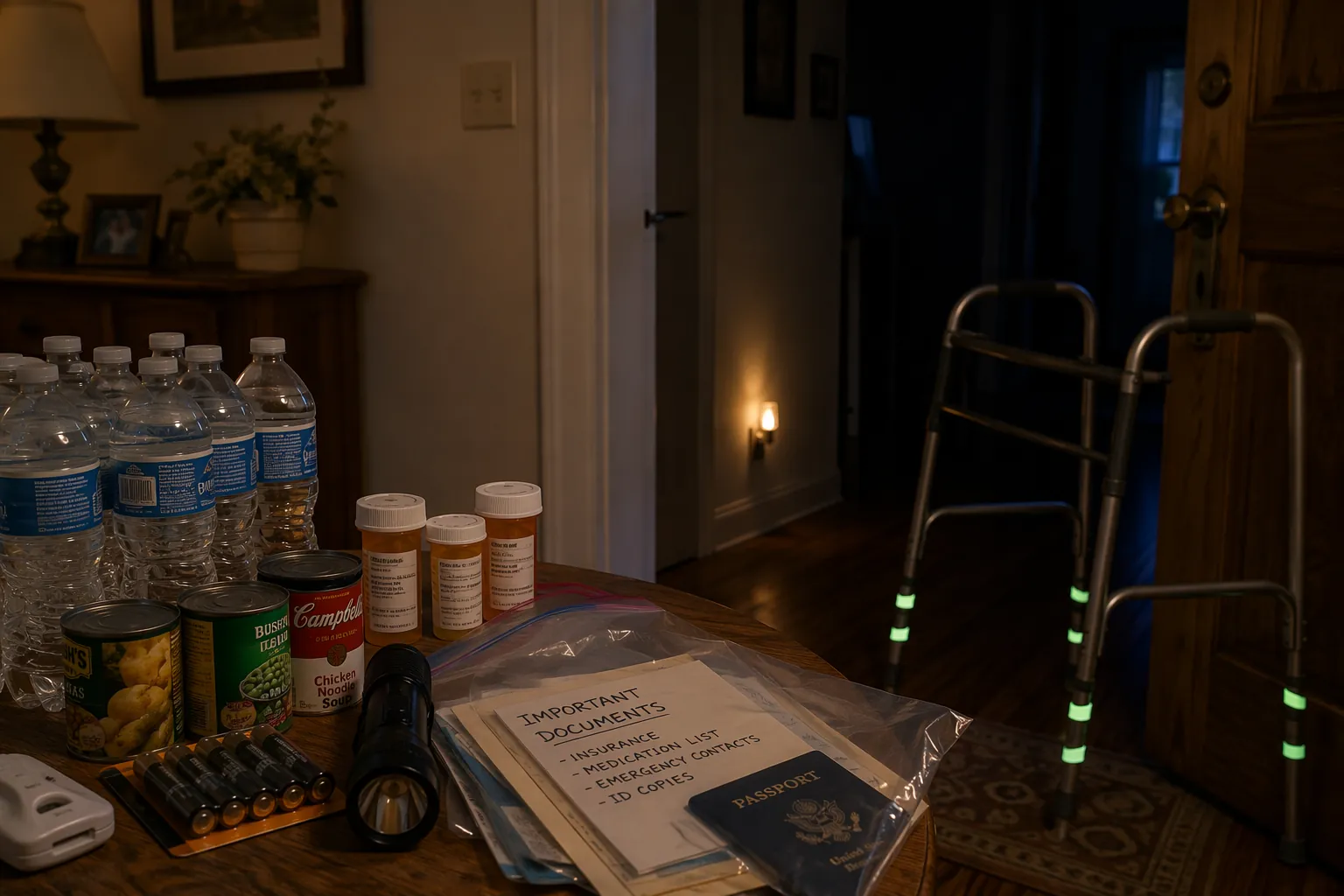
The hurricane kit can look finished and still leave the most dangerous trip in the house untouched. Your parent may have water, canned food, batteries, medication, copies of documents, and a flashlight in the bin. That covers a lot of what standard emergency checklists ask for. Ready.gov tells households to build kits with water, food, a flashlight, a first-aid kit, extra batteries, medications, sanitation supplies, and important family documents; the Red Cross survival kit list follows the same practical baseline.[1][2]
But after the power goes out, the kit is not the one walking to the bathroom at 3 a.m. Your parent is. The hallway is darker than usual. The entryway may be damp. A throw rug may have been shoved aside during storm prep. A walker may be across the room because furniture was moved away from windows. That is where an emergency kit checklist for elderly during hurricane season needs a second layer: not more generic supplies, but fall-prevention items placed where movement actually happens.
Why Falls Need Their Own Kit Layer
Falls are already common before a storm changes the house. The CDC reports that more than 1 in 4 older adults fall each year in the United States.[3] A hurricane adds exactly the conditions that make an ordinary fall more likely: poor lighting, wet surfaces, displaced furniture, fatigue, rushed bathroom trips, and disrupted routines.
Disasters also do not affect older adults evenly. AARP’s disaster resilience work notes that adults age 75 and older were about 6% of New Orleans’ population before Hurricane Katrina but accounted for roughly half of Katrina deaths; it also reports that adults age 60 and older made up 70% of Hurricane Ian fatalities.[4] Those figures are not a reason to panic-buy gadgets. They are a reason to stop treating “senior-specific” as a label slapped onto the same old kit.
If you still need the full baseline kit, start with How to Build a Hurricane Emergency Kit for an Elderly Parent. This article assumes that part is mostly handled. The question here is narrower and more practical: what do you add so your parent can stand up, see the route, keep traction, reach the mobility aid, and avoid improvising when the house is not behaving like it usually does?
Start With the Dark Hallway, Not the Supply Bin
The first fall-prevention items to add are the ones that make the walking path visible without requiring your parent to hunt for anything. A flashlight in a drawer is better than no flashlight, but it still asks a half-awake person to remember the drawer, open it in the dark, and hold the light while using a cane or walker.
Keystone Health’s emergency preparedness guidance for seniors is unusually useful here because it does not stop at “have a flashlight.” It advises placing flashlights in every room, using glow sticks on mobility aids before a storm, removing throw rugs, and securing cords to reduce fall risk during outages.[5]
| Add this | Put it here | Set it up when | Fall mechanism it reduces |
|---|---|---|---|
| Motion-sensor nightlights | Bathroom, hallway, bedroom route, kitchen path | Before storm conditions begin | Walking blind or reaching for switches in the dark |
| Glow-in-the-dark tape | Walker legs, cane shaft, rollator frame, bedside grab point | Before the first expected outage | Losing sight of the mobility aid or misjudging its position |
| Flashlights in every room | On open surfaces, not buried in drawers | When the kit is staged | Crossing rooms to find one central flashlight |
| Glow sticks or visibility markers | Walker basket, cane handle, bathroom doorway, bed rail | The day the storm approaches | Missing key objects and path edges during low light |
Motion-sensor nightlights belong low and along the actual route, not just in the room where the kit sits. Put one near the bed, one in the hallway, one in the bathroom, and one anywhere your parent routinely turns. Battery-powered or rechargeable models are useful where outlets are scarce, but the important detail is placement. The light should appear before your parent has to take the first uncertain step.
Glow-in-the-dark tape is not decoration. It is a way to make a walker, cane, rollator brake handle, or bedside grab point show up when the room loses its normal visual cues. Add short strips where the eye naturally looks: the upper crossbar of a walker, the sides of the frame, the cane handle, and the front legs that can blend into shadows. Do it while the lights are still on, then check it from the bed with the room dimmed.
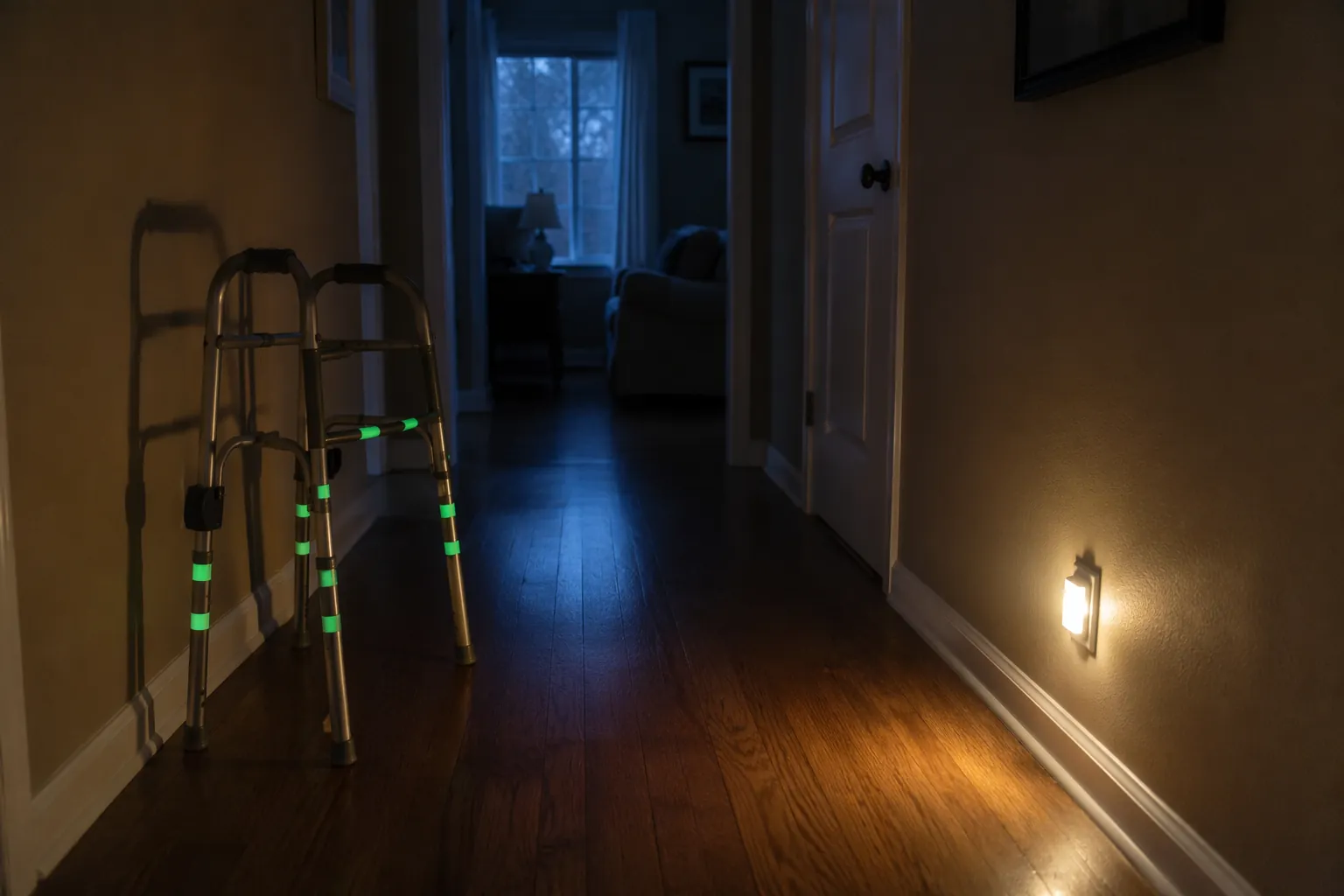
Flashlights should be staged like handrails: wherever your parent may need one, not wherever the family usually stores one. Put one beside the bed, one in the bathroom, one near the favorite chair, one in the kitchen, and one near the exit path. If your parent uses both hands for a walker, add a headlamp or clip-on light rather than expecting them to carry a flashlight while steering.
Glow sticks or clip-on visibility markers are useful because they can mark objects that should not disappear in the dark: the walker, the bathroom doorway, the edge of a step, the bedroom door, or the bag that holds medications and incontinence supplies. Tape them down or attach them securely. A loose glow stick on the floor becomes one more thing to step on.
Pack Traction Before the Floor Gets Wet
Storm advice often says “be careful on wet floors,” which is technically true and practically useless. A wet entryway, bathroom tile, laundry room, or porch threshold needs a plan before rain is blowing sideways and everyone is tired.
Add a pair of non-slip, closed-back shoes to the hurricane kit or go-bag. Not slippers. Not flip-flops. Shoes your parent can put on quickly, keep on securely, and walk in with a cane or walker. Place them beside the bed when the storm approaches, not in the closet. If your parent evacuates, those shoes should travel with them because unfamiliar floors at shelters, hotels, or relatives’ homes can be just as tricky as a dark hallway.
Pre-cut non-slip treads are another small item that earns its space. If there are two or three steps between the garage and kitchen, a slick porch edge, or a single step down into a sunroom, cut the treads before hurricane season and label where they go. Waiting until the rain starts is how the job gets skipped or done badly.
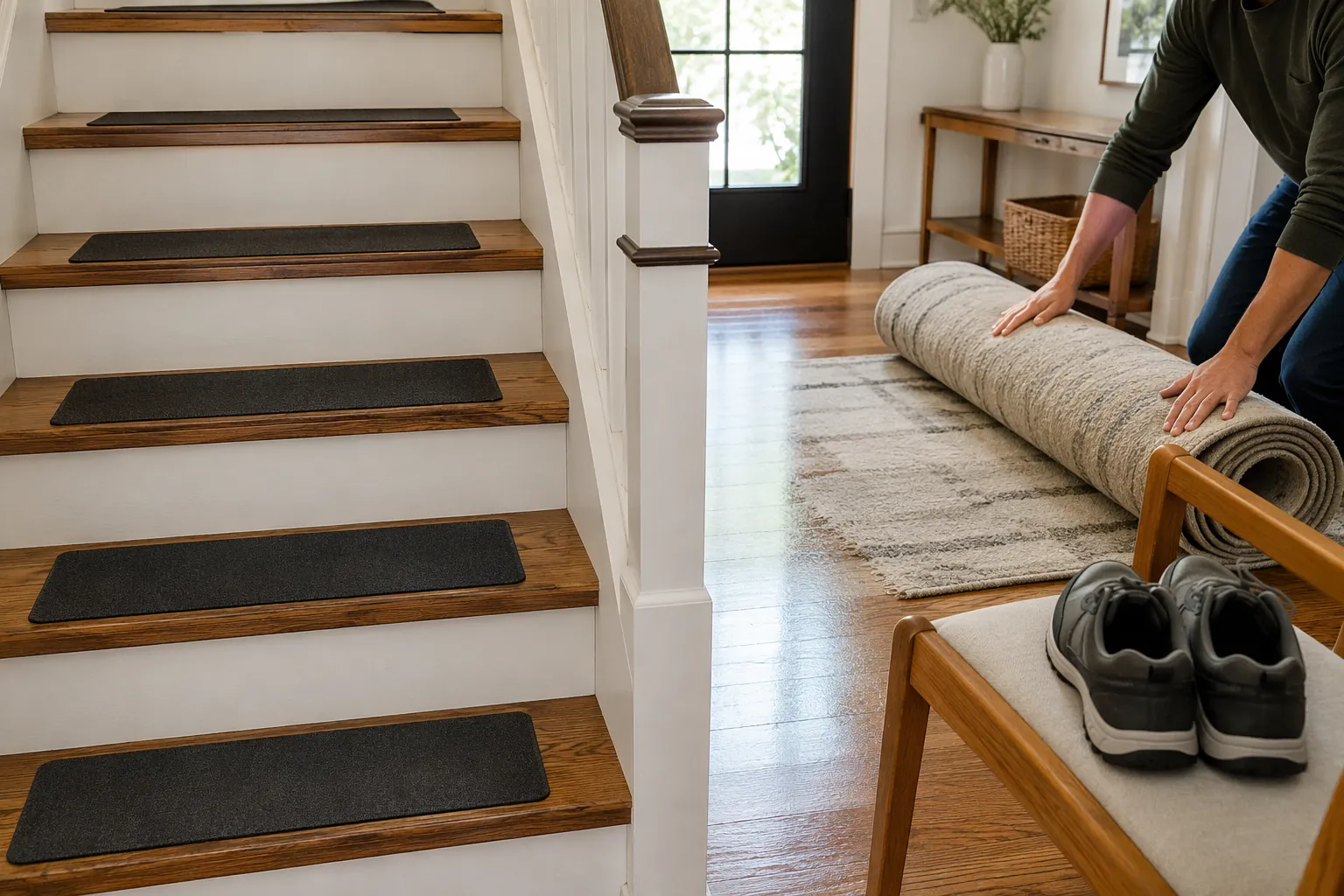
The wet-floor part of the kit can be simple: absorbent towels that do not migrate into the walking path, a small roll of painter’s tape to hold down a temporary mat edge if needed, and a trash bag for soaked items. The goal is not to create a perfect dry house during a hurricane. It is to avoid the common bad fix: throwing a towel onto the floor and forgetting that it now slides, bunches, and catches a walker foot.
Make a Rug Plan While Everyone Is Calm
Throw rugs deserve their own decision because they are exactly the kind of familiar hazard families stop seeing. Keystone Health specifically includes removing throw rugs and securing cords in its power-outage fall-prevention advice for seniors.[5] That matters more during storm prep, when furniture moves, extension cords appear, towels come out, and normal walking routes change.
Do not wait until the wind is up to negotiate every rug in the house. Walk the route from bed to bathroom, bedroom to kitchen, favorite chair to bathroom, and bedroom to exit. Decide which rugs get rolled up, which ones need non-slip backing, and where they will be stored so they do not become clutter in another hallway.
- Remove small loose rugs from the bathroom, hallway, bedside, kitchen sink, and entry path before storm conditions begin.
- Tape or route cords along walls, not across the path your parent uses with a cane, walker, or wheelchair.
- Keep storm supplies off the floor; a case of water beside the hallway wall can narrow a walker path enough to matter.
- After moving patio furniture or window coverings inside, re-walk the route with the mobility aid in place.
For a broader room-by-room pass, use Room-by-Room Hurricane Safety for Seniors Living Alone. If the same hazards come up every season, the kit may be telling you the house needs permanent changes; Home Modifications That Keep Seniors Safe During Tropical Storms is the better place for grab bars, lighting upgrades, threshold fixes, and other work that should not be improvised during a watch or warning.
Do Not Let the Medical Kit Create a Movement Problem
The medical side of the hurricane kit still matters. The Red Cross advises older adults to keep a 30-day supply of medications, include extra assistive items such as canes and eyeglasses, and plan for medical devices that need power.[6] Ready.gov’s older-adult guidance also emphasizes support networks, medications, medical equipment, mobility needs, and power-dependent devices.[7]
The fall-prevention question is where those items sit and what happens when a routine breaks. If blood pressure medication, diabetes supplies, hearing aid batteries, eyeglasses, or a cane tip are across the house, your parent may make extra trips when the lighting is worst. If incontinence supplies are not reachable, a bathroom trip becomes rushed. If the power plan for a medical device is vague, the family may move equipment in a hurry and leave cords across the path.
AgingCare’s senior emergency kit recommendations include items such as incontinence supplies, waterproof document storage, extra eyeglasses, hearing aid batteries, and backup mobility support.[8] Those are often treated as comfort or paperwork details. In a fall-prevention kit, they also reduce unsafe improvising: fewer rushed bathroom trips, fewer searches in the dark, fewer last-minute trips to another room.
- Keep medication, glasses, hearing aid supplies, and phone chargers in a reachable, well-lit staging area.
- Pack incontinence supplies where your parent can reach them without crossing the house.
- Store copies of medical documents in a waterproof pouch so nobody has to search drawers during an evacuation.
- Add spare cane tips, walker glides, batteries, and any small part that would make a mobility aid unsafe if it failed.
- Write the medical-device power plan on paper, including who checks it and when, so cords and equipment do not get moved in a panic.
Build the Go-Bag for the First Ten Steps Out the Door
Evacuation packing usually focuses on what your parent will need after leaving. That is important, but the first fall risk may be the walk from the bedroom to the car: wet threshold, rushed timing, dim garage, narrow path, loose sandals, bag too heavy, walker in the wrong place.
Pack the go-bag so it does not compete with the mobility aid. A backpack or small rolling bag may work for some families; for others, the caregiver should carry the bag and leave your parent’s hands free for the walker or cane. Do not hang a heavy kit from a walker unless the walker is designed and balanced for that load. A bag that swings or pulls forward can change how the device behaves.
The go-bag should include the non-slip shoes, a backup pair of glasses if available, essential medications, incontinence supplies, a small flashlight or headlamp, a charged phone power bank, waterproof documents, and any compact mobility backup your parent actually uses. If evacuation planning is the bigger issue, especially for limited mobility, the wildfire-focused evacuation plan for seniors with limited mobility is a useful comparison because the same movement problems show up in a different disaster.
Place Supplies Where the Storm Will Interrupt Routine
A fall-prevention kit is partly a supply list and partly a placement job. If everything is packed neatly in one plastic bin, the house may still fail your parent at the bedside, the bathroom doorway, or the step into the garage. Split the kit by use.
| Location | Stage these items | Why it matters |
|---|---|---|
| Bedside | Non-slip shoes, flashlight or headlamp, glasses, phone, walker or cane within reach | The first steps after waking are often taken in the worst lighting |
| Bathroom route | Motion-sensor nightlights, clear floor, removed rugs, reachable incontinence supplies | Bathroom trips are where rushing and slick surfaces meet |
| Main chair | Flashlight, phone charger, water, medication schedule, mobility aid parked consistently | Long outages shift daily life into one or two rooms |
| Entry or exit path | Non-slip treads, clear threshold, dry towel plan, go-bag that does not block the walker | Evacuation and post-storm checks often happen under stress |
| Medical equipment area | Power plan, cords routed along walls, backup batteries if used | Last-minute equipment moves can create trip hazards |
If your parent likes to monitor storm updates, make that safer too. Set up the radio, phone charger, written contact list, and flashlight near the chair or bed so they are not walking through a dark house to check alerts. For that specific problem, see How Seniors Can Monitor Hurricane Updates Safely.
A Fall-Prevention Add-On Checklist
This is the layer to add after the standard hurricane kit is packed. It does not replace water, food, medication, batteries, first aid, evacuation contacts, or official emergency guidance. It fills the gap between “we have supplies” and “my parent can move safely while using them.”
- Motion-sensor nightlights for the bedroom, bathroom, hallway, kitchen path, and any turn in the walking route.
- Glow-in-the-dark tape for walker legs, cane handles, rollator frames, bed rails, and other key touchpoints.
- Flashlights in every room, placed on open surfaces; add a headlamp or clip-on light if your parent uses both hands for mobility.
- Glow sticks or secure visibility markers for mobility aids, bathroom doorways, step edges, and the emergency bag.
- Non-slip, closed-back shoes staged beside the bed and packed in the go-bag if evacuation is possible.
- Pre-cut non-slip treads for known slick steps, thresholds, porch edges, or garage entries.
- A written rug plan: which rugs are removed, which are secured, and where they are stored before the storm.
- Cord-control supplies such as painter’s tape, cord clips, or routing labels so charging cables and medical-device cords stay out of the walking path.
- Reachable incontinence supplies, spare eyeglasses, hearing aid batteries, and waterproof documents to prevent rushed searches.
- Backup mobility parts or aids your parent already knows how to use, such as cane tips, walker glides, or a manual wheelchair if appropriate.
For a full storm-season sequence, use A Fall-Safe Tropical Storm Preparedness Checklist for Seniors or the broader Hurricane Preparedness Checklist for Older Adults to Prevent Falls. Those cover timing across the season, during the storm, and after the storm. The kit list here is the part you can put in your hands and place around the house.
The Pre-Storm Placement Check
Before the first serious weather arrives, walk the house as if the power is already out. Start where your parent sleeps. Can they see the walker or cane? Are the non-slip shoes reachable without standing barefoot? Is the bathroom route lit without a wall switch? Are loose rugs gone from the path? Are cords along the wall? Is the flashlight visible from the bed or chair?
Then check the wet spots: entryway, bathroom, kitchen, garage step, porch threshold. Put treads where they belong. Decide where damp towels will go so they do not become sliding rugs. Move cases of water, coolers, storm shutters, and supply bins out of the walker path.
A hurricane kit for an older parent is not complete just because it can sustain them for days. It is complete when it also helps them move through those days: from bed to bathroom, chair to kitchen, hallway to exit, without asking them to navigate darkness, water, clutter, and missing mobility aids at the worst possible time.
References
- Build A Kit, Ready.gov.
- Survival Kit Supplies, American Red Cross.
- Facts About Falls, CDC.
- Impact of Disasters on Older Adults, AARP, November 2022.
- Emergency Preparedness for Seniors, Keystone Health.
- Older Adults Emergency Preparedness, American Red Cross.
- Older Adults, Ready.gov.
- 10 Things to Include in a Senior Emergency Kit, AgingCare.
Related reading
Noticed something outdated or inaccurate on this page? Flag a correction. We review every report against CDC, NIA, and AARP HomeFit guidance before updating a page.
Part of the Fall Prevention section.