
STEADI: Intervene
How Senior Hikers Can Stay Safe From Lightning Without Falling
Standard lightning safety advice can create dangerous fall risks for older hikers. This guide provides fall-safe adaptations for every step—from earlier turn-back thresholds to modified shelter postures—so seniors can protect themselves without rushing into a fall.
The dangerous moment for an older hiker is often not the lightning flash. It is the first crack of thunder, the darkening ridge, and the sudden decision to hurry downhill over wet rock because “we have to get out of here.” That instinct is understandable. It is also where many standard lightning safety tips for senior hikers need translating into movements an older body can actually perform.
For adults 65 and older, falls are already common: the CDC reports that about 1 in 4 older adults, more than 14 million people, fall each year.[1] That statistic is not hiking-specific, and it should not be used to frighten capable hikers off the trail. It does, however, set the right baseline. Add loose gravel, bifocals, a steep descent, arthritic knees, thunder, and a walking partner saying “come on,” and evacuation itself becomes a hazard.
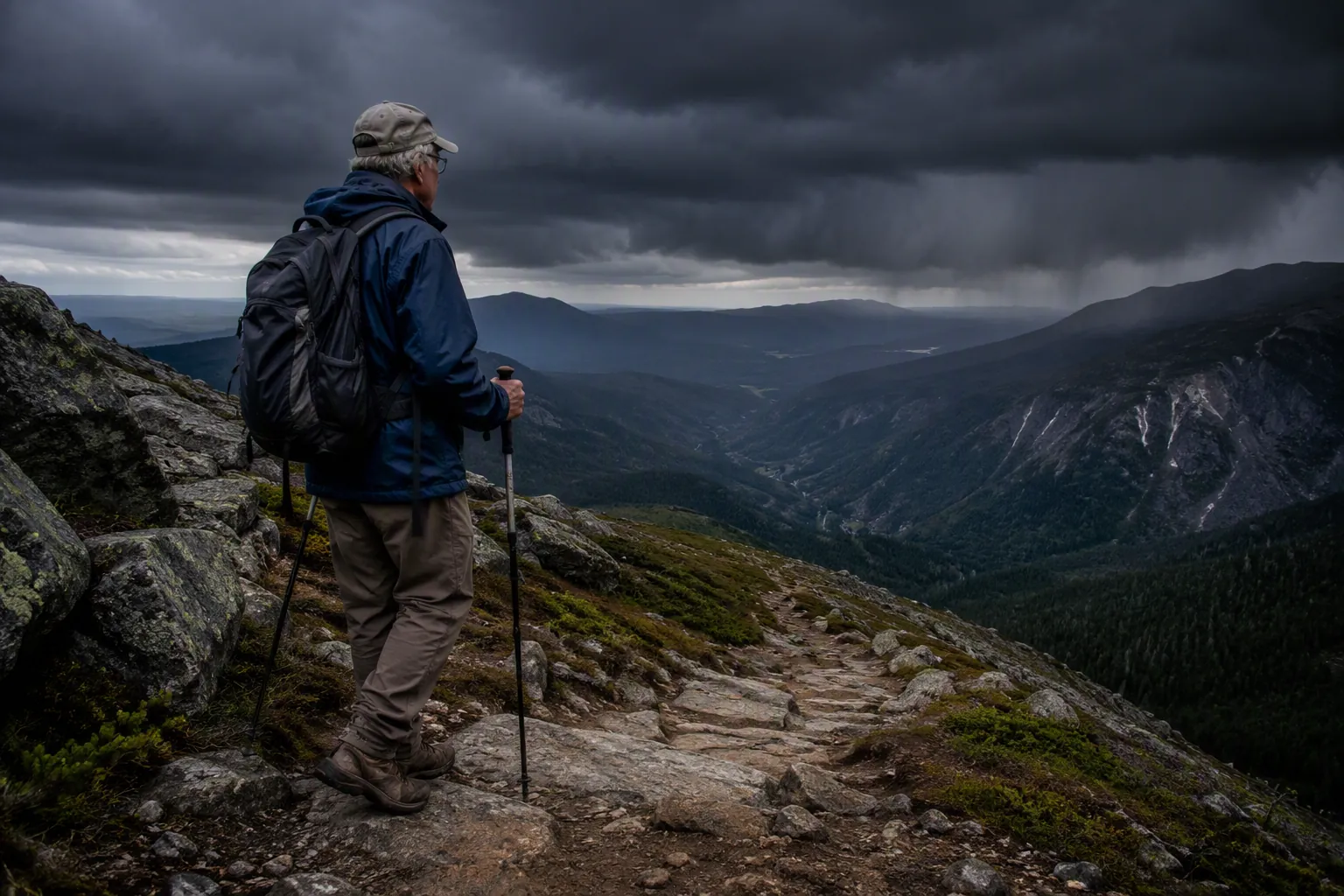
The goal is not to choose between lightning safety and fall prevention. The goal is to make the lightning plan earlier, slower, and more deliberate so nobody has to perform a young person’s scramble in a storm.
Start the lightning plan before thunder makes you rush
The best fall-prevention lightning decision is made while the group is still calm. Once thunder is overhead, even a strong hiker with replaced knees may move too fast, shorten judgment, or stop using poles properly. For senior hikers, “turn around early” is not timid advice. It is the main adaptation.
Lightning does not wait for rain to begin. The National Park Service warns that lightning can strike before rain starts and as far as 10 miles from the rain core.[2] It also notes that in one NPS lightning-safety article, two-thirds of lightning deaths occur between noon and 6 p.m.[3] Those facts change the day’s schedule. A senior group should not be reaching an exposed ridge at the same hour younger hikers are congratulating themselves for making good time.
A practical plan has to be decided before boots hit the trail:
- Set a turnaround time that gets the slowest descender below exposed ground before the usual afternoon storm window.
- Name the first safe-enough exit point: trailhead, vehicle, substantial building, lower forested area, or another place with less exposure.
- Agree that hearing thunder ends the debate. The group turns back without stopping for photos, snacks, or “just another quarter mile.”
- Put the slowest stable pace in charge of the descent, not the fastest person’s anxiety.
That last point is the one I have watched families struggle with. The adult child can see the parking lot in their mind. The older parent can feel every unstable step. Rushing the parent may shorten the clock on lightning exposure, but it can lengthen the odds of a fall. A storm plan that only works if everyone hurries is not a senior-safe plan.
When thunder starts, descend as if falling is part of the storm risk
If there is a real indoor shelter or a hard-topped vehicle close by, go there. The National Weather Service and CDC use the plain rule: “When thunder roars, go indoors,” and CDC guidance says to stay away from windows, plumbing, corded phones, and electrical equipment once inside.[4] On many trails, though, indoors is not immediately available. That is where senior hikers need a movement plan, not a slogan.
Use trekking poles while moving. Metal poles are not something to cuddle during a lightning storm, but for an older hiker on wet descent, poles may be the difference between controlled movement and a hard fall. The safer sequence is not “throw away the poles and stumble downhill.” It is: use the poles for stability while evacuating, then separate from them once you have stopped at the least-bad shelter location.
| Trail situation | Senior-safe action | Why it matters |
|---|---|---|
| Thunder is distant but audible | Turn around now; keep pace steady and controlled | Avoid being forced into a fast, panicked descent |
| Descending wet rock or loose gravel | Use trekking poles, shorten steps, keep eyes on the next foot placement | Fall prevention is still an immediate safety task |
| Reaching a temporary shelter position outdoors | Set poles and other metal items away from the body before settling | Conductive gear should not stay in contact once it is no longer needed for movement |
| Waiting after the storm seems to pass | Start a 30-minute timer after the last thunder | Memory and impatience are poor storm clocks |
On descent, small mechanics matter. Step down sideways if that protects a painful knee. Plant the pole, then the foot; do not jab the pole far ahead and lean after it. Keep the group close enough to communicate, but not so bunched that one slip knocks another person down. If someone wears bifocals, remember that looking through the wrong part of the lens can distort the landing spot. Slow enough to see the next step is not dawdling.
If the trail has open summit, ridge, meadow, or isolated-tree exposure, leave those places as early as possible. If the only available route down is technical enough that the older hiker must rush or fall, stop pretending speed is always safer. Move with control toward lower, less exposed ground, and use the best available terrain rather than the shortest-looking line.
Choose the least-bad shelter; do not hide under rock
The right shelter answer is still a substantial building or a hard-topped vehicle. A picnic shelter, small trail kiosk, tent, cave, or rock overhang is not the same thing. The National Park Service warns against caves and overhangs because lightning can jump across the opening.[2] That warning matters for senior hikers because caves and overhangs feel like common-sense shelter when rain starts, and they often lure people into awkward, slippery footing.
If you cannot reach a real indoor shelter, reduce exposure rather than chasing perfect safety. Avoid high points, isolated trees, metal fences, open water, and wet vertical rock. In a forested area, a lower stand of trees of similar height is generally preferable to standing beside the tallest tree around. Spread group members apart enough that one strike mechanism is less likely to involve everyone, while still keeping voices within reach if someone is frightened or unsteady.
This is also the moment to handle trekking poles deliberately. Once the older hiker has reached the waiting spot and no longer needs the poles to keep from falling, lay them on the ground well away from the body rather than holding them upright. I have not found a CDC or NWS rule written specifically for senior hikers with poles; this is a practical synthesis of general lightning guidance and fall-prevention reality. The sequence matters: stability first while moving, separation from conductive gear once stopped.
Replace the old lightning crouch with a posture older knees can hold
Many older hikers learned the lightning crouch decades ago: squat low, heels together, head tucked. For arthritic hips, knee replacements, balance problems, and wet ground, that position can be a fall waiting to happen. It is also no longer the favored advice. The National Weather Service stopped recommending the lightning crouch in 2008, and lightning-safety experts quoted in Backpacker have described it as ineffective.[5]
The part worth keeping is not the deep squat. It is the feet. Ground current is a major lightning injury mechanism; CDC guidance says lightning can travel along the ground from a strike point, and StatPearls describes ground current as accounting for up to 50% of lightning injuries.[4][6] Keeping the feet close together reduces the distance electricity can travel through the body if ground current is present. That is a movement an older hiker may be able to perform without collapsing.
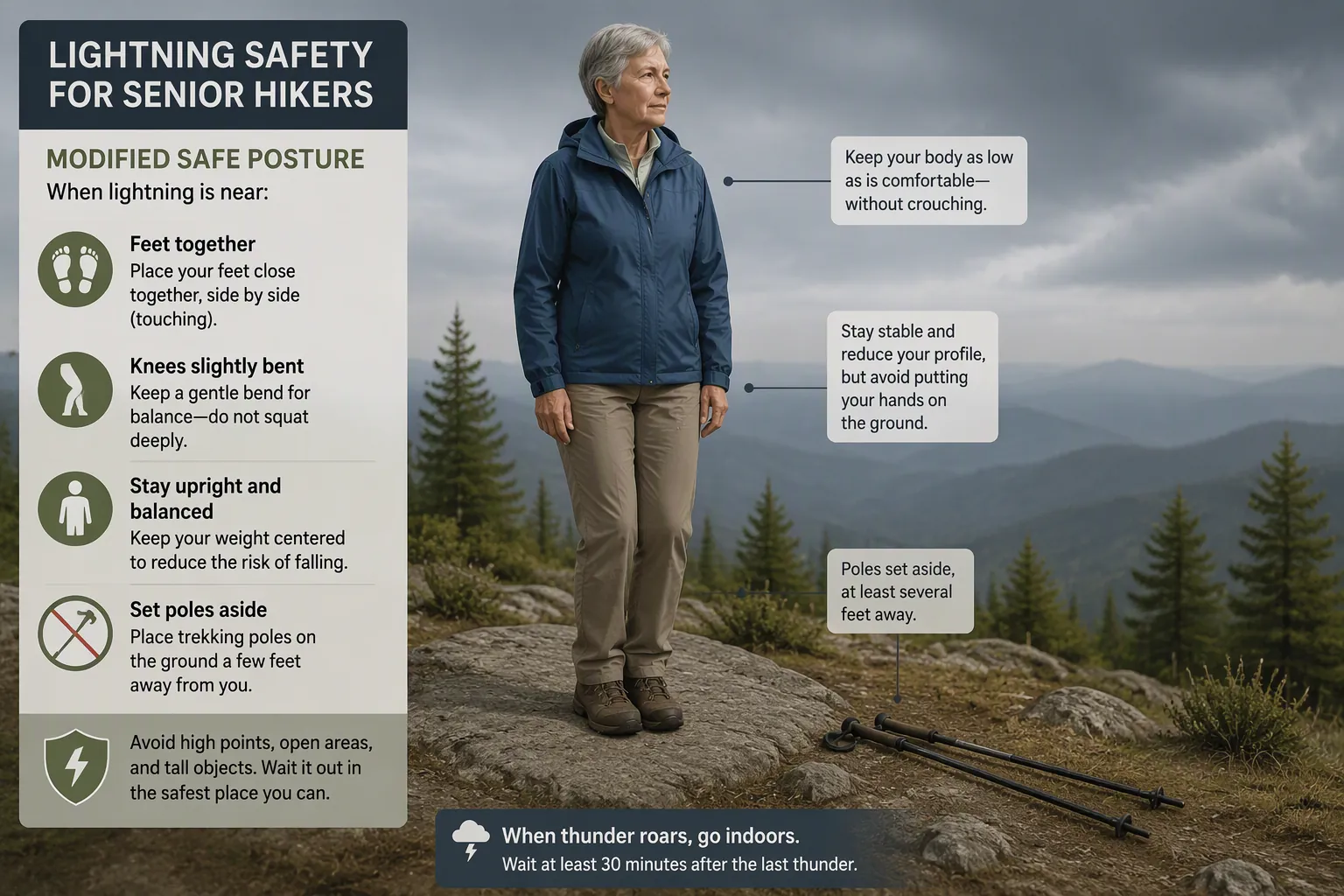
A senior-safe waiting posture looks modest:
- Place feet close together, with both feet on the same surface if possible.
- Bend the knees only as much as balance comfortably allows.
- Keep hands off the ground, tree trunks, rock walls, and metal objects.
- If standing is unsafe, choose the most stable position available while still keeping contact with the ground as limited and controlled as possible.
- Do not attempt a deep crouch that you cannot rise from without help.
This is not perfect protection. Outdoor shelter in lightning never is. But it removes one old piece of advice that can push a senior hiker into a fall, while preserving the part that addresses ground current.
Do not over-focus on the rarest strike
Direct lightning strikes are dramatic, but CDC lightning information says direct strikes account for only 3% to 5% of lightning injuries, while side splash accounts for about one-third.[7] That distinction should calm—not dismiss—the planning. You are not safe simply because lightning does not hit your head. Being beside the wrong tree, rock face, or metal object can still matter.
For senior hikers, this means the shelter decision should avoid the obvious traps: a lone tree, a cave mouth, a cliff overhang, a fence line, a summit sign, or a wet boulder that looks convenient for sitting. It also means the group should stop arguing over whether a strike is “likely.” If thunder is close enough to hear, it is close enough to change behavior.
Wait 30 minutes after the last thunder
Once the worst of the storm seems to pass, the pressure to move returns. People get cold. Knees stiffen. The parking lot feels emotionally closer than it is physically. This is where a phone timer is better than confidence.
CDC guidance says to wait at least 30 minutes after hearing the last thunder before leaving shelter.[4] For an older hiker, that timer also prevents the stop-start pattern that causes mistakes: stand up, gather poles, hear thunder again, rush to crouch, stumble, repeat. Start the timer after the last thunder. If thunder returns, restart it.
Use the waiting time plainly. Put on a layer before shivering makes hands clumsy. Eat something if the delay is stretching longer than expected. Check whether anyone is too anxious, too cold, or too sore to descend safely at the original pace. The storm plan does not end when the rain softens; it ends when the group can move again without rushing.
If someone falls during evacuation, slow the scene down
A fall during a thunderstorm tempts everyone into bad choices. The fallen hiker wants to get up fast. The companion wants to pull them upright. The sky adds urgency to a moment that already has too much of it.
First, make the immediate area as safe as conditions allow: away from edges, moving water, isolated trees, and rockfall risk. Then check the person before moving them. New confusion, head impact, severe pain, inability to bear weight, chest symptoms, shortness of breath, or signs of shock should shift the group from “walk out quickly” to “get appropriate help.” Older adults may have injuries that are not obvious in the first minute, and medications such as blood thinners are a reason for extra caution after head impact, even though lightning-specific medication guidance is not established in the sources used here.
If the hiker can continue, rebuild the descent rather than resuming the rush. Recheck pole length, pack weight, glasses, footing, and who walks nearest. The person who fell should not be made to lead on a technical descent unless that is clearly the safest position. If a caregiver needs a broader post-fall framework after the immediate trail situation is over, Your Parent Just Fell: A Caregiver's Guide to the First 72 Hours is a useful next read.
Build the plan at home, not on the ridge
The senior version of lightning safety is not softer. It is more exact. It asks, before the hike, who is the slowest safe descender, what time the group must be below exposed terrain, and what everyone will do when thunder is heard. It also asks whether each person can actually perform the movement being recommended.
Practice the modified waiting posture once on dry ground: feet close together, knees only slightly bent, hands off the ground, poles set aside. Decide where poles ride when not in use and how they will be set down at a shelter location. Pack a layer where it can be reached without unloading everything in the rain. If severe weather creates fall risks at home as well as on trail, the same thinking carries into severe weather fall prevention for seniors.
Good hiking judgment is not proved by outrunning a storm. It is proved by making the turn early enough that nobody has to. Senior hikers can keep their ridge views, early starts, and long trail lives. They just need lightning safety translated into stable feet, deliberate poles, earlier decisions, and enough patience not to let the storm turn safety advice into a fall.
References
- Older Adult Falls Data, CDC, 2024.
- Lightning Safety, National Park Service.
- Lightning Safety, National Park Service.
- Lightning Safety Guidelines, CDC.
- Experts Debunk 5 Common Myths About Lightning Safety, Backpacker.
- Lightning Injuries, StatPearls, NCBI Bookshelf.
- Lightning and Your Safety, CDC.
Related reading
Noticed something outdated or inaccurate on this page? Flag a correction. We review every report against CDC, NIA, and AARP HomeFit guidance before updating a page.
Part of the Fall Prevention section.