
STEADI: intervene
How your earthquake donation keeps seniors safe from falls
After an earthquake, a senior's fall-proofed home can become more dangerous due to new hazards like cracked grab bars and broken glass. This article explains how targeted donations to senior-focused disaster relief funds help restore the fall-prevention infrastructure—safe flooring, working grab bars, mobility aids, and lighting—that keeps older adults upright.
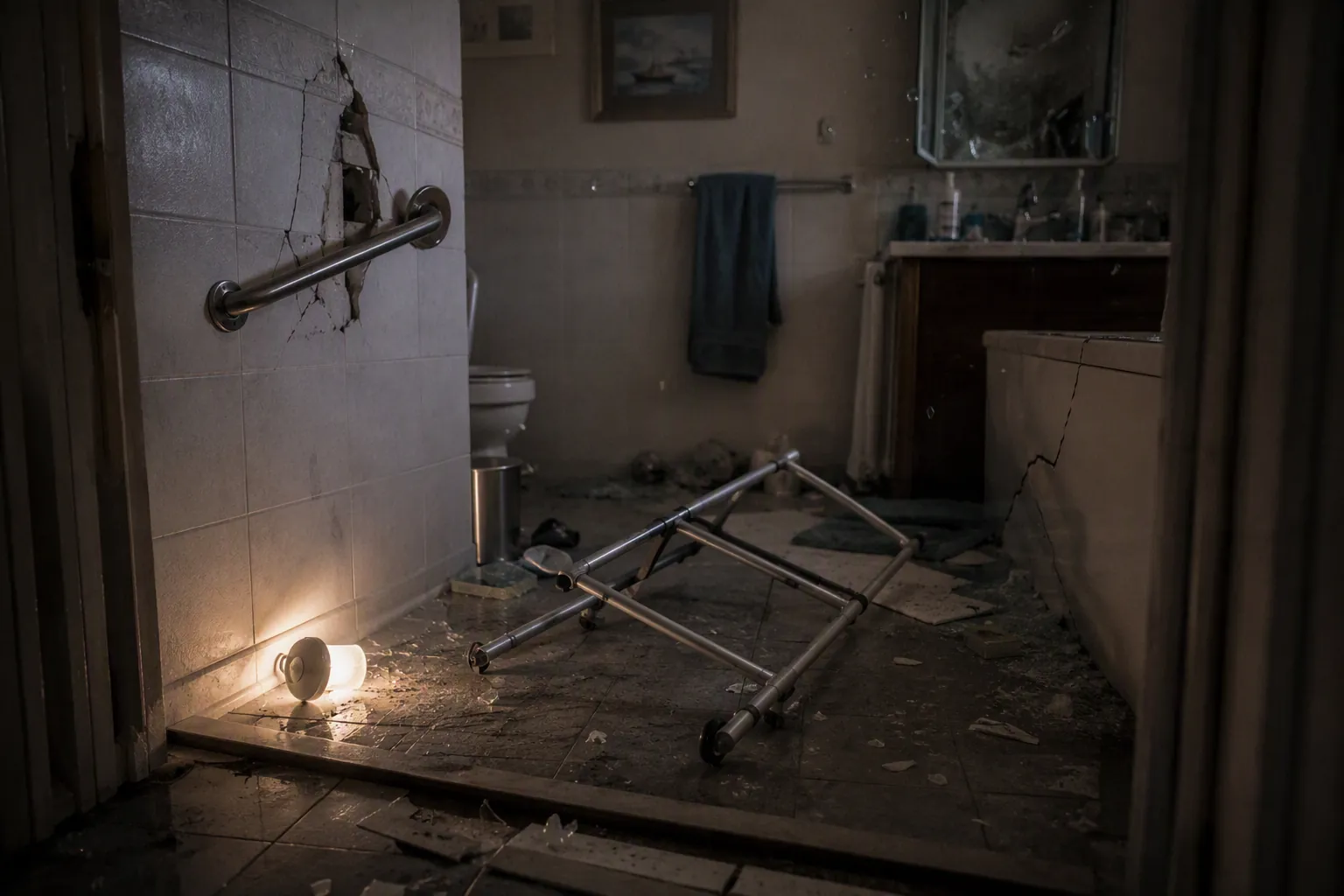
After an earthquake, the dangerous part of an older adult’s home is often the part that used to be safe. The grab bar in the bathroom may still be on the wall, but the screws may have pulled loose. The hallway may look familiar until the power is out and the night-light is on the floor. A walker may be intact but trapped behind a fallen bookcase. A threshold that was already a little awkward may have shifted just enough to catch a slipper.
That is the practical answer for someone asking how to donate to help seniors after an earthquake. The best donation is not just a gesture toward disaster relief. It helps restore the fall-safety system an older person depends on: clear floors, stable handholds, working lights, usable mobility aids, medical supplies, transportation, and a safe place to sleep while the home is being repaired.
The fall hazards start at floor level
Earthquake safety guidance makes one thing uncomfortably clear: the shaking is not the only danger. The Red Cross identifies broken glass and debris on the ground as common sources of earthquake injuries and advises wearing sturdy shoes after the shaking stops.[1] That advice is useful for anyone, but it has a different weight in a senior’s home. A healthy adult may step around glass, find boots, and move furniture. An older adult using a cane, walker, rollator, oxygen tubing, or a bedside commode may not have that margin.
The Illinois Emergency Management Agency’s earthquake planning guide for seniors also names falling objects as one of the greatest hazards in an earthquake and notes that some seniors may not be agile enough to quickly drop and cover.[2] That is not a small caveat. It means a home that was carefully arranged around slow, predictable movement can become a room full of new decisions: where to place a foot, what to hold, whether the handrail will bear weight, whether the bathroom is still usable.
Caregivers already know the small things matter. A lamp cord across a walkway matters. A bath mat that curls at the corner matters. After an earthquake, those small things multiply: cabinet contents spill into traffic paths, pictures fall, glass breaks, furniture shifts, and doorways no longer feel as predictable. If power is out, the same dark-walkway problems covered in a senior power outage fall-prevention checklist become part of the earthquake response, not a separate issue.
Why the donation has to reach older adults specifically
Falls were already a serious threat before the quake. CDC data show that falls among adults 65 and older caused more than 38,000 deaths in 2021, and older adult falls led to nearly 3 million emergency department visits.[3] Those numbers do not prove what happens after every earthquake, and they should not be stretched that far. They do explain why a loose grab bar, a missing walker, or a dark bathroom path is not a minor inconvenience for an older adult.
There is also the money problem. The Center for Disaster Philanthropy notes that more than 17 million older adults in the U.S. are economically insecure, defined as living at or below 200% of the federal poverty level.[4] The same resource reports that two-thirds of deaths in Hurricanes Katrina, Sandy, and Ian were adults over 60.[4] Hurricanes are not earthquakes, and the hazards are not identical. But the pattern matters: disasters put older adults under heavier strain, especially when recovery requires repairs, transportation, medication replacement, temporary housing, and help navigating services.
A general disaster donation can still do good. Food, shelter, emergency communications, and broad relief all matter. But if the goal is to help seniors regain safe footing after an earthquake, the donation channel should be able to answer a more concrete question: what part of the older adult’s fall-safety system can this money put back into service?
Follow the money to the thing that keeps someone upright
USAging’s Disaster Relief Fund is the clearest example of a donation path that maps to fall safety. USAging states that 100% of donations to the fund go to local Area Agencies on Aging and that those agencies use the money for needs such as home repairs, flooring and threshold fixes, grab bar reinstallation, replacement of medical devices and beds, safety checks, temporary housing, transportation, and related supports.[5]
That list is not abstract. Each item corresponds to a place where an older adult’s body meets the damaged environment.
| Post-earthquake problem | Why it raises fall risk | Donation-supported repair or support |
|---|---|---|
| Loose or damaged grab bar | The older adult reaches for support and gets false stability | Grab bar reinstallation or bathroom repair through local aging-service partners |
| Shifted threshold or damaged flooring | A walker wheel, cane tip, or slipper catches where the floor used to be predictable | Threshold fixes, flooring repair, or home modification support |
| Broken bed, damaged medical device, or lost mobility aid | Transfers become harder and walking support may disappear | Replacement of beds, medical devices, or mobility-related equipment |
| Home is unsafe while repairs are pending | The senior keeps navigating debris, darkness, unstable fixtures, or blocked rooms | Temporary housing, safety checks, and transportation |
| No safe ride to care, pharmacy, or family support | The older adult may delay treatment or attempt unsafe movement alone | Transportation arranged through local aging-service networks |
This is where a senior-focused fund earns its place. The local agency does not have to treat a cracked bathroom wall as only a construction problem. It can recognize that the cracked wall matters because the grab bar attached to it is part of a transfer routine. It can recognize that a damaged bed matters because standing up from the wrong height can turn the first step of the morning into the riskiest step of the day.
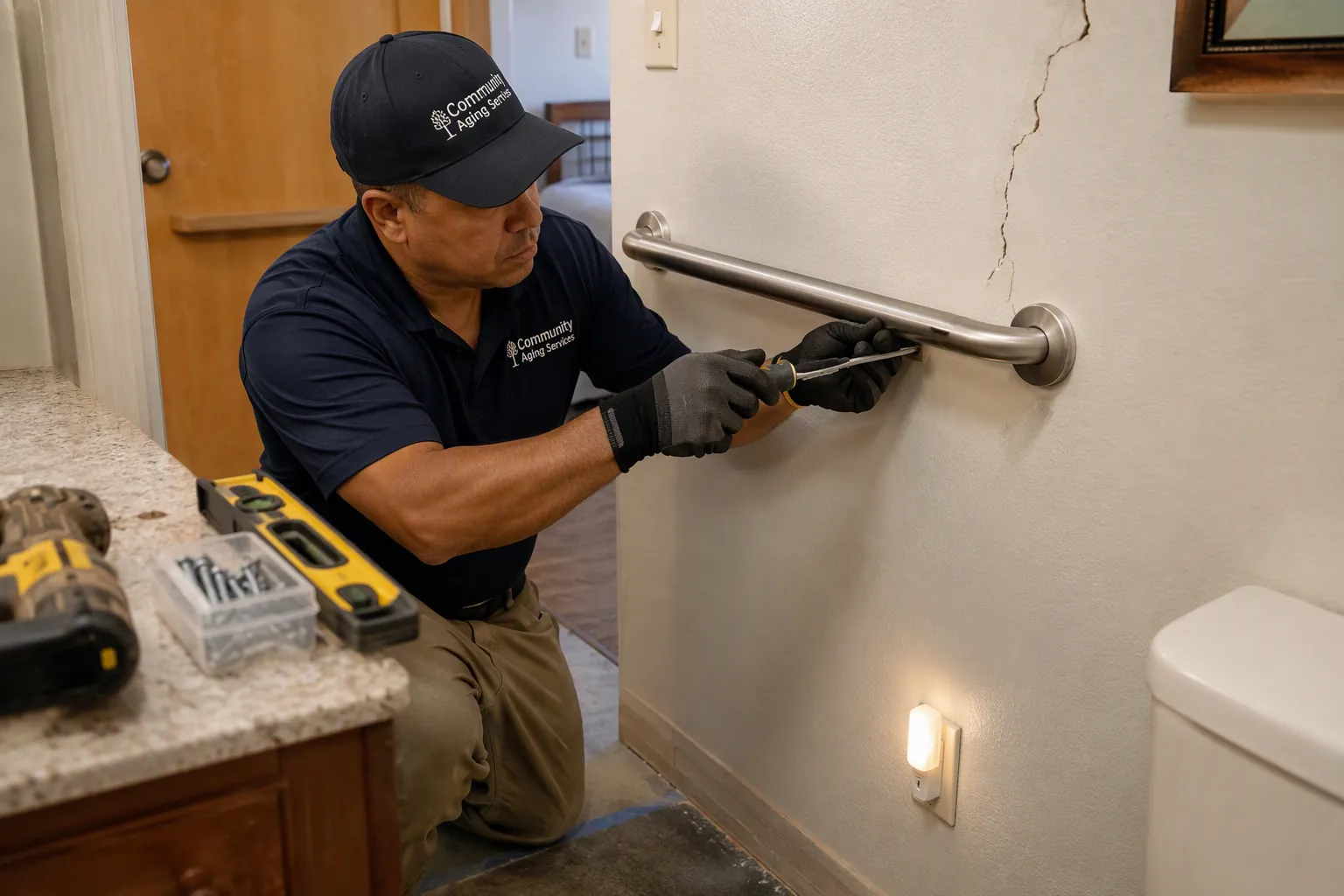
The same logic applies outside the bathroom. A safety check can identify whether a path from bed to toilet is clear, whether a walker is within reach, whether lighting works, whether the older adult can exit safely if aftershocks or building damage require evacuation. For caregivers who have planned evacuation routes before, the overlap with helping an elderly parent evacuate without falling is obvious: a safe route is only safe if it still exists after the disaster.
Medical supplies are part of fall safety too
Direct Relief approaches the problem from the medical-supply side. Its emergency work includes medical supplies, insulin, EpiPens, hygiene kits, mobility aids, and designated disaster donations; Direct Relief states that 100% of contributions designated for specific emergencies go to those relief efforts.[6]
That may sound less directly connected to falls than a grab bar, but for many older adults it is not separate. A missing mobility aid changes gait. Interrupted medication access can affect strength, balance, alertness, blood sugar, pain control, or the ability to move safely. Hygiene supplies matter when a person is trying to stay clean without using a damaged bathroom. Emergency medical supplies matter when local clinics, pharmacies, or caregivers are under pressure.
The point is not that every medical-supply donation prevents a fall. That would be too clean. The better way to judge it is whether the donation helps keep an older adult medically stable enough to stand, transfer, walk, use the bathroom, and recover without improvising around missing equipment.
A practical donation frame
When choosing where to give after an earthquake, look for language that connects donations to older adults’ physical recovery, not only to broad disaster need. A useful organization should make at least some of the chain visible: who receives the money, who serves the older adult locally, and what the funds can buy or repair.
- For home safety restoration, prioritize senior-focused disaster funds that work through Area Agencies on Aging or comparable local aging-service networks.
- For damaged equipment and medical continuity, consider disaster medical-relief organizations that provide supplies, mobility aids, hygiene items, and medication-related support.
- For an older adult who cannot safely remain at home, value temporary housing and transportation as fall-prevention supports, not as side benefits.
- For homes affected by power outages, aftershocks, flooding from broken pipes, or blocked exits, treat lighting, clear routes, and safe transfers as urgent recovery needs.
If you are donating after a specific earthquake, read the fund page before giving. Prefer designated disaster funds when you want the money restricted to that response. If the organization allows notes or designations, use plain language such as “older adult home safety,” “mobility aid replacement,” “senior transportation,” or “aging services disaster relief.” The exact wording may not control how the charity spends the gift, but it keeps your intent tied to the safety problem you are trying to solve.
It also helps to think beyond the first day. Broken glass can be swept up quickly; a loose handrail, damaged floor, missing walker, or unsafe bathroom may take longer. The older adult still has to get out of bed, reach the toilet, step over thresholds, manage medication, and move through rooms that no longer behave the way memory says they should. A good donation helps shorten that unsafe interval.
What your gift can and cannot promise
No donation can guarantee that an older adult will not fall after an earthquake. Too many variables sit between the gift and the person’s next step: the condition of the building, the speed of local response, the older adult’s health, the availability of workers and supplies, aftershocks, utilities, transportation, and whether family or neighbors can help.
But a donation can help restore the conditions that reduce fall risk. It can help put the grab bar back into a stud, smooth the threshold, replace the walker, arrange a ride, supply needed medical goods, move someone temporarily out of an unsafe home, or send a trained local worker to check what changed. For an older adult after an earthquake, those are not cosmetic repairs. They are the pieces of a home that let the next step be a little less dangerous.
References
- Earthquake Safety, American Red Cross
- Planning Guide for Seniors, Illinois Emergency Management Agency and Office of Homeland Security
- Older Adult Falls Data, Centers for Disease Control and Prevention
- Older Adults, Center for Disaster Philanthropy
- Disaster Relief Fund, USAging
- Emergency Response, Direct Relief
Related reading
Noticed something outdated or inaccurate on this page? Flag a correction. We review every report against CDC, NIA, and AARP HomeFit guidance before updating a page.
Part of the Fall Prevention section.