
STEADI: intervene
How to Build a 72-Hour Senior Power Outage Safety Kit
A standard emergency kit is not enough for older adults aging at home. This guide provides a comprehensive checklist tailored for seniors, covering medical device backup, medication cooling, mobility aids, and communication tools to survive a 72-hour power outage safely.
A standard 72-hour emergency kit is a good starting point. For an older adult living at home, it is not the finish line.
The usual advice says to keep enough food, water, flashlight batteries, and basic supplies for at least three days. FEMA’s Ready.gov and the American Red Cross both use that three-day minimum as a practical benchmark for household preparedness.[1][2] But when I look at a parent’s kitchen, bedroom, bathroom, and hallway, the real power outage safety tips for seniors at home are less tidy: What happens to the CPAP machine? Where is the walker if the lights go out at 2 a.m.? Can insulin stay safe? Can she hear the emergency call? Can she open the food she has stored?
That is the difference between owning an emergency bin and having a senior power outage plan. The kit has to match the person, the house, the medical equipment, and the rooms where trouble is most likely to happen.
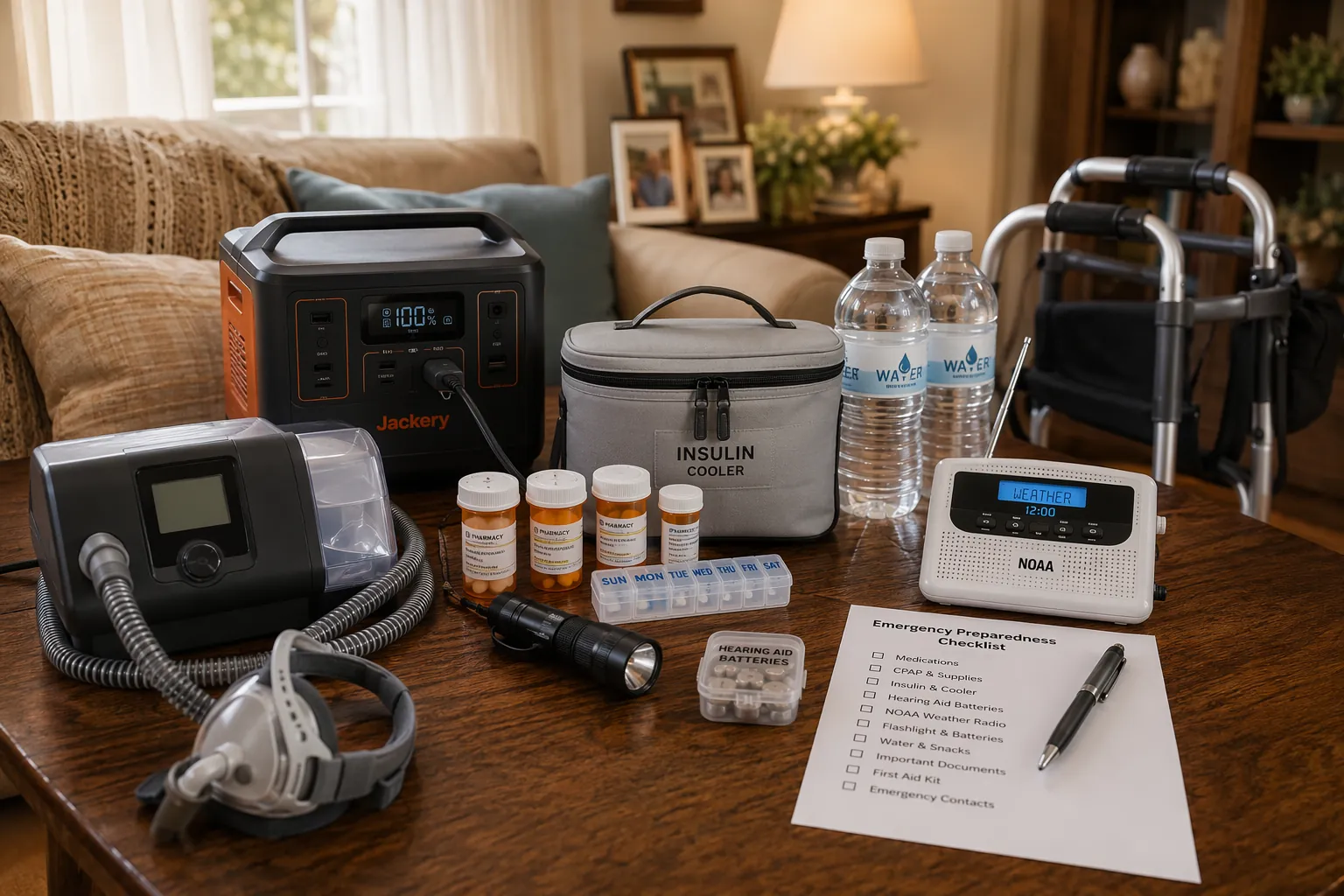
Start With the 72-Hour Kit, Then Add the Senior-Specific Gaps
Before buying anything new, walk through the home with a printed checklist and a pen. Do not start in the garage. Start where the older adult actually spends time: bedside, favorite chair, bathroom route, kitchen counter, medication area, and entryway.
The standard emergency kit covers the broad household needs. The senior version adds the failure points that are easy to miss until the lights are already out.
| Standard kit question | Senior-specific question |
|---|---|
| Do we have water and shelf-stable food? | Can the senior open, chew, swallow, and prepare that food without power? |
| Do we have flashlights? | Are they placed where transfers happen: bed, bathroom, recliner, hallway, and stairs? |
| Do we have medications? | Is there a seven-day supply, a current medication list, and a cooling plan for temperature-sensitive prescriptions? |
| Do we have a phone charger? | Is there backup power for the phone, medical devices, hearing aids, and communication if the cell network is poor? |
| Do we have an emergency contact list? | Is it printed, large enough to read, and placed where a neighbor or responder could find it? |
| Do we have a safe place to wait? | Can the senior get there without crossing a dark room or using an unpowered stair lift? |
Medical Power Comes First
For many older adults, power is not about comfort. It is treatment. A CPAP machine, oxygen concentrator, nebulizer, powered recliner, hospital bed, stair lift, or electric wheelchair charger can turn a short outage into a medical or mobility problem.
This part of the kit should be planned with the clinician, equipment supplier, pharmacist, or home health agency. Do not guess how long a prescribed device can safely be off, whether oxygen equipment has a backup mode, or whether a battery is approved for the device. The kit should include written instructions specific to the equipment in that home.
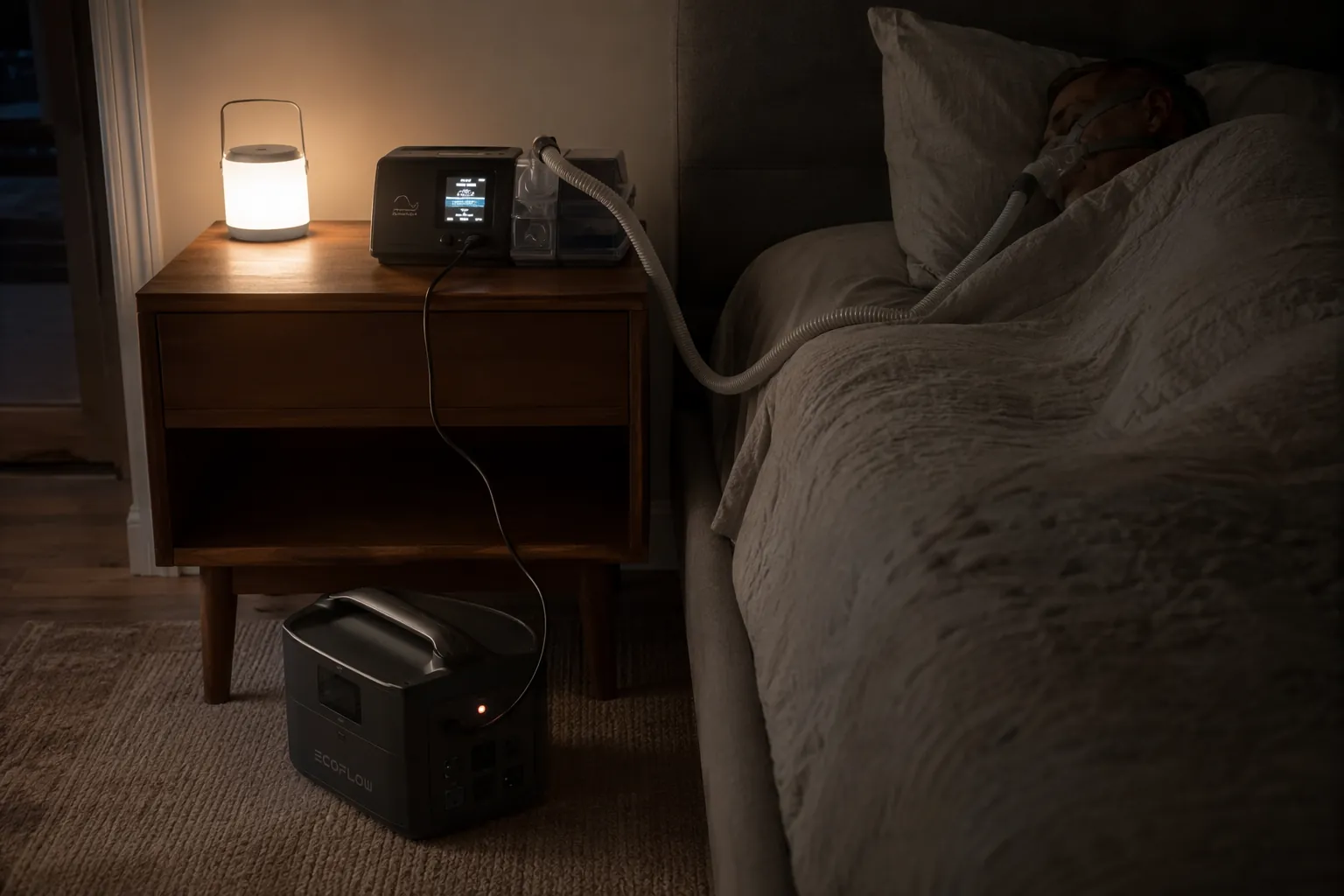
Build a simple medical power sheet and tape a copy near the device, with another copy in the emergency binder.
| Device or need | Write down before the outage |
|---|---|
| CPAP or BiPAP | Exact model, power draw if available, battery option, whether humidification can be turned off to conserve power, and who confirmed the plan |
| Oxygen concentrator | Supplier emergency number, backup cylinder instructions, safe oxygen storage, and when to call for help |
| Nebulizer | Backup power option, medication schedule, and whether a portable alternative has been prescribed |
| Powered recliner or hospital bed | Manual release instructions, safe transfer plan, and flashlight placement |
| Stair lift | Battery status, manual procedure if applicable, and the plan if the senior must stay on one floor |
| Phone or medical alert device | Charging cable location, power bank location, backup contact method, and monitoring plan |
For backup power, avoid the temptation to shop by product category first. Start with the device and the person using it.
- What must run: medical devices, phone, radio, lighting, refrigerator, or only small electronics.
- How long it must run: overnight, through several sleep cycles, or until a caregiver can arrive.
- Who can operate it: the senior alone, a neighbor, or only an adult child who may not be there.
- Where it can be used safely: indoors for a battery power station; outdoors only for a fuel-powered generator.
- How it will be tested: with the actual device, the actual cable, and the senior present.
- What happens after 72 hours: recharge location, evacuation trigger, or caregiver pickup plan.
A portable power station may be safer and simpler indoors than a generator for small devices, but it still has to be charged, labeled, reachable, and tested. A generator may support larger loads, but it creates its own danger if handled casually. The CDC and Ready.gov warn that generators should never be used indoors or in a garage, and should be kept at least 20 feet from windows, doors, and vents because of carbon monoxide risk.[3][2]
Medication Safety Needs Its Own Cooler, List, and Refill Plan
Medication is where a neat emergency bin can give false confidence. A bottle on the counter is not the same as a usable supply, and a refrigerator full of prescriptions is not protected just because the door is closed.
PowerOutage.us recommends that older adults keep a seven-day supply of medications when possible and notes that some states allow early refills during declared disasters.[4] That does not mean everyone can automatically obtain extra medication, especially with controlled substances or insurance limits. It does mean the question should be asked before storm season, not after the pharmacy is closed.
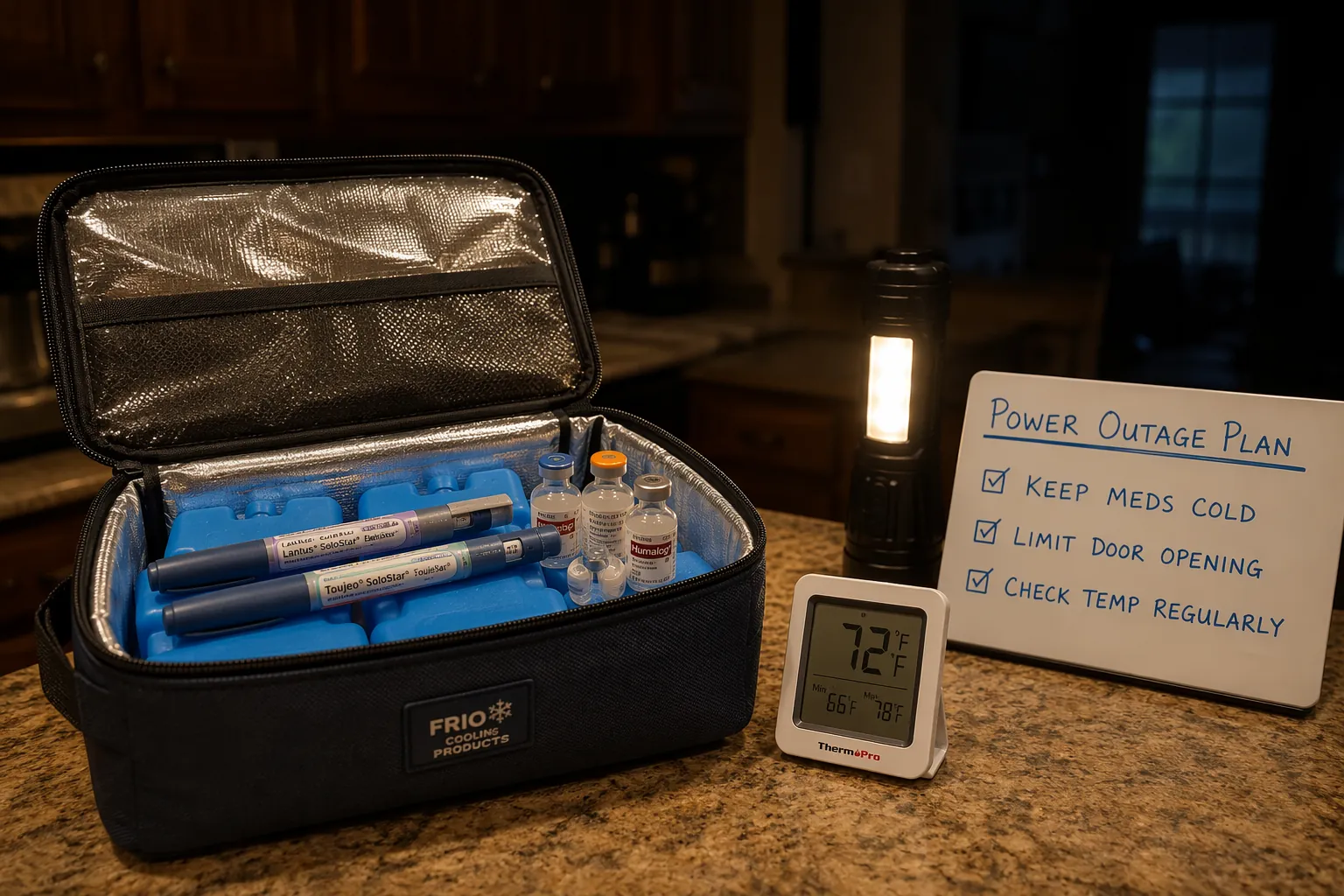
Temperature-sensitive medication deserves written instructions from the pharmacist or prescriber. PowerOutage.us warns that insulin degrades above 77°F, so even a short summer outage can matter if insulin is sitting in a warm kitchen.[4] Do not improvise by freezing, overheating, or repeatedly moving medication without professional guidance.
- Keep an insulated medication cooler bag where the senior or caregiver can find it quickly.
- Store reusable ice packs in the freezer and label them for medication use.
- Add a small thermometer if the pharmacist recommends temperature tracking.
- Print the medication list with drug names, doses, timing, prescribing clinicians, pharmacy number, allergies, and major diagnoses.
- Keep copies in the kit, on the refrigerator, and with the primary caregiver.
- Ask the pharmacy in advance about emergency refill rules during declared disasters.
The point is not to turn a family caregiver into a pharmacist. It is to make sure the right professional answer is already in the house when the power is out.
Cold Food, Hot Rooms, and Winter Nights Are All Part of the Same Kit
The refrigerator buys less time than many people assume. The CDC says an unopened refrigerator keeps food cold for about four hours; a full freezer holds temperature for about 48 hours, or about 24 hours if half full.[3] The Red Cross gives the same freezer time guidance for outage food safety.[1]
That matters for food, but also for behavior. An older adult should not be sorting through a dark refrigerator over and over, trying to decide what is safe. Put a printed food-safety note on the refrigerator now: keep doors closed, use shelf-stable food first, move temperature-sensitive medication according to the pharmacist’s written plan, and discard food if safety is uncertain.
Heat and cold need equal respect. During summer, the kit should include a cooling plan: battery fans if appropriate, cooling towels, water, electrolyte drinks if allowed by the clinician, a list of cooling centers or nearby homes with power, and a decision point for leaving before the house becomes unsafe. The companion guide on cooling seniors without AC during heat waves goes deeper on heat and fall prevention.
In winter, the same outage can create the opposite risk. CDC and Mayo Clinic materials identify confusion, slurred speech, drowsiness, shivering, and clumsiness among warning signs associated with hypothermia.[3][5] For an older adult, confusion may be mistaken for “just being tired” unless the family has agreed ahead of time that it is a reason to act.
- Add warm layers that are easy to put on without bending or struggling with tight sleeves.
- Keep blankets near the usual chair and bed, not sealed in a distant closet.
- Avoid candles and unsafe indoor heating methods.
- Write down the temperature or symptom trigger for calling family, a neighbor, local nonemergency services, or 911.
Mobility Supplies Have to Be Where the Fall Could Happen
A power outage kit is also a fall-prevention tool. The most dangerous item may be the flashlight sitting safely in a bin across the house while the senior tries to reach the bathroom in the dark.
Place supplies by transfer points, not just by category. Bedside needs a light, glasses, phone, sturdy shoes or non-slip slippers, and any cane or walker used at night. The bathroom route needs motion lights or battery lights. The favorite chair needs a flashlight, phone charger cable, water, and a blanket. If stairs are involved, the plan should say whether the senior stays on one level during an outage.
For what to do after the lights go out, use the Power Outage Fall Prevention Checklist for Seniors as the during-the-outage companion to this kit.
- Keep a backup cane or walker on the floor where the senior will remain during the outage.
- Do not store mobility aids behind furniture, in a closet, or in a garage.
- Place flashlights where hands are already reaching: bedside table, bathroom entrance, recliner side table, kitchen counter, and stair landing.
- Choose lights the senior can turn on with stiff fingers, low vision, or mild panic.
- Add glow tape or high-contrast labels to key switches, walker handles, and emergency supplies if vision is limited.
Hearing, Vision, and Communication Backups Are Not Extras
If a senior cannot hear the phone, read the contact list, or understand the radio, the communication plan has failed. NIH reports that disabling hearing loss affects 22% of adults ages 65 to 74 and 55% of adults 75 and older.[6] That makes hearing support a core outage supply, not a nice addition.
- Spare hearing aid batteries or a charged hearing aid case, labeled and stored in two places.
- Backup eyeglasses, magnifier if used, and a large-print emergency contact sheet.
- NOAA weather radio with fresh batteries and instructions taped to it.
- Charged power banks for the phone, with the correct cable attached to the power bank.
- Walkie-talkies if nearby family or neighbors have agreed to use the same channel.
- Printed phone numbers for family, neighbors, clinicians, pharmacy, utility company, local emergency management, and building management if applicable.
A communication tool counts only if it has been practiced. If the radio is still in the box, the walkie-talkies are not charged, or the printed list is too small to read, the kit is not finished.
The Basic Supplies Still Matter, Just Keep Them Usable
The ordinary emergency supplies do not need a speech. They need to be complete, reachable, and chosen for the person who will use them.
- Water for at least three days, plus any clinician-specific fluid instructions.
- Shelf-stable foods the senior already eats and can open without power.
- Manual can opener with an easy-grip handle.
- Flashlights, battery lanterns, and extra batteries in the correct sizes.
- First aid supplies, gloves, masks if used, hand sanitizer, wipes, and trash bags.
- Toilet paper, incontinence supplies, denture supplies, skin-care items, and any hygiene product that would be hard to replace quickly.
- Pet food, leash, carrier, and medication if the senior has an animal that affects whether they will leave home.
- Small bills, copies of key documents, insurance cards, ID, and a written home access plan.
Pack some supplies in a labeled central bin, but do not force everything into one location. A senior should not have to walk across a dark house to get the item that would have prevented the walk.
Plan for 72 Hours, Then Decide What Extends the Plan
The 72-hour kit buys time. It does not guarantee that the outage will end in three days. PowerOutage.us notes that Hurricane Helene caused outages lasting more than 14 days in some rural areas.[4] That example is not a reason to panic-buy equipment. It is a reminder to decide what happens when the first kit is no longer enough.
The extension plan should be written as decisions, not wishes.
- If medical device power drops below the agreed threshold, who is called first?
- If indoor temperature becomes unsafe, where does the senior go?
- If the phone network is unreliable, what neighbor, radio, or landline backup is used?
- If roads are blocked, who can check on the senior on foot?
- If the outage reaches day three, who makes the stay-or-leave decision?
- If the senior refuses to leave, what specific condition changes that decision?
Local planning matters here. A household in Boston facing severe thunderstorms has different contacts, transportation choices, building types, and municipal alerts than a rural household on a well pump. The guide to preparing seniors in Boston for severe thunderstorms is a useful example of adding local coordination to a general kit.
The Final Home Audit
Do the final pass when the house is calm, the senior is present, and nobody is rushing. The goal is not a prettier bin. The goal is a kit the older adult can actually use.
- The central kit is labeled in large print and stored where the senior can reach it.
- Bedside, bathroom route, favorite chair, kitchen, and entryway each have the supplies needed in that location.
- Medical devices have written backup power instructions confirmed by the appropriate professional or supplier.
- Medication supply, storage, refill rules, and cooling steps have been reviewed with the pharmacist or clinician.
- Power banks, radios, battery lights, hearing aid chargers, and portable power stations are charged and tested on a schedule.
- Generator instructions include never indoors, never in the garage, and at least 20 feet from windows, doors, and vents.
- Emergency contacts are printed, readable, current, and shared with the people expected to help.
- The senior has practiced turning on lights, using the radio, calling for help, and reaching the safest room without crossing unnecessary dark space.
- The family has a written decision point for leaving home if heat, cold, medical power, medication safety, or mobility becomes unsafe.
Preparedness for seniors is not just owning supplies. It is matching those supplies to medical dependence, temperature risk, communication limits, and the real walking path through the home.
References
- Power Outage Safety, American Red Cross
- Power Outages, Ready.gov
- What to Do to Protect Yourself During a Power Outage, CDC
- Power Outage Preparedness for Seniors & Elderly, PowerOutage.us
- Hypothermia, Mayo Clinic
- Age-Related Hearing Loss, NIH/NIDCD
Related reading
Noticed something outdated or inaccurate on this page? Flag a correction. We review every report against CDC, NIA, and AARP HomeFit guidance before updating a page.
Part of the Fall Prevention section.