
STEADI: intervene
Power Outage Safety Checklist for Seniors Aging in Place
Seniors aging in place need a power outage plan that addresses medical equipment, medication storage, and temperature thresholds beyond generic checklists. This guide provides the specific actions, temperatures, and supplies to stay safe before, during, and after an outage.
Power outages are not just an inconvenience for older adults aging in place. A March 2026 PLOS Medicine study, reported by Psychiatry Advisor, linked outages to 4,246 excess cardiovascular and respiratory hospitalizations among older adults in the United States.[1] That number is useful because it points to the part of outage planning families often underestimate: heat, cold, powered medical equipment, refrigerated medication, communication, and falls all start interacting at once.
A power outage safety checklist for seniors should still include flashlights, water, food, and phone charging. But it is not complete until it answers four kitchen-table questions before the lights go out: How long will each medical device run? Which medications have temperature limits? At what indoor temperature does staying home become unsafe? And where are the hearing aid batteries, mobility backup, thermometer, and written medication list when the hallway is dark?
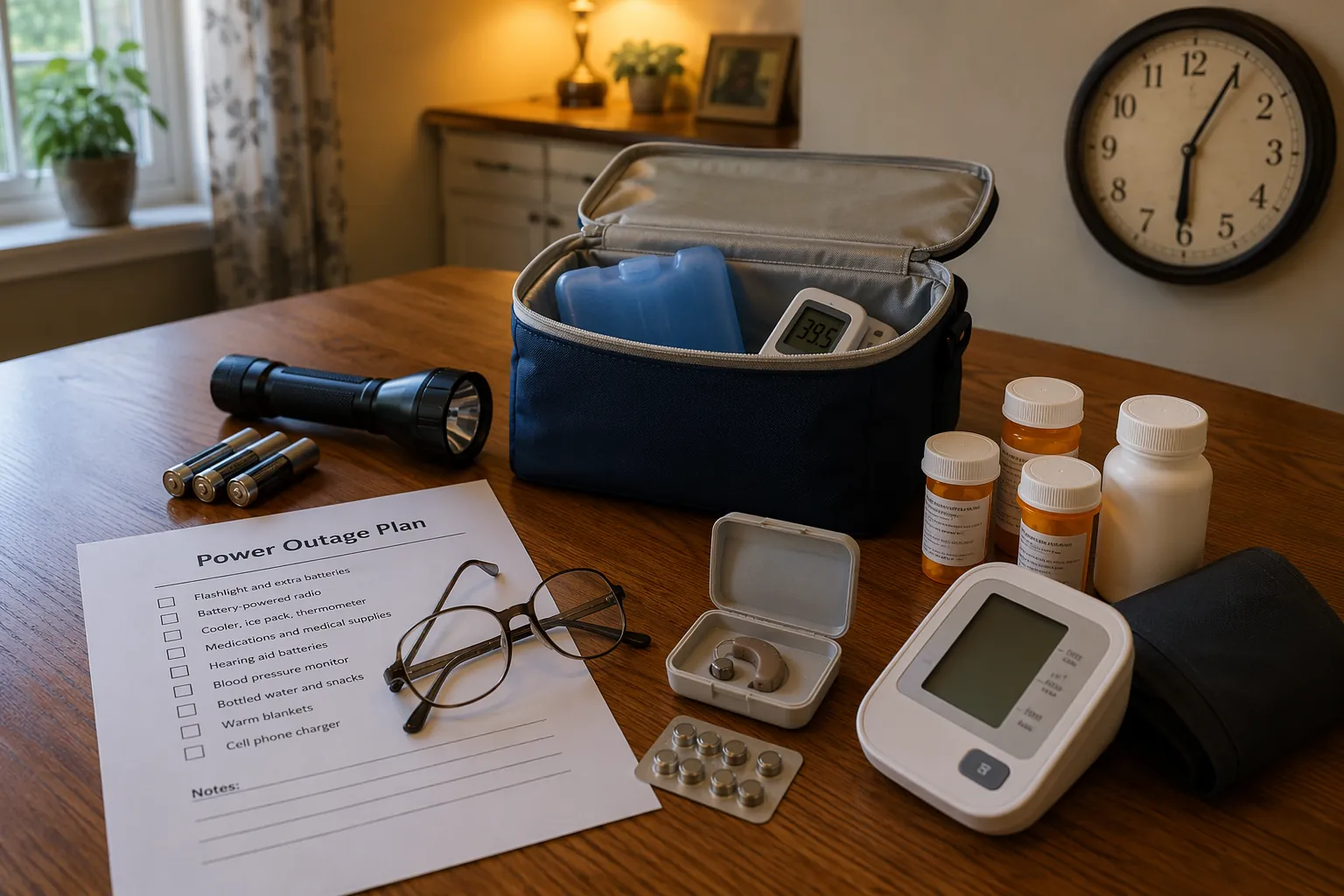
The Printable Checklist
This checklist is written for planning ahead, not for replacing medical care. Use it to prepare the home, then ask the relevant clinician, pharmacist, equipment supplier, and utility company to fill in the household-specific blanks.
| When | Action | Write Down or Stage |
|---|---|---|
| Before an outage | List every powered medical device and ask the equipment supplier for expected battery runtime at the current settings. | Device name, settings, battery age, runtime, supplier phone number, and when to relocate. |
| Before an outage | Apply for utility medical priority or medical needs enrollment if available. | Physician-signed form, confirmation number, renewal date, and utility outage phone number. |
| Before an outage | Build a 72-hour senior-specific kit. | Water, ready-to-eat food, flashlights, batteries, charging banks, medication list, spare hearing aid batteries, mobility backup, cooler, ice packs, thermometer, and temperature log strips. |
| Before an outage | Choose two relocation options. | One nearby cooling or warming location and one overnight option with transportation notes. |
| During an outage | Keep refrigerator and freezer doors closed unless removing needed medication or food. | Refrigerator: about 4 hours unopened. Full freezer: about 48 hours. Half-full freezer: about 24 hours.[2][3] |
| During an outage | Move refrigerated medications to a cooler with ice packs and a thermometer when needed. | Target refrigerated range for many medications: 36-46°F; ask a pharmacist about each medication. |
| During an outage | Monitor indoor temperature and symptoms. | Consider relocation above 85°F for heat-vulnerable seniors, especially those on heart medications, and below 60°F for cold-vulnerable seniors, including those on blood thinners. |
| During an outage | Use generators only outdoors and away from openings. | At least 20 feet from windows, doors, and garages; never indoors; battery carbon monoxide detectors on each level.[2][3][4] |
| After power returns | Check food, medication temperatures, equipment batteries, and the written plan. | Discard unsafe food, call the pharmacist about questionable medications, recharge batteries, replace used supplies, and update any failed steps. |
Before the Outage: Medical Equipment Gets Its Own Page
Do not write “oxygen has backup battery” and call it planned. For oxygen concentrators, CPAP or BiPAP machines, powered beds, nebulizers, infusion pumps, dialysis-related equipment, lift chairs, stair lifts, and rechargeable mobility devices, the useful question is not whether a battery exists. It is how long that device will run for this person, at these settings, with this battery, in its current condition.
Battery life varies by device, settings, battery age, and use pattern, so the equipment supplier—not a neighbor, not the product box, not an online estimate—should give the written runtime used in the plan.[5] If the supplier will only give a range, write the lowest number and plan from that.
- Device name and model.
- Current prescribed settings, such as oxygen flow rate or pressure setting.
- Expected battery runtime at those settings.
- Whether the device can run safely from a portable power station, vehicle inverter, or generator.
- Supplier phone number, after-hours number, and replacement battery process.
- Relocation trigger: the battery level or time remaining when the household leaves rather than waits.
That last line is the one families tend to avoid because it feels like admitting the plan may fail. It is actually the line that prevents a 9 p.m. argument. If the oxygen backup is expected to last four hours, the relocation trigger should not be hour three and fifty-five minutes. The caregiver, older adult, and backup contact should agree in advance when “wait it out” ends.
If the home has storm-related outage risk, it can help to pair this device page with a broader severe-weather contact plan, such as the site’s guide to preparing seniors for severe thunderstorms. The device list should still stand alone on the refrigerator, inside the emergency bag, and with the out-of-town contact.
Utility Medical Enrollment Helps, but It Is Not a Rescue Plan
Many utility companies offer medical needs, life-support, or priority notification programs. These programs usually require paperwork in advance, often including a signed clinician form. They cannot be assumed during an outage, and enrollment does not guarantee faster power restoration.[6]
The practical use of enrollment is documentation and communication: the utility may know there is medical equipment at the address, may send advance shutoff or restoration information, and may have a dedicated line for medically vulnerable customers. The household still needs batteries, transportation, and a place to go.
Build the 72-Hour Kit Around the Person, Not the Closet
Ready.gov advises older adults to prepare with their specific daily needs in mind, including medical, mobility, communication, and support needs.[4] For an aging-in-place household, the emergency bag should be reachable from the main living area, not tucked behind holiday decorations. If the person uses a walker, the kit cannot be so heavy that it becomes one more fall hazard.
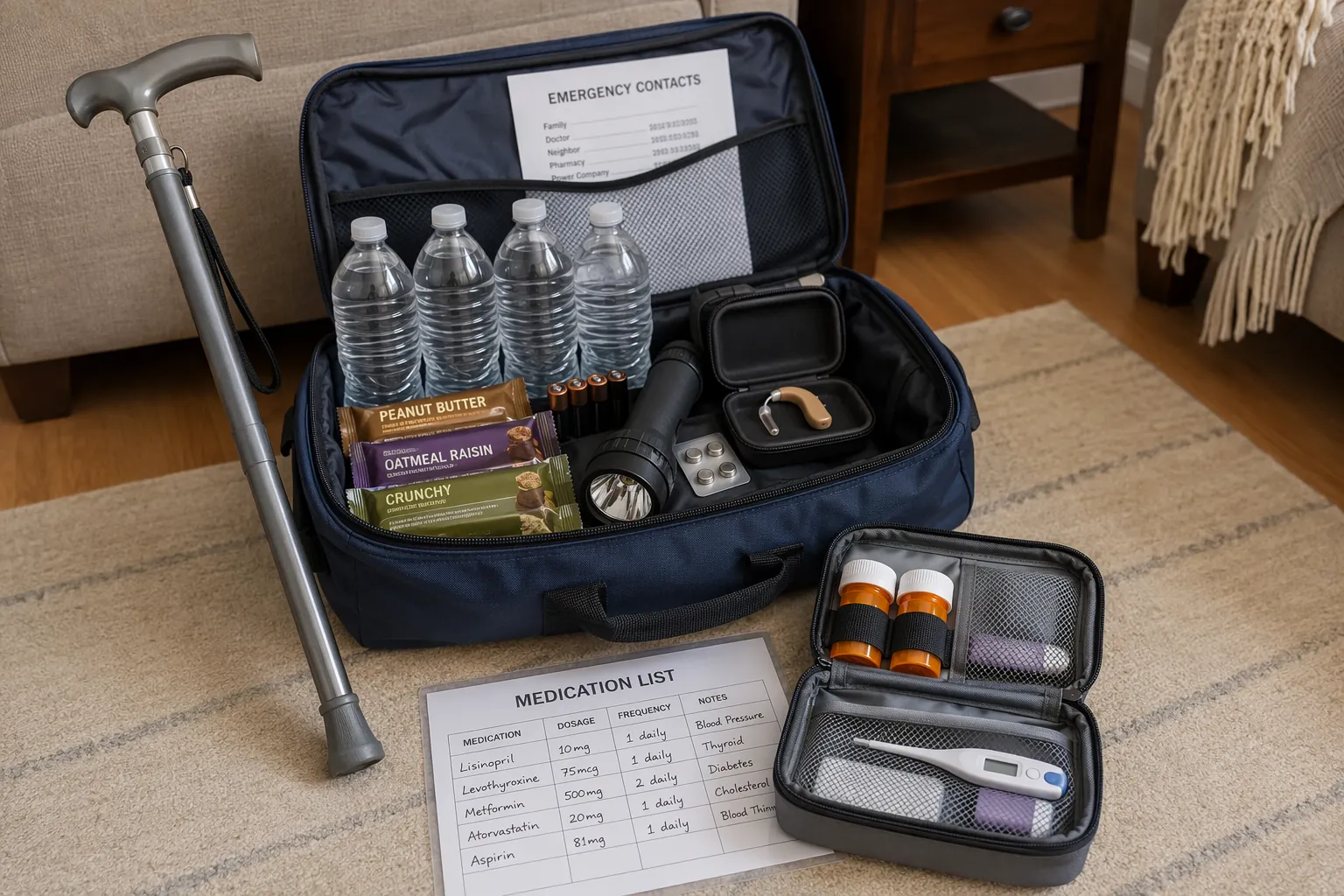
- Lighting: flashlights or lanterns with extra batteries in the bedroom, bathroom path, kitchen, and kit.
- Communication: charged power banks, charging cords, written phone numbers, and a check-in schedule.
- Medical information: medication list, diagnoses, allergies, pharmacy, clinicians, insurance cards, and device supplier numbers.
- Medication supplies: current medications, a cooler plan for refrigerated items, ice packs, thermometer, and temperature log strips.
- Hearing and vision: spare hearing aid batteries or charger, glasses, magnifier, and labeled containers.
- Mobility: cane, walker tips, wheelchair charger plan, non-slip footwear, and a clear path to the bathroom.
- Food and water: ready-to-eat food that fits the person’s diet, manual can opener if needed, and drinking water.
- Temperature tools: indoor thermometer, lightweight cooling items, warm layers, and written relocation thresholds.
The hearing aid batteries deserve their own line because communication often fails quietly. A person who cannot hear the phone, a smoke alarm, a carbon monoxide alarm, or instructions from a neighbor is not simply uncomfortable. They are harder to help. Keep the spare batteries or charger where the person can reach them without crossing a dark room.
For the fall side of the plan, use this checklist with the site’s power outage fall-prevention checklist for seniors. Darkness changes the home: cords move, rugs buckle, bathrooms become harder to navigate, and the safest route may not be the usual route.
During the Outage: Protect Medication Temperatures First
Medication storage is where vague advice can do real harm. Most refrigerated medications should be kept between 36°F and 46°F unless the medication’s own instructions say otherwise.[7] A refrigerator that stays closed can keep food at a safe temperature for about 4 hours, while a full freezer can hold temperature for about 48 hours and a half-full freezer for about 24 hours.[2][3] Those food-safety windows are helpful, but they do not answer every medication question.
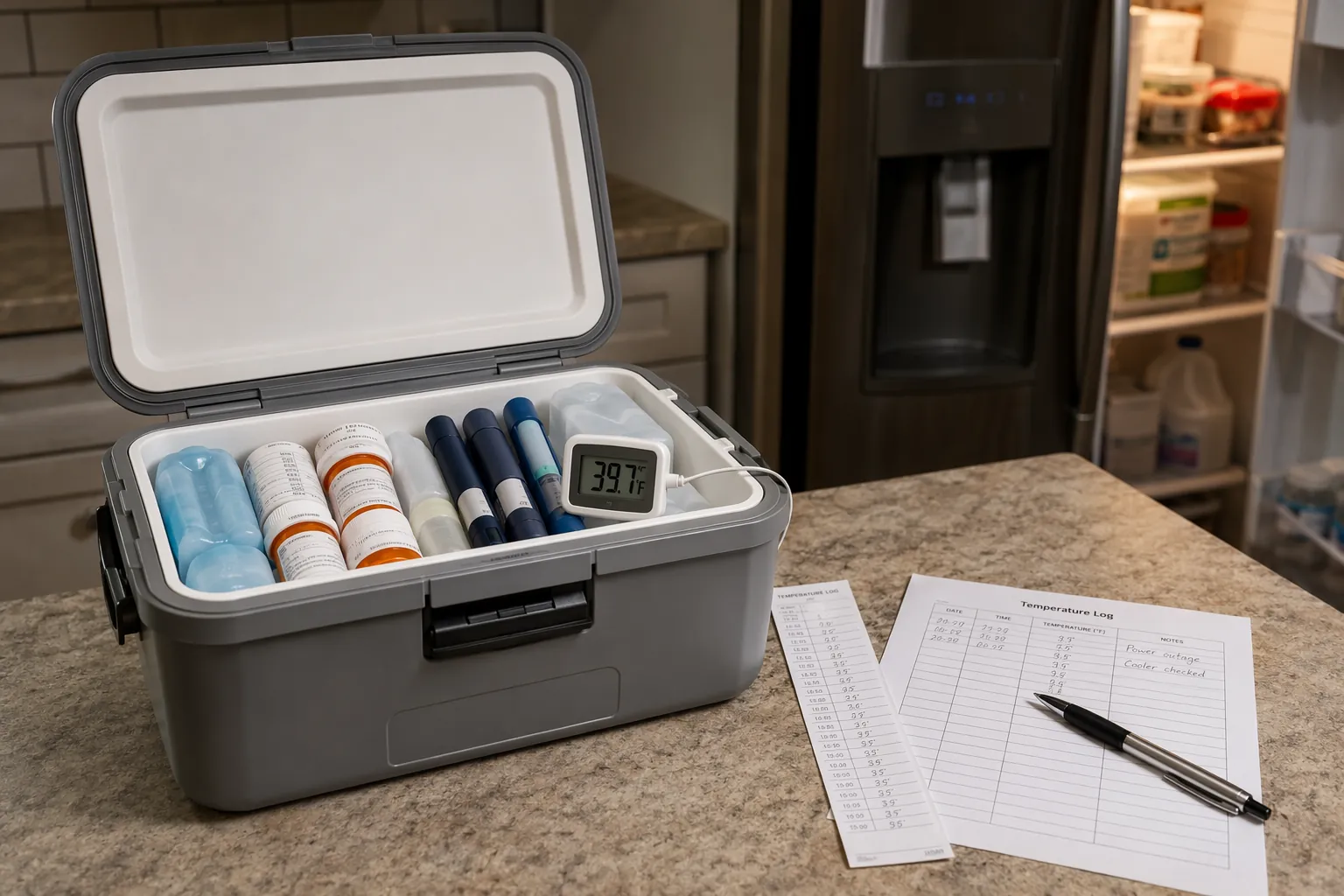
Insulin needs careful wording. FDA-linked guidance cited by PowerOutage.us says unopened insulin vials stored between 59°F and 86°F may remain usable for up to 28 days, while insulin exposed to higher temperatures can degrade.[7] That does not mean every diabetes medication can sit warm, and it does not mean a person should guess about insulin that has frozen, overheated, changed appearance, or been stored outside its labeled instructions.
The safest household plan is simple: keep refrigerated medications in the refrigerator while it is cold, move them to a cooler with ice packs and a thermometer when needed, log the temperature, and call the pharmacist or clinician before using medication that may have gone out of range. Temperature log strips are inexpensive enough that the family should not be relying on memory.
| Medication Situation | What to Do |
|---|---|
| Refrigerated medication still in a closed refrigerator during the first hours of an outage | Keep the door closed. Check only when necessary, and record the refrigerator temperature if available. |
| Refrigerator is warming or outage may last longer than the safe window | Move medication to a hard-sided cooler with ice packs, a thermometer, and a log strip. Avoid direct contact between medication and ice if freezing would damage it. |
| Unopened insulin has been kept between 59°F and 86°F | Do not automatically discard it; FDA-linked guidance says it may remain usable for up to 28 days, but confirm with the pharmacist or clinician for the exact insulin and situation.[7] |
| Medication froze, overheated, changed appearance, or the temperature is unknown | Call the pharmacist, clinician, or manufacturer guidance line before using it when possible. If urgent medication is needed, seek medical advice promptly. |
Use Indoor Temperature Triggers Before the House Feels Dangerous
Older adults may not sense heat and cold the same way they did earlier in life, and medications can change the body’s response. The checklist should name temperature triggers because “I feel fine” is not a reliable plan in a sealed-up house.
- If indoor temperature rises above 85°F, consider relocation for heat-vulnerable seniors, especially those with heart disease, breathing problems, limited mobility, or medications that affect fluid balance or heart function.
- If indoor temperature falls below 60°F, consider relocation for cold-vulnerable seniors, including those on blood thinners or with limited circulation, frailty, or difficulty moving safely.
- If the person becomes confused, unusually weak, dizzy, short of breath, clammy, very hot, very cold, or unable to drink fluids safely, treat that as a medical warning sign rather than a comfort issue.
- If medical device battery time is approaching the written relocation trigger, leave while transportation and communication are still workable.
A relocation plan does not have to be elaborate. It needs names, addresses, phone numbers, transportation, and acceptance of the medical equipment or mobility device involved. A cooling center is useful only if the person can get there, can remain there safely, and has the equipment, medication, hearing support, and bathroom access they need.
For hot-weather outages, pair this plan with the site’s guide to cooling seniors without AC and preventing falls during heat waves. Heat plans and fall plans belong together because weakness, dehydration, rushing, and dim rooms often show up at the same time.
Generator and Carbon Monoxide Rules Are Non-Negotiable
A generator can be a useful backup for a medically fragile household, but only if the safety rules are written into the plan and followed every time. The CDC and Red Cross warn that generators should never be used indoors, in garages, or near doors and windows; they should be placed at least 20 feet away from windows, doors, and garages.[2][3] Ready.gov also emphasizes carbon monoxide protection for older adults preparing for emergencies.[4]
- Never run a generator inside the home, garage, basement, crawl space, porch, or enclosed patio.
- Place portable generators at least 20 feet from windows, doors, and garages, with exhaust pointed away from the home.
- Use battery-powered carbon monoxide detectors on each level of the home.
- Never use a gas stove or oven to heat the home.
- Ask the medical equipment supplier which devices can safely connect to the backup power source before the outage.
If no one in the household can set up the generator safely in rain, heat, darkness, or snow, the generator is not a complete plan. It may still be useful, but the relocation plan remains necessary.
Communication: Assume the Adult Child Is Not Automatically in the Loop
Out-of-town caregivers often assume someone local will know what is happening. During a widespread outage, that assumption breaks quickly. The plan should assign one primary check-in person, one backup, and a neighbor or nearby contact who can knock on the door if calls fail.
| Communication Item | Minimum Plan |
|---|---|
| Check-in schedule | Set times, such as morning and evening, with a clear rule for what happens after a missed call. |
| Phone backup | Charged power banks, cords labeled by device, and a low-battery plan. |
| Written contacts | Utility, pharmacy, clinicians, medical equipment supplier, neighbors, family, and transportation options. |
| Hearing support | Spare hearing aid batteries or charger stored with the phone, not across a dark hallway. |
| Door access | Safe way for a trusted local contact to enter if the older adult cannot reach the door. |
The missed-call rule matters. If no one answers at the agreed time, does the caregiver call again in 15 minutes, call the neighbor, request a wellness check, or drive over? Families should decide that while everyone is calm.
After Power Returns: Do the Reset Before You Forget
The outage is not finished when the lights come back on. Food, medication, batteries, and the plan itself need a reset while the details are still fresh.
- Food: discard food that exceeded safe temperature limits or has an unsafe odor, texture, or temperature history; do not taste food to decide.
- Medication: review thermometer readings and log strips, then call the pharmacist about any medication that may have gone out of range.
- Medical equipment: recharge batteries, replace disposable supplies, and note whether the actual runtime matched the written plan.
- Utility paperwork: confirm medical enrollment status, update physician forms if required, and record any outage reporting numbers that were hard to find.
- Fall hazards: remove temporary cords, lanterns, coolers, and extension cables from walking paths before normal routines resume.
- Family notes: write down what failed, what ran out, who answered, who did not, and which relocation option was realistic.
A good checklist is not the longest one. It is the one that removes the decisions most likely to fail under heat, darkness, medical dependence, and distance: written device runtimes, medication temperature supplies, relocation triggers, utility paperwork, communication backups, and a reset step after power returns.
References
- Power Outages May Increase Risk for Hospitalization Among Older US Adults, Psychiatry Advisor.
- What to Do to Protect Yourself During a Power Outage, CDC.
- Power Outage Safety, American Red Cross.
- Older Adults, Ready.gov.
- Power Outage Planning for Oxygen and Medical Devices, Banner Health.
- Power Outage Preparedness for Seniors & Elderly, PowerOutage.us.
- Keep Insulin and Medications Cold During Power Outages, PowerOutage.us.
Related reading
Noticed something outdated or inaccurate on this page? Flag a correction. We review every report against CDC, NIA, and AARP HomeFit guidance before updating a page.
Part of the Fall Prevention section.