
STEADI: intervene
What to Do During a Power Outage for an Elderly Person
A power outage creates four simultaneous danger zones for an older adult: darkness (fall risk), temperature extremes, medical device dependency, and communication failure. This article explains the specific prevention strategies and when to relocate for each zone.
When the lights go out, the first question is not whether the outage is “serious.” For an older adult at home, it becomes serious when one of four things stops being controlled: the walking path is dark, the room gets too hot or too cold, a medical device loses power, or the person cannot reliably reach or hear help. The safest answer to what to do during a power outage for elderly loved ones is to check those four zones in that order, then keep checking them as the outage continues.
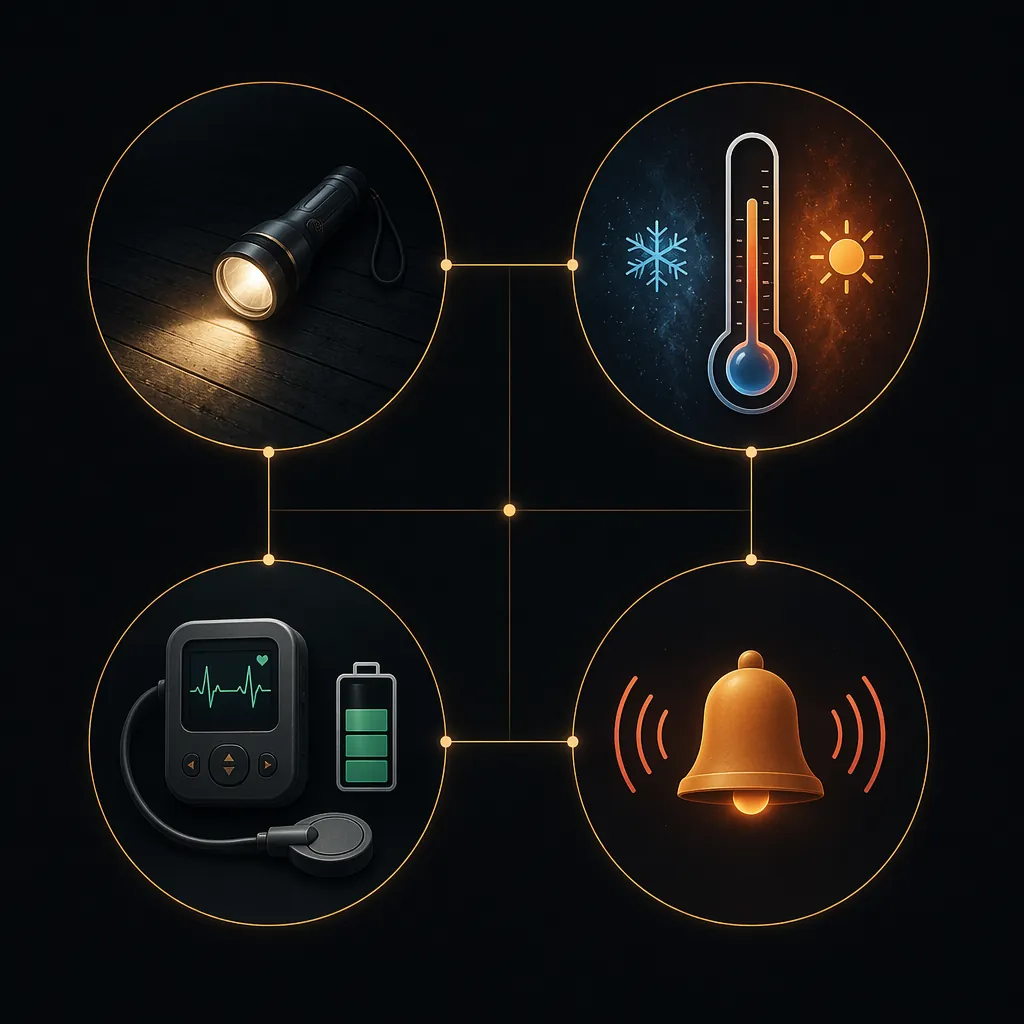
That may sound blunt, but it prevents the argument families often have at exactly the wrong time. One person says, “It will probably come back soon.” Another says, “You need to leave.” The better question is narrower: can this person move safely, stay within a safe indoor temperature range, keep essential devices running, and contact help if something changes?
First 10 Minutes: Stabilize the House Before Anyone Starts Walking Around
Start with stillness. If the older adult is seated, in bed, or already in a safe spot, ask them to stay there until light is placed between them and the bathroom, kitchen, phone, and exit. The CDC’s power outage guidance emphasizes using flashlights instead of candles and avoiding carbon monoxide hazards from unsafe heating or cooking sources during outages.[1] That advice matters more in a frail home because one bad workaround can create the next emergency.
- Put a working flashlight or lantern within reach before anyone walks to another room.
- Check whether the older adult needs the bathroom now, because that trip becomes harder the longer the house stays dark.
- Look at the indoor temperature, not just the weather outside.
- Check every powered medical device and note the battery level or remaining runtime.
- Make one outgoing contact: tell the agreed-upon person that the power is out, who is home, and what still works.
If you are calling from outside the home, do not settle for “I’m fine” until you know the basics: whether they have light in reach, whether the phone is charged, whether they are using oxygen or another powered device, and what the thermostat or room thermometer says.
Danger Zone 1: Darkness and Falls
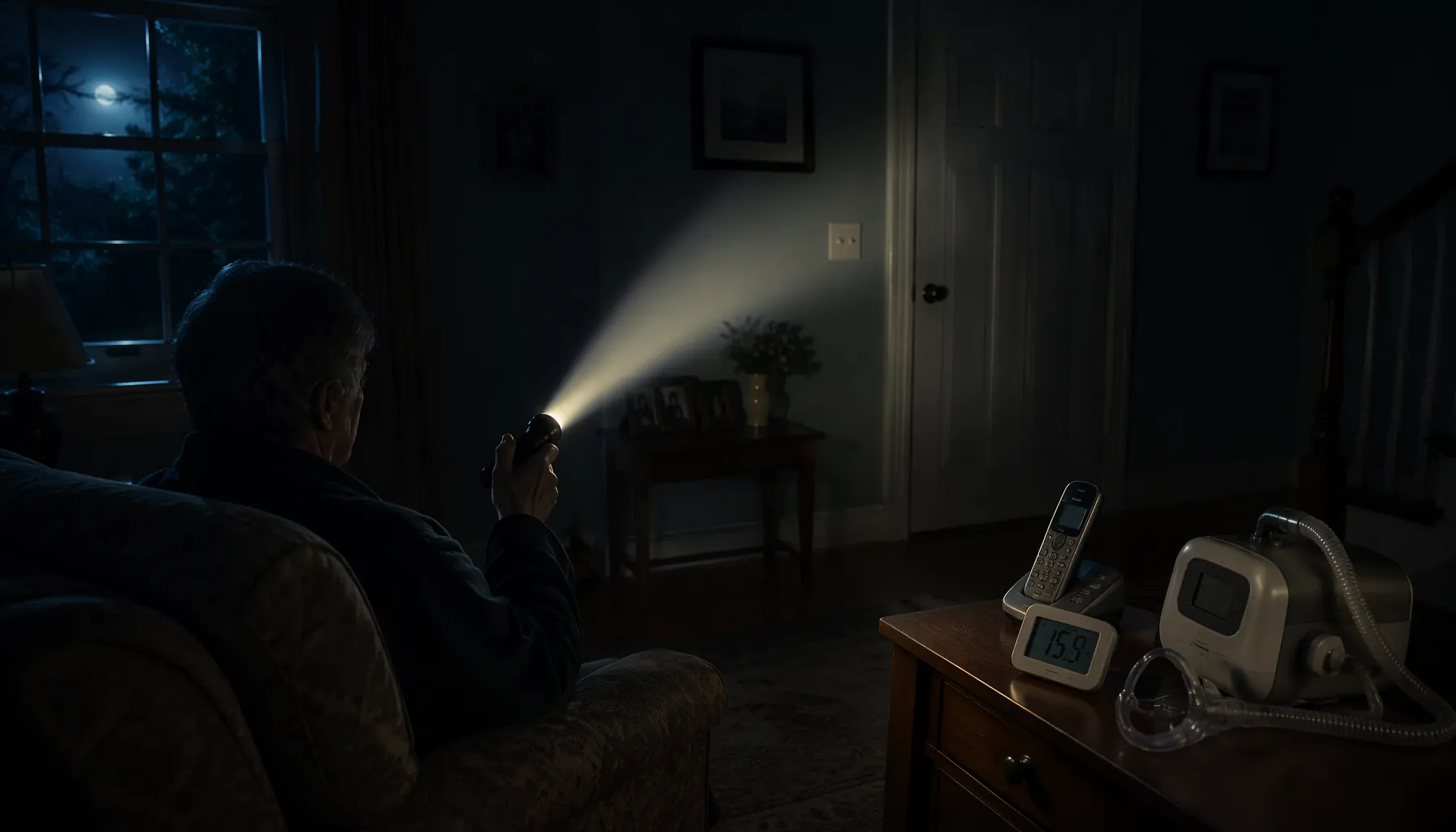
Darkness is not just inconvenient for older eyes. Older adults can take about 20 to 30 minutes to adapt to the dark, which is far longer than the time it takes to stand up, reach for a wall, misjudge a rug edge, and fall.[2] Telling someone to “just walk carefully” ignores the way the body is actually working in that room.
The fall numbers justify taking this first. The CDC reports that about 1 in 4 older adults falls each year, and falls are a leading cause of injury among adults 65 and older.[3] CDC and National Institute on Aging fall-prevention materials also note that many falls happen at home, which is exactly where an outage removes the lighting and routines people depend on.[3][4]
The most dangerous walk is usually not dramatic. It is the short trip from the bed to the bathroom, the reach for the thermostat, the shuffle to check the refrigerator, or the step over an extension cord someone placed in a hurry. If the house is dark, the better plan is to shrink movement, not prove independence.
- Place light first: use lanterns, headlamps, or flashlights aimed at the floor path, not into the person’s eyes.
- Clear the route: remove throw rugs, loose cords, shoes, baskets, and pet bowls from the bed-to-bathroom path.
- Use stable support: encourage a walker, cane, grab bar, or sturdy furniture already used safely, not a rolling chair or towel rack.
- Keep footwear simple: non-slip shoes or slippers beat socks on smooth floors.
- Reduce trips: bring water, medications, phone, glasses, hearing aids, and a blanket to the safe sitting or sleeping area.
Bathroom access deserves its own attention because urgency makes people move before the path is ready. If bedside toileting equipment is already part of the home setup, an outage is the time to use it. If not, the goal is still the same: light the path, slow the transfer, and make sure the person has something secure to hold. For a deeper room-by-room fall setup, see the storm power outage fall-prevention checklist.
The relocation trigger for this zone is practical: if the older adult cannot reach the bathroom, bed, phone, and exit without unsafe walking in the dark, staying home is no longer a low-risk choice. A fall during an outage is harder to discover, harder to assess, and harder to respond to. If a fall does happen, use fall-response guidance rather than rushing the person up; a separate guide on activating senior health services after a fall can help with that decision.
Danger Zone 2: Temperature Extremes
Temperature is where families wait too long because the house feels only “a little uncomfortable” at first. Older adults may not sense or respond to heat and cold as quickly, and some medications or chronic conditions can make temperature stress more dangerous. The room thermometer matters more than reassurance.
For cold conditions, National Institute on Aging guidance has warned that an indoor temperature around 60 to 65°F can raise hypothermia risk for older adults.[2] For heat, CDC power-outage guidance warns that indoor temperatures above 90°F can be dangerous and advises finding a cooler location when the home cannot be kept safe.[1]
| Indoor condition | What to do | When to leave |
|---|---|---|
| House is cooling but still above the cold-risk range | Close off unused rooms, dress in layers, use blankets, and keep the older adult in one safer room. | Leave before the room reaches the 60-65°F risk range if heat will not return soon or the person is frail, wet, confused, or shivering. |
| House is heating up | Move to the coolest room, close curtains on sun-facing windows, sip fluids if medically allowed, and avoid unnecessary movement. | Leave for a cooling center, family home, or other safe location before indoor heat rises above 90°F. |
| Someone suggests a gas oven, grill, or charcoal indoors | Stop that plan immediately. | Relocate instead of using unsafe heating or cooking methods. |
The unsafe shortcuts are not small mistakes. The CDC, FEMA Ready.gov, and the Red Cross all warn against using outdoor grills, camp stoves, generators, or charcoal-burning devices inside because of fire and carbon monoxide risks.[1][5][6] A gas oven is not an emergency heater. A generator in a garage is not “almost outside.”
Preparation for this zone is not glamorous: a room thermometer with large numbers, layered clothing, extra blankets, a plan for a cooler or warmer destination, and transportation arranged before the weather peaks. Hurricane and storm planning can go deeper into room setup and supplies; the room-by-room hurricane safety guide and hurricane kit fall-prevention guide are useful continuations when weather is the reason for the outage.
Danger Zone 3: Medical Devices and Battery Limits
Medical devices change the meaning of “waiting it out.” If an older adult uses oxygen equipment, a powered hospital bed, a CPAP or BiPAP machine, a ventilator-related device, suction equipment, a medication pump, a power wheelchair, or refrigerated medication, the outage has a clock attached to it.
A University of Tennessee Knoxville summary of research on electricity-dependent medical devices reports that device backup batteries may last only about 3 to 8 hours, while actual runtime varies by device model, battery age, settings, and use.[7] That range is too short to treat a long evening outage as a minor inconvenience.
- Find the device list: identify every device that needs electricity, battery charging, refrigeration, or powered adjustment.
- Read the battery display or backup-power indicator; do not guess from memory.
- Call the device supplier, clinician, home health agency, or emergency contact listed in the device plan if runtime is unclear.
- Switch to the approved backup method only if it was provided or confirmed for that device.
- Leave early if the device is essential and power may not return before the battery is depleted.
This is also where utility registration matters, though it should never be treated as a rescue guarantee. Many utilities have medical baseline, life-support, or priority notification programs for customers who depend on powered medical equipment. Registration may help with notices or planning, but it does not keep the electricity on in every outage and it does not replace backup power or relocation.
For advance planning, write the device plan on paper: device name, supplier phone number, clinician contact, backup battery location, expected runtime, charging instructions, and the destination that can support the device if home cannot. A medical-device outage checklist can help organize those details, but the final instructions should come from the device supplier, clinician, utility, or emergency plan for that specific person.[8]
The broader outage pattern makes early decisions more important. UTK reports that more than half of U.S. counties experienced outages lasting more than 8 hours, citing Nature Communications, and that U.S. outages became 9% more frequent and 56% longer from 2014 through 2023, citing federal energy data.[7] A secondary report on a PLOS Medicine study also described 4,246 excess hospitalizations among older adults associated with power outages in a single year; because that figure is from secondary coverage, it is best read as evidence that outages can have measurable health consequences, not as a number to apply to every household.[9]
Danger Zone 4: Communication Failure
Communication failure is quieter than the other zones. The older adult may still be at home, still sitting safely, still saying everything is fine — and no one knows the phone is almost dead, the cordless handset depends on wall power, the medical alert base station has lost backup, or the person did not hear the alert.
Hearing loss makes ordinary alert plans weaker. NIH/NIDCD statistics, cited in senior outage-preparedness guidance, estimate that disabling hearing loss affects about 22% of adults ages 65 to 74 and about 55% of adults 75 and older.[2] A phone alert, siren, or shouted instruction is not a plan if the person cannot reliably hear it.
- Keep at least one charged cell phone power bank where the older adult can reach it.
- Use a battery-powered or hand-crank NOAA weather radio for official updates when internet and television are down.
- Set a check-in schedule with a real deadline: for example, if there is no contact by the agreed time, someone calls again or goes over.
- Write phone numbers on paper, including family, neighbors, utility, device supplier, pharmacy, clinician, 211, and the Eldercare Locator.
- If the person uses monitoring equipment, confirm what still works during an outage and what fails when Wi-Fi, landline service, or wall power is gone.
A neighbor plan is often better than another app. The useful arrangement is specific: who has a key or lockbox code, who checks the porch light or answers a knock, who can drive at night, and who calls emergency services if the older adult cannot be reached. For families choosing backup monitoring or check-in tools, the elderly monitoring system decision framework can help separate helpful redundancy from gadgets that fail with the same power outage.
When Staying Home Stops Being the Safer Choice
Many older adults do not want to leave home, and that preference deserves respect. The mistake is making relocation a debate about fear instead of a decision about thresholds. Staying home is reasonable only while all four zones remain controlled.
| Zone | Relocation trigger |
|---|---|
| Darkness and falls | The person cannot move between bed, bathroom, phone, and exit without unsafe walking. |
| Temperature | Indoor temperature is approaching the cold-risk range around 60-65°F or the heat-danger range above 90°F, and the home cannot be corrected safely. |
| Medical devices | An essential device may lose power before electricity returns, or its backup plan is unclear. |
| Communication | The person cannot reliably call, hear, receive updates, or be checked on. |
Leaving early is usually easier than leaving late. It means medication can be packed with light, mobility equipment can be loaded without rushing, and the older adult can move before fatigue, heat, cold, or darkness narrows the options. If transportation, pets, oxygen, wheelchair access, or dementia-related distress complicates the decision, build that into the plan before the next outage; the emergency evacuation plan for seniors is the better place to work through those details.
The practical rule is simple enough to use at 9 p.m.: if lighting, temperature, devices, and communication are all controlled, sheltering in place may be reasonable. If any one of them crosses its threshold, the safer plan is to relocate before the outage turns four small failures into one large emergency.
References
- What to Do to Protect Yourself During a Power Outage, CDC
- Power Outage Preparedness for Seniors & Elderly, PowerOutage.us
- Facts About Falls, CDC
- Home Safety Checklist, AAOS
- Power Outages, FEMA Ready.gov
- Power Outage Safety, American Red Cross
- Power Outages and Electricity-Dependent Medical Devices, University of Tennessee Knoxville Center for Transportation Research
- Medical Device Power Outage Checklist, PowerOutage.us
- Power Outages May Increase Risk for Hospitalization Among Older US Adults, Pulmonology Advisor
Related reading
Noticed something outdated or inaccurate on this page? Flag a correction. We review every report against CDC, NIA, and AARP HomeFit guidance before updating a page.
Part of the Fall Prevention section.