
STEADI: Intervene
Senior Preparation Tips for Oregon Red Flag Warnings
When a red flag warning is issued in Oregon, seniors and their caregivers need a concrete action plan. This guide explains why Oregon's Office of Emergency Management recommends older adults leave at a Level 1 evacuation notice, and provides a step-by-step checklist for preparing medication go-bags, fall-proofing evacuation routes, and building a clean-air room.
A red flag warning in Oregon does not mean every older adult should run for the car. It means the weather and fuel conditions can let a fire start and spread fast enough that the usual “we’ll decide later” habit becomes risky. Oregon State University Extension describes the National Weather Service red flag criteria as sustained winds of at least 15 mph, relative humidity at or below 25%, and dry fuels.[1]
For an older adult living outside town, the practical answer is simple: use the red flag warning to activate the plan, then use Oregon’s evacuation levels to decide when to move. Once an evacuation notice reaches Level 1, Oregon guidance shared through OSU Extension says older adults should leave because they “can’t move quickly and need more time to evacuate.”[2]
That is the part many families miss. Level 1 is called “BE READY,” so it can sound like a waiting room. For a senior who uses a walker, depends on oxygen, sorts several medications, has hearing loss, drives only in daylight, or needs an adult child to come from another town, Level 1 is not just notice. It is the safe-action point.
First, Make Sure the Warning Is Yours
Red flag warnings are issued for fire weather zones, not as a blanket order for every address in Oregon. A warning that matters in the Rogue Valley may not mean the same thing for a relative on the coast or in a different county. Before anyone starts loading a car, check the county emergency management page, the National Weather Service alert for the actual location, and the local emergency alert system. Ready Jackson County, for example, treats red flag warnings as local conditions that residents should monitor through official alert channels.[3]
The habit to build is not panic. It is verification. The caregiver checks the zone. The older adult turns on the phone ringer. The go-bag comes out where it can be seen. The car gets pointed toward the exit route if that is safe to do. Nobody should be learning the county alert system for the first time while smoke is already in the driveway.
| Notice or Level | What It Means | Senior-Specific Action |
|---|---|---|
| Red flag warning | Weather, humidity, and fuel conditions can support rapid fire spread.[1] | Activate the plan: confirm alerts, charge phones, check medications, fuel, shoes, walker, and ride. |
| Level 1: BE READY | There is a potential threat; pack and monitor conditions.[2] | Begin moving early if mobility, medication, oxygen, cognition, vision, hearing, pets, or transportation makes delay unsafe. |
| Level 2: BE SET | There is significant danger; be ready to leave at a moment’s notice.[2] | Only final checks should remain. The bag, documents, assistive devices, and ride should already be handled. |
| Level 3: GO | Leave immediately.[2] | No packing, no sorting, no debate. Leave by the safest available route. |
Why Level 1 Carries More Weight for Seniors
The reason to leave earlier is not that older adults are helpless. It is that the margin for a rushed mistake is smaller. The Oregon State Fire Marshal reports that adults 65 and older are twice as likely to die in a fire as the general population, and by age 85 the risk is four times as high.[4]
Falls are already the leading cause of fatal and nonfatal injuries among Oregon adults 65 and older, and the Oregon Health Authority says 1 in 3 older adults fall each year.[5] An evacuation adds the exact things that make falls more likely: dim halls during a power outage, smoke that irritates eyes, a rushed turn at the threshold, a walker catching a rug edge, shoes chosen in a hurry, and a caregiver trying to carry too much at once.
So the plan should not be built around the fastest possible person in the house. It should be built around the slowest safe version of the real person: tired, worried, maybe coughing, maybe without full power, maybe with the good shoes in the bedroom and the pill organizer still on the kitchen counter.
When the Red Flag Warning Arrives
This is the check that happens before an evacuation level is issued. It should take minutes, not become a household project.
- Confirm the warning applies to the older adult’s actual address or fire weather zone.
- Turn on county alerts, phone volume, and emergency radio if one is used.
- Plug in the phone, backup battery, hearing aids, oxygen or CPAP battery, and medical alert device.
- Move the medication bag, document folder, shoes, walker, cane, glasses, and keys to the chosen exit.
- Call the first caregiver in the chain and say the same sentence every time: “Red flag warning is active; we are on alert, not leaving unless Level 1 or conditions change.”
- Check gas or charging level in the evacuation vehicle and make sure it is not blocked in.
That last call matters. In too many families, everyone assumes someone else checked. One person should own the call tree. One person should be the backup. The older adult should know who is coming, who is not coming, and what condition changes the plan.
At Level 1, Start Moving the Parts That Take Time
Level 1 is the point to stop pretending the evacuation will be tidy. If leaving early turns out to be unnecessary, that is inconvenient. If waiting turns a slow, manageable departure into a dark hallway scramble, the cost can be a fall, missed medication, or a delayed exit.
Start with medication because it is the item most likely to sit in the wrong place. A senior wildfire go-bag should hold a 7- to 14-day supply of medications when possible, along with a printed medication list, allergies, diagnoses, physician contacts, insurance cards, pharmacy information, and copies of essential medical documents.[6] A phone photo is helpful, but it should not be the only copy. Phones lose power, screens crack, and evacuation shelters or clinics may need paper.
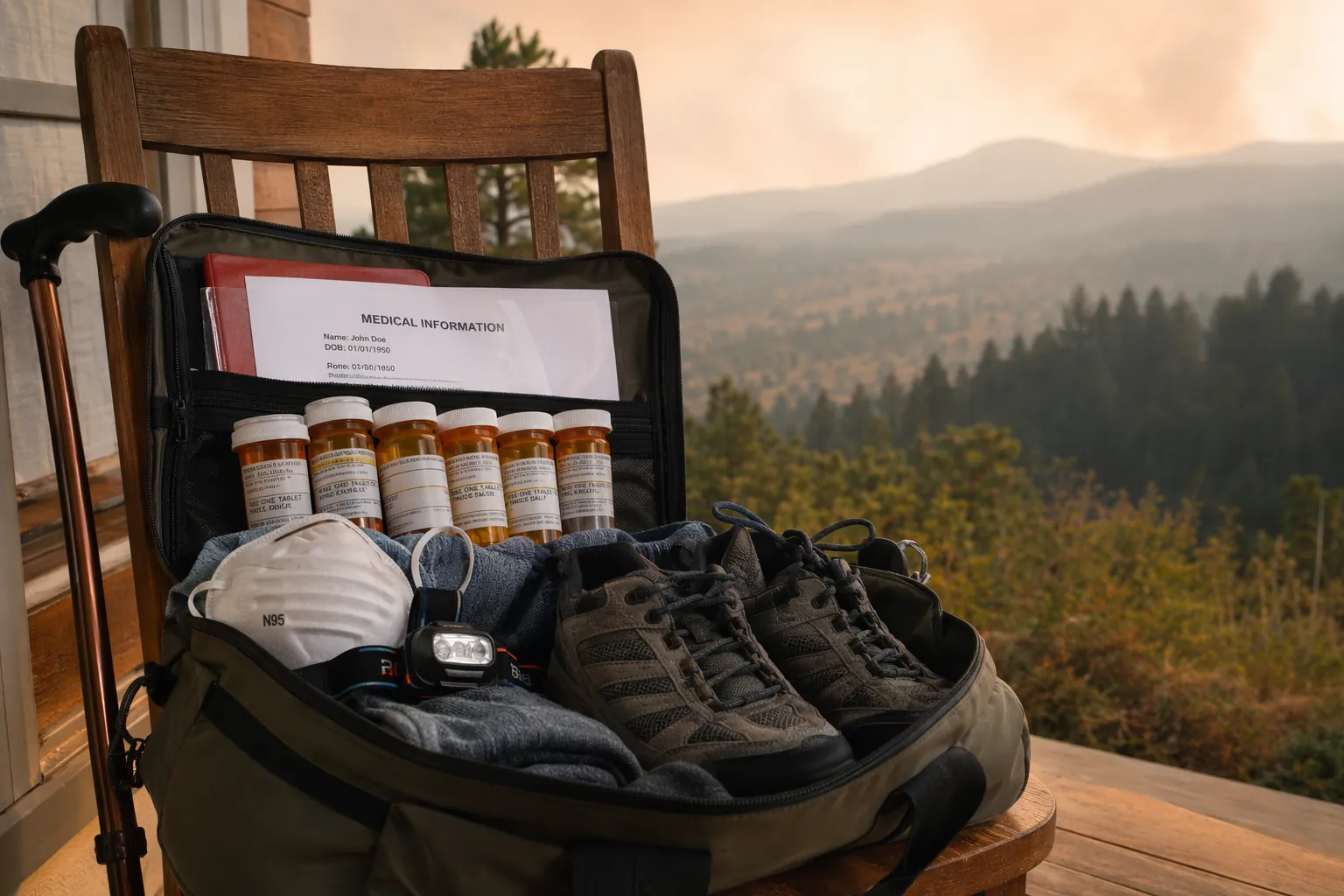
The bag should also hold a headlamp with spare batteries, not just a flashlight. A headlamp leaves both hands free for a walker, rail, cane, pet carrier, or car door. Add sturdy non-slip shoes to the bag instead of assuming they will be on the right feet at the right time. Slippers are comfortable until a gravel driveway, wet porch board, or smoke-darkened step turns them into a hazard.
For mobility equipment, Level 1 is when the walker comes to the exit, the cane tip gets checked, wheelchair footrests are attached, and the portable ramp is placed where the caregiver can reach it. The U.S. Fire Administration advises older adults to make sure doors and exits can accommodate walkers and wheelchairs.[7] That is not a theoretical measurement. It means the walker must actually fit through the door used during an evacuation, with the oxygen tubing, dog, caregiver, and go-bag in the same real hallway.
If the older adult uses oxygen, CPAP, hearing aids, a power wheelchair, or other battery-dependent equipment, Level 1 is also the time to decide whether staying in place is still practical. Backup batteries belong on the checklist, but batteries are not a full evacuation plan. If equipment cannot travel easily, the early destination needs to be chosen before Level 2.
Pets need the same early treatment. A cat carrier in the garage rafters is not an evacuation item. Leashes, carriers, food, medication, and vaccination records should be where one person can pick them up without searching. If a pet will cause the older adult to delay leaving, that pet is part of the Level 1 plan, not a side issue.
A Level 1 Call Script
Caregivers can avoid a lot of negotiation by agreeing on the words before fire season. A plain script works better than a lecture:
- “The county has issued Level 1 for your area.”
- “Because you need extra time with the walker and medications, this is our moving point.”
- “We are going to leave before it becomes urgent.”
- “The bag, shoes, documents, phone charger, and medications go now.”
The point is not to win an argument about bravery or independence. The point is to leave while the older adult can still stand up slowly, use the bathroom, put on the right shoes, and get into the car without sirens and smoke making every choice harder.
At Level 2, There Should Be Almost Nothing Left to Pack
Level 2 means significant danger and the need to be ready to leave at a moment’s notice.[2] For a senior household, that should not be the beginning of packing. It should be the short check before the door closes.
- Medication bag is in the vehicle or beside the exit.
- Medical documents, insurance cards, ID, glasses, hearing aids, phone, charger, and backup battery are with the person.
- Walker, cane, wheelchair, oxygen, CPAP, or other equipment is ready to load.
- Shoes are on, not packed.
- The caregiver knows the destination and the route.
- The older adult is not alone unless the plan already accounts for that.
If any of those items are still unresolved at Level 2, that is a sign the Level 1 threshold was too late for that household.
At Level 3, Leave
Level 3 means leave immediately.[2] This is not the time to collect photos, sort pill bottles, change shoes, call three relatives, or look outside to judge the smoke. If a senior still has packing decisions at Level 3, the plan has already failed in the place where planning was supposed to help.
The only useful question is which exit and route are safest right now. Follow official instructions, avoid blocked roads, and do not return until authorities say it is safe.
Build the Go-Bag Before Fire Season, Not During Dinner
Oregon’s broader preparedness message asks households to be ready to be self-sufficient for two weeks.[8] For seniors, that idea needs to become a bag, a folder, and a few duplicate items that are never borrowed for daily use.
| Item | Why It Belongs in the Senior Go-Bag |
|---|---|
| 7- to 14-day medication supply | Evacuation may disrupt pharmacies, refills, mail delivery, or normal caregiving routines.[6] |
| Printed medication list and medical documents | A paper backup works when phones are dead or staff need quick information. |
| Insurance cards, ID copies, emergency contacts | Caregivers and responders should not have to search a wallet or phone. |
| N95 or P100 respirators | Cloth and surgical masks do not provide adequate wildfire smoke protection; N95 or P100 respirators are the useful option.[9] |
| Headlamp and spare batteries | Hands-free light reduces fall risk during dark exits or power shutoffs. |
| Sturdy non-slip shoes | The safest evacuation shoes should not depend on memory or timing. |
| Backup batteries | Hearing aids, phones, oxygen, CPAP, and mobility devices may need power away from home. |
| Written contact card | A simple card helps if the older adult is separated from a phone or caregiver. |
The bag should be light enough for the caregiver to carry while still helping the older adult. If it becomes a 40-pound symbol of preparedness, it will be left behind. Use a backpack, small rolling bag, or tote that works with the person’s real mobility.
Fall-Proof the Exit Route While the House Is Calm
The evacuation route should be boring. Same door. Same shoes. Same place for keys. Same place for the walker. Same motion lights. The more predictable the route is, the less the older adult has to solve under stress.
- Remove throw rugs, loose mats, and electrical cords from the path between bed, bathroom, kitchen, and exit.
- Keep oxygen tubing and CPAP hoses out of the evacuation path, or route them so they cannot loop around a walker.
- Test the walker, wheelchair, or scooter through the chosen exit door, not just the widest door in the house.
- Install battery-operated motion lights in the bedroom, hallway, bathroom, and exit area.
- Check cane tips, walker glides, walker wheels, brakes, and wheelchair footrests before the first hot, windy week.
- Practice the route once in daylight and once in low light, with the real shoes and mobility device.
A caregiver should do this walk-through at the older adult’s speed. If the adult child strides ahead and announces that the path is fine, the test has not happened. Watch the turns. Watch the thresholds. Watch whether the walker catches the edge of the rug that everyone has stopped seeing.
Set Up the Clean-Air Room Before the Smoke Day
Not every red flag warning turns into an evacuation, but smoke can still make staying home harder. The preparation is not a cloth mask in a drawer. AARP reported in July 2026, citing a 2024 PNAS study, that wildfire PM2.5 can be about 10 times more toxic than fossil-fuel air pollution, and it notes that cloth and surgical masks do not protect against wildfire smoke the way N95 or P100 respirators can.[9]
OSU Extension’s indoor-air guidance turns that concern into a room setup: use a portable HEPA air cleaner or a box fan fitted with a MERV-13 filter, close windows and doors, run HVAC on recirculate when possible, and seal gaps with weatherstripping or damp towels.[10]
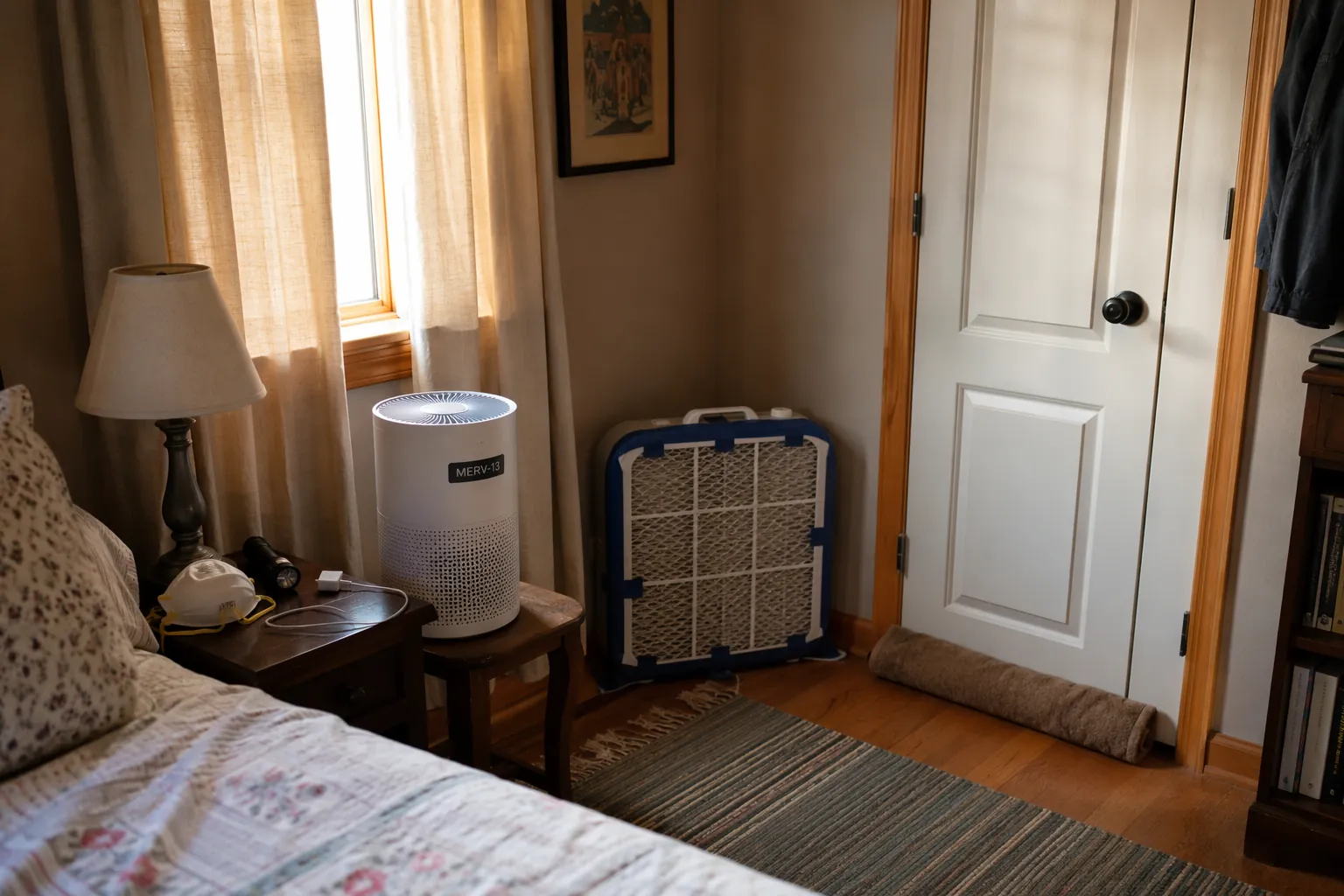
Choose the room before smoke arrives. A bedroom often works because the older adult may need to rest there, but the best room is the one with the fewest leaks, enough outlets, space for mobility equipment, and a bathroom route that does not create a fall hazard. Put the purifier, filters, tape or weatherstripping, towel, phone charger, water, flashlight, and respirator in that room before the air turns bad.
A clean-air room is not a reason to ignore an evacuation notice. It is for smoke days, waiting periods, and situations where officials have not told the household to leave. Once the evacuation level reaches the household’s moving point, the clean-air room stops being the plan.
Keep the County Alert Chain Simple
Every Oregon senior household in wildfire country needs at least two ways to receive official alerts: the county emergency alert system and a backup such as NOAA Weather Radio, local emergency management social media, local radio, or a caregiver who is signed up for the same address. The backup matters because older adults may silence phones, miss texts, lose power, or misunderstand a message that uses unfamiliar emergency language.
The caregiver list should be short and assigned. One person checks official alerts. One person calls the older adult. One person can drive if the first person cannot. One out-of-area contact receives updates so relatives do not flood the senior’s phone while decisions are being made.
Write those names and numbers on paper and put the card in the go-bag, on the refrigerator, and near the main phone. Disaster planning advice for older adults from the National Council on Aging emphasizes having a support network and emergency plan that accounts for medical and daily living needs.[11]
The Decision Rule
Use the red flag warning as the activation point: verify the zone, charge devices, check the bag, and put the exit route in order. Use Level 1 as the moving point for an older adult who needs extra time. Use Level 2 only for final checks. Use Level 3 for leaving, not thinking.
If an Oregon senior cannot leave quickly, Level 1 is not early notice. It is the safe-action point.
References
- What is a red flag warning? — OSU Extension Service.
- Preparing your household — OSU Extension Service.
- Red Flag Warnings — Ready Jackson County.
- Fire Safety for Older Adults — Oregon State Fire Marshal.
- Helping older adults reduce their risk of falling — Oregon Health Authority.
- Wildfire Preparedness Guide for Seniors & Caregivers — FireHelpCenter, 2026.
- Fire Safety for Older Adults — U.S. Fire Administration/FEMA.
- Be 2 Weeks Ready — Oregon Department of Emergency Management.
- 8 Ways Wildfire Smoke Affects Your Health — AARP, July 2026.
- Protecting Indoor Air from Wildfire Smoke — OSU Extension Service.
- What Older Adults Can Do If Disaster Strikes — National Council on Aging.
Related reading
Noticed something outdated or inaccurate on this page? Flag a correction. We review every report against CDC, NIA, and AARP HomeFit guidance before updating a page.
Part of the Fall Prevention section.