
STEADI: Intervene
Parent Got the Wrong Medication in Hospital? Do This Now
When an older parent may have received the wrong medication in the hospital, the first hours matter most. This guide gives you a clear bedside sequence: watch for urgent reaction signs, ask staff to verify what was given against the medication record, request a chart note and monitoring plan, and protect the discharge transition before your parent comes home.
If you think your elderly parent received the wrong medication in the hospital, the first job is not to prove fault. It is to get a clinician to assess your parent now, verify exactly what was given, and make sure the concern is documented while memories, timestamps, and medication records are still fresh. ConsumerMedSafety’s guidance is direct: speak with a healthcare professional immediately, because only a clinician can assess whether harm occurred and arrange treatment if needed.[1]
This article is safety guidance for a family member at the bedside, not medical or legal advice. If your parent has symptoms that look urgent, do not wait for a calm conversation about the chart.

First minutes: get a clinician to the bedside
While your parent is admitted, use the nurse call button for concerning symptoms and say plainly: “I’m worried my parent may have received the wrong medication, and I need someone to assess them now.” If the response is slow and your parent appears to be in immediate danger, step into the hallway and ask for help from the nearest staff member.
Watch your parent, not the room. A calm monitor screen does not tell you whether your parent is suddenly more confused, weaker, or bleeding. A reassuring sentence does not replace a fresh assessment.
- Trouble breathing, wheezing, blue or gray lips, or severe sleepiness that is new.
- Swelling of the face, lips, tongue, throat, hands, or feet.
- Sudden confusion, agitation, fainting, shaking, or a seizure.
- Unusual bleeding, black stools, vomiting blood, a rapidly spreading bruise, or bleeding that will not stop.
- Symptoms that could reflect a blood-sugar problem, such as sweating, shakiness, sudden weakness, unusual drowsiness, or acting unlike themselves.
- A sudden drop in strength, balance, alertness, or ability to speak clearly compared with an hour earlier.
If your parent is no longer in the hospital and develops life-threatening symptoms after discharge, call 911. Once they are home, there is no bedside team to summon with a button.
Ask staff to verify the medication event, not just reassure you
Once your parent is being assessed, ask the nurse or doctor to compare what was given against the medication administration record, often called the MAR. The wording can be simple:
- “Can you please verify the drug name, dose, route, and time that was administered?”
- “Can we compare that with the active medication order and the medication administration record?”
- “Was this medication intended for my parent, and were two patient identifiers checked?”
- “Who reviewed this with you — the nurse, physician, pharmacist, or another clinician?”
This is not nitpicking. Medication errors can occur at several points in the pathway, including prescribing, transcription, dispensing, and administration, and medication safety guidance emphasizes using two patient identifiers rather than relying on a room number or bed location.[2]
If you saw a medication cup, syringe, IV bag, patch, inhaler, or pill bottle, describe what you saw without embellishing. “It was a small white pill” is useful only up to a point; “the nurse scanned a medication at 8:10 p.m., gave two tablets by mouth, and my mother became unusually drowsy by 8:45” gives staff a sequence they can check.
Do not throw away labels, cups, discharge paperwork, or home medication bottles that may help clarify the issue. Do not stop, restart, or change your parent’s medications on your own because a label looks unfamiliar. If the concern involves a home medication label or possible product issue, compare the exact name, strength, manufacturer, and lot information with a prescriber or pharmacist; the same label-checking habit matters in situations such as a levothyroxine recall, but the decision to stop or substitute the drug still belongs with a clinician.

Get the concern into the chart and ask what will be monitored
A verbal apology may be sincere. It is still not a monitoring plan. Ask for the concern to be entered into your parent’s medical record in factual language: what medication was questioned, when it was given or suspected, what symptoms were present, who assessed your parent, and what the plan is now.
You can say: “Please document that the family raised a concern about a possible wrong medication, what was verified in the MAR, and what monitoring is planned.” If staff say the medication was correct, ask them to document that verification too.
Also ask whether a hospital safety or incident report will be completed. Many hospitals treat incident reports as internal quality documents, so you may not receive a copy. The practical bedside point is different: the hospital should have a formal way to review what happened, and your parent’s clinicians should still document the medical facts and the care plan in the chart.
Questions for the next 24 to 72 hours
- What side effects or complications are you specifically watching for?
- How often will vital signs, mental status, blood sugar, bleeding signs, oxygen level, or labs be checked, if relevant?
- Could the medication increase dizziness, sedation, confusion, weakness, blood-pressure changes, or fall risk?
- Should any scheduled medication be held, changed, or delayed — and who is making that decision?
- What symptom should make the family call immediately tonight?
Write down the names and roles of the people who answer. You are not building a courtroom file in the first hour; you are preserving the sequence so the next nurse, doctor, pharmacist, or primary care clinician does not have to reconstruct it from fragments.
If the answer is unclear, escalate inside the hospital
Start with the bedside nurse or treating doctor. If you still cannot get a clear verification or monitoring plan, ask for the charge nurse. If the issue remains unresolved, ask for the hospital’s patient advocate, patient representative, or risk manager. ConsumerMedSafety notes that most hospitals employ patient representatives who can help address concerns.[1]
The Department of Health and Human Services gives the same basic order of action for poor medical care concerns: raise the issue with doctors and nurses as soon as possible, be specific, ask how it can be resolved, and ask for a hospital social worker if needed.[3]
| If you are at this point | Ask for this |
|---|---|
| The bedside nurse says they will check | A medication administration record review: drug name, dose, route, time, order, and patient identifiers |
| The explanation does not match what you saw | The charge nurse and, if appropriate, the treating physician or pharmacist |
| Your parent has symptoms and no clear plan | Immediate clinical reassessment and a written monitoring plan |
| You still cannot get a clear answer | Patient advocate, patient representative, or risk manager |
A formal complaint channel can matter later, especially if the hospital will not address the concern. But in the first medically important hours, do not let complaint paperwork replace assessment, verification, documentation, and monitoring.
Before discharge, slow the medication list down
The danger does not necessarily end when staff say your parent is stable. Discharge is where medication confusion often becomes the family’s problem: a stopped home drug reappears, a hospital-only medication goes home by mistake, a dose changes without anyone explaining why, or a sedating drug is continued in a person who now has to walk to the bathroom at night.
A 2024 study of older adults reported medication discrepancies during hospital stays in about two-thirds of patients, including 35% at admission, 20% at inter-unit transfer, and 49% at discharge. In that report, 96% of discrepancies were omitted pre-hospital medications, and patients with unintentional discrepancies had a twofold higher 30-day emergency department revisit risk.[4]
That does not mean every discrepancy causes harm, and it does not prove that your parent’s suspected wrong-medication event will lead to a return visit. It does mean discharge is too important to treat as a paperwork formality.
Ask for a discharge medication review before your parent leaves. Have the current hospital list, the pre-hospital home list, and the actual home bottles available if you can. If you do not have the bottles, ask someone at home to read labels to you or send photos of the front and back of each container.
What to compare before leaving
- Every medication your parent took before the hospital: name, dose, schedule, and reason for taking it.
- Every medication started in the hospital that should continue at home.
- Every medication stopped in the hospital, with the reason and whether it is temporary or permanent.
- Every dose or timing change, especially blood-pressure drugs, diabetes medications, blood thinners, pain medicines, sleep medicines, sedatives, and drugs that can affect balance or alertness.
- Any over-the-counter medicine, supplement, patch, eye drop, inhaler, injection, or as-needed medication that is easy to leave off a list.
If the suspected error involved a drug that may have delayed effects, ask for the warning signs in writing. “Call if anything seems off” is too vague for a tired family member at 2 a.m. Better questions are: “What bleeding signs should make us call?” “How sleepy is too sleepy?” “What blood sugar range is concerning?” “What blood pressure symptoms matter?” “When should we return to the emergency department?”
For a future admission, use a plan-ahead medication reconciliation process such as Preventing Medication Errors at Every Hospital Handoff. In this moment, keep the focus narrower: leave with one reconciled list that your parent’s next clinician can trust.
Make the follow-up appointment part of the safety plan
Ask who will reconcile the medications after discharge: the primary care doctor, specialist, prescriber, pharmacist, home health nurse, or another clinician. Then ask when. “Soon” is not a plan. For an older adult leaving the hospital after a suspected medication problem, the follow-up appointment should happen early enough to catch confusion before it becomes a fall, missed dose, repeat dose, or emergency visit.
A 2025 report on adults age 65 and older discharged home found that 39% made at least one medication error by day 7 and 50% by day 90. Comprehensive discharge medication planning was documented for only 13% of medication changes.[5]
Those figures are about post-discharge medication errors, not proof that hospitals always discharge older adults unsafely. They do, however, support a very practical rule: do not assume the printed list is correct just because discharge has been approved.
| Before your parent leaves | What you need |
|---|---|
| Medication list | One reconciled list, not two conflicting versions |
| Changed medications | Clear reason for each stop, start, dose change, or timing change |
| Monitoring | Written symptoms that should trigger a call, urgent visit, or 911 |
| Follow-up | Named clinician or clinic responsible for medication reconciliation |
| Home setup | A plan for pill organizer use, caregiver supervision, and fall-risk precautions if the medication may affect alertness or balance |
At home, watch the medication and the walking
Once your parent is home, the question changes from “What did the hospital give?” to “What is my parent actually taking now?” Put every bottle, blister pack, inhaler, patch, eye drop, insulin pen, supplement, and over-the-counter medication on the table. Compare them against the discharge list line by line. Set aside anything that is unclear, but do not throw it away or restart it without a clinician’s instructions.
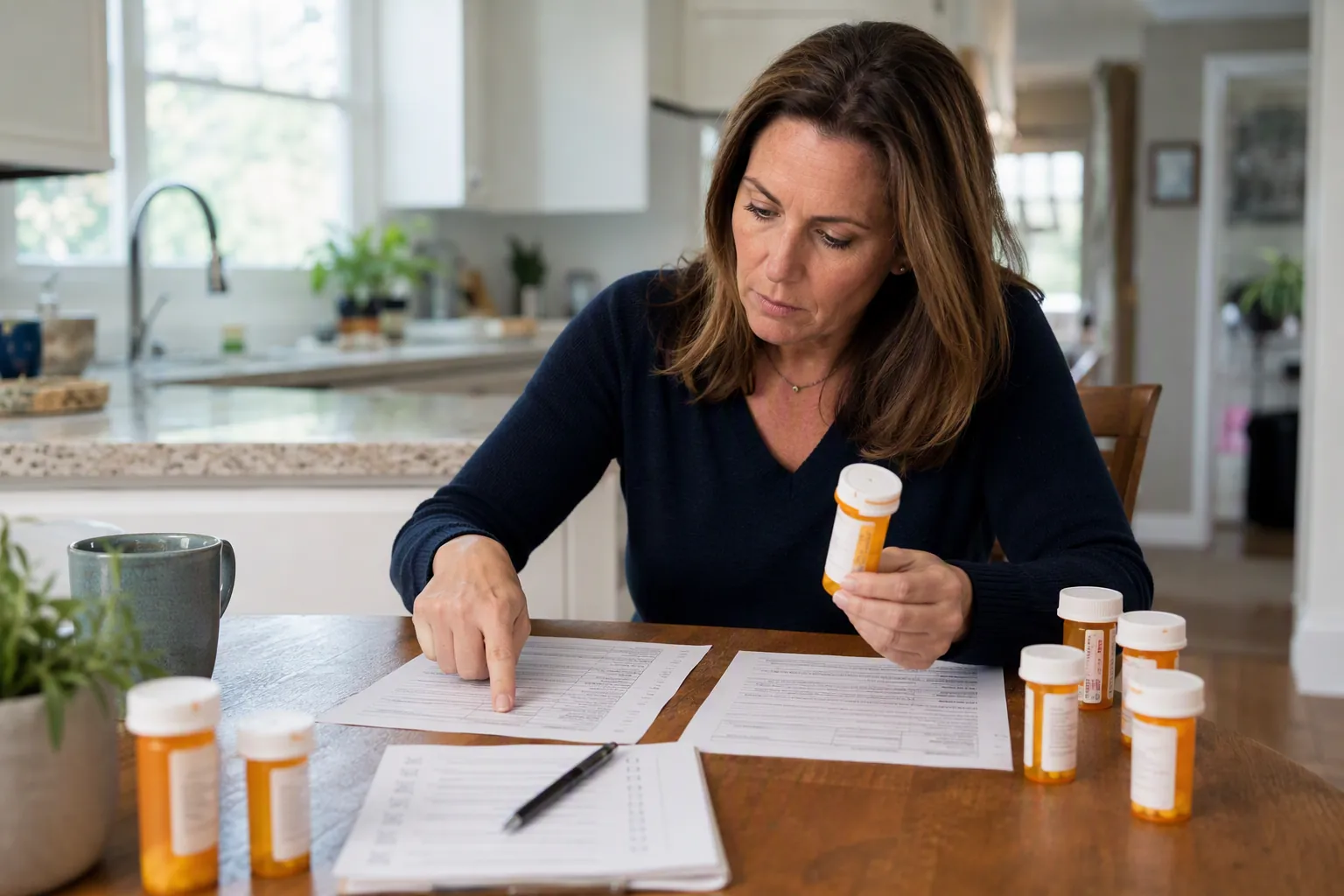
Medication effects that are tolerable in a hospital bed can become dangerous in a hallway, bathroom, or kitchen. New dizziness, sedation, confusion, weakness, low blood pressure symptoms, shakiness, diarrhea, nighttime urgency, or vision changes can all change fall risk at home. During recovery weeks, medication monitoring and fall prevention belong together; the same kind of close observation used in older-adult recovery planning applies here too.
- Use a simple written dosing schedule for the first week home.
- Have one person fill or check the pill organizer, rather than several people making separate changes.
- Track new sleepiness, confusion, dizziness, appetite change, bleeding, swelling, rash, bowel changes, or blood-sugar symptoms.
- Keep a clear path to the bathroom, add night lighting, and supervise walking if a medication may affect balance or alertness.
- Call the discharge number, prescriber, pharmacist, or primary care office if the list and bottles do not match.
- Call 911 for life-threatening symptoms, severe breathing trouble, fainting, seizure, signs of stroke, severe allergic reaction, or heavy bleeding.
Keep the notes from the hospital with the discharge paperwork: what was suspected, what was verified, who reviewed it, what monitoring was recommended, and which clinician will reconcile the list next. That is the handoff your parent needs when the hospital room is gone and the medication cup has become a row of bottles on the kitchen table.
References
- Frequently Asked Questions. ConsumerMedSafety.org.
- Wrong-Patient and Wrong-Drug Errors. P&T. 2014.
- How can I complain about poor medical care I received in a hospital?. HHS.gov.
- Study finds medication errors common among seniors at hospital discharge. McKnight’s Long-Term Care News.
- Hospital Discharge Leaves Many Older Adults Vulnerable to Medication Errors. U.S. Medicine.
Related reading
Noticed something outdated or inaccurate on this page? Flag a correction. We review every report against CDC, NIA, and AARP HomeFit guidance before updating a page.
Part of the Fall Prevention section.