
STEADI: Intervene
How to Prevent Medication Errors at Hospital Discharge
Discharge is the riskiest medication handoff for older adults — about half make at least one medication error within 90 days of going home, and most discrepancies are omitted drugs. This guide gives families a line-by-line before/after bedside check for the discharge list, plus teach-back, a same-week pharmacy review, and a follow-up visit booked before leaving the hospital.
The dangerous part of discharge often happens after everyone thinks the work is done. The older adult is dressed, the wheelchair is coming, the discharge packet is stapled, and the caregiver is trying to listen while also finding the car keys. That is exactly when a long-standing blood pressure pill, heart medication, diabetes drug, or sleep medication can quietly disappear from the home plan.
For older hospital patients, discharge deserves its own medication-error check. In a 2024 BMC Geriatrics cohort study, 49% of hospital medication discrepancies occurred at discharge, and unintentional discrepancies were associated with twice the risk of a 30-day emergency department visit. The most useful detail is not just the 49%; it is the pattern. Omitted medications accounted for 96% of discrepancies, and cardiovascular medications accounted for 45%.[1]
A separate 2025 prospective cohort in the Journal of General Internal Medicine found that 39% of older adults had at least one medication error by day 7 after discharge, rising to 50% by day 90. The same study reported that comprehensive discharge medication planning covered only 13% of medication changes, one-third of discharge medication changes were modified again within 90 days, and one-quarter of older adults did not receive timely post-discharge follow-up.[2]
Those numbers change what the family should do before leaving. It is not enough to scan the discharge list for new prescriptions. The safer bedside task is to compare the medication list from before the hospital stay against the discharge medication list, one line at a time, with the nurse, hospitalist, discharge planner, or pharmacist still in the room. For the broader admission-to-transfer process, see Preventing Medication Errors at Every Hospital Handoff. This article stays with the last handoff: the one that sends the medication problem home.

The bedside comparison that matters before leaving
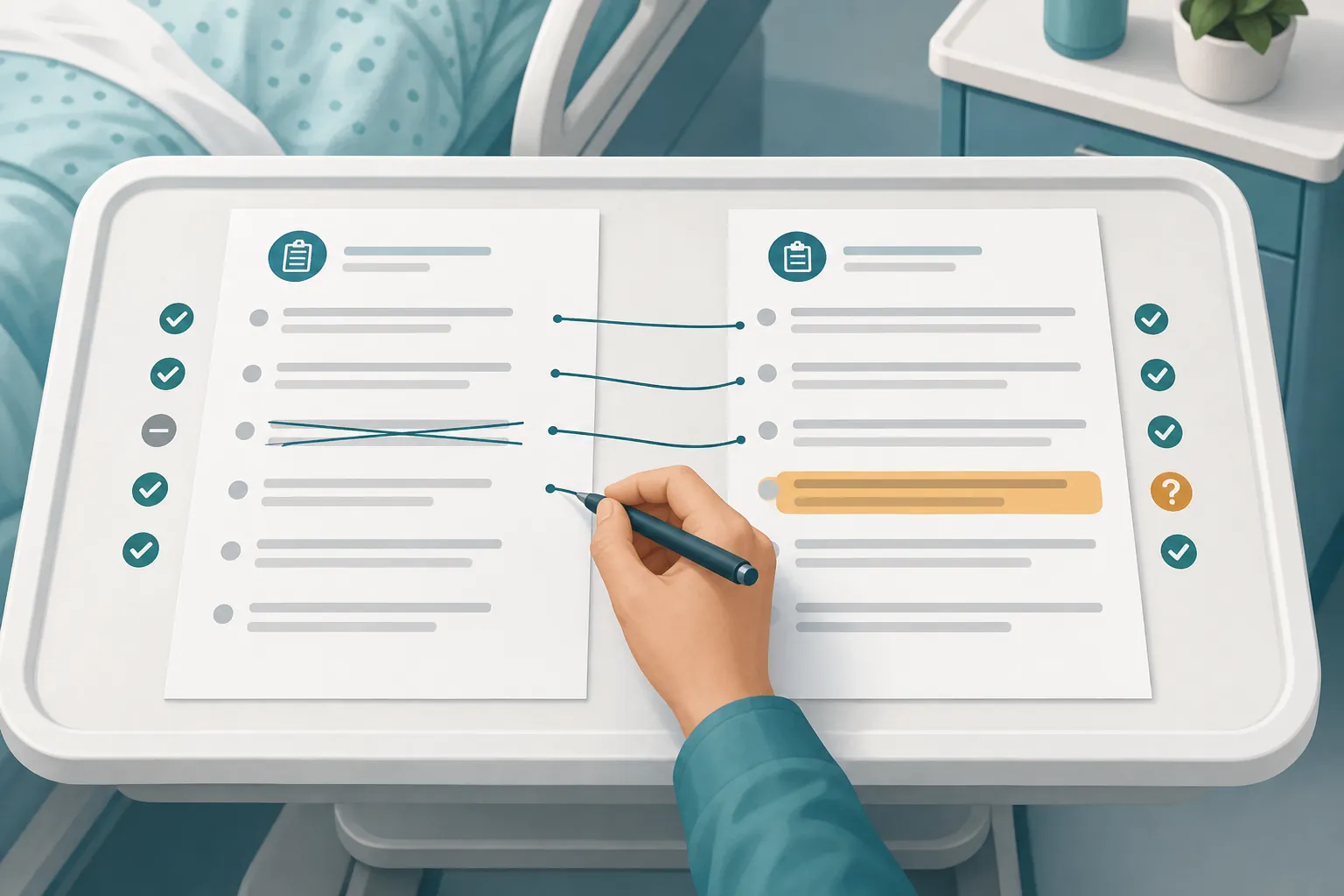
Ask for two lists to be in front of everyone: the best available list of what the older adult was taking before admission, and the final discharge medication list. If the pre-admission list is on a phone, in a portal, in a pill-bottle photo, or written on paper, use it anyway. The point is to stop treating the discharge list as a stand-alone document.
The caregiver’s role is not to decide which medications should be taken. The role is to verify what the care team intends, write it down clearly, and repeat it back before the patient leaves. No family member should independently restart a medication that is missing, stop a medication that is listed, or change a dose because it “looks wrong.” The line-by-line check is how those questions get brought to the clinician while the hospital team can still answer them.
| For each medication | Ask at the bedside | What you need written on the discharge plan |
|---|---|---|
| Every medication taken before admission | Is this continued, stopped intentionally, changed, replaced, or missing by accident? | Continue / stop / change / replace, plus the reason if it changed |
| Every medication newly listed at discharge | What is it for, when does it start, and how long should it be taken? | Purpose, dose, timing, duration, and stop date if temporary |
| Every changed dose or schedule | What changed from the old home routine, and why? | Old dose, new dose, timing, and who will reassess it |
| Every medication that looks duplicated | Are these two names the same kind of medicine or meant to be taken together? | Clear instruction on whether both are intended |
| Every high-consequence medication concern | What side effects should make us call, and who exactly do we call? | Warning signs, phone number, and after-hours plan |
The omitted-drug finding is why the first row in that table matters so much. Many caregivers naturally look for unfamiliar new names. That catches one kind of problem, but it can miss the medicine that was part of the older adult’s ordinary home routine and simply does not appear on the discharge page. If 96% of discrepancies in the BMC Geriatrics cohort were omissions, the comparison has to begin with the old list, not the new one.[1]
Start with the medications the patient was already taking
Go down the pre-hospital medication list one item at a time. For each one, point to it and ask: “What happens to this medication when we get home?” Then wait for one of five answers: it continues, it stops intentionally, the dose changes, it is replaced by another medication, or it appears to be missing and needs review.
A clear stop is different from a quiet disappearance. “Stop the old water pill because kidney function changed, and the primary doctor will recheck labs next week” is an instruction. A medication that is absent from the discharge list with no explanation is a question that should be answered before the patient leaves.
Cardiovascular medications deserve especially literal checking because they made up 45% of discrepancies in the BMC Geriatrics cohort.[1] That does not mean a caregiver should manage heart medicines alone. It means the caregiver should not accept “same as before” unless the list actually shows what is continuing, what changed, and what has been stopped on purpose.
Then check every new or changed discharge medication
Once the old list has been accounted for, move to the discharge list. Every new medication should have a plain-language purpose attached to it. “Take once daily” is not enough. The caregiver should know whether the medicine is for infection, pain, blood pressure, clot prevention, sleep, nausea, constipation, or another specific problem.
- What is this medication for?
- What dose should be taken, and at what time of day?
- Should it be taken with food, away from other medicines, or only as needed?
- Is it temporary? If yes, what is the stop date or stopping condition?
- What side effects should we watch for in the first week?
- Who do we call if there is dizziness, confusion, a fall, vomiting, missed doses, or a refill problem?
Pain medicines, sleep medicines, blood pressure medicines, diabetes medicines, anticoagulants, and any medication that can cause dizziness or confusion deserve extra attention because the first days home are when weakness, poor appetite, dehydration, and disrupted sleep can overlap. If the discharge involves surgery, it can help to review pain options and side effects before leaving; this guide on non-opioid pain relief for seniors after surgery may help families prepare questions for the prescriber.
Do not leave with unexplained categories
The discharge list should not leave the family sorting medications into vague piles at the kitchen table. By the time the older adult leaves, each medication should fit into a practical category: keep taking, start taking, take differently, stop taking, or clarify before taking.
The “clarify before taking” group is important. It is safer to name uncertainty than to improvise. If a medication appears on the old list but not on the discharge list, ask the team to mark whether it was intentionally stopped. If two medications seem to treat the same condition, ask whether both are intended. If the patient has old pill bottles at home that conflict with the discharge list, ask which document controls the plan until the follow-up appointment.
Medication reconciliation at transitions of care is strongly recommended by the World Health Organization, and pharmacist involvement is often emphasized because pharmacists are trained to compare medication histories, current orders, and discharge instructions.[3][4] But the family still has to ask whether a pharmacist has actually reviewed this discharge list. “A pharmacist-led process helps” is not the same as “a pharmacist has checked this patient’s final home plan today.”
Use teach-back before the wheelchair arrives
After the line-by-line comparison, ask the nurse, pharmacist, or discharge clinician to listen while the patient or caregiver explains the plan in their own words. This is the moment to say it plainly: “I want to make sure I understood, because I’ll be the one setting up the medicines tonight.”
A useful teach-back sounds practical, not polished. For example: “We are stopping the old evening blood pressure pill. We are starting this new one tomorrow morning. The antibiotic is twice a day until Sunday. If she gets dizzy, confused, has swelling, or falls, I call this number. The primary doctor will review the list next week.” If any part of that sentence is wrong, the bedside is where it should be corrected.
Ask for the corrected plan to be reflected in the written discharge paperwork, not only spoken in the room. A tired caregiver can misremember. A tired patient may nod just to leave. The paper, portal, and pharmacy instructions should match as closely as possible.

Build the first-week safety net before going home
The first week home is not a quiet administrative period. In the 2025 Journal of General Internal Medicine cohort, 39% of older adults had at least one medication error by day 7.[2] That is why the discharge conversation should end with appointments and reviews already arranged, not with a general instruction to “follow up.”
Arrange a same-week pharmacy review
Ask whether the hospital pharmacist can review the final discharge list before departure. If that is not available, arrange a same-week review with the community pharmacist and bring the discharge list plus the actual pill bottles from home. The pharmacist should be asked to look for duplicates, missing chronic medications, unclear stop dates, refill problems, and instructions that do not match the hospital paperwork.
This is especially useful when the older adult uses more than one pharmacy, receives mail-order medications, or has old automatic refills. A discontinued medication can still arrive in the mail. A changed dose can sit beside the old bottle in the cabinet. The discharge list may be correct, but the home environment can still defeat it.
Book the follow-up visit before leaving
Before discharge, ask which clinician owns the next medication review: primary care, cardiology, surgery, geriatrics, or another specialty. Then ask for the appointment to be scheduled before the patient leaves the hospital. One-quarter of older adults in the 2025 cohort did not receive timely post-discharge follow-up, and one-third of discharge medication changes were modified again within 90 days.[2]
The follow-up visit should not begin from scratch. Bring the discharge medication list, the pre-hospital list, the pill bottles actually being used, and any notes about dizziness, sleepiness, confusion, appetite changes, bowel changes, blood pressure readings, blood sugar readings, pain, or falls. If the family is still choosing or changing primary care, this guide on how to choose a doctor who asks about falls and medications can help frame the visit.
Know what to watch for at home
The family should leave with a short list of symptoms that require a call. For many older adults, medication trouble does not announce itself as “a medication error.” It may look like new dizziness, sleepiness, confusion, weakness, poor intake, nausea, constipation, diarrhea, bleeding, swelling, low blood pressure symptoms, low blood sugar symptoms, or a fall.
Do not wait for a perfect explanation before calling. If a symptom begins after a medication was started, stopped, or changed, report the timing and ask whether the plan should be reviewed. Families who are tracking early changes may also find it useful to read how to monitor health changes in elderly parents or how to spot health decline in aging parents.
A safe stopping point before discharge
Before the older adult leaves the hospital, the caregiver should be able to point to the pre-admission list and the discharge list and explain what happened to every medication: continued, stopped, changed, replaced, newly started, or still needing clarification. Any medication in the last group should be reviewed with the care team before it is taken at home.
The discharge is ready only when the patient or caregiver can repeat the medication plan in their own words, the same-week pharmacy review is arranged, and the follow-up appointment is booked before leaving the hospital.
References
- Medication discrepancies and associated risk factors identified among elderly patients at care transition: a cohort study, BMC Geriatrics, 2024.
- DOI 10.1007/s11606-025-09973-x, Journal of General Internal Medicine, 2025.
- Medication Safety in Transitions of Care, World Health Organization.
- Medication Reconciliation, StatPearls, 2024.
Related reading
Noticed something outdated or inaccurate on this page? Flag a correction. We review every report against CDC, NIA, and AARP HomeFit guidance before updating a page.
Part of the Fall Prevention section.